
title: Dysorthographia: Typical Recurring Errors and Classroom Assessment Strategies
description: Teacher guide dysorthographia elementary school: types recurring errors (phonetic, lexical, grammatical), differentiated assessment strategies, identification, observation grids, diagnostic dictations, correction adaptations, compensation strategies.
keywords: dysorthographia, spelling errors, recurring, assessment, elementary school, teachers, identification, dictations, phonetic, lexical, grammatical, adaptations, corrections
[/META]
dysorthographia, spelling errors, recurring, assessment, elementary school, teachers, dictations, phonetic, lexical, grammatical, identification, adaptations, corrections, strategies
[/TAGS]
Reading time: 34 minutes

« Emma makes the same mistakes for 2 years, despite repetitions… » « Lucas writes ‘he goed to school’, is this normal in 2nd grade? » « How to differentiate dysorthographia from lack of work? » « Should I correct everything in red? »
Dysorthographia is not just being « bad at spelling ». It’s a specific, lasting, massive disorder that resists ordinary learning. Certain errors are typical, recurring, characteristic. Identifying them allows for disorder recognition, fair assessment, and adapted corrections.
This guide explains typical dysorthographia errors, how to assess them, and how to correct without discouraging.
—
Table of Contents
2. The 3 types of recurring errors
—
What is dysorthographia? {#definition}
Definition
Dysorthographia: Specific spelling acquisition disorder.
Characteristics:
Massive errors: 20-50%+ words misspelled (vs 5-10% ordinary difficulties).
Resistance: To learning (repetitions, rules, dictations ineffective).
Duration: Persists for years (vs catch-up delay).
Specificity: Collapsed spelling, other areas preserved (reading sometimes correct, normal intelligence).
Link to dyslexia
Frequent association:
75-90% dyslexics: Also dysorthographic.
Common origin: Phonology (sound awareness).
But difference:
Dyslexia: Reading + writing.
Dysorthographia: Mainly writing (reading may be correct).
Isolated dysorthographia:
10-25% cases: Without dyslexia (reads correctly, writes catastrophically).
Distinguishing dysorthographia vs ordinary difficulties
Ordinary difficulties:
Errors: Decrease with teaching, repetitions, maturation.
Learning: Effective (rules progressively integrated).
Progress: Visible (upward curve).
Dysorthographia:
Errors: Massive, persistent, resistant.
Learning: Ineffective (rules never automated).
Stagnation: Or minimal progress (flat curve).
—
The 3 types of recurring errors {#types-erreurs}
1. Phonetic errors
Definition: Confusion, omission, inversion of sounds.
Origin: Defective phonology (discrimination, sound segmentation).
Manifestations:
Confusions of similar sounds:
Voiced/voiceless: « pool » → « bool » (p/b), « vent » → « fent » (v/f), « train » → « drain » (t/d).
Nasals: « bon » → « bom », « champ » → « chan ».
Vowels: « a/e » (« with » → « wath »), « é/è » (« school » → « scool »).
Omissions:
Letters: « table » → « tale », « backpack » → « bakpack ».
Syllables: « chocolate » → « cholate », « computer » → « compter ».
Inversions:
Letters: « tree » → « tere », « arm » → « amr ».
Syllables: « animal » → « aminal ».
Substitutions:
Similar sounds: « house » → « hose », « play » → « pley ».
Student examples:
Leo (1st grade): Writes « the bot saild on the se » (= « the boat sailed on the sea ») – confusions v/g, a/ai, letter omissions.
Emma (2nd grade): Writes « he had eated a domme » (= « he had eaten an apple ») – confusions é/ai, b/p, silent letter omissions.
Frequency: 40-60% dysorthographia errors.
2. Lexical errors
Definition: Spelling of irregular words, silent letters.
Origin: Defective visual orthographic memory.
Manifestations:
Phonetic spelling:
Frequent words: « with » → « wif », « because » → « becuz », « always » → « alwayz ».
Silent letters: « night » → « nite », « could » → « cood », « time » → « tim ».
Doublings: « running » → « runing », « apple » → « aple ».
Homophones:
to/too/two: « I want too go » (= « I want to go »).
there/their/they’re: « Their going » (= « They’re going »).
your/you’re: « Your late » (= « You’re late »).
Irregular words:
Exceptions: « said » → « sed », « friend » → « frend », « enough » → « enuff ».
Student examples:
Tom (3rd grade): Writes « he went too the forrest wif his dog » (= « he went to the forest with his dog ») – all phonetic, no word spelled correctly.
Chloe (4th grade): Writes « the cat and the dog is in the garden » (= « the cat and the dog are in the garden ») – systematic homophone confusions.
Frequency: 30-40% dysorthographia errors.
3. Grammatical errors
Definition: Agreements, conjugations, morphology.
Origin: Working memory, defective automation.
Manifestations:
Subject-verb agreement:
Plural: « the children plays » (= « the children play »).
Person: « I plays » (= « I play »).
Noun-adjective agreement:
Gender: « a beautiful castle » → correct in English (no gender agreement).
Number: « the black cats » → « the black cat » (missing plural).
Past participle agreement:
With auxiliary: « they have went » (= « they have gone »).
Conjugations:
Endings: « he eat » → « he eated », « they has eaten » → « they have ate ».
Tenses: Mixing (past/present/future).
Student examples:
Lucas (2nd grade): Writes « the girls plays in the yard, they is happy » – no agreement (plural, gender).
Sophie (3rd grade): Writes « yesterday, I goes to the park and I have play » – mixed tenses, wrong endings.
Frequency: 20-30% dysorthographia errors.
—
Assessment grids by type {#evaluation}
Phonetic errors grid
Student production: Dictation, free writing.
Analyze:
- [ ] Voiced/voiceless confusions (b/p, d/t, g/k, v/f, z/s)
- [ ] Nasal confusions (an/on, in/un)
- [ ] Vowel confusions (a/e, é/è/ê, i/u/ou)
- [ ] Letter omissions (beginning, middle, end of words)
- [ ] Syllable omissions (long words)
- [ ] Letter inversions (tree → tere)
- [ ] Syllable inversions (animal → aminal)
- [ ] Similar sound substitutions
- [ ] Frequent words phonetically spelled (« with » → « wif »)
- [ ] Silent letters forgotten (« night » → « nite »)
- [ ] Doublings forgotten (« running » → « runing »)
- [ ] Confused homophones (to/too, there/their, your/you’re)
- [ ] Exceptions phonetically spelled (« said » → « sed »)
- [ ] Subject-verb agreements (number, person)
- [ ] Noun-adjective agreements (gender, number)
- [ ] Past participle agreements
- [ ] Verb endings (ed/ing/s)
- [ ] Conjugations (tenses, concordance)
- [ ] Grammatical homophones (to/too, there/their, your/you’re)
- DYS Disorders Training: identify dysorthographia and adapt assessments
- Training: Supporting students with learning disabilities
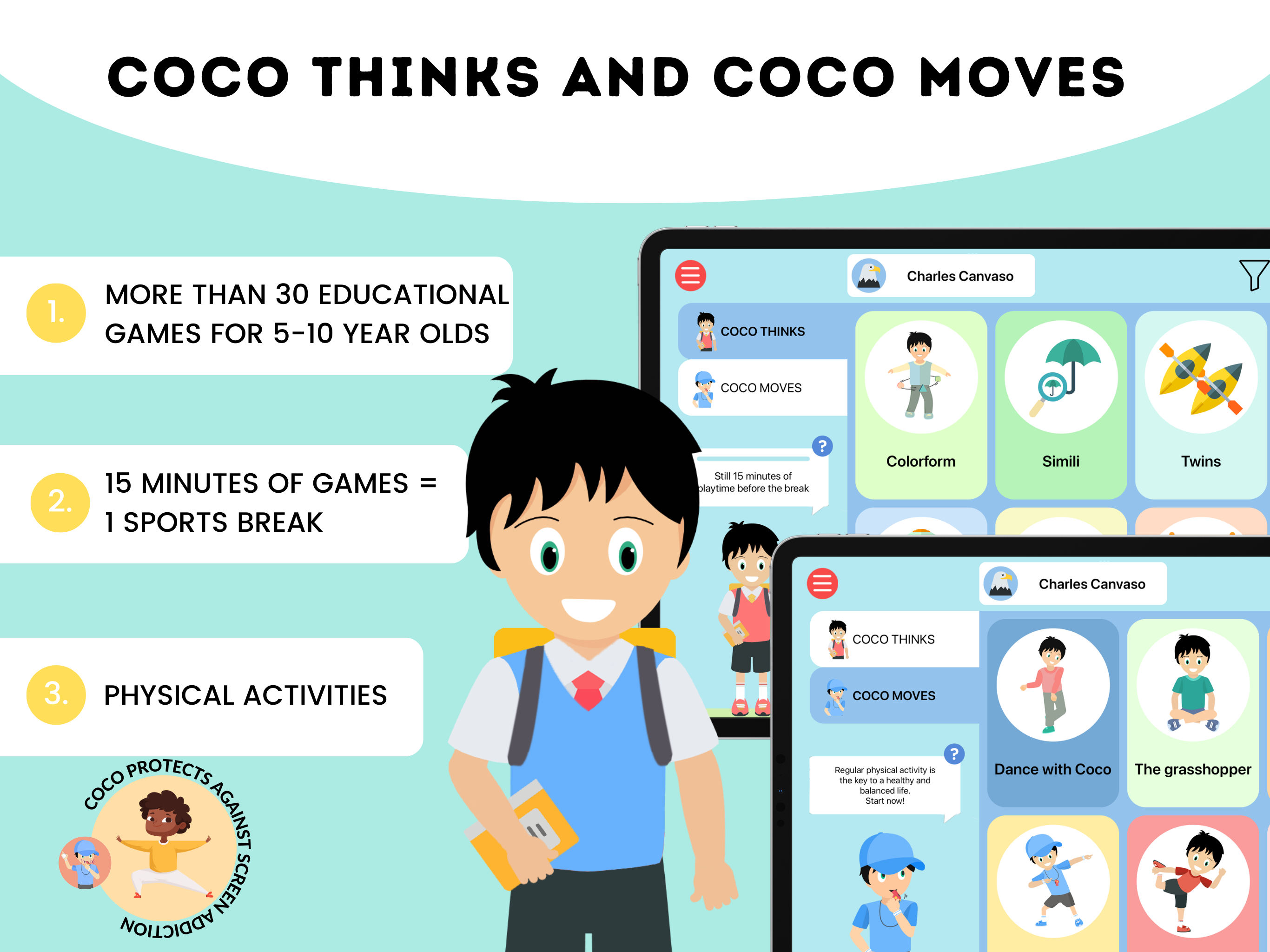
- COCO THINKS and COCO MOVES Program: adapted spelling games
Score: Number phonetic errors / total words.
Interpretation:
<5%: Normal.
5-15%: Phonological difficulties (strengthen phonological awareness).
>15%: Probable phonetic dysorthographia (speech therapy assessment).
Lexical errors grid
Student production: Dictation of irregular, frequent words.
Analyze:
Score: Number lexical errors / irregular words dictated.
Interpretation:
<10%: Normal.
10-30%: Visual memorization difficulties (strengthen).
>30%: Probable lexical dysorthographia (assessment).
Grammatical errors grid
Student production: Short writing.
Analyze:
Score: Number grammatical errors / expected agreements.
Interpretation:
<15%: Normal (progressive learning).
15-40%: Grammatical difficulties (review rules, exercises).
>40%: Probable grammatical dysorthographia (assessment).
Overall dysorthographia grid
Cumulative: 3 error types.
If:
2+ types: >threshold = Probable dysorthographia.
1 type: >high threshold (e.g.: 30% phonetic errors) = Specific dysorthographia.
Resistance: Errors persist after intensive teaching (8-12 weeks) = Confirms dysorthographia.
—
Diagnostic dictations {#dictees}
Principle
Dictation: Not graded assessment, but diagnostic tool.
Objective: Identify error types, dysorthographia profile.
Frequency: 2-3x/year (beginning, middle, end of year).
No grade: Qualitative analysis (vs punishment).
Phonetic dictation (K-1st grade)
Content: Simple, regular words (direct grapheme-phoneme correspondence).
Example:
« Dad has a bike. Lola reads. The cat flies. He drank milk. »
Target: Phonetic errors (confusions, omissions, inversions).
Analysis:
« dad » → « bad »: Confusion d/b.
« bike » → « bke »: Omission « i ».
« flies » → « flys »: Confusion ie/y.
Interpretation:
Massive errors: Probable phonetic dysorthographia.
Lexical dictation (2nd-4th grade)
Content: Frequent irregular words, silent letters, homophones.
Example:
« He is with his friend. They are in the garden. The weather is nice. She has many flowers. »
Target: Lexical errors (irregular words, homophones).
Analysis:
« is » → « iz »: Phonetic (vs lexical spelling).
« with » → « wif »: Phonetic.
« weather » → « wether »: Silent letter omission.
« many » → « meny »: Phonetic.
Interpretation:
Massive errors in frequent words: Lexical dysorthographia.
Grammatical dictation (3rd-4th grade)
Content: Sentences requiring agreements.
Example:
« The girls went to the park. They ate red apples. The boys are playing in the yard. »
Target: Grammatical errors (agreements).
Analysis:
« went » → « go »: No past tense agreement.
« red apples » → « red apple »: No noun-adjective agreements.
« are playing » → « is play »: No subject-verb agreement.
Interpretation:
No agreements: Grammatical dysorthographia.
Mixed dictation (2nd-4th grade)
Content: Mix of 3 types (complete profile assessment).
Example:
« Yesterday, the children went to the forest with their parents. They saw many animals. It was a beautiful day. »
Analysis: Count errors each type.
Profile:
Emma: 15 phonetic errors, 8 lexical, 3 grammatical → Dominant phonetic dysorthographia.
Tom: 3 phonetic, 18 lexical, 2 grammatical → Dominant lexical dysorthographia.
Lucas: 5 phonetic, 7 lexical, 20 grammatical → Dominant grammatical dysorthographia.
Adaptation: Targeted remediation for dominant type.
—
Adapted corrections {#corrections}
Principle of supportive correction
Not everything in red:
Discouragement: Massively red paper = abandonment (« I’ll never succeed »).
Ineffective: Dysorthographic student sees errors, doesn’t understand why (neurological disorder, not ignorance).
Select errors:
Objectives: 3-5 words max per production (vs 50 underlined errors).
Progression: Start with phonetic errors (fundamental), then lexical, finally grammatical.
Value successes:
Correct words: Underline in green (vs only red errors).
Progress: Compare with previous production (vs class norm).
Content: Evaluate ideas, structure, creativity (vs spelling).
Correction by error type
Phonetic errors:
Underline: Whole word.
Help: Say word slowly, segment sounds.
Rewrite: Together orally, then student writes.
Example: « bot » → Teacher says « bo-at », student repeats, writes « boat ».
Lexical errors:
Provide: Correct spelling (visual memorization, not deduction).
Copy: 3-5x (anchor visual memory).
Display: Frequent words in classroom (permanent reference).
Example: « wif » → Show « with », student copies 5x, adds to personal frequent word list.
Grammatical errors:
Explain: Rule briefly.
Circle: Concerned words (subject + verb, noun + adjective).
Rewrite: Agreement.
Example: « the girls plays » → Circle « girls » + « plays », say « plural, therefore ‘play' », student corrects.
Adapted grading scales
Separate:
Content: 70-80% grade (ideas, structure, richness).
Spelling: 20-30% grade (vs 50% classic).
Or separate grades:
Content: Grade A.
Spelling: Grade B (informative, not penalizing average).
Progress bonus:
Comparison: Previous production.
Value: Error reduction (vs absolute number).
Example: Emma 50 errors production 1 → 35 production 2 = Enormous progress (bonus points).
Adapted dictations
Not classic dictations:
Ineffective: Dysorthographic student always fails (demotivation).
Alternatives:
Prepared dictation: Words given day before, reviewed, dictated next day.
Choice dictation: Student chooses 10 words from list of 20 (guaranteed success).
Negotiated dictation: Pairs, discuss spelling, write together.
Cloze dictation: Pre-written text, few words to complete.
Zero dictation: If severe dysorthographia (assess differently).
—
Compensation strategies {#strategies}
Technological tools
Spell checker:
Systematic: Computer, tablet.
Learn: To use (not everything automatic – choice of corrections).
Not cheating: Compensatory tool (like glasses).
Voice dictation:
Software: Dragon, built-in functions (phone, computer).
Frees: From writing constraint (ideas verbalized, transcribed).
Limits: Punctuation, homophones (supervision necessary).
Word predictor:
Suggestions: Words while writing (reduces errors).
Memorization: Correct spellings memorized visually.
Memory aids
Reference materials:
Frequent words: Posted in classroom, student’s personal list.
Homophones: Tables (to/too, there/their, your/you’re + differentiation tips).
Rules: Simplified, visual (posters, desk mats).
Color codes:
Agreements: Highlight (subject blue, verb red, arrowed links).
Nature: Nouns green, verbs red, adjectives yellow (visual identification).
Mnemonics:
Create: With student (personalized = memorable).
Examples: « to » verb → replace « going to » (« I want to go » → « I want going to go » = correct).
Proofreading strategies
Targeted proofreading:
Not everything: Focus on 1 error type.
Example: 1st proofreading = subject-verb agreements only. 2nd = homophones. Etc.
Tools:
Grid: Verification (checklist of error types).
Peers: Cross-proofreading (another student, supportive).
Time: Extra (dysorthographic proofreading 2-3x longer).
Reducing demands
Quantity:
Less writing: 5 rich sentences (vs 20 rushed).
Quality: Content (vs quantity).
Formats:
Oral: Prioritize (presentations, audio recordings).
Diagrams: Mind maps, annotated drawings (vs long compositions).
Assessments:
Multiple choice: Vs open questions (reduce writing).
Oral: Vs written (assess knowledge, not spelling).
Adapted training
Spelling games: Fun, progressive, no pressure.
Phonology: Sound awareness (foundation).
Visual memory: Frequent words (games).
Speech therapy:
Remediation: Specialized (phonology, orthographic memory, strategies).
Regular: 1-2x/week minimum.
Patience: Slow progress, but possible.
—
Teacher testimonials
Claire, 2nd grade teacher
« Emma had 40 errors in dictations of 20 words. Everything in red = tears. DYNSEO training: learned adapted correction. Now: 5 words max corrected (objectives), correct words highlighted in green, content grade separated from spelling. Emma re-motivated (sees progress), longer productions (dares to write). Dysorthographia remains, but managed, accepted. »
Marc, 3rd grade teacher
« Tom everything phonetic (‘he goed to school’). Catastrophic dictations (0/20 systematic). DYNSEO grids used: phonetic + lexical dysorthographia identified. Adaptations (prepared dictations, computer + spell checker, priority content evaluation). Speech therapy started. Tom progresses slowly, but now writes (vs avoided). Fair assessment = key. »
Sophie, 4th grade teacher
« Lucas no agreements (plural, gender, conjugation). Thought ‘doesn’t know rules’. Training: learned grammatical dysorthographia (automation impossible, working memory). Strategies taught (color codes, targeted proofreading, verification grids). Lucas applies (laborious), errors decrease (50% vs 90%). Understanding mechanism = adapt effectively. »
—
Conclusion: Identify to adapt fairly
Dysorthographia is not a lack of work, concentration, or intelligence. It’s a neurological disorder that prevents normal spelling acquisition despite intense efforts. Identifying types of recurring errors allows for fair assessment, effective correction, compensatory adaptations. Because perfect spelling is not a realistic goal for dysorthographic individuals. But error reduction, compensation strategies, and acceptance of difference are possible. And allow writing, communicating, succeeding.
Keys to supporting dysorthographia:
1. ✅ Identify error types (phonetic, lexical, grammatical)
2. ✅ Assess profile (diagnostic dictations, grids)
3. ✅ Correct selectively (3-5 errors max, not everything red)
4. ✅ Value content (ideas, structure vs spelling)
5. ✅ Adapt grading scales (separate content/spelling)
6. ✅ Compensate (digital tools, memory aids)
7. ✅ Reduce demands (quantity, formats)
8. ✅ Train (understand disorder, master differentiated assessment)
Dysorthographia can be compensated, worked around. Our DYNSEO training teaches adapted assessment + correction. COCO THINKS and COCO MOVES trains spelling playfully. You can transform the dysorthographic student’s relationship to writing.
—
DYNSEO resources for supporting dysorthographia:
—
Behind every red paper, there is a child who tried. Who thought, searched, corrected, copied. Who thought ‘with’ is spelled ‘wif’ because it’s logical. Who forgets plural ‘s’ because their brain forgets. Not because they don’t care. Not because they don’t work. Just because of dysorthographia. And if you identify typical errors, if you assess fairly, if you correct with kindness, this child can continue to write. Despite mistakes. Despite everything. Because writing is communicating. And that, they can do.
Ce contenu vous a aidé ? Soutenez DYNSEO 💙
Nous sommes une petite équipe de 14 personnes basée à Paris. Depuis 13 ans, nous créons gratuitement des contenus pour aider les familles, les orthophonistes, les EHPAD et les professionnels du soin.
Vos retours sont notre seule façon de savoir si ce travail vous est utile. Un avis Google nous aide à toucher d'autres familles, soignants et thérapeutes qui en ont besoin.
Un seul geste, 30 secondes : laissez-nous un avis Google ⭐⭐⭐⭐⭐. Ça ne coûte rien, et ça change tout pour nous.
