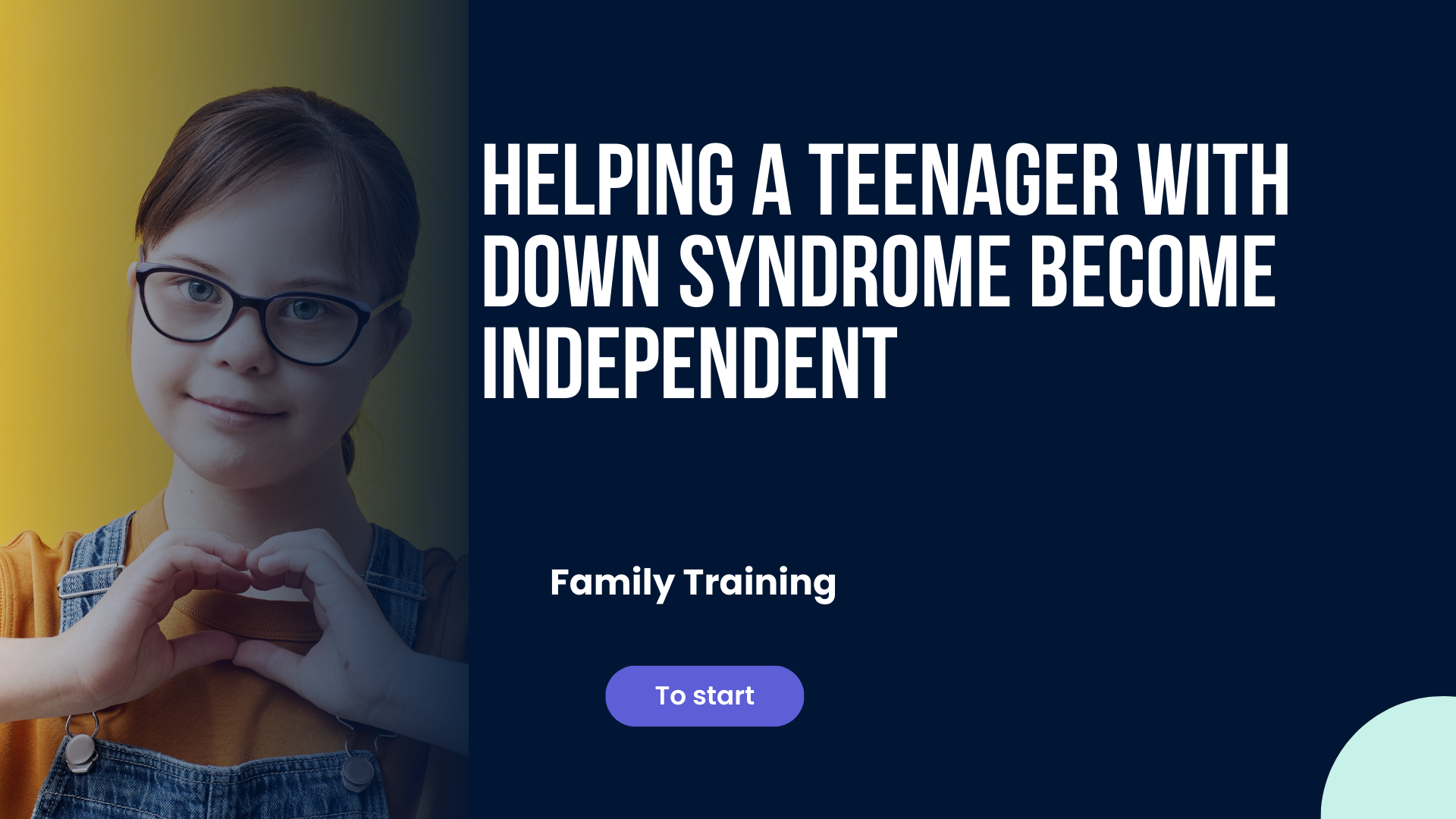
About Course
Helping a teenager with Down's syndrome become independent
Developing daily living skills, social skills, and preparing for the future
Keys to support your teenager towards the most independent adult life possible
Progress in small steps using the backward chaining technique
Target Audience
Parents and family caregivers of teenagers with Down syndrome who wish to support them towards increasing independence while respecting their pace and specific needs.
Duration
1 hour — Comprehensive training divided into 6 progressive modules
Format
100% online training, accessible from your computer or tablet. You progress at your own pace, whenever you wish, without time constraints.
What You Will Learn
This training provides you with the keys to support your teenager towards the most independent adult life possible. You will understand how your teenager’s motivation and interests are the driving forces of learning, and how to progress in small steps using the backward chaining technique.
You will discover how to establish routines suitable for adolescence (morning, transitions, travel, evening), develop daily living skills (hygiene related to puberty, money management, household tasks), and support social and emotional life. You will also learn how to prepare for the future (career guidance, life project) while maintaining a balance between protection and independence.
By the end of this training, you will be able to:
- Use your teenager’s motivation and interests as entry points for learning independence
- Transform necessary learning into meaningful projects: managing their playlist, saving for a purchase, taking the bus to meet friends
- Apply the backward chaining technique: support the entire journey except for the last part, then gradually move back
- Break down each complex skill into simple and achievable steps
- Create a safe environment where making mistakes is part of learning
- Respond to mistakes in three steps: acknowledge the effort, identify the mistake without judgment, guide towards the solution
- Establish a suitable morning routine: checklist on the phone, alarms at key moments, anticipation the night before
- Support the bodily changes of puberty: sweating, acne, body hair, menstruation
- Create age-appropriate visual sequences for hygiene gestures (avoid overly childish pictograms)
- Teach independent travel in four steps: journey together, gradual guidance, semi-independence, independence with a safety net
- Structure evenings and weekends: homework, screen management, leisure, preparation for the next day
- Learn money management: recognize coins and bills, manage pocket money, envelope system
- Encourage participation in household tasks: family planning, breaking down into steps, valuing contributions
- Promote friendships in structured contexts and support social codes
- Prepare for first outings with friends progressively
- Teach emotional regulation strategies suitable for adolescence: calm box, music, physical activity
- Develop self-assertion: saying no, expressing preferences, signaling an uncomfortable situation
- Explore career orientation: discovery internships, existing programs (ULIS, IME, ESAT, supported employment)
- Involve the teenager in all decisions regarding their life project
- Adapt positive reinforcement to adolescence: avoid overly childish systems, prioritize recognition
- Find the balance between protection and independence: accept a degree of calculated risk, gradually let go
- Establish discreet safety nets: phone with geolocation, check-in routines
- Adjust expectations according to periods: growth fatigue, hormonal fluctuations, school stress
You will leave with concrete tools
- Age-appropriate checklists
- Visual sequences for hygiene
- Travel supports
- Envelope system for pocket money
- Family task planning
- Personalized calm box
- Preparation sheets for internships
Bonus
Discovery of the JOE app, the brain coach, with its 30+ cognitive games to strengthen memory, attention, and planning — essential skills for independence.
Course Content
Module 1 – Understanding How Adolescents Learn to Become Independent
-
Lesson 1: The Role of Motivation and Interests
-
Lesson 2: Progressing in Small Steps
-
Lesson 3: Errors as a Driver of Learning
Module 2 – Establishing Essential Routines for the Adolescent
Module 3 – Developing Daily Living Skills
Module 4 – Supporting Social and Emotional Life
Module 5 – Maintaining Motivation and Adapting Support
Module 6 – Digital Tools for Autonomy
Student Ratings & Reviews