About Course
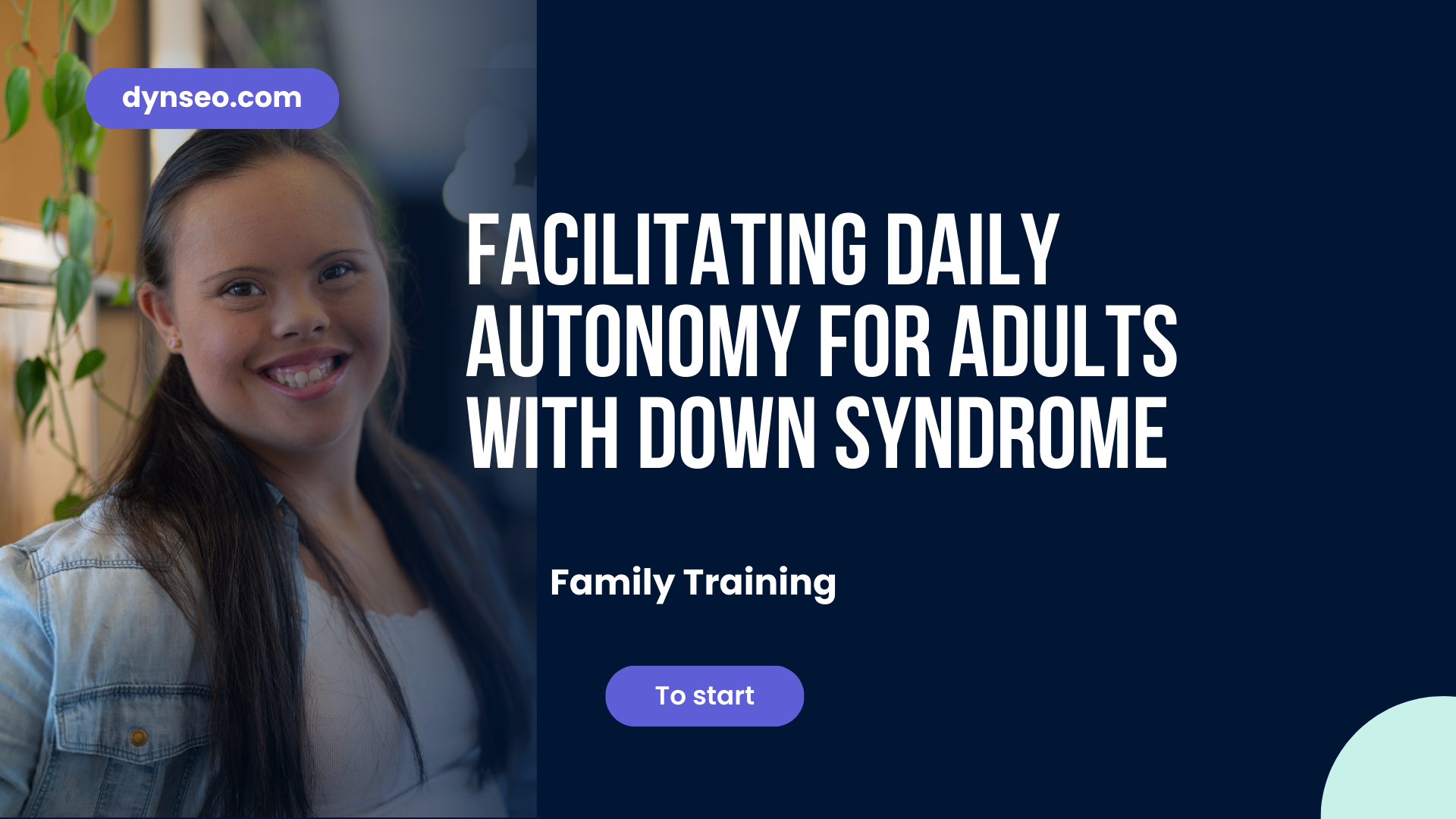
Facilitating Daily Autonomy for Adults with Down Syndrome
Organization, Routines, and Visual Tools
Motivation, Backward Chaining, and Positive Reinforcement
Visual sequences, choice method, adapted materials
Target Audience
Professionals in the medico-social field, family caregivers, and anyone supporting adults with Down syndrome towards a more independent life, whether in a group home, supported apartment, or family home.
Duration
1 hour – Comprehensive training divided into 5 progressive modules
Format
100% online training, accessible from your computer or tablet. You progress at your own pace, whenever you wish, without time constraints.
What You Will Learn
Supporting an adult is fundamentally different from supporting a child. It is essential to respect their status as an adult, their choices, and their preferences while providing the necessary support to develop or maintain their skills. Neuroscience confirms that brain plasticity persists throughout life, allowing for the acquisition of new skills even later in life.
This training provides you with concrete tools to understand how adults learn to develop their autonomy. You will discover the central role of motivation and interests, the progression in small steps using the backward chaining technique, and how to make mistakes a driving force for learning rather than a failure.
You will learn to establish essential routines adapted to adulthood: morning routine for work in ESAT or activities, transitions and movements (including public transport), evening routine for quality sleep. You will master appropriate visual and material tools: step-by-step visual sequences, the choice method between 2 options, materials facilitating autonomy (dressing, hygiene, cooking).
You will know how to encourage, support, and maintain motivation with positive reinforcement adapted to adults, valuing effort rather than perfection, and adjusting your expectations according to fatigue and the day. Special attention is given to early aging and adapting support.
At the end of this training, you will be able to:
- Understand the role of motivation and interests: observe spontaneous interests (music, sports, cooking, animals, gardening), use them as entry points to develop autonomy, make tasks meaningful with rewarding responsibilities, create motivation systems adapted to adults (tracking charts, points exchangeable for activities)
- Apply progression in small steps: break down each complex activity into simple and achievable steps, use backward chaining (assist with all steps except the last, then gradually move back), end each session with a success, set a specific and limited goal per week
- Make mistakes a driving force for learning: create an environment where the person has the right to make mistakes without being judged or infantilized, a three-step method (recognize effort, identify the mistake without judgment, guide towards the solution), avoid discouraging phrases, do not do it for them to avoid mistakes
- Establish the morning routine: anticipate the night before (clothes, bag, breakfast), create a visual sequence with real photos of the person or pictograms adapted for adults, calculate the actual time needed broadly, use concrete tools to manage time (visual timer, calibrated playlist, gentle alarms)
- Support transitions and movements: announce transitions in advance with stages (15 min, 10 min, 5 min), never ask to stop abruptly, prepare movements (inform, describe the program, visual checklist), gradual learning of public transport (together, the person in front, then alone with a phone)
- Structure the evening routine: encourage going to bed at the same time every night, typical structure (return and tidy up, relax, meal, clearing away, hygiene, preparation for the next day, quiet time, bedtime), visual sequence for the shower with appropriate materials, quiet time before sleep (soft music, reading, breathing)
- Create effective visual sequences: identify the activity to break down, one action per step, use real photos of the person (ideal) or pictograms representing adults, readable format with numbered steps, support fixed at the activity location, accompany the person to understand and use the support
- Apply the choice method between 2 options: limit to two options to facilitate decision-making and reduce anxiety, show options in images or real objects, present with identical intonation, respect the decision, use “false choices” to guide when necessary
- Adapt materials to facilitate autonomy: dressing (clothes with elastic, Velcro shoes, color point for the front), hygiene (grab bar, pump shower gel, non-slip mat), cooking (ergonomic utensils, suction cup boards, transparent containers), create “autonomy stations” in the home
- Apply positive reinforcement adapted to adults: avoid infantilizing rewards, favor sincere recognition, quality shared moments, and positive natural consequences, reinforce effort not just results, tracking systems adapted to adults
- Value effort rather than perfection: avoid phrases that do not value effort, accept imperfect results, transform failures into learning (what happened, why, what to do differently)
- Adapt expectations according to fatigue and days: identify limit signals (agitation, unusual refusals, new mistakes), adjust demands and simplify routines, avoid guilt-inducing phrases, anticipate predictably difficult periods, encourage the person to express their state of fatigue (color code, visual scale)
- Support early aging: understand aging from 40-45 years, adapt support (simplify routines, strengthen visual aids, maintain existing skills), identify signs of decline, aim to maintain quality of life
You will leave with concrete tools
Models of visual sequences for routines (morning, evening, shower), transition and movement checklists, material adaptation grids (dressing, hygiene, cooking), positive reinforcement systems adapted to adults, color code to communicate fatigue.
Bonus
Discovery of the EDITH application — 30+ memory and brain training games adapted for adults, designed with health professionals (speech therapists, occupational therapists, neuropsychologists). Particularly suitable for adults with Down syndrome: simple instructions, clear visuals, intuitive interface. Maintenance of cognitive functions in the face of early aging, support for social connection with two-player games.
Course Content
Module 1 – Understanding how adults learn to develop their autonomy
-
Lesson 1: The Role of Motivation and Interests
-
Lesson 2: Progressing in Small Steps
-
Lesson 3: Mistakes as a Learning Engine
Module 2 – Establishing Essential Routines
Module 3 – Using Appropriate Visual and Material Tools
Module 4 – Encourage, Support, and Maintain Motivation
Module 5 – The EDITH application to stimulate cognitive functions
Student Ratings & Reviews