
“`html
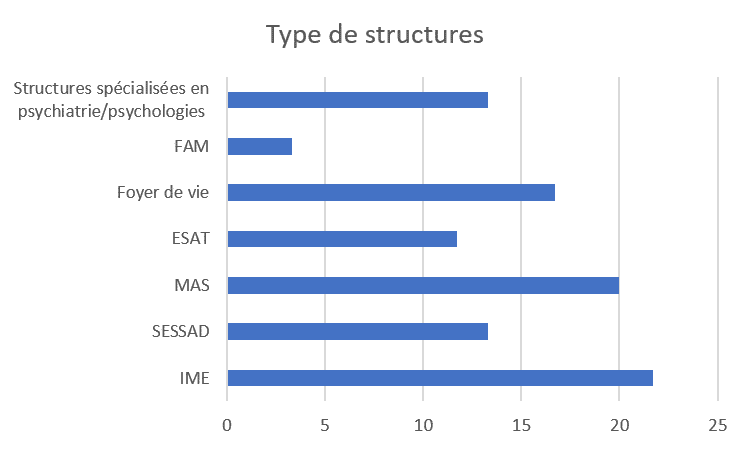
Our survey targets all motor and psychic disabilities in children and adults:
Multiple disabilities,Motor disability with or without associated disorders,
Mental disability, psychic disorders, and behavioral disorders,
PDD with or without ID,
Autism ASD,
Mild or moderate intellectual disabilities with or without associated disorders,
Persons with brain injuries,
Autoimmune diseases,
Disabled people in professional reclassification (18-77 years old, average age 45)
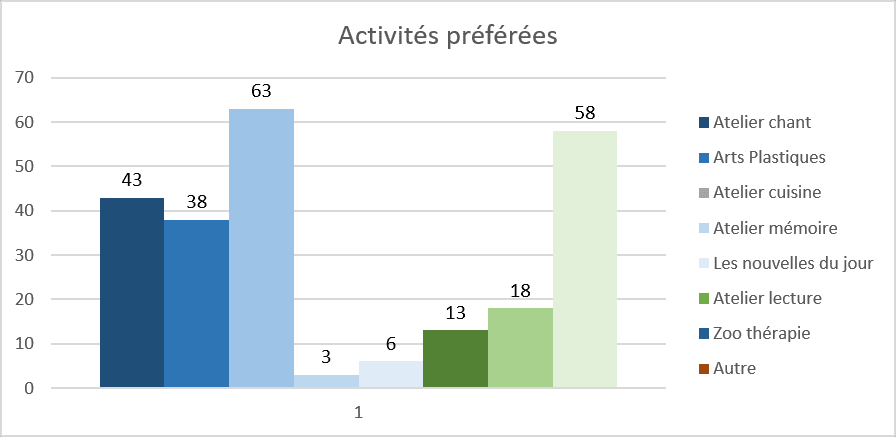
The other favorite activities listed are:
Writing workshops,Newspaper reading,
Musical awakening,
Cultural outings,
Aquatic space, water sports: swimming pool, balneotherapy,
Physical activities: circus arts, horse riding/harnessing, walking, tandem skiing and joelette,
Sophrology, Snoezelen room,
Walks, garden-wood workshops,
Playful and educational activities: kapplas,
Animal workshops, animal mediation,
Learning towards autonomy such as taking the bus or shopping.
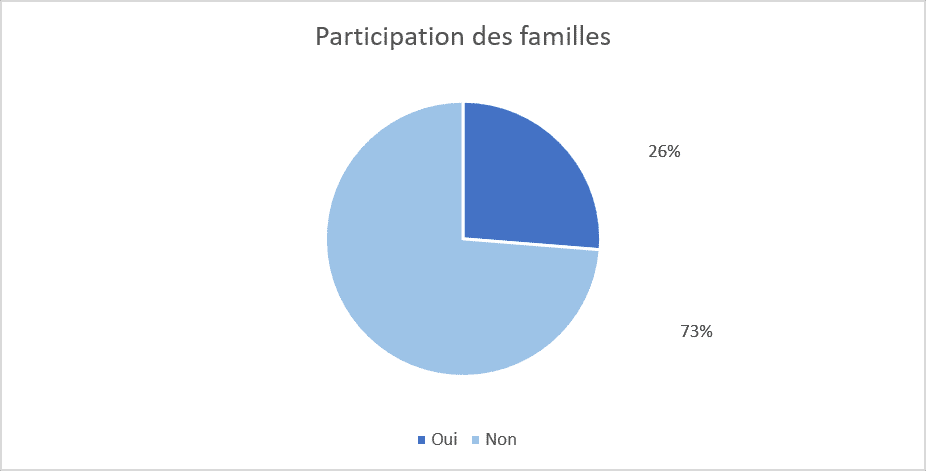
At 26%, families participate in activities in institutions specialized in the disability sector.
Families accompany their loved ones when invited to outings, particularly to encourage them in a new activity. They occasionally attend an activity such as the swimming pool and thus witness their loved one's progress while having a pleasant time.
They are present for them during theatrical performances or to see any work accomplished.
Some professionals and parents get involved to start an association with the purpose of organizing events: bingo or the Christmas market. Families offer visits and do not hesitate to call on their network.
The question of family participation is being considered in some associations.
Some families live too far from their children's institution or have too demanding jobs or have other children making them less available for this type of support. Families may occasionally miss an activity due to the need for respite.
After the animation
After the animation
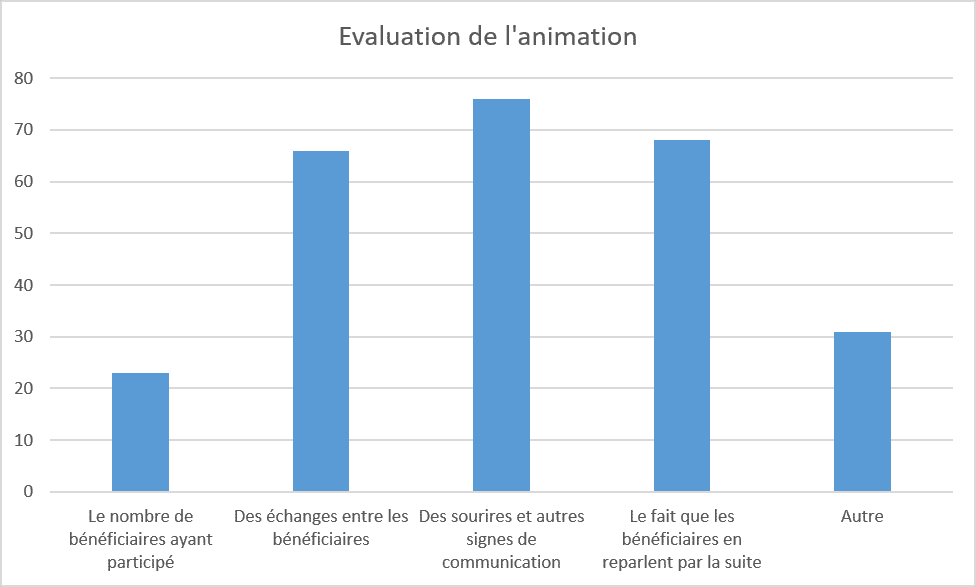
Healthcare professionals ask youths if they enjoyed the activity and what they remembered. Some youths express their satisfaction and feel valued by the activity.
Users look forward to the next session. They become loyal to the activity. They talk about it among themselves.
In the more or less long term, the user progresses in their perception of space, gains more autonomy, develops social skills, and improves behavior.
The result of an animation is also the relationship that is built over time, leaving a shared memory imprint for everyone.
Feedback from families on their child's progress is also a good indicator.
As a specialized educator, what percentage of group activities compared to individual activities do you do?
Activities are almost never only group or individual. They are balanced, with nonetheless a distribution of 70% group activities and 30% individual activities.
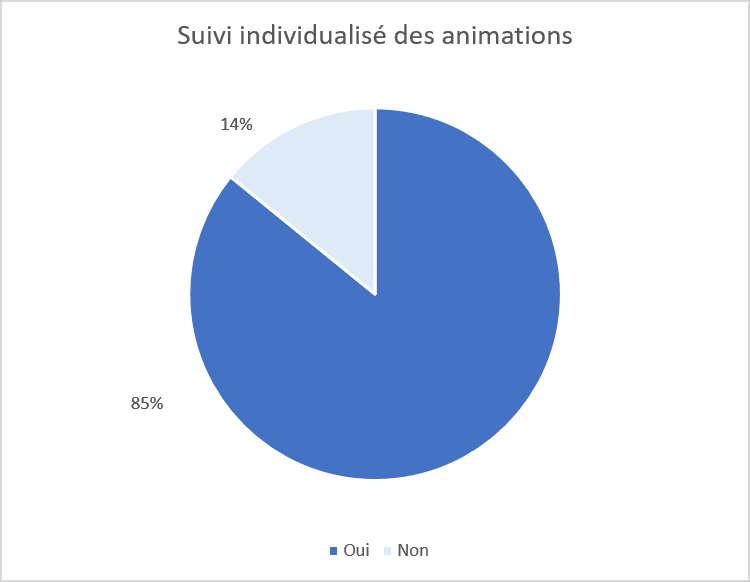
Do you do individualized follow-up for your activities?At 85%, activities are accompanied by individualized follow-up.

What worked?
Here are the new technologies that worked and their specificities:
Educational and/or fun games,Coloring on tablets,
Movie trailers, cartoons, and other videos,
Music, reading messages,
Internet searches,
Augmented reality.
In terms of perception too, new technologies have brought new things to residents, and animators have noted:
Self-improvement made possible by technology,Help with articulation thanks to audio recordings,
Valuation of self-awareness and the image the user sends to others,
Curiosity of residents and exchanges among them.
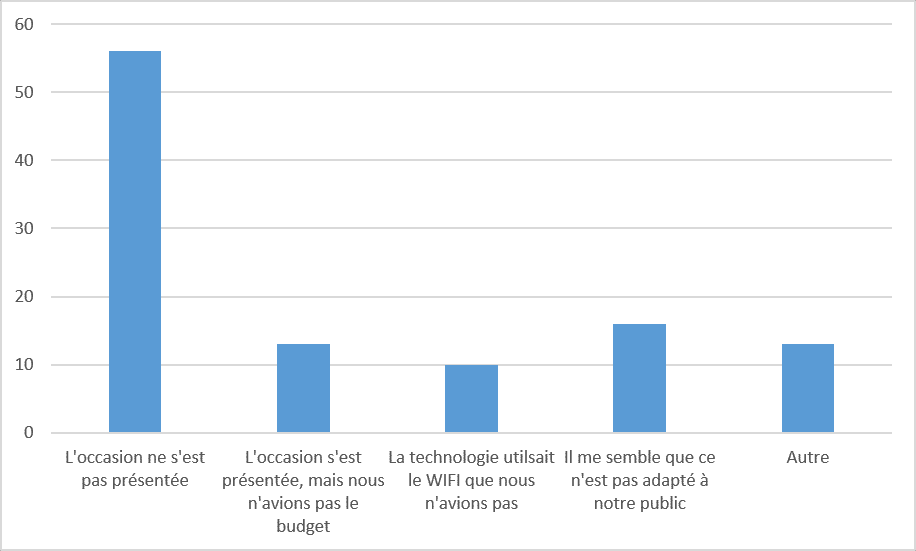
Here are other reasons why new technologies have not been used:
The cost of adapted software and computers is too high,Difficulty in implementing individualized projects for each child,
The motor and perceptive difficulties of residents sometimes seem too significant.
Information about the structure
Respondent's profile
In 48% of cases, the respondents to this survey were the specialized educators of the institutions, but the questionnaire was also often completed by caregivers or psychologists.
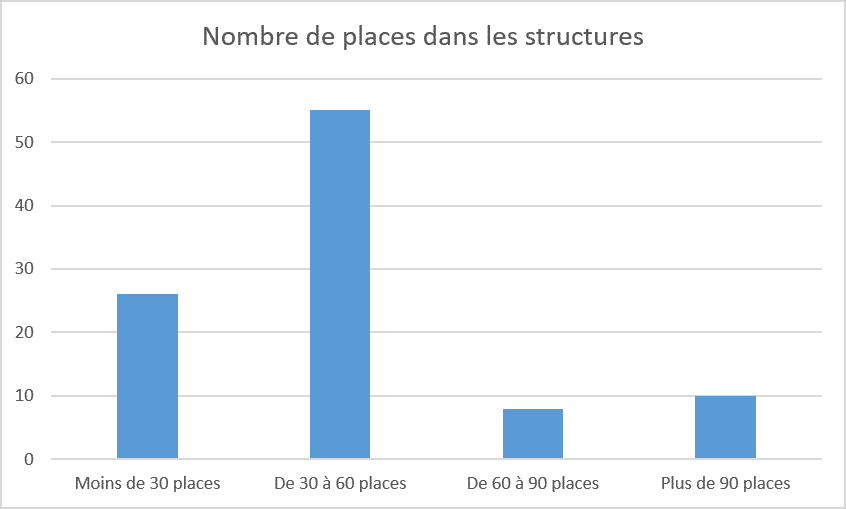
How many places does your structure have?
Mostly, institutions have a capacity of 30 to 60 places.

Our memory games EDITH, JOE, COCO are the solution!
Our memory games EDITH, JOE, COCO are the solution! Currently used in IME, SESSAD, MAS, ESAT, in medical foster care (FAM), in SAMSAH, our games are handled by occupational therapists, speech therapists, logopedists, psychomotor therapists, nurses, or even caregivers and life assistants. Our brain training program thus allows children and adults to be entertained while stimulating them cognitively.

COCO THINKS and COCO MOVES An educational and sports version for children aged 5 to 10

JOE A version for adults and seniors in prevention

EDITH A version for seniors easy and adapted
Support children with Down syndrome
Support a person with ADHD
Support a person with Alzheimer's
DYNSEO organized a national survey in October on animation and specialized education in the disability sector. The objective was to provide an overview of existing practices and share good practices with the community.
We received over 60 responses to our questionnaire, and we warmly thank all the specialized educators, occupational therapists, animators, psychologists, and directors who took the time to respond to our survey.
As a specialized educator, what are the best animations you have implemented?
Here is a sample of the best animations carried out in specialized institutions in the disability sector, which complement the list above, do not hesitate to write to us to obtain the full list. Creative, artistic, and sports animations are very numerous and are very popular. They are always cited among the best animations.
- Projects around music: singing, choir, guitar, djembe,
- Artistic expression: clay, ink, oil pastels, collage, photo workshops, light-painting with exhibition at the end of creation,
- Forum theaters, circus, slam,
- Creation of discussion groups, communication workshops using photos, games, storytelling, tales with or without music,
- Scrapbooking workshops and journal creation,
- Creation of individual moments: setting up a library space,
- Sensorial activities, self-esteem, and equine therapy,
- Workshops around cooking: snacks, themed meals with decoration of the living space corresponding to the theme like the Caribbean or Asia, creating a tea room to professionalize hosted individuals.
- Activities around events: making a mini Christmas village, preparing a float followed by a parade with the residents in the city, manual activities for the world cup, etc.
- Participation in events such as the Christmas market, community carnivals, or the Telethon of the town.
- Organization of dance competitions and shows: folk, contemporary, or expressive dance.
- Partnerships with schools, with winegrowers for harvesting, with a cartoonist to create a comic strip, or with a linen sorting organization,
- Outings to the sea or zoo,
- Aquatic hikes, sports stays, rugby, running, cross adapted to everyone's possibilities.
Do you get support from others during your activities?
The animators/specialized educators in the disability sector are:
- 28% always accompanied by a professional, (often 32%)
- 35% often by psychomotor therapists,
- 34% often by psychologists.
However, in 59% of cases they are never accompanied by caregivers or 60% by occupational therapists, nor 70% by speech therapists.
Thus, we can assume that in most cases, animators organize alone the activities in institutions specialized in the disability sector, with occasional participation from a psychomotor therapist, psychologist, and other professionals of the institution.
Do families participate in activities in disability institutions?
How do you evaluate a good animation in the disability field?
Several other criteria allow evaluating a good animation, both in achieving set objectives but also in user and entourage reactions:
What advice would you give to a beginner animator?
Here is a list of advice given by animators in specialized institutions in the disability sector. This list is not exhaustive, given the wealth of information collected, do not hesitate to ask us for more details!
In preparation for the animation
- Learn about the pathology,
- Observe users at first to identify their preferences and desires,
- Anticipate and prepare by adapting to each participant,
- Set realistic and achievable goals to avoid putting the user in a situation of failure.
During the animation
- Observe and adapt,
- Give individual time to participants during your sessions.
Sequencing is an important element during animation. It allows participants to follow and engage throughout the session. To this end, participants create key moments such as centering, round-table discussions before/after the session. It is important to schedule breaks related to the targeted audience. At the end of the session, participants summarize and announce the next activity program. They can adjust their program based on different feelings.
After the animation
- Write and discuss the feedback immediately after,
- Question yourself about the benefits of the animation, seek external opinions and possibly ask colleagues for help,
- Multiply professional experiences in different fields of disability.
In general
- Be attentive to the beneficiaries,
- Be patient and adopt a positive attitude in the face of possible failure of residents; they must always be proud of themselves.
- Be approachable, trust your team, users, and their families.
It is preferable to choose quality individual support by favoring groups with a limited number of users rather than having a larger number of residents participate.
In terms of organization
- Think collectively, then individually,
- Keep a logbook to adjust your projects and create an evaluation,
- Implement new activities and have as many people as possible try them.
The activity is a medium for the relationship, what matters is the goal it tends to achieve. A good animation corresponds to collaboration with family and various partners.
Specialized institutions in the disability sector facing new technologies
Have you tested new technologies?
At 54%, specialized institutions in the disability sector have tested new technologies.
What new technologies have been tried?
What did not work well?
Here are the negative points of using new technologies within specialized institutions in the disability sector:
- Tools not sufficiently adapted to residents' capabilities,
- Difficulties in accepting digital tools that may seem intrusive,
- No home internet access,
- Lack of financial means for purchasing a computer or tablet,
- Too supervised learning paths for experimentation and thus quite confining.
What needs to be improved?
Here are the areas to improve regarding the currently used new technologies:
- Adaptation of Word, Excel software, keyboards, mice,
- Expansion of animator training,
- Systematic transcription of daily actions,
- Starting and real-time data verification of the heart rate monitor remotely,
- The cost of some tools is sometimes an obstacle,
- Wider dissemination of educational and fun tools calling on both theory and practice.
Why haven't you tried new technologies?
Discover disability-adapted innovations that may interest you
Guides to accompany anyone with cognitive impairment
Can you tell us more about the job of a specialized educator?
This professional mainly works with children, adolescents, or even adults in situations of dependency, difficulty, or disability. They offer a tailor-made support that varies depending on the patient and their pathology. The everyday role of the specialized educator is to favor or preserve the autonomy and social adaptation of these individuals.
In summary, this professional is a key player in educational action and organizing the daily lives of those concerned. They work closely with other specialized education professionals.
Regarding job opportunities, most specialized educators (+80%) practice their profession in the private associative sector. However, there are also positions available in the public sector. If you have the necessary skills and certification for this work, you can easily find a specialized educator job on some specialized sites.
Qualities to have and conditions to meet to be a good specialized educator
To work as a specialized educator, one must first be highly available. Indeed, the missions of this professional can be particularly time-consuming. You must personally commit. In addition, you need to be both gentle and firm. A good deal of patience is also necessary. Added to that are a developed practical sense, a great open mind, and excellent emotional balance.
How to join a training center for specialized educators?
Regarding education, to be able to join a school specialized in this type of profession, it is not necessary to have any diploma. However, it is imperative to go through entrance tests involving oral exams to assess self-control and evaluate motivations, written exams to determine the general education level of each candidate.
You are exempt from the written exams if you hold one of the following diplomas:
- Baccalaureate or equivalent foreign or European diploma
- Diploma, homologated title, or certificate at level IV or higher
- State diploma of medico-psychological aid
- State diploma of family assistant
- State diploma of Educational and Social Accompaniment
- State Diploma of Social Life Assistant or complementary mention of home help
- BP Jeps social animation
The training of a specialized educator lasts 2 years. It includes 28 weeks of practical internship and 950 hours of theoretical courses. The student must complete a 20-week internship in the 1st year and 8 weeks in the 2nd year.
Promote social inclusion through animations
Beyond the simple institutional framework, animations can become real levers of social inclusion. They allow people with disabilities to be part of city life, enhance their sense of belonging, and deconstruct societal stereotypes.
Objectives of an inclusive animation:
Create bridges between users and civil society : by opening institutions to external partners or participating in local events.
Highlight skills and talents : showing what users can do and not what they cannot do.
Enhance social autonomy : learning to operate in non-specialized contexts.
Concrete examples of inclusive animations:
Organization of artistic exhibitions in public places (media libraries, town halls, cultural centers) to showcase residents' creations.
Creation of a mixed theater troupe or musical group, with participants with and without disabilities, performing for an open audience.
Participation in local events : carnival, Christmas market, garage sales, where residents hold a stand or present a completed project.
Intergenerational projects with schools or EHPAD: gardening, cooking, or shared reading workshops.
Implementation of citizen cafes or open forums, led by users around themes that concern them (disability, culture, environment, etc.).
Observed benefits:
Better self-esteem of participants, proud to show their creations or participate in public events.
Strengthening social ties and the ability to engage with strangers.
Change in public perception of disability, often more benevolent after sharing a common human experience.
Opening to opportunities for civic or professional engagement for some users.