
Family Caregiver Guide :
Tablet and Memory Games with an Alzheimer’s Relative
📥 Download the complete guide (free PDF)

« Support is the key to success for your loved one to take control of the tablet. It allows, initially, to feel reassured regarding their cognitive and/or physical disability, but also to create a bond, thus setting aside the tensions of daily life related to the disease and memory loss. Through play, we play, and we play together. The person being assisted cannot always express their gratitude towards their family caregiver — but a smile during a game, a burst of laughter, is also a beautiful acknowledgment. »
This guide is for you — the family caregiver who gives a little (or a lot) of themselves every week, every day, to support their loved one affected by Alzheimer's disease or another form of dementia. This role is demanding, exhausting, sometimes lonely. And yet, it is also filled with precious moments — an unexpected smile, a memory that resurfaces, a moment of connection that transcends the disease. This guide aims to multiply these precious moments through the tablet tool and the memory games SCARLETT DYNSEO.
1. The Tablet, a Mediation Tool for the Family Caregiver
Often, it is quite difficult for family caregivers who take care of a loved one with Alzheimer's disease to continue engaging in activities together. Your loved one can no longer do the activities they used to, and a void can settle during visits — at home or in a nursing home — as conversation topics go in circles and silence can be heavy.
Through play, it is easier to convey emotions. The interest is also to share a good moment together, to enjoy oneself, while training memory and cognitive functions. Thus, the tablet appears as a wonderful tool for mediation and communication, which perfectly finds its place to enhance the daily life of a dependent person.
Before exploring practical usage tips, it is important to understand why the tablet can work where other attempts have failed. The tablet offers mediation — it is a third party in the relationship, a neutral tool around which the caregiver and the person being assisted can meet without the emotional tensions that often accompany direct assistance (meals, care, behavior management). Through play, the relationship becomes what it was before the disease — two people who love each other and share a moment, not a caregiver and a patient. This change in posture is profoundly therapeutic for both parties.
2. Our Tips for Using SCARLETT Effectively
De-sacralize the tablet
The first reactions to the sight of the touchscreen tablet are often negative from seniors — they have never seen one and are afraid they won't manage. You will often hear: “new technologies? too little for me.” But curiosity quickly takes over, as it only takes a touch and the screen moves — it has a “magical” side.
SCARLETT has been designed with nursing homes to adapt the ergonomics to the expectations of seniors: pastel colors with strong contrasts, very few buttons, comfort areas with very large fonts, available zooms. The games are so simple that a person with Alzheimer's disease can use them alone. And since the games work without WiFi, you can play anywhere: armchair, sofa, bed.
It is important to reassure your loved one from the start about their ability to handle the tablet, emphasizing that you will accompany them and that you will do it together.
Doing together — the importance of sharing
Accompaniment is the key to success and it must remain benevolent. Learning is often based on a demonstration followed by execution — which is fundamental in the face of a new technology that is not typical of their generation. Handling is learned much more easily when accompanied by a loved one who will show, be patient, and not judge if the first times are difficult.
The important thing is to participate. Playing together is anything but a race to success — it is a moment of sharing and a bubble of respite to focus on the bonds that unite you. The goal is to accept the other as they are and to become their play partner.
Be patient
Patience is the essential virtue of the family caregiver in these sessions. Demonstration, gentle repetition, encouragement without pressure — these are the ingredients for a successful session. You may be surprised by how quickly some seniors, who have never seen a tablet, take ownership of it in a single session. But even if it takes longer, the goal is shared pleasure, not performance.
Dialogue and listening — avoid failure
Throughout the games, never put your loved one at fault. Make them understand that if they can't do it, it's not a big deal — the important thing is to enjoy playing. Our memory games have been designed to avoid failure, and the games always end with a “Well done.”
This may seem symbolic, but tests have shown it: by highlighting wrong answers for too long, seniors no longer wanted to play. By simply saying “Well done” each time, people suffering from Alzheimer's disease restart games and continue to play for hours. Enjoyment is ultimately the most important.
A progressive approach adapted to the disease
In order not to put your loved one at a disadvantage and to support them as best as possible, start with the easiest memory games. The most accessible games to play alone are those that appeal to sensory memory and the oldest automatisms. More cultural games are a great support for playing together, strengthening the bonds that unite you.
SCARLETT was developed specifically in connection with care professionals and nursing home structures — not just by computer scientists. This co-design with the field ensures that every interface choice, every level of difficulty, and every feedback mechanism has been tested on real users affected by Alzheimer's disease. It is this design rigor that explains why people at a moderate to severe stage of the disease can use SCARLETT with pleasure — which is rare in the field of digital applications for seniors.
3. The Most Accessible SCARLETT Games
These games are recommended to start, thanks to their accessibility and adaptation to Alzheimer's profiles.

The Musical Ear — Recognize everyday sounds and animal noises.

Bouncing Ball — Catch a tennis ball that rolls across the screen. Simple and fun.
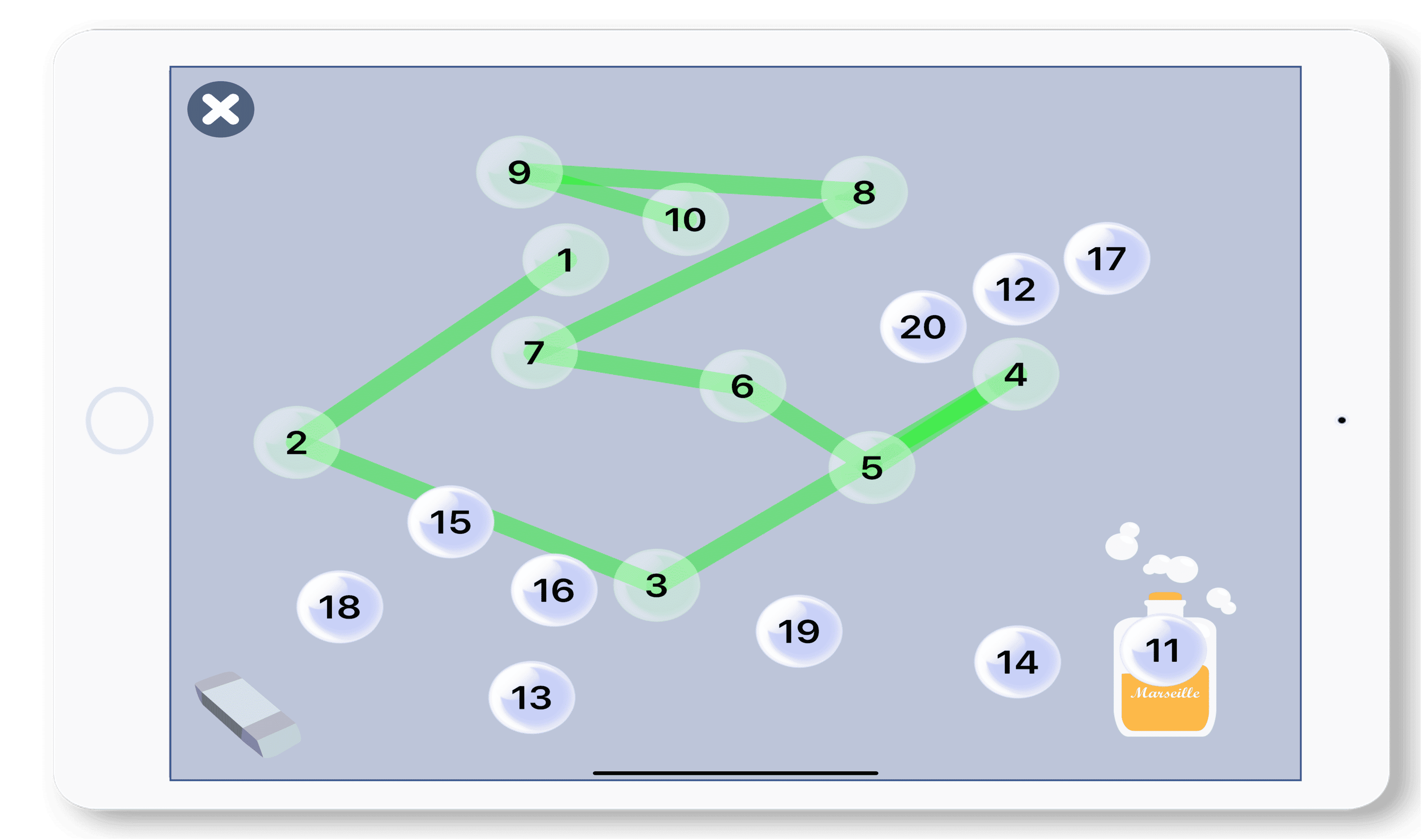
Relibulle — Connect the numbers in ascending order. One of the favorite games of people with Alzheimer's.
Accessible games provide a positive first experience with the tablet — one or two sessions of Bouncing Ball or The Musical Ear are usually enough to overcome initial resistance and create a positive association with the tool. Once this first step is taken, exploring the other games becomes natural and desired by the loved one themselves.
4. Games to Play Together
These more cultural games are a great support for playing together, strengthening the bonds that unite you. Despite their cultural aspect, they work just as much on attention, concentration, old memory, and strategy development.

ColorMind — Reproduce color combinations. Works on working memory.

Intruder Hunt (easy level) — Among 4 words, find the intruder. Stimulates language and logic.

Brainstorm — Recompose famous sayings and proverbs. Ideal for sharing memories.

A Card A Date — Calls for deduction and cultural knowledge.

Quizzle — General knowledge questions. Triggers discussions and memories.

World Tour — Place the departments on the map of France or European countries.

Puzzle Plus — Recompose puzzles of famous paintings. Stimulates fine motor skills.

Infernal Cascade — Check the differences between symbols. Appeals to attention and executive functions.

Grandma Cooking — Find the ingredients of a recipe. Calls on immediate memory and language.
The selection of games offered by SCARLETT is not arbitrary. Each game has been chosen and calibrated in collaboration with neuropsychologists specialized in gerontology to engage specific memory networks, at difficulty levels suited to the Alzheimer's profile. The progression within each game — from the most accessible level to the more challenging level — allows each person to be supported where they are, without confronting them with failure.
5. The Benefits of the Tablet with a Relative with Alzheimer's

The DYNSEO memory games have several effects, on multiple dimensions:
😊 Pleasure Dimension
Pleasure is the most important feeling. Although the disease is present, our seniors still have desires and wishes — a desire to share, a desire to laugh and have a good time. The games also call upon old memories they experienced during their early childhood — paintings by Monet or Van Gogh, a song by Édith Piaf or Maurice Chevalier — and these childhood memories always move them.
🧠 Cognitive Stimulation Dimension
The memory games have been created with neuropsychologists to work on the different functions of memory — attention, concentration, visuospatial memory, language, etc. These are all functions that will be stimulated during the gaming sessions on the tablet.
🤝 Behavioral Dimension
Our memory games have virtues for people suffering from behavioral disorders. Players become calmer, soothed by the tablet, and a decrease in aggression, apathy, and agitation is observed. Playing thus reduces the behavioral disorders of people with Alzheimer's disease and also promotes communication.
💬 Communication Dimension
Some individuals receiving assistance suffering from communication disorders have calmed down upon discovering the tablet and the games, which are very ergonomically adapted. Mute individuals have expressed themselves while playing, re-establishing a communication link with their family caregiver — one of the most touching testimonies collected by the DYNSEO team.
The benefit dimensions of SCARLETT games are interdependent and mutually reinforce each other. Pleasure reduces apathy, which facilitates cognitive engagement. Cognitive stimulation maintains residual abilities, which improves the quality of social interactions. Positive social interactions reduce anxiety and behavioral disorders. And all this together improves the overall quality of life — for the sick person and the family caregiver. It is a virtuous cycle that is difficult to initiate but very powerful once set in motion.
6. With Me or with the Caregiver?
In certain situations, it is difficult for the family caregiver to accompany their loved one in their regular memory exercises — whether for geographical or emotional reasons. It is very hard to face the illness of a loved one and not react to the increasingly frequent memory losses. A caregiver can take over with the necessary patience to carry out memory games through the tablet.
« Take care of your loved ones, take care of yourself. » The role of a family caregiver is demanding and is exercised over the long term. It is therefore important to take a step back and take care of oneself — for one's own well-being but also for the loved one you are supporting. Certain signs are unmistakable: fatigue, stress, no longer being able to tolerate the behaviors of your loved one. It is essential to listen to these early alarms and know how to ask for help.

The tablet thus helps to strengthen the bonds that unite you with your loved one — while working on your loved one's cognitive functions and memory, it symbolizes novelty and arouses curiosity, playing the role of mediator in your relationship. New bonds will thus be built with your loved one.
It also happens that the family caregiver feels guilty about delegating game sessions to a caregiver. This guilt is understandable but unjustified. Choosing to preserve one's own mental health by alternating with professionals is not abandoning your loved one — it is making a responsible decision that will allow you to be present in the long term. An exhausted caregiver is not a good caregiver. By recharging yourself, you return with more presence, patience, and love — which your loved one needs the most.
7. Being Supported Online by a Memory Coach
Book 1-hour sessions with our DYNSEO expert. During the coaching, using the COCO, CLINT, or SCARLETT application, the expert offers you certain games based on the cognitive functions you wish to improve (attention, memory, language). They advise you on the best games for your goal and provide you with strategies to implement.
It is important to be followed by a doctor or healthcare professional. Coaching is a support tool for using our tablet programs — it does not replace a speech therapy assessment. If you are using our programs because you have a disease, discuss it with your doctor.
Coaching can be booked by different profiles:

Three profiles of beneficiaries
Individuals who want to be supported: training at home alone can be difficult. One can lose motivation without anyone to play with. Going through an outside person can be simpler and more motivating.
Individuals followed by healthcare professionals: between sessions with the professional, the expert can advise you on the most suitable games for your needs to train at home.
Individuals awaiting a therapeutic pathway: waiting times to make an appointment with a speech therapist can be very long. During the wait, you can start your cognitive training supervised by our expert.

A quick appointment

Without leaving your home

Personalized advice to your needs
DYNSEO's online coaching meets a real need for many families — to have access to an expert who knows the programs, can personalize recommendations, and can provide remote support. For caregivers living far from their loved ones, or for those managing mild cognitive difficulties themselves and seeking personalized support, coaching is an accessible and effective solution. In one hour of coaching, an expert can transform the use of SCARLETT — by identifying the most suitable games for the cognitive profile of the loved one, suggesting specific support strategies, and answering practical questions that guides cannot anticipate.
8. Involve the Grandchildren — an Intergenerational Approach
Involving the youngest family members in using the tablet with a loved one suffering from Alzheimer's disease can be extremely beneficial for everyone. This intergenerational dynamic helps strengthen family bonds and values each generation in its role.
✦ Why involve the grandchildren
- Strengthen the emotional bond: sharing a game or activity together on the tablet strengthens the intergenerational relationship in a gentle and playful way.
- Stimulate the senior's motivation: the presence of the child stimulates attention and the desire to play. The senior is often proud to show their progress or simply to be accompanied.
- Raise awareness of the disease: participating in these games allows the younger ones to better understand Alzheimer's disease — not in fear or sadness, but in a positive and joyful action.
Concrete ideas for intergenerational activities on tablet
🎨 ColorMind and The Musical Ear
The child can suggest color combinations while the senior tries to reproduce them (ColorMind). For The Musical Ear, both generations can guess sounds together or compare them to their personal memories — this game creates natural conversations about history and daily life.
📖 Brainstorming and World Tour
Sayings and proverbs are often a valuable subject of oral transmission — the child can try to guess their meaning with the help of the grandparent (Brainstorming). For World Tour, the child can help place countries on the map while the grandparent shares memories of travels or geography lessons from the past.
🧩 Puzzle Plus
Children, very skilled on tablets, can guide the senior on the right pieces while commenting on the paintings or places represented. These exchanges around works of art or landscapes are a natural opportunity for cultural transmission in both directions.
Choose a calm moment, without distractions · Let the child lead without pressure — this is not a lesson, it's a bonding moment · Prepare small friendly challenges (“Who will recognize the sound first?”) · Value cooperation more than performance.
Intergenerational activities with the SCARLETT tablet are also a way to include the whole family in supporting the sick person. When grandchildren bring their natural ease with technology, their enthusiasm, and their unfiltered affection for their grandparent, they create something very special — a relaxed play atmosphere where the grandparent feels valued and still belongs to a family that includes and plays with them. These moments leave lasting memories for all participants.
Family caregiver associations play a crucial but underestimated role in supporting Alzheimer's disease. Beyond the practical resources they provide, they offer something even more valuable — meeting others who are experiencing exactly what you are going through. Talking to someone who understands from the inside what it means to see your parent no longer recognize you, manage a nighttime wandering crisis, or explain to your children why their grandmother keeps asking the same question — there is no equivalent in guides or medical consultations. This solidarity among caregivers is a therapeutic resource in its own right.
9. Preventing Family Caregiver Burnout
The family caregiver is often forgotten in discussions about Alzheimer's disease. However, studies show that family caregiver burnout — the “caregiver burnout” — is a major public health issue. In France, it is estimated that there are 8 million informal family caregivers, a large proportion of whom care for people with neurodegenerative diseases like Alzheimer's. These caregivers have significantly higher rates of depression, anxiety, cardiovascular diseases, and immunodepression than the general population.
The SCARLETT tablet, in this context, is not just a cognitive stimulation tool for the sick relative — it is also a respite tool for the caregiver. During a play session, the caregiver does not have to manage difficult behaviors, respond to repeated questions, or navigate painful conversations. The tablet structures the time, provides a clear framework for the meeting, and transforms a potentially anxiety-inducing visit into a moment of shared enjoyment. This respite, even if partial, is valuable for the caregiver's health.
✦ Warning signs of caregiver burnout to monitor
- Persistent chronic fatigue even after a full night’s sleep
- Feeling unable to tolerate the behaviors of your loved one, even benign ones
- Irritability, impatience, disproportionate reactions
- Feeling of loneliness and misunderstanding from those around
- Neglecting your own medical, social, and leisure needs
- Persistent guilt regardless of the amount of care provided
If you recognize several of these signs, it is important to talk to your doctor and seek respite solutions — home helpers, day care, temporary accommodation. These services exist precisely to allow caregivers to recharge without guilt.
Caregiver burnout is not inevitable — it is the result of an accumulation of stress without a pressure release valve, without respite, without support. Resources exist — caregiver associations, support groups, respite platforms, financial aid — but they are not spontaneously known and accessible. In France, France Alzheimer and Alzheimer Disease are the two main associations that support families — they offer training, support groups, a helpline, and a directory of local resources. Do not wait until you are at the end of your rope to contact them.
10. Better Understanding Alzheimer's Disease to Better Support
Understanding Alzheimer's disease helps the caregiver better interpret the behaviors of their loved one and adjust their reactions. The disease progressively affects different regions of the brain, which explains the succession of symptoms. Recent memory is affected first — your loved one forgets what they did 10 minutes ago but remembers their childhood perfectly. This is why the EDITH games that rely on old memory (memories, general knowledge, proverbs) work so well — they draw on memory networks that are still relatively preserved.
Difficult behaviors — agitation, aggression, repetitions — are not bad will or manipulation. They often reflect unexpressed anxiety, uncommunicable pain, or sensory overload. When an Alzheimer’s loved one becomes agitated or hostile, seeking the cause (hunger, pain, fear, noise, change of environment) is more effective than reacting to the behavior itself. The EDITH tablet, by offering a structured and engaging activity, can precisely interrupt these cycles of agitation by redirecting attention to something pleasant and manageable.
Understanding the disease is also an antidote to guilt. When you understand that your loved one’s aggression is not directed at you but is a neurological symptom, you can protect yourself emotionally while remaining present and caring. When you understand that repetitions are not indifference to what you just explained but the effect of severe anterograde amnesia, you can respond with patience rather than frustration. This neuroscientific understanding of the disease is one of the most effective protections against the emotional exhaustion of the caregiver — and EDITH, by providing a structured and predictable interaction framework, helps maintain this caring posture.
Alzheimer's disease brutally reminds us of something we often forget in the hustle and bustle of modern life: what remains when words fade is not information or factual memories — it is the emotional texture of relationships, the feeling of being loved, the warmth of a presence. The EDITH games work precisely in this space — they create moments of shared pleasure, excitement, and encouragement, which settle in the emotional memory of the loved one, often preserved much longer than episodic memory. This is why people in advanced stages of the disease may appear "happy" without remembering what just happened — the positive emotion was felt and recorded, even if the content of the experience was not memorized.
11. Organizing Sessions — Practice and Organization
For the EDITH sessions to be regular and beneficial, some practical organizational tips can make the difference between random practice and an established therapeutic habit.
⏰ Choose the right time of day
For most people with Alzheimer's disease, afternoons are often difficult (the "sundowning" phenomenon — agitation and confusion at the end of the day). Mornings, or just after lunch when the senior is relaxed and relatively alert, are generally the best times for SCARLETT sessions. Observe your loved one's rhythms and adjust accordingly.
📅 Establish a routine
People with Alzheimer's disease greatly benefit from predictable routines. A SCARLETT session at a fixed time — for example, every Wednesday afternoon during your visit — creates positive anticipation. Over time, your loved one may develop a positive association with the tablet, reducing initial resistance and increasing engagement.
🔇 Arrange the sensory environment
A calm environment, without a television on in the background, without distracting conversations, with good lighting — promotes concentration and reduces the sensory overload often present in Alzheimer's disease. If your loved one is in a nursing home, finding a quiet space away from the common activity can make a big difference in the quality of the session.
Arranging SCARLETT sessions is not just physical and temporal — it is also relational. The way you position yourself as a caregiver during the session makes a significant difference. Being side by side rather than face to face (a less confrontational position), at the same level as your loved one (if possible), with a soft and enthusiastic voice, frequent encouragement, and sincere praise — all these elements of non-verbal and verbal communication create the affective safety climate in which your loved one can engage in the games without fear of judgment. It is not the tablet that makes SCARLETT sessions — it is your warm presence around it.
Frequently Asked Questions
A well-organized SCARLETT session starts even before opening the tablet. Sitting comfortably next to your loved one, establishing warm eye contact, presenting the tablet enthusiastically ("I have something fun to show you") — these small introductory rituals put the senior in a state of positive receptivity and curiosity. After the session, taking the time to value what happened ("You remembered all the ingredients of the cake — I am impressed!") extends the positive state of the session well beyond it.
Ultimately, the SCARLETT tablet is not a magic solution that cures Alzheimer's disease nor a substitute for medical and paramedical care. It is a quality of life tool — for the sick person, who regains moments of pleasure, competence, and human connection, and for the family caregiver, who has a valuable mediator in an often challenging relationship. By cultivating these moments of shared play, you build common memories that persist despite the illness, in both directions — your loved one may retain the feeling of a pleasant moment even if they do not remember the detailed content, and you will always remember that smile that lit up when the familiar melody began.
Yes — it's one of the key advantages of SCARLETT. The games work without WiFi, allowing you to play anywhere — at the relative's home, in a nursing home, during a trip, in a hospital room. The tablet thus becomes a portable game companion independent of connectivity.
SCARLETT is designed to support people with Alzheimer's from mild to moderate to severe stages. The most accessible games (Bouncing Ball, Musical Ear, Relibulle) are suitable for advanced stages. The cultural games (Quizzle, World Tour, Brainstorming) are more suited for mild to moderate stages. The clean interface and absence of failure allow everyone to play at their level without frustration.
No — DYNSEO coaching is a support for using the tablet programs, not a medical or paramedical care. It does not replace a speech therapy assessment or medical follow-up. However, it can complement these supports — by offering regular exercises between sessions with professionals, or while waiting for specialized care to begin. If your relative has an illness, always discuss it with their doctor.
Regularity is ultimately the key to the effectiveness of SCARLETT sessions. Short and frequent sessions — 20 to 30 minutes, two to three times a week — are much more effective than long spaced-out sessions. The brain benefits from regular stimulation to keep its synaptic connections active. And the tablet, due to its portability and autonomy (no need for WiFi), makes this regularity possible even when visits are constrained by time or distance. Each session, no matter how short, has its value — for the pleasure it brings, for the connection it creates, and for the cognitive stimulation it produces.
This guide has been designed to support you in your first sessions as well as in your long-term practice. If you have specific questions about using SCARLETT with your relative, feel free to book a coaching session with our DYNSEO experts — they are here precisely to help you make the most of these precious moments.
💙 Support your relative with SCARLETT DYNSEO
30+ cognitive games adapted for Alzheimer's · No WiFi · Clean interface · Online coaching available · 7 days free trial.
The journey of a family caregiver of a person with Alzheimer's is long, often solitary, and filled with conflicting emotions — love and fatigue, attachment and grief, hope and discouragement. This guide cannot solve all these challenges, but it can help make this journey a little less difficult and a little richer in moments of true connection. Every smile triggered by a recognized melody in the Musical Ear, every saying reassembled in Brainstorming that triggers a memory, every picture from Puzzle Plus that evokes a trip or a history lesson — it's life continuing, relationships persisting, humanity transcending illness.