
Understanding why stillness is impossible and how to transform movement into an ally for learning
—
Introduction: The Student Who Can’t Sit Still
“Sit down!”, “Stop fidgeting!”, “Stay still!” These commands echo daily in classrooms where students with ADHD are learning. The teacher who utters them expresses understandable exasperation when faced with a child who seems incapable of staying in place for more than a few minutes. Yet, these repeated reminders remain desperately ineffective, and the agitation invariably resumes.
This situation generates frustration and misunderstanding on both sides. The adult perceives the agitation as a lack of willpower or respect. The child, meanwhile, experiences genuine torture when asked for prolonged stillness that they cannot physiologically maintain.
Because the need to move in a child with ADHD is not a whim, a lack of upbringing, or a deliberate choice to disrupt the class. It is a neurological necessity, rooted in the very functioning of their brain. Neuroscience research has demonstrated that this movement, far from being an obstacle to learning, can become a facilitator when properly understood and channeled.
This article explores the scientific foundations of this need for movement, its manifestations in the school context, and above all, concrete strategies to make it an ally rather than an enemy of learning.
—
Part One: The Neurological Basis of the Need for Movement
The Vestibular System and Arousal Regulation
To understand why a child with ADHD needs to move, we must first examine the vestibular system. Located in the inner ear, this system plays a crucial role in the perception of movement, balance, and the body’s position in space. But its functions go far beyond these proprioceptive aspects.
The vestibular system maintains close connections with the brain centers responsible for arousal, attention, and emotional regulation. When we move, this system sends signals to the brain that help maintain an optimal level of activation. This is why we spontaneously tend to fidget when we are tired or to walk when we think.
In a child with ADHD, the baseline cortical activation level is often suboptimal. The brain struggles to spontaneously maintain the arousal necessary for sustained attention. Movement then becomes a compensatory mechanism: by moving, the child stimulates their vestibular system, which in turn sends activation signals to the cortex.
This understanding reverses the usual perspective. The child who fidgets is not deliberately disrupting: they are unconsciously trying to keep their brain in a state that allows it to function. Punishing them for this behavior amounts to removing the tool that helps them stay present.
Dopamine and the Need for Stimulation
The dopaminergic system plays a central role in ADHD and in the accompanying need for movement. Dopamine, a neurotransmitter involved in motivation, pleasure, and attention, functions differently in people affected by this disorder.
Research has shown that the ADHD brain exhibits reduced sensitivity to dopamine and/or faster reuptake of this neurotransmitter. The result is a “functional dopaminergic deficit” that translates into a constant search for stimulation to reach satisfactory activation levels.
Physical activity is one of the most effective means of naturally stimulating dopamine release. When the child moves, runs, jumps, their brain produces more dopamine. This phenomenon explains why children with ADHD seem to have “inexhaustible energy”: their brain drives them toward movement as a means of neurochemical regulation.
This neurobiological reality also explains why periods of forced immobility are so difficult. Deprived of the movement that regulates their brain chemistry, the child sees their dopamine level drop, leading to a deterioration in attention, motivation, and mood.
Self-Regulation Through Movement
Movement in a child with ADHD serves not only to maintain arousal: it participates in emotional and cognitive self-regulation in the broad sense.
When facing stress, anxiety, or frustration, movement offers a natural outlet. Physical activation allows for “discharging” accumulated tension, reducing stress hormones, and returning to a more stable emotional state. The child who taps their foot under their desk during a difficult exercise is not just fidgeting: they are managing their stress.
Cognitively, movement can facilitate certain thought processes. Many people, not just those with ADHD, think better while walking, pacing, or manipulating an object. Movement seems to free up cognitive resources rather than monopolize them.
This self-regulation function explains why agitation often increases in the most demanding or stressful situations. It’s not that the child “isn’t making an effort”: it’s that they are mobilizing all the tools at their disposal to cope with the difficulty, including movement.
—
Part Two: Manifestations of the Need for Movement in Class
Permanent Motor Agitation
The most visible manifestation of the need for movement is constant body agitation. The child fidgets in their chair, swings their legs, taps their feet, squirms, constantly changes position. This agitation can be subtle or very pronounced depending on the child and the moment.
This motor hyperactivity is not uniform throughout the day. It tends to intensify in situations that require the most attention and inhibition: prolonged passive listening, demanding individual work, end of the day when resources are exhausted.
Paradoxically, agitation can decrease when the child is absorbed in a particularly engaging activity. Video games, building, drawing can produce relative immobility because the activity itself provides the necessary stimulation to the brain.
The attentive teacher will observe that agitation is not random but responds to a physiological logic. It increases when the brain needs additional stimulation and decreases when this stimulation is provided through other channels.
Incessant Movement
Beyond fidgeting in place, the child with ADHD often experiences an urgent need to move around. They get up to sharpen their pencil, to throw away a paper, to ask a question, for any pretext that allows them to move.
These movements are generally not consciously planned as schemes to disrupt. They arise as automatic responses to a pressing physiological need. The child finds themselves standing before they have even decided to get up.
Transition moments are particularly conducive to these motor overflows. The passage from one activity to another, which should be brief and orderly, becomes an opportunity for effervescence that is difficult to contain. The child takes advantage of the freedom to “discharge” the movement contained during the previous sequence.
Recess periods, supposed to meet the need for movement, often prove insufficient. The child returns to class just as agitated, or even more so, because the excitement of free play has stimulated rather than calmed their motor system.
Object Manipulation
A frequent and often misinterpreted behavior concerns the constant manipulation of objects. The child spins their pen, fiddles with their eraser, undoes and redoes their bracelet, touches everything within reach.
These manipulations are sometimes perceived as signs of inattention or lack of interest. “Stop playing and listen!” orders the adult. Yet, these behaviors can actually support attention. The sensorimotor activation provided by manipulation helps maintain the cortical arousal necessary for listening.
Of course, not all manipulations are beneficial. Some do indeed become sources of distraction, capturing attention to the detriment of the main task. The difference often lies in the type of object manipulated and the underlying intention: automatic and discreet manipulation supports attention, manipulation that becomes the main object of interest diverts it.
“Fidgets” or stress relief objects find their justification here. Designed to provide minimal and not very distracting sensorimotor stimulation, they allow channeling the need for manipulation toward an appropriate medium.
Body Noise
The need for movement is also expressed through involuntary sound productions: finger tapping, foot rubbing, mouth noises, humming. These sound manifestations accompany motor agitation and participate in the same stimulation function.
These noises often disturb the classroom environment much more than visual agitation. They distract classmates and annoy the teacher. The child themselves is often not aware of them until they are pointed out.
The request to stop these noises places the child in a difficult situation. On the one hand, they do not always perceive that they are producing them. On the other hand, even when aware, they struggle to inhibit them sustainably because they respond to a deep need.
Alternatives can be offered: silent objects to manipulate, possibility of positioning themselves slightly apart for moments of irrepressible sound production, discreet reminder signals rather than public reprimands.
—
Part Three: The Consequences of Suppressing Movement
Impact on Attention and Learning
Forcing a child with ADHD to complete immobility does not solve the attention problem – it aggravates it. The cognitive resources that the child must mobilize to suppress their movement are no longer available for the learning task.
Research has demonstrated this phenomenon experimentally. When children with ADHD are asked to remain perfectly still during a cognitive task, their performance drops significantly. On the other hand, when they are allowed to move moderately, performance improves or is maintained.
This counterintuitive result is explained by the concept of “limited cognitive resources.” Inhibiting movement consumes a portion of these resources. If all available resources are already being used for motor inhibition, there are none left for learning processes.
The teacher who demands perfect immobility therefore obtains the opposite of what they seek. The child may seem more “well-behaved” on the outside, but their brain is less available to learn.
Impact on Emotional State
The suppression of movement generates growing tension in the child, comparable to the sensation of needing to sneeze without being able to. This tension accumulates and eventually finds an outlet, often in the form of emotional or behavioral overflow.
End-of-day crises, common in children with ADHD, are partly explained by this accumulation. After hours of forced containment, the child “explodes” as soon as the constraint is relaxed. Parents who pick up a frenzied child at the end of school are only receiving the discharge of tension accumulated throughout the day.
Anxiety can also develop in the child who anticipates reprimands related to their agitation. Knowing that they cannot manage to stay still, they develop apprehension about the school situation that increases their stress level and, paradoxically, their agitation.
The relationship with the teacher can deteriorate in a vicious circle where repeated reproaches fuel the child’s feeling of inadequacy, which translates into avoidance or opposition behaviors.
Impact on Self-Esteem
The child who daily receives the message that they should be able to stay still but cannot manage to do so develops a negative self-image. They internalize the idea that they are different, deficient, incapable of what others do without apparent effort.
Comparisons with classmates who stay quietly seated reinforce this feeling. “Look at Thomas, he can stay calm” constitutes a devaluing message that ignores the fundamental neurological difference between the two children.
Guilt sets in faced with behavior that the child cannot control despite their efforts. They sincerely want to please their teacher, their parents, but their body does not obey them. This helplessness generates deep suffering often unknown to adults.
—
Part Four: Strategies to Integrate Movement into Learning
Legitimizing the Need to Move
The first step is to recognize the need for movement as legitimate rather than as a behavior to eradicate. This change in perspective transforms the approach to support.
Explaining to the child, with words adapted to their age, that their brain needs to move to function well relieves their guilt. They understand that their agitation is not a moral weakness but a characteristic of their functioning that they can learn to manage.
Informing other students in the class, with the agreement of the child and their family, can also facilitate acceptance of accommodations. Classmates who understand why their peer is entitled to certain adaptations are generally kind.
The teacher themselves benefits from adjusting their representation. Seeing agitation as an adaptation attempt rather than as a provocation modifies their reactions and preserves the relationship with the student.
Offering Structured Movement Alternatives
Rather than prohibiting all movement, effective support consists of offering acceptable alternatives that meet the need without disrupting the class.
Dynamic seating constitutes a first category of tools. The balance ball allows constant micro-movements while maintaining the seated position. The balance cushion placed on the chair offers an unstable surface that constantly requires postural adjustments. The wobble stool allows discreet swaying.
Silent manipulation tools provide sensorimotor stimulation without sound disruption. Stress balls, fidget cubes, elastic bands stretched between chair legs offer an outlet for the need for hand and foot movement.
The possibility of working standing up, at least at times, responds to some children’s need to change position. A raised desk or a high table in a corner of the classroom can be offered as an occasional alternative.
Integrating Regular Movement Breaks
The temporal organization of the day can integrate moments dedicated to movement, pressure valves that allow “recharging” containment capacities for the next sequence.
Active breaks of a few minutes between two intellectual activities have demonstrated their effectiveness. A few physical exercises, a song with gestures, a brief moment of dancing allow the entire class to move and particularly benefit students with ADHD.
The COCO THINKS and COCO MOVES program from DYNSEO formalizes this approach by offering a structured alternation between cognitive activities and physical breaks. This design respects the neurological functioning of children who need to move to learn.
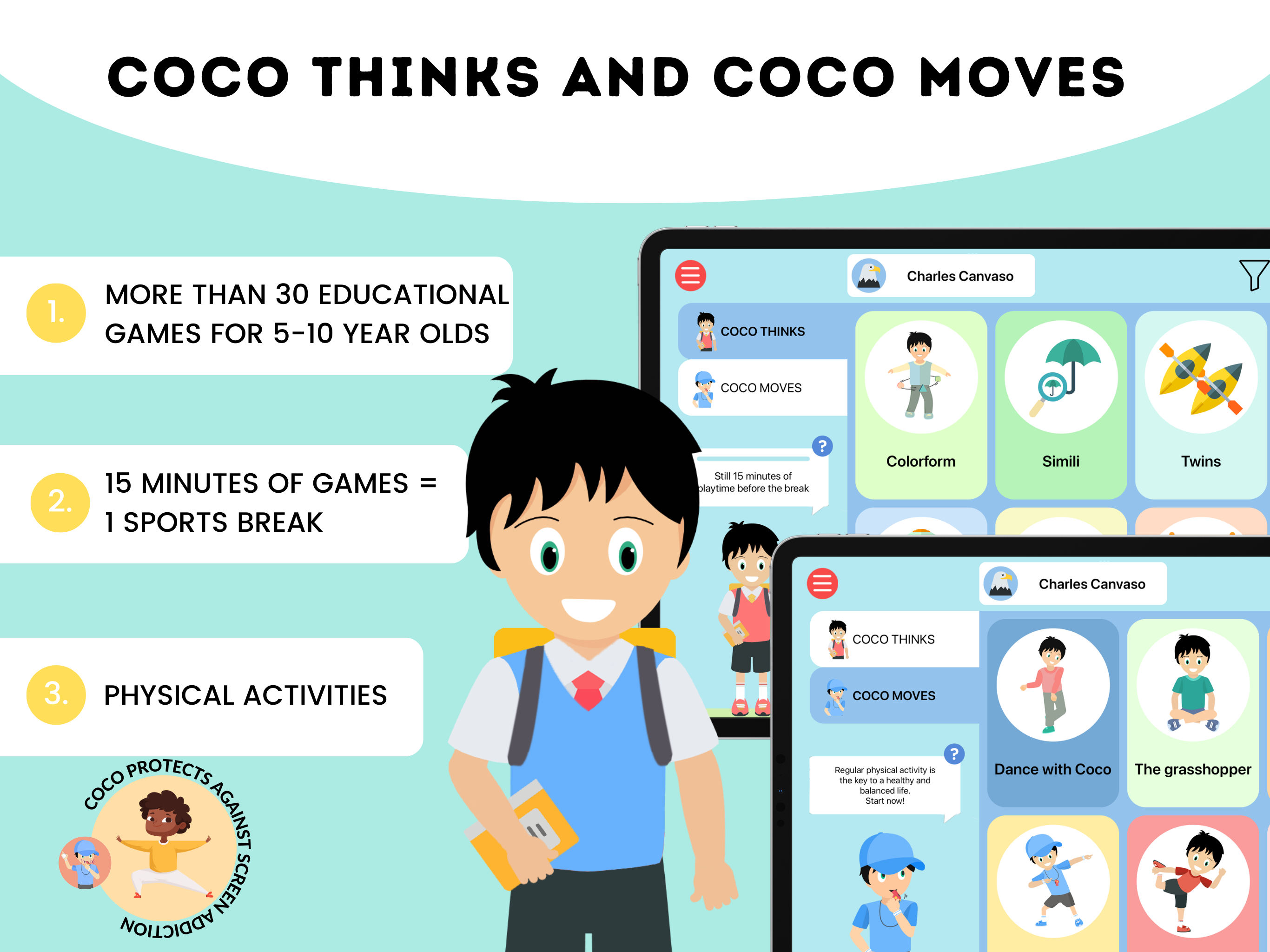
The COCO MOVES games allow targeted active breaks that recharge attentional resources. Children then return to COCO THINKS activities with better cognitive availability.
Discover COCO THINKS and COCO MOVES
“Movement missions” can be entrusted to the student with ADHD: distributing notebooks, erasing the board, delivering a message. These responsibilities provide legitimate opportunities to move while valuing the child.
Designing Active Pedagogical Activities
Beyond breaks, pedagogy itself can integrate movement as a component of learning.
Activities that involve the body promote the engagement of students with ADHD. Learning a poem by associating gestures with each verse, reviewing multiplication tables by jumping on the answers on the floor, working on conjugation while moving transform passive learning into an active experience.
Workshop work with rotation between several stations offers regular opportunities for movement while structuring the activity. The child moves from one workshop to another within a defined framework.
Concrete manipulations, particularly in mathematics and science, engage the body in learning. Manipulating materials, building, experimenting mobilize the kinesthetic channel often preferred by children with ADHD.
—
Part Five: Training Teachers in a New Approach
Understanding to Adapt One’s Posture
The effectiveness of movement-related accommodations fundamentally depends on adults’ understanding of them. A teacher who still perceives agitation as a lack of discipline will have difficulty serenely implementing strategies that allow it.
Training allows understanding the neurobiological basis of the need for movement and drawing practical consequences. It helps the teacher distinguish what stems from the disorder from what stems from chosen behavior, and to calibrate their expectations accordingly.
This understanding also transforms the teacher’s emotional experience. Understanding that the student is not fidgeting “against them” or to provoke them soothes frustration and preserves the pedagogical relationship.
DYNSEO Training to Support Students with ADHD
DYNSEO offers training specifically designed for education professionals who wish to better support students with ADHD.
The training “Student with ADHD: Advanced Strategies for Managing Impulsivity and Opposition in the Classroom” addresses in depth the need for movement and strategies to respond appropriately. It offers concrete tools directly applicable in the classroom.
The training “Supporting Students with Learning Disabilities” offers a broader view of different disorders and their interactions, allowing a comprehensive approach to pedagogical differentiation.

The training “DYS Disorders: Identifying and Adapting” completes this offer by addressing specific learning disorders frequently associated with ADHD.

Working as a Team Around the Student
Supporting the need for movement benefits from being thought through collectively. All adults working with the child must share the same understanding and apply consistent strategies.
Exchanges between teachers allow sharing strategies that work and those that fail. What works with one student can inspire adaptations for another.
Coordination with specialized professionals (psychomotor therapist, occupational therapist, psychologist) enriches the approach. These professionals bring a complementary perspective and can recommend specific accommodations.
Communication with the family ensures consistency between environments. Strategies that work at school can be adapted at home, and vice versa.
—
Part Six: Supporting the Child in Managing Their Need for Movement
Developing Body Awareness
As they grow, the child can be supported in becoming aware of their own need for movement and strategies to respond to it.
Helping them identify internal signals that announce the need to move constitutes a first step. Feelings of discomfort, increasing agitation, difficulty concentrating can be recognized as indicators that the body needs movement.
Teaching them regulation strategies that they can apply autonomously develops their independence. Discreet muscle contractions, deep breathing, requesting a movement break are tools they can gradually mobilize without adult intervention.
Valuing their progress in managing their need for movement encourages perseverance. Every situation where the child has managed to use an appropriate strategy rather than fidgeting in a disorganized manner deserves to be recognized.
Building a Personalized Plan
Each child with ADHD is unique, and strategies that work for one may not be suitable for another. A personalized plan, developed with the child and the various actors in their support, optimizes the effectiveness of interventions.
This plan identifies the moments and situations where the need for movement is most intense. It defines authorized strategies (tools, breaks, missions) and communication signals between the child and the adult.
The plan is evolving. It adjusts based on feedback from the child, observations from adults, and the evolution of needs over time and with maturation.
The child’s active participation in developing this plan strengthens their commitment. When they have contributed to choosing strategies, they are more inclined to use them and make them work.
—
Part Seven: Perspectives and Evolution
Movement as a Cross-Curricular Competency
The approach that integrates movement into learning does not only benefit students with ADHD. It responds to a broader need of today’s children, often too sedentary and constrained to prolonged sitting positions.
Research in education sciences highlights the benefits of active pedagogy for all learners. Moving, manipulating, experimenting constitute effective learning modalities that complement more traditional approaches.
The school that makes room for movement becomes a more humane school, more respectful of the child’s physiology. Accommodations initially designed for students with ADHD can thus benefit everyone.
Evolution with Age
The need for movement evolves throughout the child’s development. The progressive maturation of the prefrontal cortex improves motor inhibition capacities, generally allowing better management of agitation with age.
This evolution does not mean that the need disappears. It transforms, manifests differently, sometimes expresses itself more discreetly or in a better-channeled way. The adolescent then the adult with ADHD often retain a need for movement that finds other forms of expression.
Supporting the child in developing strategies to manage their need for movement prepares them for the rest of their journey. The tools acquired in childhood can be adapted to the contexts of adolescence and then adult life.
—
Conclusion: From Problem to Resource
The need to move in a student with ADHD is not a defect to correct but a neurological characteristic to support. This recognition profoundly transforms the educational approach, moving from suppression to integration.
Neuroscience research has demonstrated that movement, far from hindering learning, can support it when properly channeled. The child who moves appropriately learns better than one who is constrained to immobility that exhausts their cognitive resources.
Strategies exist: discreet movement tools, active breaks, kinesthetic pedagogy, personalized plan. Their implementation requires training adults and a willingness to question the traditional image of the immobile and attentive student.
DYNSEO training and tools like COCO THINKS and COCO MOVES offer education professionals the resources to operate this transformation. Because the school of tomorrow will be one that knows how to welcome bodies as much as minds.
The child with ADHD who finds their place in a classroom that accepts their need for movement is no longer a problematic student. They are a student who can deploy their abilities, often remarkable, in an environment that respects their functioning. This transformation is in our hands.
—
Article published on the DYNSEO blog – Specialist in cognitive support and training for education professionals
Keywords: need to move ADHD, hyperactivity, classroom movement, student agitation, movement strategies, ADHD accommodations, inclusive school, active pedagogy


