About Course
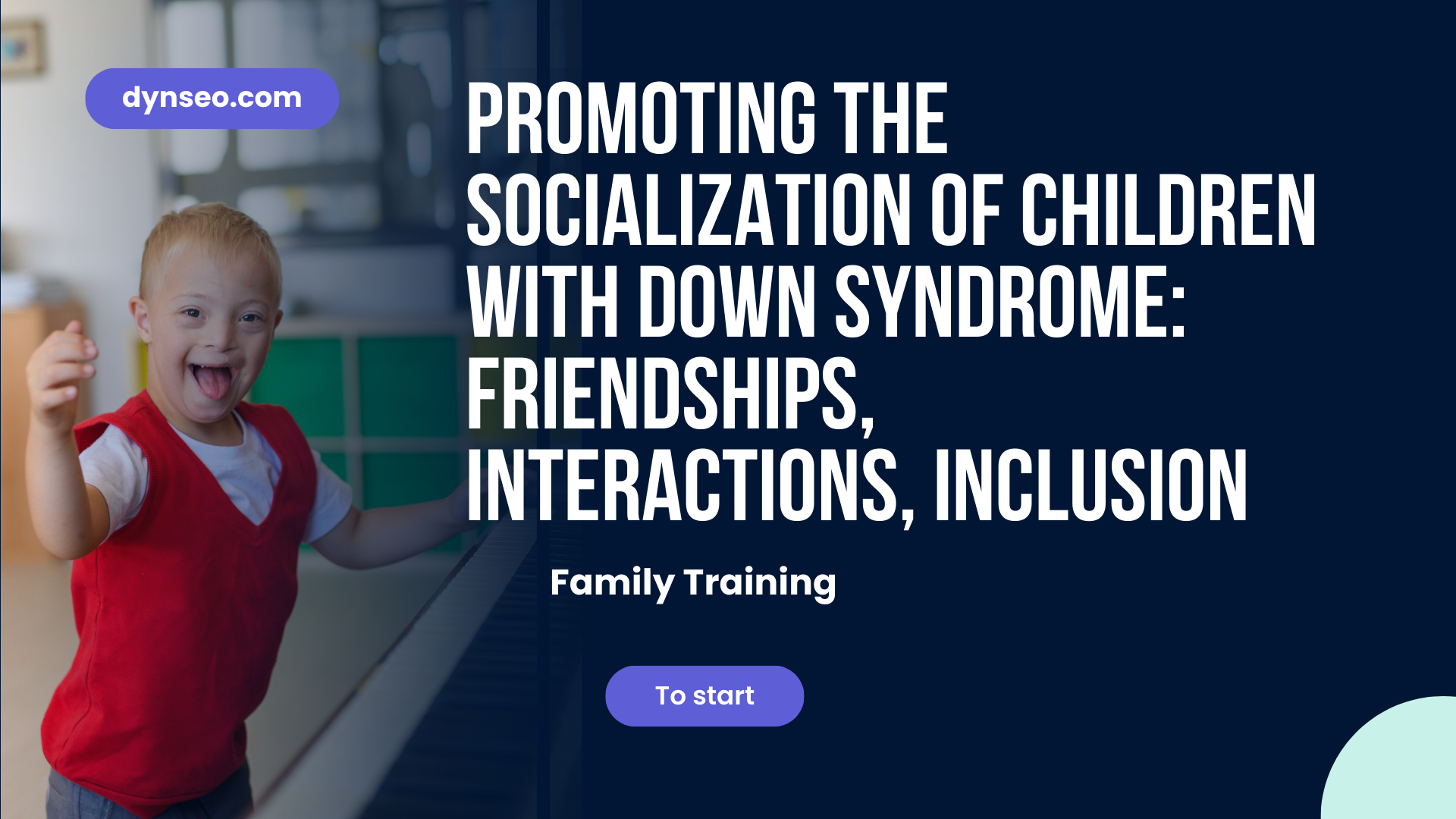
Promoting Socialization for Children with Down Syndrome: Friendships, Interactions, Inclusion
Helping your child to connect, understand social codes, and avoid isolation
👨👩👧 Target Audience Parents and families of children with Down syndrome who wish to support their child in their social life, help them create genuine friendships, and protect them from the risks associated with their social naivety.
⏱️ Duration Comprehensive training divided into 5 progressive modules
💻 Format 100% online training, accessible from your computer or tablet. You progress at your own pace, whenever you wish, without time constraints.
What You Will Learn
Your child with Down syndrome possesses an extraordinary relational wealth: a natural sociability, a genuine desire to connect with others, and a capacity to form bonds with disarming authenticity. This human warmth is a true strength. However, it can sometimes be accompanied by a social naivety that may make them vulnerable to teasing, manipulation, or isolation.
This training provides you with the keys to support your child in their social life. You will understand the social particularities related to Down syndrome: why implicit social codes are difficult to decode, why your child may not perceive when others are mocking them, and why their desire to be accepted can sometimes override caution.
You will learn to explicitly and concretely convey fundamental social rules — waiting their turn, greeting, asking, refusing. You will discover how to help them understand the emotions of others, play together without conflict, and develop their social skills through role play and adapted board games.
Finally, you will know how to concretely promote inclusion and friendships: create opportunities for encounters, identify potential affinities, prepare social situations (birthdays, outings), and strengthen your child’s self-confidence so they can experience authentic and fulfilling relationships.
By the end of this training, you will be able to:
- Understand the social particularities of Down syndrome: natural sociability and disarming authenticity, social naivety and difficulty decoding implicit codes, vulnerability to hidden intentions, balance between encouraging relational wealth and developing critical thinking
- Decode frequent misunderstandings: physical distance and signs of affection (tendency to be very tactile), interpretation of expressions and tone (teasing vs mocking), pace of exchanges (need time to respond), interests (difficulty perceiving when others are bored)
- Identify social risks: direct or sneaky teasing, paradoxical isolation despite sociability, passive imitation to fit in, warning signs to recognize
- Convey fundamental social rules: waiting their turn (materializing with an object, short then progressive situations), greeting (greeting routines, role play), asking (phrases, right moment, right person), refusing (essential skill for protection)
- Help your child understand the emotions of others: recognize basic emotions with visual aids, understand the causes of emotions (cause-and-effect links), create a “response repertoire” (what to do when a friend is sad, angry, happy), work on non-verbal expressions
- Facilitate conflict-free play: sharing (structured situations with a timer), cooperation (games where everyone wins or loses together), managing disagreements (useful phrases, guiding towards resolution), accepting loss (chance games, modeling how to lose gracefully)
- Develop social skills through role play: restaurant game, doctor game, shopkeeper game, school game — simple scenarios then complexified, gradual introduction of “problems” to solve
- Choose suitable board games: simple and clear rules, appropriate duration, concrete visual support, cooperative games (The Orchard, Hop Hop Hop, Woolfy), adapt rules if necessary
- Help your child build connections: create opportunities for encounters (one child invited at a time), identify potential affinities, contact parents, support the relationship over time
- Prepare social situations: before the event (explain the process, show photos, anticipate difficult moments), during (observe integration, intervene discreetly, recognize fatigue), after (discuss, congratulate, analyze difficulties)
- Strengthen self-confidence in relationships: value strengths with specific compliments, encourage autonomy, learn to speak positively to oneself, prepare to handle failures, create a support circle
You will leave with concrete tools: strategies for teaching social rules, methods for preparing for social situations, role plays to replicate at home, criteria for choosing suitable board games, techniques to strengthen self-confidence.
Bonus: Discovery of the COCO PENSE & COCO BOUGE application (game “Mime an emotion” for emotional recognition, two-player games for turn-taking and cooperation, sports breaks for moments of bonding) and MON DICO (customizable visual dictionary to express needs, desires, and emotions when words fail).
Course Content
Module 1 – Understanding the Social Particularities in Down Syndrome
-
Lesson 1: Great Sociability… But Sometimes Social Naivety
-
Lesson 2: Decoding Common Misunderstandings
-
Lesson 3: Risks – Mockery, Isolation, Passive Imitation
Module 2 – Learning Social Rules
Module 3 – Developing Social Skills through Play
Module 4 – Promoting Inclusion and Friendships
Module 5 – DYNSEO Applications to Support Socialization
Final quiz
Student Ratings & Reviews