About Course
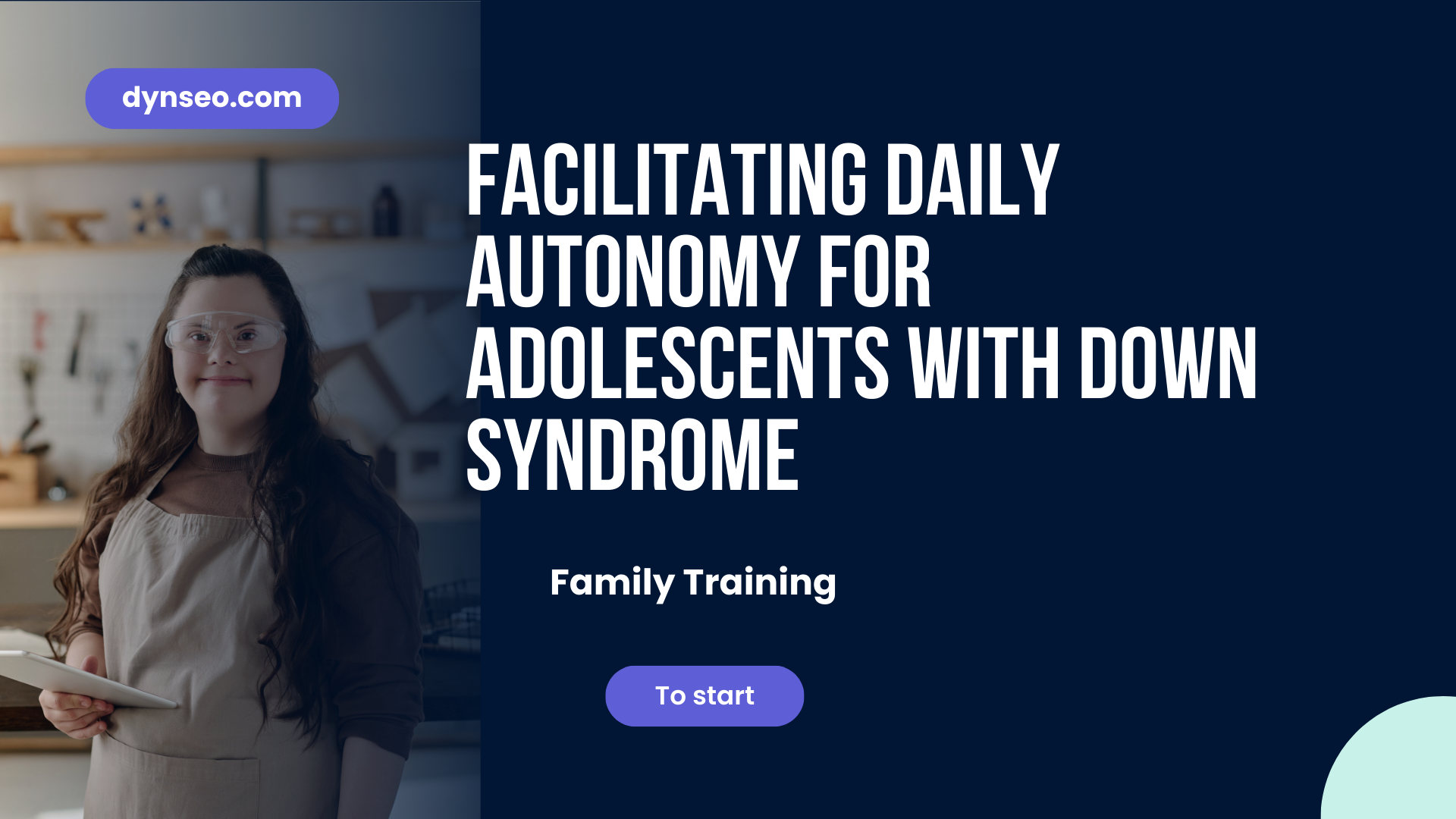
Facilitating Daily Autonomy for Adolescents with Down Syndrome
Preparing the adolescent for the most independent adult life possible
Concrete tools to develop autonomy in all areas of daily life
6 progressive modules — 100% online, self-paced
Target audience
Parents, family caregivers, and professionals supporting an adolescent with Down syndrome, wishing to help them develop autonomy in all areas of daily life.
Duration
1 to 2 hours — Comprehensive training divided into 6 progressive modules.
Format
100% online training, accessible from your computer or tablet. You progress at your own pace, whenever you wish, without time constraints.
What you will learn
Adolescence is a pivotal period where the issues of autonomy take on a new dimension. It is no longer just about getting dressed or brushing teeth, but about acquiring skills that will prepare your adolescent for the most independent adult life possible: money management, transportation, personal hygiene related to puberty, social relationships, and preparation for professional life.
This training provides you with concrete tools to understand how the adolescent learns to become autonomous. You will discover the central role of motivation and interests, how to transform necessary learning into meaningful projects, the progression in small steps using the backward chaining technique, and how to make mistakes a learning driver rather than a failure.
You will learn to establish essential routines adapted to the adolescent age: morning routine with time management and puberty hygiene, transitions and independent travel (bus, trips), evening routine with homework, leisure, and screen management. You will develop daily living skills: personal hygiene and appearance in adolescence, money management and purchases, participation in household chores.
You will know how to support social and emotional life: friendships and first outings, emotional management and self-assertion, future preparation (orientation, life project). Finally, you will find the delicate balance between protection and autonomy, learning to gradually let go while remaining vigilant.
At the end of this training, you will be able to:
- Understand the role of motivation and interests: observe the adolescent’s interests (music, sports, video games, cooking, animals), use them as entry points for learning, transform learning into meaningful projects (saving for an album, going alone to a concert, managing a food budget).
- Apply progression in small steps: break down each complex skill into simple and achievable steps, use the backward chaining technique, set limited and realistic goals, progress brick by brick without aiming for immediate perfection.
- Make mistakes a learning driver: create a safe environment where making mistakes is part of the process, a three-step method (recognize effort, identify the mistake without judgment, guide towards the solution), avoid discouraging phrases.
- Establish the morning routine: anticipate the day before, age-appropriate visual sequence (checklist on phone or wipeable board), support puberty hygiene (sweating, acne, body hair, menstruation), tools for managing time (smartwatch, explicit alarms, timer).
- Support transitions and travel: announce changes in advance, progress in four steps towards independent travel (journey together, gradual guidance, semi-independence, independence with a safety net), create travel support materials (notebook, laminated sheet).
- Structure the evening and weekend routine: typical structure of an evening (decompression, homework, free time, chores, dinner, bedtime), manage screens with clear and visual rules, create an environment conducive to homework, use the weekend for other skills.
- Support personal hygiene and appearance in adolescence: explain puberty changes naturally and respectfully, create age-appropriate visual sequences for each hygiene gesture, involve the adolescent in choosing their clothes, address puberty and sexuality simply and honestly.
- Teach money management and purchases: lay the foundations (recognize coins and bills, understand value, understand that payment is necessary), develop advanced skills (pay an exact amount, check change, compare prices, manage a budget, save), use pocket money as a concrete tool, progress from accompanied purchases to independent shopping.
- Organize participation in household chores: tasks accessible to the adolescent, break down into steps with visual sequences, establish a clear schedule visible to all, avoid redoing tasks — guide towards gradual improvement.
- Encourage friendships and outings: structured contexts for meetings, support social codes with role-playing, progress for first outings with friends, support safe use of social networks.
- Support emotional management and self-assertion: identify and name emotions (visual supports, normalize all emotions), teach appropriate regulation strategies, develop self-assertion (saying no, expressing preferences, asking for help), address the issue of disability with honesty and positivity.
- Prepare for the future (orientation, life project): explore interests and skills, professional discovery internships, know the available resources (ULIS, IME, ESAT, adapted companies, supported employment), involve the adolescent in all decisions, work on transversal skills (punctuality, following instructions, teamwork).
- Adapt positive reinforcement to the adolescent: avoid overly childish systems, prioritize social reinforcements and adapted concrete reinforcements (screen time, outings, pocket money), value efforts respectfully.
- Find the balance between protection and autonomy: accept a degree of calculated risk, gradually let go (low-stakes situations then increasing responsibility), discreet safety nets (phone, geolocation, check-in), resist the temptation to intervene unless there is real danger.
- Adapt expectations according to periods: understand variability factors (growth-related fatigue, hormonal fluctuations, school or social stress), accept normal regression periods, adjust expectations based on the day’s state.
You will leave with concrete tools
- Adapted morning checklist templates for adolescents.
- Typical progression for independent travel.
- Visual sequences for puberty hygiene.
- The three-envelope system for money management.
- Family planning for household chores.
- The “calm box” method for emotional regulation.
- Guide for professional discovery internships.
Bonus
Discover the JOE app, your brain coach — 30+ cognitive stimulation games working on memory, attention, perception, language, and planning. Essential cognitive skills for autonomy: remembering a route, focusing on a task, organizing actions. Fun and motivating approach, progress tracking to boost self-confidence.
Course Content
Module 1 – Understanding how the adolescent learns to become autonomous
-
Lesson 1: The Role of Motivation and Interests
-
Lesson 2: Progressing in Small Steps
-
Lesson 3: Mistakes as a Learning Engine
Module 2 – Establishing Essential Routines
Module 3 – Using Appropriate Visual and Material Tools
Module 4 – Encourage, Support, and Maintain Motivation
Module 5 – Digital Tools for Independence
Final Quiz
Student Ratings & Reviews