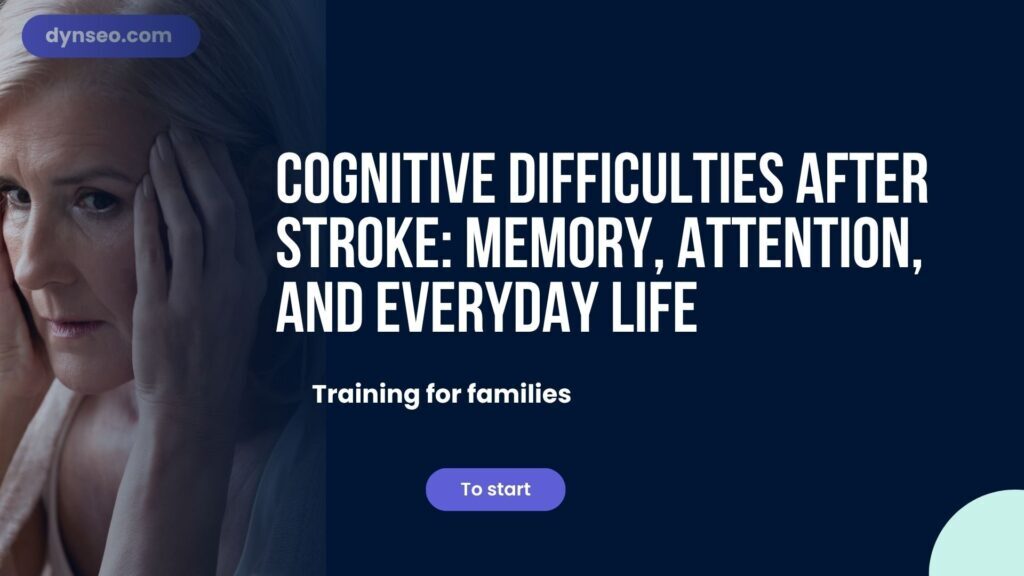
Post-Stroke Rehabilitation: Exercises and Recovery
Post-stroke rehabilitation is the key factor that makes the most difference between dependence and regained autonomy. Motor, cognitive, or language — understanding the phases and approaches to maximize recovery.
Dans cet article
La formation associée
Les ressources citées
 Test mémoire
 Test concentration
1. The 3 Phases of Post-Stroke Rehabilitation
Acute Phase (Day 0–Day 7)
Neurovascular unit (NVU). Medical stabilization, prevention of complications (bedsores, thrombosis), assessment of deficits, early maintenance physiotherapy, speech therapy evaluation. Objective: preserve recovery potential.
Subacute Phase (1–6 months)
Neurological rehabilitation (Post-Acute Care and Rehabilitation) then home. Intensive motor, cognitive, and language rehabilitation. Maximum recovery period. Objective: recover the maximum number of functions.
Chronic Phase (> 6 months)
Maintenance of gains, adaptation to the environment, digital compensatory tools. Slower recovery but still possible. Objective: maximum quality of life and autonomy.
2. Motor Rehabilitation
Physiotherapy is at the heart of post-stroke motor rehabilitation. It aims to recover the mobility of paretic limbs, relearn walking, and restore balance. Current techniques include constraint-induced movement therapy (CIMT — forcing the use of the affected limb by immobilizing the healthy limb), functional electrical stimulation, rehabilitation in a virtual environment, and robotic rehabilitation for severe cases.
🔬 Neuroplasticity: the brain can rewire itself
After a Stroke, brain regions adjacent to the damaged area — and sometimes even the opposite hemisphere — can gradually take over functions that were initially foreign to them. This phenomenon of cortical reorganization is stimulated by the intensive repetition of rehabilitation exercises. It is the neurobiological basis for post-Stroke recovery and the justification for early and intensive rehabilitation.
3. Cognitive Rehabilitation
Post-Stroke cognitive disorders — memory, attention, executive functions, spatial neglect — are present in 40 to 50% of patients and often constitute the main obstacle to autonomy. Neuropsychological rehabilitation aims to specifically train the affected functions and develop compensatory strategies for those that do not fully recover.
Digital tools play an increasing role in this rehabilitation: they allow for daily training at home between sessions, with adapted progression and objective monitoring. DYNSEO offers a Memory Test, a Concentration and Attention Test, and 62 cognitive stimulation tools tailored to the needs of post-Stroke patients.
4. Language Rehabilitation: Speech Therapy
Aphasia affects 25 to 40% of survivors of left hemisphere Stroke. Speech therapy rehabilitation should begin as early as possible — ideally within the first 72 hours. It aims to reactivate preserved language networks, develop alternative communication strategies, and address associated disorders (dysarthria, dysphagia). The intensity of rehabilitation (number of sessions per week) is positively correlated with long-term outcomes.
5. Psychological Support
Post-Stroke depression affects 30 to 40% of patients in the following year. It is both reactive (grieving lost abilities) and organic (brain lesions directly disrupt emotional regulation circuits). If untreated, it significantly slows functional recovery. Psychological or psychiatric support is an essential component of comprehensive care.
🧠 DYNSEO Tools for Post-Stroke Cognitive Rehabilitation
• Training "Cognitive Disorders after a Stroke"
• Memory Test — assess memory post-Stroke
• Concentration and Attention Test
• 62 cognitive stimulation tools — progressive exercises tailored
FAQ
How long does rehabilitation last?
3 phases: acute (0-7 days), subacute (1-6 months, maximum recovery), chronic (beyond, maintenance of gains). Progress remains possible for years after the Stroke.
What cognitive sequelae after a Stroke?
40 to 50% of survivors: memory, attention, executive functions, aphasia, spatial neglect. These disorders require specialized cognitive rehabilitation.
Is cognitive rehabilitation effective?
Yes. Neuroplasticity allows the brain to reorganize its circuits. Early and intensive rehabilitation significantly improves affected functions.
What is post-Stroke aphasia?
Acquired language disorder affecting 25-40% of survivors of left hemisphere Stroke. Intensive speech therapy, started early, yields the best results.
Is depression common after a Stroke?
30-40% of survivors in the year. It is both reactive AND organic. If untreated, it slows recovery. Psychological support is essential.
Conclusion: rehabilitation, a daily investment
Post-Stroke recovery is not linear or guaranteed — but it is possible. The first three months are the golden window: this is when neuroplasticity is most active and intensive rehabilitation yields the best results. The combination of physical + cognitive + speech therapy + psychological rehabilitation, supported by digital tools like those from DYNSEO, maximizes the chances of regaining autonomy and quality of life.