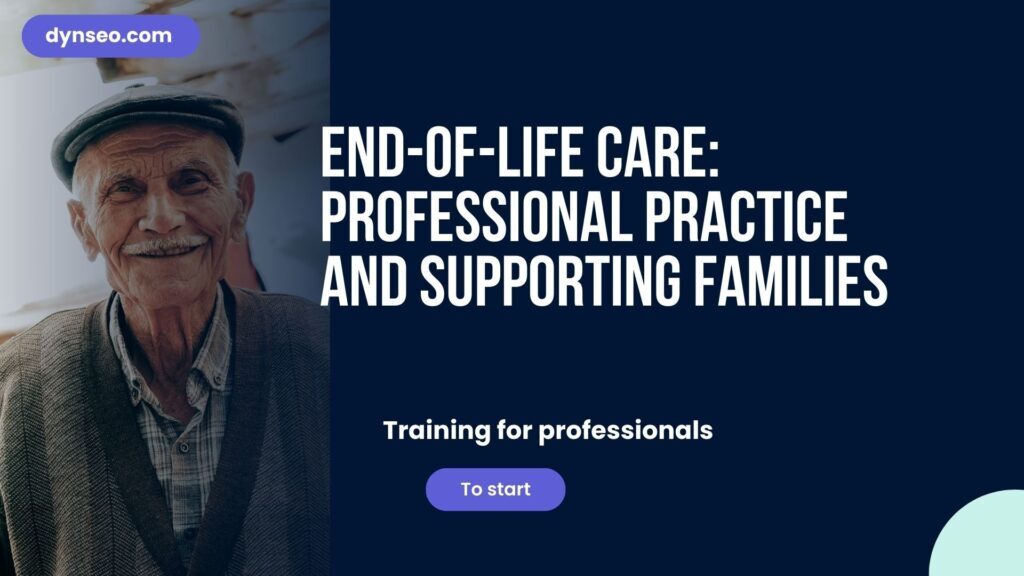
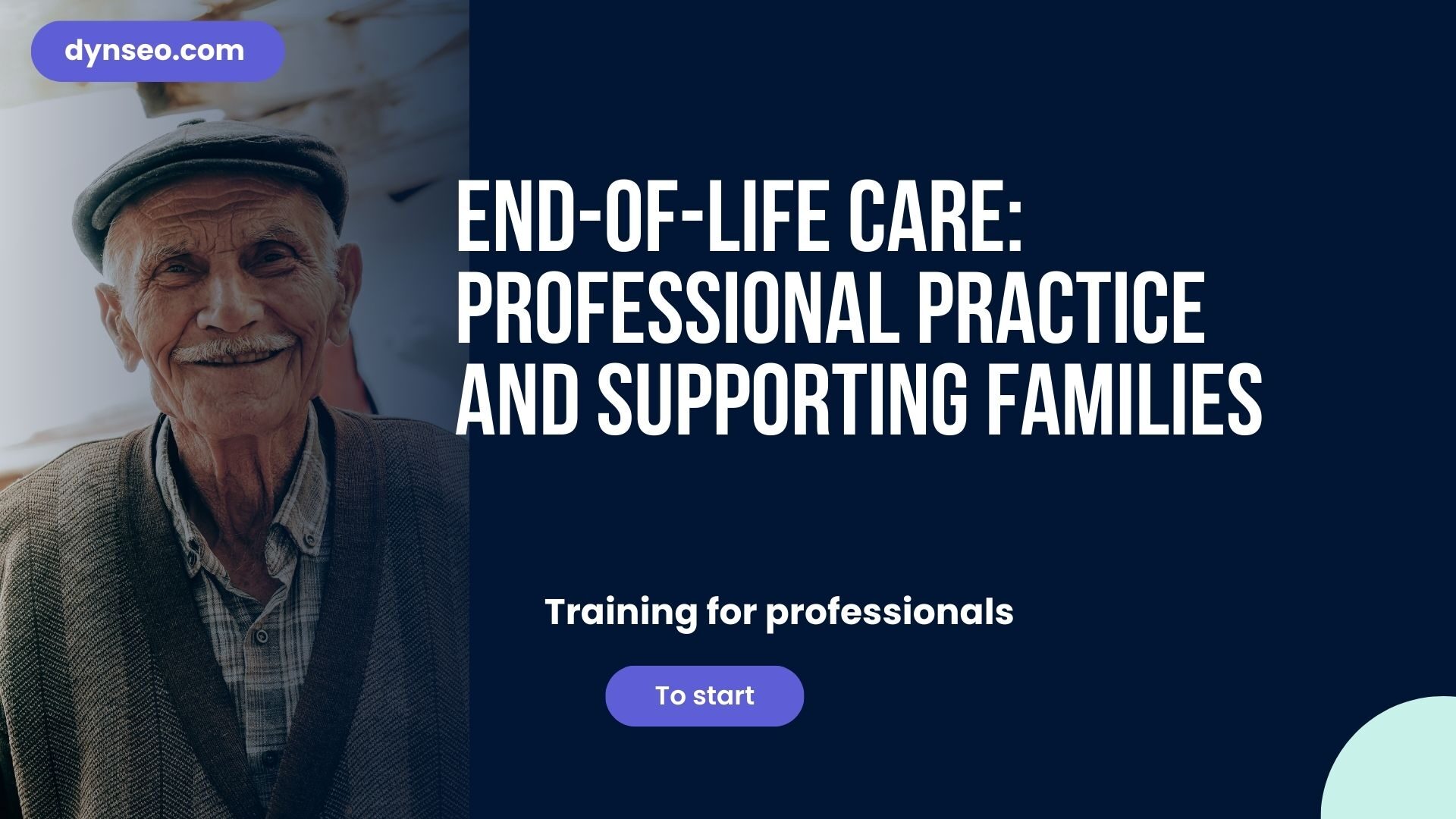
Accompanying at the end of life: an ethical guide for caregivers and families
Accompanying until the end is not caring less, it is caring differently. Presence, listening, respect for dignity: the end of life calls for a posture where the human element prevails, for the person being accompanied as well as for those around them.
Dans cet article
La formation associée
Les ressources citées
 Décodeur d'Expressions Faciales
 Thermomètre des émotions
 Roue des choix - Outils Formation DYNSEO
Accompanying a person at the end of life is one of the most delicate and profound missions there is. It confronts everyone — caregiver, helper, relative — with their own limits, emotions, and the question of meaning. And yet, it is also a moment where accompaniment can take on its full nobility: when healing is no longer possible, there is always something to offer, relief, presence, respect. This ethical guide is aimed at healthcare and medico-social professionals as well as families. It does not claim to provide recipes — the end of life does not lend itself to that — but offers guidelines: solid ethical principles, a reflection on the right posture, suggestions for communicating, relieving, and supporting loved ones. Because accompanying with dignity means recognizing that until the last breath, a person remains a person, worthy of care and consideration.
1. Accompanying at the end of life: what are we talking about?
1.1 When care changes its face
The end of life refers to the period when a person is suffering from a serious, progressive illness, in an advanced or terminal phase, for which healing is no longer the goal. This moment shifts care from a curative logic (healing, prolonging) to a logic of accompaniment and comfort. This change is not an abandonment; quite the opposite: it is about redirecting all efforts towards what now matters — the remaining quality of life, relief from suffering, respect for wishes, and maintaining the dignity of the person.
This approach has a name: palliative care. Far from the reductive image sometimes associated with it — "the moment when nothing is done" — palliative care is active and holistic care. It addresses pain and physical symptoms, as well as psychological, social, and spiritual suffering. It addresses the person in their entirety and always includes support from those around them. It can be provided in hospitals, specialized units, medico-social establishments, or at home.
1.2 A collective and multidisciplinary approach
Accompanying at the end of life is never the responsibility of just one person. It is a team approach that involves doctors, nurses, nursing assistants, psychologists, volunteer companions, sometimes chaplains or spiritual representatives, and of course the family. Each brings complementary skills and presence. This multidisciplinary nature also protects the caregivers themselves: the emotional burden of end-of-life care should not rest on the shoulders of one alone. Sharing, consultation, and mutual support are integral parts of quality accompaniment.
palliative care addresses the whole person: body, psyche, relationships, spirituality
palliative care is not the cessation of care, but active care focused on comfort and dignity
support relies on a multidisciplinary team and never forgets the loved ones
in France, the law recognizes the right to palliative care and relief from suffering
2. The main ethical principles of support
End-of-life support raises ongoing ethical questions. A few key principles, derived from reflections on care ethics, serve as a compass when situations are complex and certainties are lacking.
🌟 Dignity
The person remains, until the end, a subject worthy of respect — not a "case" or a body to be treated. Preserving their dignity means honoring their history, their modesty, their identity.
🗝️ Autonomy
Listen to and respect the person's choices, their advance directives, their will — even when it differs from what we would do in their place.
🤲 Non-abandonment
No matter what happens, do not leave them alone. When we can no longer heal, there is still the opportunity to support. "I cannot heal you, but I will not abandon you."
⚖️ Proportionality
Avoid unreasonable obstinacy (perseverance) as well as premature abandonment. Adapt care to what truly serves the person's well-being.
💛 Kindness
Do everything possible to relieve physical and moral suffering, without causing harm. The comfort of the person guides every decision.
🧭 The ethical compass: when faced with a difficult end-of-life decision, three questions help illuminate the path. What is the person's will? What truly serves their comfort and dignity? And: has this decision been collectively considered, as a team, with loved ones? The ethics of care is not the application of rules, but careful deliberation, case by case.
3. The caring posture: being present differently
3.1 Presence before actions
At the end of life, what heals the most is often not a technical gesture, but a presence. Being there, simply, without fleeing from silence or taking refuge in agitation, is in itself an act of care. Many caregivers feel discomfort in the face of helplessness — "I don't know what to say, what to do" — and fill it with awkward words or incessant activity. However, the person at the end of life often needs less words than a calm presence, a held hand, a gaze that does not turn away. Learning to "be" rather than "do" is one of the most demanding lessons of caregiving.
3.2 The right distance: neither fusion nor coldness
Accompanying requires finding a "right distance": close enough to be warm and empathetic, distinct enough not to be overwhelmed. Too much distance becomes coldness and abandonment; too much proximity leads to exhaustion and confusion of roles. This right distance is not a fixed posture: it adjusts continuously, according to situations and individuals. It is worked on, reflected upon, and supported within the team. Recognizing one's own emotions — sadness, fear, sometimes discouragement — without denying them or allowing them to take over is part of this professional and human posture.
✗ Postures to avoid
- Fleeing silence by talking too much or fidgeting
- Trivializing or minimizing expressed suffering
- Promising what cannot be kept ("it will be okay")
- Taking refuge solely in technical gestures
- Deciding for the person "for their own good"
- Carrying the emotional burden alone
✓ Correct postures
- Accept and inhabit silence calmly
- Welcome emotion without trying to correct it
- Be honest and reliable in your words
- Combine technical care and human presence
- Involve the person in decisions concerning them
- Share and support each other as a team
4. Communicating at the end of life: the delicacy of words
4.1 The truth, with tact and at the person's pace
The question of truth is central and delicate. The person has the right to know, but also the right not to hear everything at once, or to proceed at their own pace. The golden rule is not to "say everything" or "hide everything," but to respond honestly to the questions asked, adjusting to what the person is ready to hear. This means listening to their real questions — behind "am I going to heal?" sometimes lies "are you going to stay close to me?" — and never lying, while knowing how to measure and accompany. A lie, even well-intentioned, breaks trust and isolates the person in their doubts.
4.2 When words fail: non-verbal language
As the disease progresses, verbal communication can become difficult, even impossible. The person may lose their speech, be confused, or too tired to talk. Communication does not stop there: touch, gaze, tone of voice, and silent presence become essential vectors of connection. Carefully observing facial expressions, gestures, and bodily reactions allows for the detection of discomfort, pain, or calm. Supports like the DYNSEO Facial Expression Decoder can help caregivers better read non-verbal signals, and the MY DICTIONARY app offers communication support for those who can no longer express themselves verbally.
💡 Practical advice: before entering the room, take a few seconds to settle down, breathe, and let go of your agitation. The person at the end of life, even if weakened, perceives with great sensitivity the inner state of the one who approaches. Entering calm, present, and unhurried changes the quality of the encounter. Announce your presence, introduce yourself even if you think you won't be heard, speak softly: these are simple gestures that honor the person.
5. Relieve: Comfort at the heart of care
5.1 Pain is not a fatality
One of the fundamental principles of palliative care is that pain and discomfort can and must be relieved. No one should suffer unnecessarily at the end of life. Pain management is the responsibility of the medical team, which has effective means tailored to each situation. The role of caregivers — both nearby caregivers and loved ones — is to observe, report signs of discomfort (grimaces, agitation, moaning, tension), and never trivialize a complaint. A expressed pain, even from someone who no longer speaks, always deserves to be taken seriously and communicated to the team.
5.2 Comfort beyond the physical
Comfort at the end of life is not limited to relieving physical pain. It encompasses a multitude of small attentions that make a big difference: a moistened mouth, a comfortable position, a soothing room, respect for modesty during care, a reassuring presence, maintaining the person's references and habits. These comfort cares, sometimes deemed "secondary," are actually at the heart of dignity. They tell the person, without words: "you still matter, we are taking care of you." Following the evolution and adapting these attentions over time can rely on tools like the DYNSEO session tracking sheet, useful for documenting and conveying observations within the team.
🎓 Training: End of life — support, caregiving posture, and family support
✓ At your own pace
✓ Qualiopi Certified
Intended for health and medico-social professionals (nurses, caregivers, companions, home helpers) as well as families, this DYNSEO training addresses the ethical guidelines of end-of-life care, the appropriate caregiving posture, delicate communication, relief, and support for loved ones and mourning. Online, at your own pace, and Qualiopi certified, it combines in-depth reflection and concrete pathways, respecting the sensitivity of the subject.
Discover the training →6. Supporting the family and loved ones
6.1 Loved ones, companions, and those being accompanied
In end-of-life support, loved ones occupy a unique place: they are both companions — present, caregivers, sometimes home caregivers — and individuals to be supported, overwhelmed by anxiety, fatigue, and anticipated grief. This dual position is exhausting. Supporting families is an integral part of the accompaniment: informing them clearly and tactfully, answering their questions, involving them in decisions while respecting the patient's wishes, allowing them to take a breath, and acknowledging what they are going through. A supported loved one accompanies better and experiences the aftermath less painfully.
6.2 Allowing loved ones to find their place
Many loved ones feel helpless, useless, not knowing "what to do." Helping them find their rightful place is valuable. Often, the most important thing is not to "do" but to "be there": holding hands, speaking softly, sharing memories, simply being present. Encouraging them to say what matters — "I love you," "thank you," "I'm sorry," "goodbye" — can be an immense gift, for the person at the end of life as well as for those who remain. These essential words, when they can be said, significantly lighten the impending grief. To express emotions and feelings when words are difficult, tools like the DYNSEO Emotion Thermometer and the DYNSEO Wheel of Choices can open the dialogue, including with the children in the family.
6.3 Supporting children in facing end of life
The presence of children — grandchildren, children of a loved one — raises specific questions. The temptation to "protect" the child by keeping them away is understandable but often counterproductive: children perceive what is happening, and exclusion leaves them alone with their imagination, which can be more distressing than reality. With simple words, adapted to their age, without lying, we can involve children in a way they can understand. Maintaining moments of play and normalcy for them is also important: they need to continue being children. Fun and reassuring applications like COCO can provide these precious breaks in the midst of a difficult time.
7. Accompaniment scenarios: posture in situation
A companion doesn't know what to say
“Am I going to die?”
A son is exhausted at his mother's bedside
8. Supporting the supporters
8.1 Preventing burnout
End-of-life care exposes one to a heavy emotional burden. Caregivers and family members are at real risk of burnout, compassion fatigue, or even suffering. Recognizing this reality is not a weakness: it is a condition for the sustainability of care. A few guidelines: do not carry alone, share in a team or with peers, allow oneself to express emotions, take a step back and rest, and accept that one cannot “fix” everything. Powerlessness is part of the end of life; accepting it without guilt protects those who provide support.
8.2 Grief: a journey, not a step to be crossed
After death comes the time of grief, for loved ones as sometimes for caregivers attached to the person. Grief is not an illness to be cured nor a stage to “pass through” in a given time: it is a unique journey, specific to each individual, that requires time and gentleness. There is no “right” way to grieve. Grief support primarily consists of offering a listening ear, not rushing, acknowledging the loss, and directing towards appropriate support (support groups, associations, psychological support) if the suffering prolongs or intensifies. For both children and adults, being able to talk, remember, and express emotions is at the heart of the journey.
🧭 The essentials to remember
Accompanying at the end of life means moving from "curing" to "caring," without ever abandoning. It is honoring the dignity of the person until the end, respecting their wishes, alleviating their suffering, and offering a true presence when words fail. It is also about supporting loved ones, accompanying grief, and caring for those who accompany. The ethics of care is not a set of rules, but a deliberate attention, case by case, guided by respect for the human being. When nothing more can be done "for" the illness, there is always so much to do "for" the person.
9. Complex ethical questions
9.1 Between unreasonable obstinacy and abandonment
One of the most frequent tensions at the end of life is that which separates two opposing pitfalls. On one side, unreasonable obstinacy — sometimes called therapeutic relentlessness — consists of pursuing heavy treatments that no longer provide any real benefit and prolong a situation at the cost of unnecessary suffering. On the other, premature renunciation abandons the person before their time, under the pretext that "there is nothing more to be done." The principle of proportionality invites us to seek the middle ground: to adapt care to what truly serves the comfort and dignity of the person, no more, no less. This evaluation is never done alone or lightly: it is a matter of collective, medical, and ethical reflection, which involves the person (or their expressed wishes) and their loved ones.
9.2 The person's wishes at the heart of decisions
Respecting autonomy means placing the person's will at the center of decisions concerning them. When they can express themselves, they are listened to and involved. When they can no longer do so, mechanisms allow their voice to be heard: advance directives, through which anyone can record their wishes regarding their end of life in advance, and the trusted person, designated to convey their words. These mechanisms are not administrative formalities: they are acts of respect for the person, allowing caregivers and loved ones to decide not "on their behalf" but "according to their wishes." Encouraging, in advance, these reflections and processes is an important part of the support.
🧭 Deciding together: at the end of life, no difficult decision should rest on a single person. Collective deliberation — healthcare team, accompanied person, loved ones — protects the quality of the decision and relieves each individual of the burden of a solitary choice. This is one of the major lessons of the ethics of care: correctness arises from dialogue, not from individual certainty.
9.3 Responding to fundamental needs
Beyond the big questions, daily support consists of attentively responding to the fundamental needs of the person. These needs, often simple, are at the heart of dignity.
The need for physical comfort
Alleviating pain, caring for the mouth, ensuring comfortable positioning, respecting modesty: the body deserves attention and gentleness until the end.
The need for security and reference points
A calm environment, familiar presences, maintaining habits: stability reassures and soothes anxiety.
The need for connection and presence
Not being alone, feeling a hand, hearing a loved voice: human connection is an essential need, until the last moment.
The need to be heard and respected
Being able to express fears, wishes, regrets, or hopes, and knowing that they are welcomed without judgment.
The need for meaning and spirituality
For many, the end of life is a time of questioning about meaning. Embracing this dimension, whether religious or not, is part of comprehensive support.
10. The framework and resources
In France, the right to palliative care and relief from suffering is recognized by law, as is everyone's right to express their wishes regarding their end of life, particularly through advance directives and the designation of a trusted person. These provisions allow everyone to be heard, even when they can no longer express themselves. Many resources exist to support individuals, families, and professionals: mobile palliative care teams, specialized units, home palliative care networks, support associations and volunteers, helplines. Being informed about these resources and knowing where to direct people is part of informed support.
💛 A word to finish: accompanying the end of life is a human experience of rare intensity. It confronts one with loss, but also reveals what is most essential: tenderness, presence, the value of each moment. Those who accompany often testify: one emerges transformed from these moments where humanity reveals itself in all its fragility and beauty. Caring, until the end, is never in vain.
11. DYNSEO tools for support
🌡️ Emotion thermometer
To help the person and their loved ones put words to what they feel, without having to verbalize everything.
Download →🎡 Wheel of choices
A visual support to express needs and preferences when speaking becomes difficult.
Download →😊 Facial expression decoder
To better read non-verbal signals — discomfort, pain, calm — in a person who can no longer speak.
Download →📝 Session follow-up sheet
To document observations and share them within the support team.
Download →📚 Complete catalog
Dozens of free tools to support communication and emotional support.
See all tools →12. DYNSEO applications in support
🟥 MY DICTIONARY — Communication
When speaking becomes difficult or impossible: support for communication to allow the person to express their needs and feelings with visual aids.
Discover MY DICTIONARY →🟪 SCARLETT — Seniors
For elderly people still capable of stimulation: gentle and accessible games to maintain connection and enjoy moments of pleasure and presence.
Discover SCARLETT →🟦 CLINT — Adults
For caregivers and companions: a moment for oneself, a break for stimulation and relaxation in the midst of a challenging period.
Discover CLINT →🟩 COCO — Children 5-10 years
For the children in the family: to preserve moments of play and normalcy, allowing them to remain children in the midst of a family ordeal.
Discover COCO →🕊️ Accompanying with accuracy, until the end
Emotion thermometer, choice wheel, expression decoder, tracking sheets, and MON DICO application — DYNSEO offers respectful tools to support communication and presence at the end of life.
❓ Frequently Asked Questions about End-of-Life Support
Does palliative care mean "doing nothing"?
No, this is a persistent but false misconception. Palliative care is not the cessation of treatment, but active and holistic care, simply reoriented. When healing is no longer the goal, all efforts focus on what matters then: relieving pain and symptoms, preserving the remaining quality of life, respecting the person's wishes, and maintaining their dignity. Physical suffering is addressed, but also psychological, social, and spiritual suffering. Loved ones are also supported. It is therefore a deeply active and engaged form of care that requires a lot of skill and presence — the opposite of abandonment.
Should you always tell the truth to a person at the end of life?
The question is not "to say everything" or "to hide everything," but how to be honest with tact and at the person's pace. They have the right to know, but also the right to navigate in their own way. The essential rule is to never lie, as lying breaks trust and isolates the person. This does not mean delivering information brutally: it involves listening to the real questions, responding honestly to what the person asks, adjusting to what they are ready to hear. Sometimes, behind an apparently factual question lies a need for reassurance or presence, which must be understood.
How to communicate with a person who no longer speaks?
Communication does not stop when speech becomes impossible. Touch, gaze, tone of voice, and silent presence become essential vectors of connection. You can continue to speak softly to the person (hearing is often preserved for a long time), announce your presence and actions, and hold their hand. Carefully observing facial expressions and bodily reactions allows you to identify discomfort or calmness. Tools like facial expression decoders help read these signals, and communication apps like MY DICTIONARY can provide an alternative means of expression as long as the person has the ability.
What does "not abandoning" mean when healing is no longer possible?
This is one of the fundamental ethical principles of support. "Not abandoning" means that even when medicine can no longer heal or prolong life, there is always something to offer: relief from suffering, presence, respect, dignity. The phrase that summarizes this stance is: "I cannot heal you, but I will not abandon you." Practically, this means continuing to visit, caring for comfort, listening, and being there. Abandonment — the feeling of being neglected because "nothing more can be done" — is one of the greatest sufferings at the end of life, and it is precisely what support aims to avoid.
How to support a loved one who is exhausting themselves at a patient's bedside?
Family caregivers are both supporters and people in distress, which exposes them to real exhaustion. To support them: acknowledge what they are going through without minimizing it, allow them to rest without guilt, help them find their rightful place (often, "being there" matters more than "doing everything"), and guide them towards resources and support. It is valuable to remind them that they cannot bear everything alone, and that taking care of themselves is not selfish but a condition for being able to continue providing support. A supported loved one can accompany better and experience less painful grief afterward.
Should children be protected by keeping them away?
The temptation to protect children by keeping them at a distance is understandable, but often counterproductive. Children perceive what is happening around them, and exclusion leaves them alone with an imagination that can be more distressing than reality. With simple words, appropriate to their age, and without lying, we can involve them at their level and answer their questions. It is equally important to preserve moments of play and normalcy for them: they need to continue being children. Depending on the situations and age, specific support may be useful. The essential thing is not to leave them alone with their emotions and questions.
How to take care of yourself when providing support?
Accompanying the end of life exposes one to a heavy emotional burden, and the risk of burnout or compassion fatigue is real, both for caregivers and loved ones. Taking care of oneself is not secondary: it is what allows one to endure. Some guidelines: do not bear it alone and share within the team or with peers, allow yourself to feel and express your emotions, take breaks and time for reflection, and accept your limits — you cannot "fix" everything, and powerlessness is part of the end of life. Granting yourself kindness, as you offer to others, is an essential part of sustainable support.
Who is the DYNSEO training on end-of-life support for?
The training "End of Life: Support, Caregiver Attitude, and Family Support" is aimed at healthcare and medico-social professionals (nurses, nursing assistants, educational and social support workers, home caregivers) as well as families and volunteer supporters. It addresses, with the respect the subject demands, the ethical guidelines of end-of-life care, the appropriate caregiver attitude, delicate communication, relief and comfort, support for loved ones, and grief accompaniment. Online and accessible at your own pace, Qualiopi certified, it combines in-depth reflection and concrete pathways to support with more accuracy and serenity.
This article has an informative and ethical reflection purpose; it does not replace the support of a care team. End of life and grief are sensitive topics: if you are going through a difficult time, professionals (doctors, psychologists, palliative care teams, support associations) and helplines can support and guide you.
🌟 Train for a fair and ethical support
Ethical guidelines, caring posture, communication, support for families and grief: the DYNSEO training "End of Life" accompanies you with rigor and delicacy — online, at your own pace, Qualiopi certified.
Did this content help you? Support DYNSEO 💙
We are a small team of 14 people based in Paris. For 13 years, we have been creating free content to help families, speech therapists, care homes and healthcare professionals.
Your feedback is the only way we know if our work is useful. A Google review helps us reach other families, caregivers and therapists who need it.
One action, 30 seconds: leave us a Google review ⭐⭐⭐⭐⭐. It costs nothing, and it changes everything for us.