
Online Training: ADHD at Work — Recognize and Support
Complete program, module content, reviews — everything you need to know about this Qualiopi certified training for managers and HR directors facing adult ADHD.
He sometimes arrives late to his own meetings. He starts five projects simultaneously, finishing two. He forgets the important follow-up — but resolves the technical problem that has been blocking the team for three days in twenty minutes. His performance is inexplicably variable: brilliant some days, absent others. This difficult-to-pin-down and exhausting employee to manage without the right tools may have adult ADHD — Attention Deficit Hyperactivity Disorder — which is estimated to affect 4 to 5% of working adults in France. The training ADHD at Work: Recognize and Support from DYNSEO has been designed to give managers these keys to understanding — and move from frustration to action.
Why Adult ADHD in the Workplace Requires Specific Training
Adult ADHD is one of the most prevalent and misunderstood neuropsychological realities in the workplace. Contrary to a persistent misconception, ADHD does not disappear in adolescence — it transforms, masks itself, and adapts. In adults, it often takes less visible forms than in children: not necessarily the obvious physical restlessness, but chronic disorganization, a structural difficulty in time management, a tendency to procrastinate followed by intense episodes of production, and cognitive exhaustion that remains invisible from the outside.
The direct consequence of this lack of understanding: ADHD employees are regularly evaluated negatively for behaviors that are not character flaws or lack of motivation, but manifestations of a different neurological functioning. The DYNSEO training allows managers and HR directors to break free from this costly cycle for everyone.
The Complete Program of the Training
The training is structured in progressive modules that alternate solid theoretical inputs, case studies from the real professional world, and directly applicable tools in the office. Each module addresses a concrete question that managers face when dealing with ADHD.
Module 1 — Understanding Adult ADHD: Mechanisms and Profiles
ADHD is a neurodevelopmental disorder whose neurobiological bases are now well documented. It is characterized by dysregulation of the prefrontal dopaminergic system, which affects executive functions: planning, organization, inhibition of distractions, time management, short-term working memory. This first module translates these mechanisms into observable realities in the office.
Adult ADHD: Neurobiological Bases and Professional Manifestations
The 3 ADHD Profiles at Work: inattentive (forgetfulness, concentration difficulties, unfinished tasks), hyperactive-impulsive (restlessness, quick decision-making, interruptions), and mixed (a combination of both profiles). Their specific manifestations in a professional context and the characteristic misunderstandings associated with each.
ADHD in Women: a massively underdiagnosed profile. Women with ADHD mask their difficulties more effectively — at the cost of chronic exhaustion and anxiety often diagnosed in their place. How this profile manifests differently and why it is so often overlooked.
Late Diagnosis: why so many adults are diagnosed only after 30, 40, or 50 years, and what this late discovery means for their professional journey and for their manager.
Module 2 — What ADHD Produces in the Workplace
This is the module most directly useful for managers. It translates neurological mechanisms into observable behaviors — and provides radically different keys for interpreting the usual readings.
ADHD Behaviors at Work: What the Manager Still Doesn't Understand
Chronic Disorganization: not a lack of method or will, but a structural difficulty in sequencing tasks, prioritizing without external support, and maintaining sustained effort on unexciting tasks. The ADHD brain responds to the proximity of deadlines and urgency — not to distant and abstract deadlines.
Variability of Performance: "good days" and "bad days" are not random. They depend on the level of stimulation, novelty, interest in the task, and cognitive resources available after a period of overload or social masking.
Hyperfocus: the remarkable ability of the ADHD brain to engage with exceptional intensity on tasks that interest it. How to identify and leverage this major asset rather than treating it as a problem of equal treatment within the team.
Masking and Invisible Exhaustion: the constant effort to "appear organized" according to neurotypical standards — and the cognitive burnout that follows, often without visible warning signs for those around.
Module 3 — Concrete Adjustments That Change Everything
This is the most directly actionable module. It presents the best-documented managerial adaptations to allow an ADHD employee to express their real capabilities — classified by ease of implementation and expected impact on performance.
✅ Priority Adjustments for an ADHD Employee
- Systematic Written Briefs: confirm by email any important oral instruction — instructions given orally alone are particularly difficult to remember and organize for an ADHD brain
- Break Projects into Short Steps with Micro-Deadlines: "deliver the action plan by Thursday" rather than "finalize the project by the end of the month" — the ADHD brain responds well to close and concrete deadlines
- Protected Concentration Blocks: uninterrupted time slots for tasks requiring sustained effort — particularly costly for an ADHD brain that is constantly solicited
- Direct and Immediate Feedback: no delayed feedback of several weeks — the link between action and feedback must be as short as possible to be integrated
- Visual Planning Tools: Kanban boards, printed lists, visible timers — externalized supports compensate for difficulties with internal working memory
- Avoid Multiplying Simultaneous Tasks: managing too many projects in parallel is particularly exhausting for an ADHD brain that already struggles to inhibit distractions
- Flexibility on Hours and Location: many ADHD employees are more productive early in the morning or in the evening — adapting mandatory presence slots can transform productivity
Module 4 — Hyperfocus as a Performance Lever
Hyperfocus is probably the least known and most poorly exploited ADHD characteristic in the workplace. The ADHD brain, which struggles to maintain attention on unexciting tasks, is capable of engaging with exceptional intensity on tasks that deeply interest it. During these episodes, productivity can be several times above average.
Transforming Hyperfocus into a Competitive Advantage
Identify Hyperfocus Areas: observe which tasks trigger intense and regular engagement from the employee — these are the areas where they can excel and bring the most value.
Align Missions with These Areas: as much as possible, direct responsibilities towards hyperfocus zones rather than overvaluing general versatility.
Create Trigger Conditions: calm, novelty, and concrete visible stakes are the most reliable triggers for hyperfocus — integrate them into how projects are presented and framed.
Anticipate the Exit from Hyperfocus: an employee in a state of hyperfocus may lose track of time, meetings, and commitments. Planning gentle reminders avoids collateral disorganization.
🎓 Training on ADHD at Work: Recognize and Support
Online Training · At Your Own Pace · Qualiopi Certified · Possible CPF / OPCO Funding
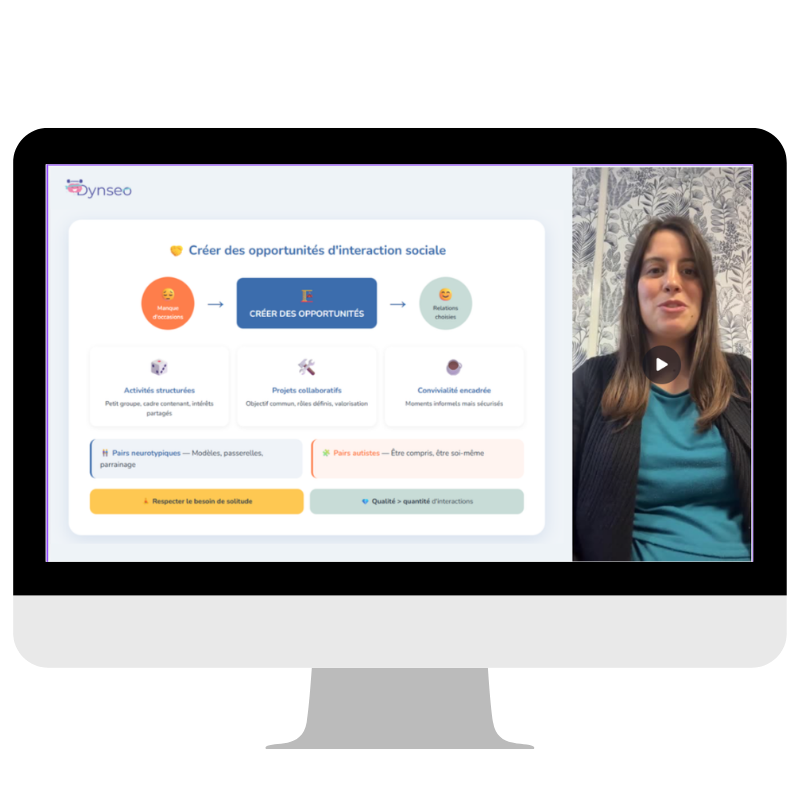
Access the Training →
Module 5 — Adapting Evaluations and Performance Reviews
Evaluating the performance of an ADHD employee poses specific challenges that the training addresses head-on. The variability of performance, the tendency to procrastinate followed by intense productive sprints, and the difficulty in "selling oneself" in an annual review often lead to a systematic under-evaluation of highly capable employees.
💡 Fairly Evaluating an ADHD Employee
Evaluate Results, Not Behaviors: an employee who sometimes arrives late but always delivers on time and with quality deserves a different evaluation than what their "visible" behavior suggests. Distinguish what is different from what is problematic.
Send Interview Questions in Advance: in writing, several days before the meeting. Formulate concrete and factual questions rather than abstract and retrospective ones.
Do Not Confuse Start-up Speed with Quality: an ADHD employee may take longer to initiate a task while delivering an excellent result once underway. Evaluate the deliverable, not the process.
Module 6 — What the Law Requires from the Employer
The training also covers the legal aspects — often overlooked — of the employer's obligations towards a recognized disabled worker with ADHD. This module provides HR directors and managers with the necessary legal foundations to act in compliance and avoid risks of direct or indirect discrimination.
⚖️ ADHD and legal obligations: key points
ADHD may entitle one to RQTH: when the disorder significantly impacts the ability to perform a professional activity, a Recognition of the Quality of Disabled Worker may be granted by the MDPH. The process is strictly voluntary — the employer cannot demand or suggest it in a directive manner.
The obligation of reasonable accommodation: as soon as an employee declares their disability, the employer is legally required to seek and implement reasonable accommodations. Refusing to do so may constitute indirect discrimination subject to penalties.
ADHD accommodations are rarely costly: written briefs, concentration blocks, partial time flexibility, visual planning tools — in the vast majority of cases, these adaptations do not represent a "disproportionate burden" in the legal sense.
The 3 ADHD profiles in the workplace: differentiate them to better support
Not all employees with ADHD are alike. The manifestations of the disorder vary significantly according to the predominant profile — and the support strategies differ accordingly. This summary table allows for quick identification of the dominant profile and associated levers.
| Profile | What the manager observes | What is really happening | Priority lever |
|---|---|---|---|
| Inattentive ADHD | Frequent forgetfulness, unfinished tasks, difficulties following long meetings, apparent daydreaming | Deficient working memory, insufficient filtering of distractions, slow cognitive mobilization | Systematic written supports, fine task breakdown, checklist and visual tools |
| Hyperactive-Impulsive ADHD | Interrupts colleagues, speaks without a filter, makes hasty decisions, visible agitation | Difficulties inhibiting responses, need for movement, real cognitive impulsivity | Active roles, frequent breaks, systematic validation before important decisions |
| Mixed ADHD | Highly variable performance "all or nothing", bursts of energy followed by lulls | Combination of both profiles, amplified by the exhaustion of daily social masking | Combined structure + flexibility, identification and valorization of hyperfocus areas |
ADHD masking: the invisible exhaustion that the manager does not see
Like in autism, masking is a central phenomenon in adult ADHD — and it is particularly costly. An adult with ADHD who has learned to function in a neurotypical world has developed sophisticated compensatory strategies: multiple lists and alarms to compensate for deficient working memory, complex organizational rituals to counter poor time management, constant efforts to appear attentive in meetings when the brain is wandering. All of this consumes cognitive resources that are then no longer available for actual work.
« I spend half my energy trying not to seem ADHD. I make lists of my lists. I arrive early to compensate for the times I will be late. And at the end of the day, I am drained — even on days when I have objectively produced little. No one understands why. »
The strengths of the ADHD profile that the company underutilizes
Managing ADHD is not just about managing difficulties. It is also — and perhaps most importantly — about recognizing and leveraging the real strengths of these profiles. Strengths that are often remarkable, and that disappear in an environment that does not recognize them.
Creativity and lateral thinking
The ADHD brain makes unconventional associations — a valuable source of innovation and original problem-solving that neurotypical brains do not consider.
Responsiveness in crisis situations
The adrenaline of real urgency mobilizes the ADHD brain exceptionally. These employees are often brilliant in critical situations that paralyze others.
Intense productivity in hyperfocus
On tasks that correspond to their areas of interest, productivity can be several times higher than average over concentrated periods.
Tolerance for rapid change
Paradoxically, while unprepared change is difficult, dynamic and varied environments may better suit the ADHD profile than monotonous and repetitive environments.
Who is this training for?
The ADHD at work training from DYNSEO has been designed for professionals who supervise employees — or who build the support policies that apply. It is relevant as soon as you work with people, even if no employee with ADHD is formally diagnosed in your team today.
Operational managers
To read behaviors differently, adapt daily practices, and prevent crisis situations before they become irreversible.
HR managers and HR teams
To build a coherent inclusion policy on ADHD, secure evaluation processes, and equip the organization's managers.
Disability referents
To deepen knowledge specifically on ADHD, support RQTH processes, and build suitable accommodation plans.
DEI managers
To integrate ADHD neurodiversity into inclusion strategies — still too often overlooked in DEI policies that focus on other dimensions.
For training that covers the entire neuroatypical spectrum — autism, ADHD, DYS disorders, and HPI — the training Managing a neuroatypical employee offers a complementary panoramic view. And for situations of invisible disability in the broad sense, the training Invisible disability: what the manager needs to know effectively completes this journey.
FAQ — ADHD at work training
Is this training also for people who think they may have ADHD themselves?
The training is designed for managers and HR teams — it adopts the perspective of the supporter. However, many participants discover through it that they themselves exhibit ADHD traits, which can be the starting point for a personal diagnostic process if desired.
How to approach the subject with an employee whom I think has ADHD without a diagnosis?
Never mention ADHD directly — it is not your role. However, you can open a conversation about the observed functional difficulties: "I notice that you have trouble meeting deadlines — is there something in your organization or work environment that is problematic for you?" and propose accommodations based on expressed needs, not on a diagnostic label.
Can ADHD be aggravated by certain professional factors?
Yes, significantly. Chronic stress, lack of sleep, workload overload, very noisy open environments, and poorly structured tasks can all amplify ADHD symptoms. Conversely, a well-structured environment, engaging tasks, and suitable accommodations can significantly reduce the functional impact of the disorder.
Is ADHD training different from DYNSEO's autism training?
Yes. ADHD and autism share some characteristics (they frequently coexist and both involve executive functions), but their mechanisms, manifestations, and support strategies are quite different. DYNSEO offers dedicated training for each profile: ADHD at work and Understanding autism in the workplace.
Is the training fundable via CPF or OPCO?
DYNSEO is Qualiopi certified, which opens up funding possibilities via OPCO depending on your sector of activity. For employees, CPF funding can also be considered. Contact DYNSEO for personalized support on the financial setup suited to your situation.
Can an employee with ADHD really become more productive with the right accommodations?
Absolutely — this is one of the most consistent lessons among managers trained by DYNSEO. Well-supported employees with ADHD often show remarkable performance peaks, creativity above average, and original problem-solving abilities. ADHD is not a glass ceiling — it is a set of unmet needs that prevents the expression of real potential.
Conclusion: recognize to better support, support to better perform
ADHD at work is a reality that 4 to 5% of your employees may be experiencing right now — often without knowing it, often in silent exhaustion, often undervalued and misunderstood. Changing this does not require a managerial revolution. It requires understanding, a few simple and sustainable adjustments, and management that measures real results rather than superficial behaviors.
This is precisely what the training ADHD at work: recognize and support from DYNSEO teaches you to do — with concrete tools, real situations, and a return on investment often visible within the first weeks of application.
🚀 Access the ADHD at work training
Online training · Qualiopi certified · At your own pace · CPF / OPCO funding possible
Access the training now →