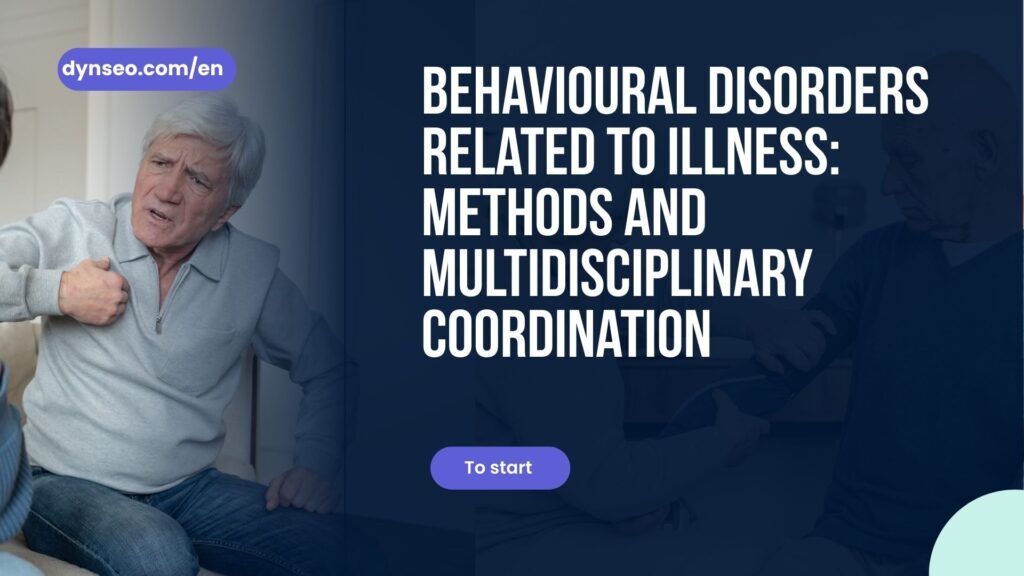
Behavioral management of people with dementia
Agitation, wandering, aggression, apathy — behavioral disorders are present in the majority of people with dementia. They are often more difficult to cope with than cognitive disorders. Understanding their causes allows for prevention and management without resorting to medication.
Dans cet article
La formation associée
1. The most common behavioral disorders
The expression of an unmet need
Agitation in dementia is rarely "without reason" — it is almost always the expression of an unmet need that the person can no longer communicate verbally: physical pain (dementias alter the perception and expression of pain), discomfort (hunger, thirst, cold, need to urinate), fear or anxiety, sensory overload (noise, agitation in the environment), or simply a need for social connection. The first response to agitation is always to seek the cause, not sedation.
Responding to a need for movement
Wandering is not random behavior — it often serves a purpose (looking for someone, going "home", going to the bathroom). Prevention involves identifying the trigger, securing the environment (door alarms, secure walking areas), and maintaining appropriate physical activity during the day that reduces nighttime agitation. Forcing or physically blocking a wandering person generates even more intense agitation.
The reaction to a violation of personal space
Aggression in dementia most often occurs during personal care (bathing, dressing) — situations that involve intense physical proximity, sometimes painful touch or perceived as an intrusion. The person does not understand what is being done to them, cannot anticipate it, and reacts with the only defense they have. Prevention: announce each action before doing it, maintain reassuring eye contact, respect the person's pace.
The most under-treated behavior
Apathy — loss of motivation, initiative, and interest — is the most common behavioral symptom in dementia, but also the least treated because it does not "disturb." However, it is strongly associated with faster cognitive decline and deterioration in quality of life. Activities that provide meaningful stimulation (reminiscence, activities related to past interests) are the most effective interventions against apathy.
2. The ABCDE method: analyze before acting
🔬 ABCDE — Behavioral Analysis Method
A — Antecedents: what happened just before? (care, visit, change of environment, noise)
B — Behavior: precise and objective description of the observed behavior (duration, intensity, form)
C — Consequences: what followed? (did the agitation stop after the care? after being left alone?)
D — Differential Diagnosis: is there a physical cause? pain, urinary infection, constipation, dehydration, medication effect?
E — Environment: triggering factors in the environment — sensory overload, lack of natural light, change of staff
3. Non-Pharmacological Approaches
Respond to the emotion, not the content
The validation method consists of accepting the subjective reality of the person — not correcting them, not "bringing them back to reality," but responding to the underlying emotion. If a person is looking for their deceased mother, "correcting" them generates distress and agitation. Validating them ("You seem worried, do you need someone by your side?") addresses the real need (safety, connection) and reduces agitation. Studies show a 30-40% reduction in agitation with this approach.
The person before the illness
The person-centred approach (Person-Centred Care, Tom Kitwood) places fundamental psychological needs at the heart of care: need for comfort, identity, occupation, inclusion, and attachment. Each behavioral disorder is interpreted as the expression of an unmet need. This approach requires knowing the person's life history, preferences, and personality before the illness — hence the importance of life books and interviews with the family.
🧠 DYNSEO Training — Behavior Management
• Training "Behavioral Disorders" — methods and multidisciplinary coordination
• Training "Refusal of Care" — understand, negotiate, and respect
• Training "Alzheimer's: Understanding the Disease"
• 62 Cognitive Stimulation Tools
FAQ
What behavioral disorders in dementia?
Agitation (50-60%), wandering (20-40%), aggression (30-40%), apathy (50-70%), delusional ideas (30-40%), disinhibition (20-30%). Increase with the progression of the disease.
What is the ABCDE method?
Behavioral analysis tool: Antecedents, Behavior (objective description), Consequences, Differential Diagnosis, Environment. Allows for identifying the cause and planning an appropriate response.
What is Feil's validation?
Responding to the underlying emotion rather than the content. Not correcting the person's "reality" — accepting their subjective reality and responding to the fundamental need expressed. Reduces agitation by 30-40%.
How to manage nighttime wandering?
Identify the cause, secure the environment, maintain a circadian rhythm (light in the morning, activity during the day). Do not physically restrain — this worsens agitation.
When are medications indicated?
Only as a second intention, when non-pharmacological approaches have been tried unsuccessfully AND when the behavior poses a danger. Adverse effects (falls, accelerated decline) warrant caution.
Conclusion: understand to no longer suffer
Behavioral disorders in dementia are exhausting — for caregivers as well as for relatives. But they are not inevitable and irreducible: in the vast majority of cases, they are the expression of an identifiable need and a suffering that deserves to be heard. Systematic analysis of causes, validation of emotions, and the person-centred approach transform the caregiving relationship and significantly reduce the suffering of all parties. DYNSEO trains professionals in these approaches with rigorous methods and practical tools.
Did this content help you? Support DYNSEO 💙
We are a small team of 14 people based in Paris. For 13 years, we have been creating free content to help families, speech therapists, care homes and healthcare professionals.
Your feedback is the only way we know if our work is useful. A Google review helps us reach other families, caregivers and therapists who need it.
One action, 30 seconds: leave us a Google review ⭐⭐⭐⭐⭐. It costs nothing, and it changes everything for us.