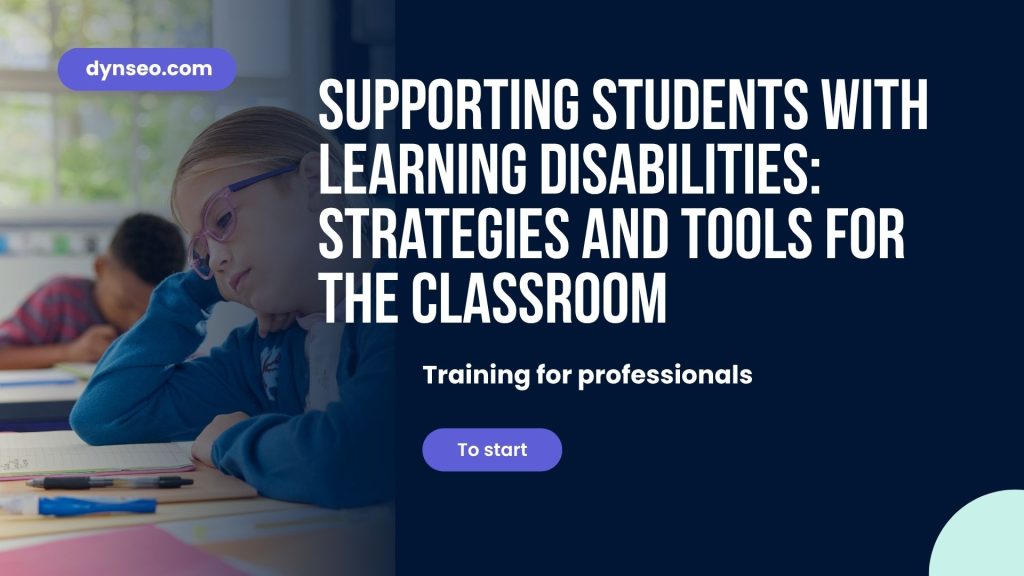
Training: Supporting Students with Learning Disorders — Strategies and Tools for the Classroom
1 in 5 students has a learning disorder. How can we transform our classroom into a space where every student can progress at their own pace? This certified training provides you with concrete strategies and immediately applicable tools.
Dans cet article
La formation associée
Les ressources citées
 Timer Visuel
 Planificateur de Devoirs
 Checklist Cartable
 Tableau de motivation - Outil Formation DYNSEO
Understanding Learning Disorders: Beyond Labels
The term "learning disorders" encompasses very diverse realities, but they all share a fundamental common point: the child is not lazy, nor is he/she unintelligent. His/her brain processes information differently, and certain school tasks that seem "simple" for the majority represent a considerable effort for him/her. Understanding this basic principle transforms the perspective we have on the student — and thus the quality of support we can offer.
Dyslexia
Reading disorder. Slow and laborious decoding, letter reversals, comprehension difficulties. Affects 5-10% of students.
Dysorthography
Spelling disorder, often associated with dyslexia. Difficulties in memorizing and applying spelling rules.
Dyscalculia
Calculation and numerical reasoning disorder. Difficulties with basic concepts: quantity, order, operations.
Dyspraxia
Coordination disorder. Laborious writing, motor difficulties, spatial disorganization. Affects 5-6% of students.
Dysphasia
Oral language disorder. Difficulties in expressing and/or understanding despite normal hearing. Less known but significant.
ADHD
Attention disorder with or without hyperactivity. Difficulty maintaining focus, impulsivity, disorganization. Affects 5% of students.
Comorbidity: When Multiple Disorders Coexist
An often overlooked aspect is that learning disorders frequently coexist: 40 to 60% of children with dyslexia also have dysorthography, 30 to 40% also have ADHD, and the combinations are numerous. This complex reality explains why adaptations too focused on a single disorder may not be sufficient, and why a global approach — like the one taught in DYNSEO training — is essential.
DYNSEO Training on Learning Disorders
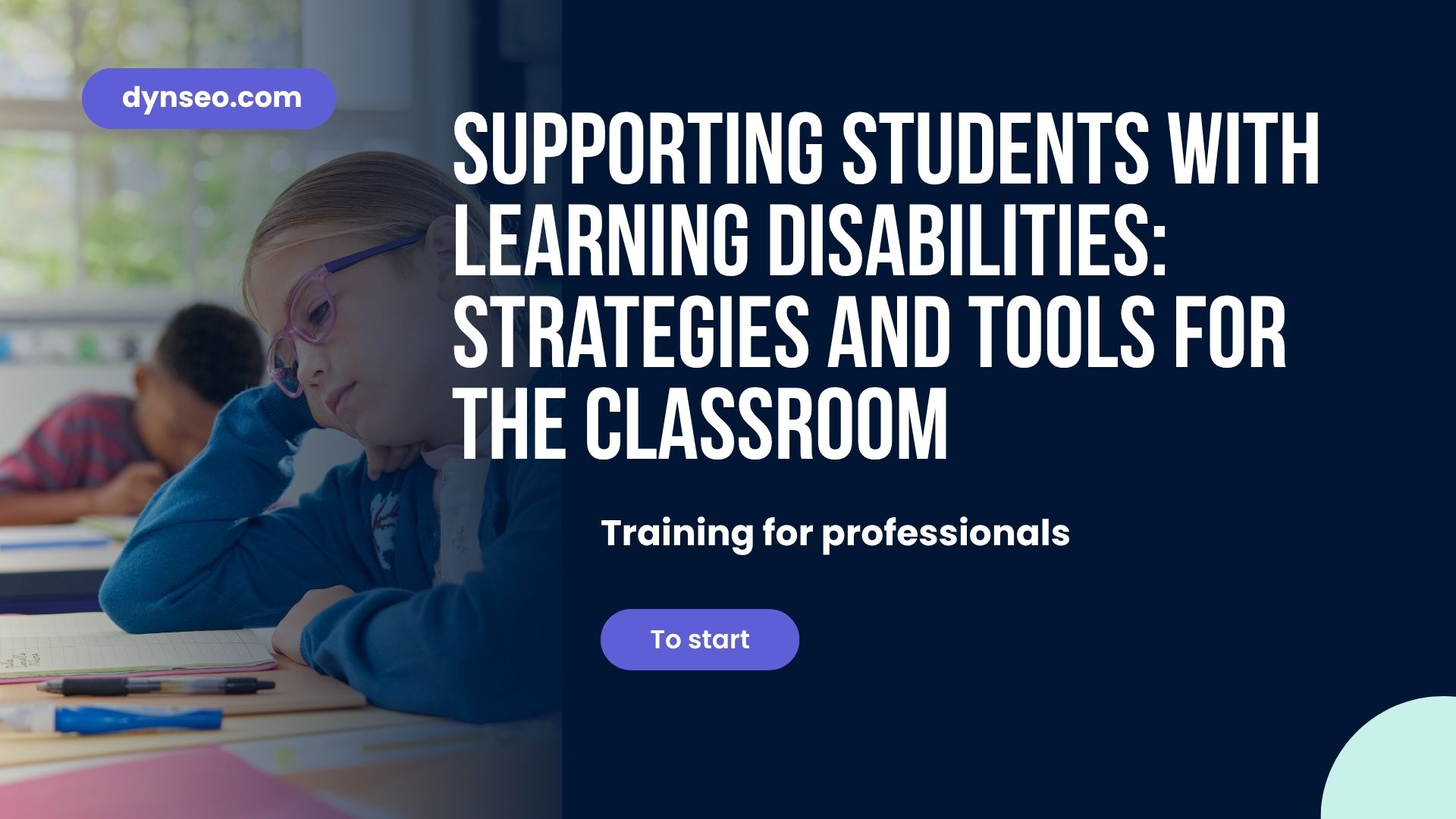
Support students with learning disorders: strategies and tools for the classroom
Complete online training to understand learning disorders and implement effective pedagogical adaptations — in the classroom as well as at home. Accessible to all education professionals and parents.
Discover the training →What you will learn
The training covers the entire spectrum — from neurobiological fundamentals (why these disorders exist, what brain mechanisms are involved) to very concrete practical applications (how to adapt a reading exercise for a dyslexic student, how to manage the class with a student with ADHD, how to collaborate effectively with parents and health professionals).
✔ Training program
- Part 1: Understanding learning disorders — definitions, neurobiology, prevalence, diagnosis, and care pathways
- Part 2: Each disorder in detail — dyslexia, dysorthographia, dyscalculia, dyspraxia, dysphasia, ADHD, and comorbidities
- Part 3: Practical pedagogical adaptations — classroom arrangements, digital tools, visual supports, time management
- Part 4: Institutional devices — PAP, PPS, AESH, role of the school doctor, team coordination
- Part 5: Collaboration with families — how to communicate, support homework, avoid conflicts
- Part 6: DYNSEO tools in the classroom — applications, structuring tools, adapted educational resources
The pedagogical strategies that change everything
Pedagogical differentiation: one principle, a thousand applications
Pedagogical differentiation involves adapting the content, process, product (the way the student demonstrates what they have understood), and environment to the individual needs of students. It is not about "lowering the level" — it is about offering different pathways to the same level of learning.
For a dyslexic student, differentiation may mean: providing a text in OpenDyslexic font or with increased line spacing, allowing text-to-speech, assessing orally rather than in writing. For a student with ADHD: breaking down long instructions into numbered steps, using a visual timer to represent time, seating the student in the front row away from sources of distraction.
Materializing time for brains that do not perceive it
The sense of time is one of the most deficient executive functions in ADHD. ADHD students consistently underestimate the available time and are chronically caught off guard. The DYNSEO Visual Timer makes time visible and concrete by visually displaying the remaining portion of time. It is one of the simplest and most transformative adaptations for ADHD students — and it benefits the whole class.
Structuring tools: externalizing executive functions
For students with ADHD or dyspraxia, executive functions (planning, organization, inhibition) are deficient. The most effective strategy is externalization: replacing what the brain cannot do automatically with visual and structuring tools.
The DYNSEO Weekly Homework Planner helps the student visualize and organize their evening work — reducing evening crises around homework and repeated forgetfulness. The DYNSEO Backpack Checklist structures the checking of the backpack — a seemingly simple task that can be a source of daily stress for a dyspraxic or ADHD student.
Transform exercises into engaging games
For students with learning disorders, the accumulation of academic failures gradually erodes intrinsic motivation. Gamification — introducing game elements into learning activities (points, badges, challenges, visible progression) — can rebuild this motivation by changing the emotional framework. The DYNSEO School Gamification System offers a ready-to-use framework to integrate these dynamics into the classroom.
Dyslexia in the classroom: understanding to better adapt
Dyslexia is the most common and well-documented learning disorder — and one of those for which effective pedagogical adaptations are best established. Dyslexia is not due to a lack of effort or intelligence. It is a difference in neurological functioning in phonological processing — the way the brain decodes the sounds that make up words.
Signs to spot and concrete adaptations
Signs of dyslexia at school: slow and laborious reading, frequent errors (letter inversions b/d, p/q, sound confusions), difficulty reading aloud, reading comprehension sometimes preserved despite decoding difficulties, significant fatigue during reading activities. Effective adaptations: printed texts in an adapted font (Arial, Comic Sans, OpenDyslexic), increased line spacing (1.5 minimum), allowance for text-to-speech, assessments favoring oral responses, extra time for tests.
The COCO app from DYNSEO offers playful language and cognitive stimulation activities for children aged 5 to 10 — a valuable resource to maintain the engagement of young dyslexic students in language activities without the pressure of academic evaluation.
ADHD in the classroom: managing attention and impulsivity
ADHD is both one of the most common disorders in the classroom (5% of students) and one of the most misunderstood. The ADHD student is not "ill-mannered" or "unmotivated" — their brain has a dopaminergic system that functions differently, with a deficit in attention regulation and inhibition that is not voluntary.
Effective accommodations for ADHD students
Research in neuroeducation has identified accommodations whose effectiveness is well documented. The seating arrangement: front row, away from windows and doors (sources of distraction), within the teacher's line of sight. The fragmented instructions: give one instruction at a time, both orally and in writing, numbering the steps. The active breaks: allow for micro-movement breaks (getting a book, walking in the hallway for 2 minutes) that recharge the dopaminergic system.
The DYNSEO Motivation Board allows for visualizing progress and valuing efforts — a particularly effective lever for ADHD students whose motivation heavily relies on frequent positive reinforcement. The COCO app offers cognitive exercises with immediate feedback — ideal for the ADHD profile.
Family-school collaboration: essential and often insufficient
Effective support for students with learning disorders cannot be limited to the classroom. Families play a crucial role — in homework, in communication with professionals, in maintaining the child's self-esteem. But this collaboration is often difficult: families feel judged, teachers feel misunderstood, and the child is caught in the middle.
Building a family-school alliance
The DYNSEO training dedicates an entire module to this collaboration. The keys to an effective alliance: sharing a common vocabulary (what do "PAP", "AESH", "extra time" mean for families discovering these terms?), recognizing respective expertise (the teacher knows the class, the family knows the child), defining common and realistic goals, and establishing regular and structured communication tools.
📱 DYNSEO apps for learning and stimulation
• COCO — children 5-10 years: progressive cognitive stimulation, memory activities, attention and language adapted to DYS profiles
• MY DICTIONARY — alternative communication for students with dysphasia or verbal expression difficulties
• CLINT — for adolescents and adults in cognitive rehabilitation
Institutional devices to know
The training also covers the legal and institutional devices that frame the support for students with learning disorders in France:
| Device | For whom | Content |
|---|---|---|
| PAP (Personalized Support Plan) | Students with recognized learning disorders | Educational adjustments: extra time, digital tools, adapted instructions |
| PPS (Personalized Schooling Project) | Students with disabilities recognized by the MDPH | Comprehensive support including AESH, adapted materials, special orientations |
| AESH (Accompanying Students with Disabilities) | Students with PPS | Human assistance in class — individual or shared support |
| PPRE (Personalized Educational Success Program) | Students with transitional school difficulties | Targeted remediation actions, teacher-family partnership |
Self-esteem: the invisible issue of learning disorders
Among all the consequences of learning disorders, the most significant long-term impact is often the one least visible in school evaluations: the deep damage to self-esteem. A child who hears "you could do better if you tried harder" dozens of times a year ends up believing they are less capable, less intelligent, less worthy of attention than their peers. This belief can accompany them into adulthood and limit their ambitions well beyond their actual abilities.
The training explicitly addresses this dimension — how to preserve and rebuild the self-esteem of students with learning disorders, through language (valuing efforts, not just results), adjustments (avoiding visible difficulties in front of others), and highlighting strengths (each student with DYS disorders has areas of competence to identify and exploit).
Supporting students with learning disorders: strategies and tools for the classroom
Online training at your own pace · Video content + practical resources · Downloadable tools · Certificate of completion · Support available
Sign up for the training →Measuring progress and adapting continuously
Supporting students with learning disorders is not a one-time action — it is a process of continuous adaptation. The DYNSEO cognitive tests allow for the objectification of certain abilities (attention, working memory, processing speed) and tracking their evolution over time. These evaluations do not replace the neuropsychological assessment, but they provide accessible and frequent indicators useful for adapting pedagogical strategies.
Conclusion: every student deserves tailored support
Learning disorders do not disappear with good intentions alone — they require knowledge, appropriate tools, and proven strategies. The DYNSEO training "Supporting students with learning disorders" provides you with exactly that: a solid understanding of the mechanisms at play, concrete adaptations applicable starting tomorrow, and the digital tools to implement them effectively.
Whether you are a teacher, AESH, school health professional, or parent, this training will give you the keys to transform the school experience of every student — replacing the shame of repeated failure with the pride of shared progress.
Join the training now →FAQ
Who is this training for?
Teachers, AESH, school psychologists, speech therapists, psychomotor therapists, and parents wishing to understand and support their child. No prerequisites in neuropsychology are required.
What are the main learning disorders?
Dyslexia (reading), dysorthographia (spelling), dyscalculia (calculation), dyspraxia (coordination), dysphasia (oral language), ADHD (attention). They affect 1 in 5 students and frequently coexist.
How to adapt the classroom for these students?
Digital tools (text-to-speech, visual timer, planner), fragmented instructions, extra time, suitable seating, gamification of learning, highlighting strengths.
Is the PAP mandatory?
No, but it is strongly recommended once a learning disorder is recognized. It formalizes the accommodations and makes them enforceable in case of inspection. Its implementation follows the student from year to year.
Is the training certified?
Yes — DYNSEO is Qualiopi certified. A certificate of completion is issued at the end of the training.
Did this content help you? Support DYNSEO 💙
We are a small team of 14 people based in Paris. For 13 years, we have been creating free content to help families, speech therapists, care homes and healthcare professionals.
Your feedback is the only way we know if our work is useful. A Google review helps us reach other families, caregivers and therapists who need it.
One action, 30 seconds: leave us a Google review ⭐⭐⭐⭐⭐. It costs nothing, and it changes everything for us.