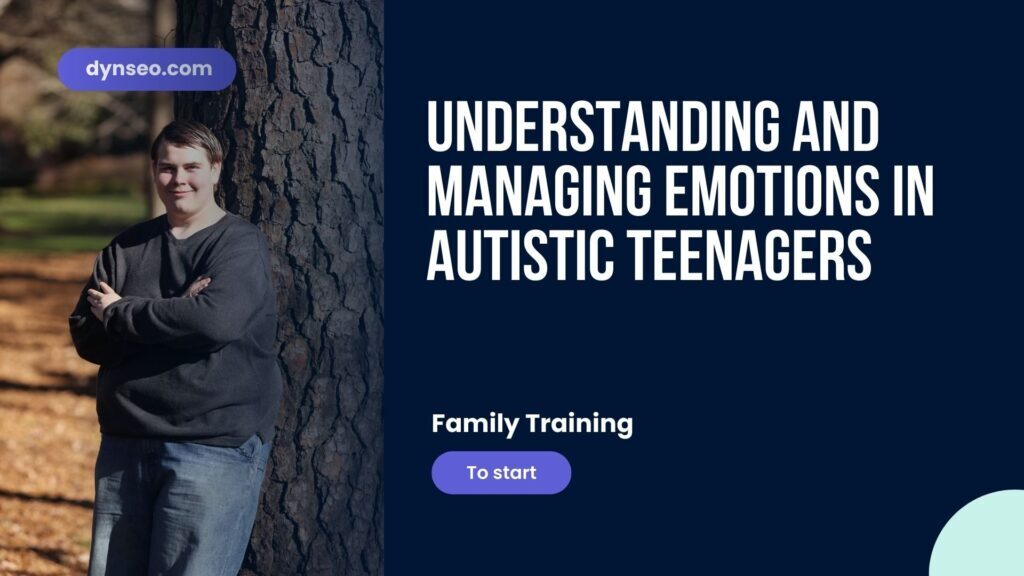
Managing the Emotions of an Autistic Adolescent:
Training, Program, and Practical Tips
Everything you need to know about emotional management specific to autistic adolescence — and discover the DYNSEO certified training to support with the right tools
Dans cet article
La formation associée
Les ressources citées
 Thermomètre des émotions
 Roue des choix - Outils Formation DYNSEO
 Décodeur d'Expressions Faciales
Adolescence is an intense period for everyone — but for an autistic young person, it combines puberty transformations, increasing social demands, and often marked alexithymia. The result: intense emotions, reactions that may seem disproportionate to those around them, and real distress in a world that is changing too quickly. Parents and professionals supporting these adolescents often wonder: what approach to take? What tools to use? How to help without hurting? This guide answers these questions — and presents the DYNSEO training dedicated to this specific challenge.
1. Autistic Adolescence and Emotions: A Complex Equation
1.1 Why Adolescence is Particularly Difficult in Autism
Adolescence brings a series of changes that represent additional challenges for autistic young people: bodily transformations related to puberty (new physical sensations that are difficult to integrate for profiles with sensory hypersensitivity); intensifying social expectations (friendships, couples, groups); increasing academic demands; and normative pressure around "emotional performance" (showing the right emotions at the right time).
🧠 Alexithymia + Adolescence: The Double Difficulty
Alexithymia — present in 50 to 85% of autistic individuals — further complicates the journey through adolescence. While a neurotypical adolescent can say "I am in love, jealous, disappointed," the alexithymic autistic adolescent feels intense physical sensations without being able to name, understand, or communicate them. Emotional outbursts or total withdrawal are then the only available exits.
1.2 The Emotional Specificities of the Autistic Adolescent
🌋 Emotional Intensity
Emotions are often experienced more intensely than by neurotypical peers — extreme joy as well as extreme distress.
⏱️ Recovery Time
After an emotionally intense event, recovery takes much longer. The emotion continues to "spin" long after the situation is resolved.
😶 Emotional Masking
Many autistic adolescents "mask" — hiding their emotional difficulties to meet social expectations. This comes at a huge energy cost.
🔄 Cognitive Rigidity
Faced with a difficult emotional situation, the cognitive flexibility needed to find alternatives is often reduced — hence the importance of tools prepared in advance.
2. Approaches That Work — and Those That Worsen
2.1 What Really Helps
Explicitly Name Emotions Without Judgment
The autistic adolescent does not automatically link their physical sensations to a named emotional state. "You look tense — are you at a 3 on your thermometer?" is more accessible than "How do you feel?" The DYNSEO emotions thermometer is the reference tool for this work.
Prepare Difficult Situations in Advance
Emotional management is worked on outside of crises. Visual social scenarios, rehearsals of potentially stressful situations, strategies decided in advance — all this preventive work reduces the intensity of emotional reactions in real situations.
Respect Recovery Times
After a crisis or intense emotion, do not try to "fix" the situation immediately. Allow the necessary recovery time — sometimes 30 minutes, sometimes several hours. Approach the analysis of the situation AFTER, never during.
Co-construct a Personalized "Emotional Plan"
With the adolescent themselves (not for them), define the strategies that help them according to the level of emotional intensity. This plan belongs to them — they are the author. The DYNSEO emotional regulation toolbox provides the structure for this co-construction.
2.2 What Worsens — Common Mistakes
- Forcing verbal emotional communication during a crisis — impossible and counterproductive
- Minimizing the emotion ("it's not a big deal, everyone has that") — invalidates the experience
- Comparing to neurotypical peers ("other adolescents manage well")
- Removing specific interests as "punishment" — they are essential emotional regulators
- Ignoring masking and assuming that "everything is fine" because the person shows nothing
Managing the Emotions of an Autistic Adolescent
Online training at your own pace for parents and professionals supporting autistic adolescents. Understand the specific emotional mechanisms of ASD in adolescence, master the appropriate management strategies, and learn to use the most effective visual and behavioral tools.
💻 100% Online
⏱️ At Your Own Pace
👥 Families & Professionals
3. DYNSEO Tools for Emotional Management
🌡️ Emotions Thermometer
The central tool for ASD profiles — it transforms the abstraction of emotional state into a concrete visual representation. The adolescent points to their level (1-5); the adult can propose a strategy adapted to that level. The thermometer creates a common language between the adolescent and their surroundings.
🎡 Choice Wheel
For moments of emotional blockage where the adolescent does not know what to do, the choice wheel offers a selection of accessible strategies. Spun or pointed at, it provides a concrete "exit" without requiring cognitive planning effort in a moment of tension.
😊 Facial Expression Decoder
Difficulties in reading others' emotions contribute to social misunderstandings that trigger emotional spirals. The facial expression decoder trains the recognition of others' emotions — an essential skill to reduce social misunderstandings in adolescence.
4. DYNSEO Resources
📚 DYNSEO Resources — Autism and Emotions in Adolescence
MON DICO App
MON DICO helps autistic adolescents with limited language express their emotional states through pictograms.
CLINT App
CLINT maintains cognitive functions related to emotional regulation in autistic adolescents and young adults.
Cognitive Tests
The DYNSEO cognitive tests objectively assess self-regulation functions in autistic adolescents.
COCO App
COCO for autistic children aged 5-10 — preparation for emotional management from a young age.
“My son is 15 years old and is autistic. Since we started using the emotions thermometer together every evening, weekend crises have decreased by half. He can now say "I am at a 3" before it becomes a 5. The DYNSEO training taught me to see these signals.”
— Parent of an autistic adolescent, participant in DYNSEO trainingSupporting the Emotions of Your Autistic Adolescent with the Right Tools
Emotional management of an autistic adolescent is not improvised — it is learned. The DYNSEO training provides you with the theoretical framework, practical strategies, and visual tools to transform repeated crises into moments of gradual self-regulation development.
Access the Qualiopi training →FAQ — Emotions and autistic teenager
Are the emotional outbursts of an autistic teenager normal?
Outbursts (meltdowns or shutdowns) are not "normal" in the sense of being trivial or acceptable without support — but they are predictable and understandable. They signal an overload that exceeds the available regulatory resources. Their frequency and intensity decrease with appropriate support that gradually develops self-regulation skills. If the outbursts are very frequent or dangerous, a consultation with an ADHD specialist is essential.
How to talk about emotions with an autistic teenager who refuses to discuss them?
Do not force direct verbal communication. Use visual aids (thermometers, cards) that allow non-verbal communication about emotions. Create indirect opportunities (shared activities, drawings, music) where emotions can be expressed differently. Some autistic teenagers communicate more easily in writing or by message — offer this alternative. The goal is not a neurotypical emotional conversation — it is an accessible and respectful connection.
Can medications help manage the emotions of an autistic teenager?
Some medications (anxiolytics, antidepressants, mood stabilizers) may be indicated in cases of anxiety or severe emotional dysregulation. But they are never an isolated approach. Medication should always be considered as a complement to behavioral and educational support — never as a substitute. The decision belongs to the specialist doctor (child psychiatrist, neurologist) after a complete evaluation.
How does DYNSEO training help me manage crises on a daily basis?
DYNSEO training "Managing the emotions of an autistic teenager" provides you with concrete and immediately applicable tools: how to use the emotion thermometer as a preventive communication tool; how to build a personalized crisis management plan; how to react during and after a crisis without worsening the situation; and how to work on emotional management outside of crises to prevent them in the long term.
Is the training suitable for professionals working with autistic teenagers in institutions?
Yes — DYNSEO training is designed for both audiences: parents and family caregivers on one side, professionals on the other (educators, nursing assistants, teachers, AVS/AESH, psychologists). The examples and strategies are applicable in both contexts. For professionals, the training is Qualiopi certified and can be funded by OPCO as part of the skills development plan.
Did this content help you? Support DYNSEO 💙
We are a small team of 14 people based in Paris. For 13 years, we have been creating free content to help families, speech therapists, care homes and healthcare professionals.
Your feedback is the only way we know if our work is useful. A Google review helps us reach other families, caregivers and therapists who need it.
One action, 30 seconds: leave us a Google review ⭐⭐⭐⭐⭐. It costs nothing, and it changes everything for us.