--dyn-bleu:#5e5ed7;
--dyn-bleu-fonce:#5268c9;
--dyn-vert:#a9e2e4;
--dyn-jaune:#ffeca7;
--dyn-rose:#e73469;
--dyn-encre:#1d1d2e;
--dyn-gris:#5c5c72;
--dyn-fond:#f6f6fd;
--dyn-ombre:0 6px 24px rgba(29,29,46,.08);
--dyn-ombre-forte:0 12px 34px rgba(94,94,215,.22);
--dyn-radius:18px;
font-family:"Inter","Segoe UI",system-ui,-apple-system,"Helvetica Neue",Arial,sans-serif;
color:var(--dyn-encre);
line-height:1.68;
font-size:clamp(16px,1.05vw + 13px,18px);
max-width:860px;
margin:0 auto;
padding:0 4px;
-webkit-font-smoothing:antialiased;
}
.dbi-art-bc9391 .dyn-article * {box-sizing:border-box;}
.dbi-art-bc9391 .dyn-article h1, .dbi-art-bc9391 .dyn-article h2, .dbi-art-bc9391 .dyn-article h3, .dbi-art-bc9391 .dyn-article h4 {
color:var(--dyn-encre);line-height:1.22;margin:0 0 .5em;font-weight:800;letter-spacing:-.015em;
}
.dbi-art-bc9391 .dyn-article h1 {font-size:clamp(1.65rem,3.4vw,2.35rem);margin-top:.4em;}
.dbi-art-bc9391 .dyn-article h2 {font-size:clamp(1.35rem,2.4vw,1.75rem);margin-top:2.1em;padding-top:.2em;}
.dbi-art-bc9391 .dyn-article h3 {font-size:clamp(1.1rem,1.7vw,1.28rem);margin-top:1.5em;font-weight:700;}
.dbi-art-bc9391 .dyn-article p {margin:0 0 1.05em;}
.dbi-art-bc9391 .dyn-article a {color:var(--dyn-bleu-fonce);text-decoration:underline;text-underline-offset:3px;}
.dbi-art-bc9391 .dyn-article a:hover {color:var(--dyn-rose);}
.dbi-art-bc9391 .dyn-article a:focus-visible {outline:3px solid var(--dyn-bleu);outline-offset:2px;border-radius:4px;}
.dbi-art-bc9391 .dyn-article ul, .dbi-art-bc9391 .dyn-article ol {margin:0 0 1.05em;padding-left:1.25em;}
.dbi-art-bc9391 .dyn-article li {margin-bottom:.45em;}
.dbi-art-bc9391 .dyn-article strong {font-weight:700;}
.dbi-art-bc9391 .dyn-article img {max-width:100%;height:auto;display:block;}
.dbi-art-bc9391 .dyn-pagehead {
position:relative;overflow:hidden;border-radius:var(--dyn-radius);
padding:30px 24px 28px;margin:0 0 1.5em;box-shadow:var(--dyn-ombre);
}
@media(min-width:720px) {
.dbi-art-bc9391 .dyn-pagehead {padding:44px 44px 40px;}
}
.dbi-art-bc9391 .dyn-pagehead::after {
content:"";position:absolute;right:-80px;top:-80px;width:250px;height:250px;border-radius:50%;
background:rgba(255,255,255,.14);pointer-events:none;
}
.dbi-art-bc9391 .dyn-pagehead > * {position:relative;z-index:1;}
.dbi-art-bc9391 .dyn-pagehead--bleu {background:linear-gradient(135deg,var(--dyn-bleu) 0%,var(--dyn-bleu-fonce) 100%);color:#fff;}
.dbi-art-bc9391 .dyn-pagehead--bleu h1 {color:#fff;}
.dbi-art-bc9391 .dyn-pagehead--bleu .dyn-pagehead__cat {color:var(--dyn-jaune);}
.dbi-art-bc9391 .dyn-pagehead--bleu .dyn-pagehead__lead {color:rgba(255,255,255,.93);}
.dbi-art-bc9391 .dyn-pagehead--bleu .dyn-pagehead__meta {color:#fff;}
.dbi-art-bc9391 .dyn-pagehead--bleu .dyn-pagehead__meta li {background:rgba(255,255,255,.18);}
.dbi-art-bc9391 .dyn-pagehead--eau {background:linear-gradient(135deg,var(--dyn-vert) 0%,#cfeff1 100%);color:var(--dyn-encre);}
.dbi-art-bc9391 .dyn-pagehead--eau .dyn-pagehead__cat {color:var(--dyn-rose);}
.dbi-art-bc9391 .dyn-pagehead--eau .dyn-pagehead__lead {color:#3b4a5c;}
.dbi-art-bc9391 .dyn-pagehead--eau .dyn-pagehead__meta li {background:rgba(255,255,255,.62);}
.dbi-art-bc9391 .dyn-pagehead--jaune {background:linear-gradient(135deg,var(--dyn-jaune) 0%,#fff7d6 100%);color:var(--dyn-encre);}
.dbi-art-bc9391 .dyn-pagehead--jaune .dyn-pagehead__cat {color:var(--dyn-rose);}
.dbi-art-bc9391 .dyn-pagehead--jaune .dyn-pagehead__lead {color:#5a5240;}
.dbi-art-bc9391 .dyn-pagehead--jaune .dyn-pagehead__meta li {background:rgba(255,255,255,.68);}
.dbi-art-bc9391 .dyn-pagehead__cat {
display:inline-block;font-size:.76rem;font-weight:800;letter-spacing:.12em;
text-transform:uppercase;margin-bottom:.9em;
}
.dbi-art-bc9391 .dyn-pagehead h1 {margin:0 0 .5em;}
.dbi-art-bc9391 .dyn-pagehead__lead {font-size:clamp(1.02rem,1.4vw,1.16rem);margin:0 0 1.3em;}
.dbi-art-bc9391 .dyn-pagehead__meta {
display:flex;flex-wrap:wrap;gap:8px;list-style:none;padding:0;margin:0;
font-size:.83rem;font-weight:600;
}
.dbi-art-bc9391 .dyn-pagehead__meta li {border-radius:999px;padding:5px 13px;}
.dbi-art-bc9391 .dyn-hero {
background:linear-gradient(135deg,#ffffff 0%,var(--dyn-fond) 100%);
border-radius:var(--dyn-radius);
box-shadow:var(--dyn-ombre);
overflow:hidden;
margin:0 0 2.2em;
}
.dbi-art-bc9391 .dyn-hero__grid {display:grid;grid-template-columns:minmax(0,1fr);}
@media(min-width:720px) {
.dbi-art-bc9391 .dyn-hero__grid {grid-template-columns:42% minmax(0,1fr);}
}
.dbi-art-bc9391 .dyn-hero__media {position:relative;background:var(--dyn-vert);}
.dbi-art-bc9391 .dyn-hero__media img {width:100%;height:100%;object-fit:cover;aspect-ratio:16/9;}
@media(min-width:720px) {
.dbi-art-bc9391 .dyn-hero__media img {aspect-ratio:auto;min-height:100%;}
}
.dbi-art-bc9391 .dyn-hero__eyebrow {
display:inline-block;background:var(--dyn-rose);color:#fff;font-size:.72rem;font-weight:800;
letter-spacing:.09em;text-transform:uppercase;padding:6px 13px;border-radius:999px;margin-bottom:.7em;
}
.dbi-art-bc9391 .dyn-hero__body {padding:22px 22px 24px;}
@media(min-width:720px) {
.dbi-art-bc9391 .dyn-hero__body {padding:28px 30px;}
}
.dbi-art-bc9391 .dyn-hero__title {font-size:clamp(1.12rem,2vw,1.42rem);font-weight:800;margin:0 0 .55em;line-height:1.25;}
.dbi-art-bc9391 .dyn-hero__title a {color:var(--dyn-encre);text-decoration:none;}
.dbi-art-bc9391 .dyn-hero__title a:hover {color:var(--dyn-bleu);}
.dbi-art-bc9391 .dyn-hero__pitch {font-size:.97rem;color:var(--dyn-gris);margin:0 0 1em;}
.dbi-art-bc9391 .dyn-badges {display:flex;flex-wrap:wrap;gap:7px;margin:0 0 1.1em;padding:0;list-style:none;}
.dbi-art-bc9391 .dyn-badges li {
background:#fff;border-radius:999px;padding:5px 12px;font-size:.79rem;font-weight:600;
color:var(--dyn-bleu-fonce);box-shadow:0 2px 8px rgba(29,29,46,.07);
}
.dbi-art-bc9391 .dyn-hero__actions {display:flex;flex-wrap:wrap;gap:10px;align-items:center;}
.dbi-art-bc9391 .dyn-btn {
display:inline-block;background:var(--dyn-bleu);color:#fff !important;text-decoration:none !important;
font-weight:700;padding:13px 26px;border-radius:999px;box-shadow:var(--dyn-ombre-forte);
transition:transform .15s ease,background .15s ease;text-align:center;
}
.dbi-art-bc9391 .dyn-btn:hover {background:var(--dyn-bleu-fonce);transform:translateY(-2px);color:#fff !important;}
.dbi-art-bc9391 .dyn-btn--ghost {
background:#fff;color:var(--dyn-bleu-fonce) !important;box-shadow:0 2px 10px rgba(29,29,46,.09);
}
.dbi-art-bc9391 .dyn-btn--ghost:hover {background:var(--dyn-jaune);color:var(--dyn-encre) !important;}
.dbi-art-bc9391 .dyn-hero__price {font-weight:800;color:var(--dyn-rose);font-size:1.02rem;margin-left:2px;}
.dbi-art-bc9391 .dyn-hero--pastel {background:var(--dom-fond);}
.dbi-art-bc9391 .dyn-pastel {display:grid;grid-template-columns:auto minmax(0,1fr);gap:18px;align-items:start;padding:22px;}
@media(min-width:720px) {
.dbi-art-bc9391 .dyn-pastel {gap:24px;padding:30px 32px;}
}
.dbi-art-bc9391 .dyn-pastel__icone {
flex:0 0 auto;width:74px;height:74px;border-radius:22px;background:#fff;
display:flex;align-items:center;justify-content:center;font-size:34px;line-height:1;
box-shadow:0 4px 14px rgba(29,29,46,.10);
}
@media(min-width:720px) {
.dbi-art-bc9391 .dyn-pastel__icone {width:88px;height:88px;font-size:40px;}
}
.dbi-art-bc9391 .dyn-pastel__domaine {
display:inline-block;background:#fff;border-radius:999px;padding:4px 12px;
font-size:.74rem;font-weight:800;letter-spacing:.08em;text-transform:uppercase;
color:var(--dom-texte);margin-bottom:.6em;
}
.dbi-art-bc9391 .dyn-hero--pastel .dyn-hero__eyebrow {background:var(--dom-texte);}
.dbi-art-bc9391 .dyn-hero--pastel .dyn-btn {background:var(--dom-texte);}
.dbi-art-bc9391 .dyn-hero--pastel .dyn-btn:hover {filter:brightness(.92);}
.dbi-art-bc9391 .dyn-hero--pastel .dyn-btn--ghost {background:#fff;color:var(--dom-texte) !important;}
.dbi-art-bc9391 .dyn-hero--pastel .dyn-badges li {color:var(--dom-texte);}
.dbi-art-bc9391 .dyn-hero--pastel .dyn-hero__price {color:var(--dom-texte);}
.dbi-art-bc9391 .dyn-dom--memoire {--dom-fond:#e9e9fb;--dom-texte:#5268c9;}
.dbi-art-bc9391 .dyn-dom--attention {--dom-fond:#dcf2f4;--dom-texte:#1b7f86;}
.dbi-art-bc9391 .dyn-dom--logique {--dom-fond:#ece9fb;--dom-texte:#5e5ed7;}
.dbi-art-bc9391 .dyn-dom--langage {--dom-fond:#ffe8d9;--dom-texte:#b35a2a;}
.dbi-art-bc9391 .dyn-dom--emotions {--dom-fond:#fdeaf1;--dom-texte:#c0295a;}
.dbi-art-bc9391 .dyn-dom--apprentissage {--dom-fond:#fff3cd;--dom-texte:#8a6a13;}
.dbi-art-bc9391 .dyn-dom--autonomie {--dom-fond:#e4f2ea;--dom-texte:#25795c;}
.dbi-art-bc9391 .dyn-tldr {
background:var(--dyn-vert);border-radius:var(--dyn-radius);padding:22px 24px;margin:0 0 2em;
}
.dbi-art-bc9391 .dyn-tldr h2 {margin:0 0 .5em;font-size:1.1rem;text-transform:uppercase;letter-spacing:.06em;}
.dbi-art-bc9391 .dyn-tldr p {margin-bottom:.8em;}
.dbi-art-bc9391 .dyn-tldr ul {margin-bottom:0;padding-left:1.1em;}
.dbi-art-bc9391 .dyn-toc {background:var(--dyn-fond);border-radius:var(--dyn-radius);padding:20px 24px;margin:0 0 2.2em;}
.dbi-art-bc9391 .dyn-toc p {font-weight:800;margin:0 0 .6em;font-size:.9rem;text-transform:uppercase;letter-spacing:.07em;color:var(--dyn-bleu-fonce);}
.dbi-art-bc9391 .dyn-toc ol {margin:0;padding-left:1.2em;}
.dbi-art-bc9391 .dyn-toc li {margin-bottom:.3em;}
.dbi-art-bc9391 .dyn-cards {display:grid;gap:14px;grid-template-columns:repeat(auto-fit,minmax(230px,1fr));margin:1.4em 0 1.8em;}
.dbi-art-bc9391 .dyn-card {
background:#fff;border-radius:var(--dyn-radius);padding:20px 20px 18px;box-shadow:var(--dyn-ombre);
}
.dbi-art-bc9391 .dyn-card h3 {margin:0 0 .45em;font-size:1.03rem;}
.dbi-art-bc9391 .dyn-card p {margin:0;font-size:.94rem;color:var(--dyn-gris);}
.dbi-art-bc9391 .dyn-card__icon {font-size:1.5rem;display:block;margin-bottom:.35em;line-height:1;}
.dbi-art-bc9391 .dyn-module {
background:#fff;border-radius:var(--dyn-radius);box-shadow:var(--dyn-ombre);
padding:20px 22px;margin:0 0 14px;
}
.dbi-art-bc9391 .dyn-module__head {display:flex;align-items:center;gap:12px;margin-bottom:.7em;}
.dbi-art-bc9391 .dyn-module__num {
flex:0 0 auto;width:38px;height:38px;border-radius:12px;background:var(--dyn-bleu);color:#fff;
display:flex;align-items:center;justify-content:center;font-weight:800;font-size:1rem;
}
.dbi-art-bc9391 .dyn-module__title {margin:0;font-size:1.05rem;font-weight:800;}
.dbi-art-bc9391 .dyn-module ul {margin:0;padding-left:1.15em;font-size:.95rem;}
.dbi-art-bc9391 .dyn-module li::marker {color:var(--dyn-rose);}
.dbi-art-bc9391 .dyn-tablewrap {overflow-x:auto;-webkit-overflow-scrolling:touch;margin:1.3em 0 1.9em;border-radius:var(--dyn-radius);box-shadow:var(--dyn-ombre);background:#fff;}
.dbi-art-bc9391 .dyn-article table {width:100%;border-collapse:collapse;min-width:460px;font-size:.94rem;}
.dbi-art-bc9391 .dyn-article thead th {
background:var(--dyn-bleu);color:#fff;text-align:left;padding:13px 16px;font-weight:700;font-size:.9rem;
}
.dbi-art-bc9391 .dyn-article tbody td {padding:12px 16px;vertical-align:top;border-top:1px solid #ececf7;}
.dbi-art-bc9391 .dyn-article tbody tr:nth-child(even) td {background:#fbfbff;}
.dbi-art-bc9391 .dyn-article th:first-child {border-top-left-radius:var(--dyn-radius);}
.dbi-art-bc9391 .dyn-article th:last-child {border-top-right-radius:var(--dyn-radius);}
.dbi-art-bc9391 .dyn-oui {color:#1a8f6b;font-weight:700;}
.dbi-art-bc9391 .dyn-non {color:var(--dyn-rose);font-weight:700;}
.dbi-art-bc9391 .dyn-note, .dbi-art-bc9391 .dyn-alerte {border-radius:var(--dyn-radius);padding:18px 22px;margin:1.5em 0;}
.dbi-art-bc9391 .dyn-note {background:var(--dyn-jaune);}
.dbi-art-bc9391 .dyn-alerte {background:#fdeef3;}
.dbi-art-bc9391 .dyn-note p:last-child, .dbi-art-bc9391 .dyn-alerte p:last-child {margin-bottom:0;}
.dbi-art-bc9391 .dyn-note strong, .dbi-art-bc9391 .dyn-alerte strong {display:block;margin-bottom:.3em;font-size:1rem;}
.dbi-art-bc9391 .dyn-cta {
background:var(--dyn-bleu);border-radius:var(--dyn-radius);padding:26px 24px;margin:2.2em 0;
color:#fff;text-align:center;box-shadow:var(--dyn-ombre-forte);
}
.dbi-art-bc9391 .dyn-cta h3 {color:#fff;margin:0 0 .4em;font-size:clamp(1.1rem,2vw,1.35rem);}
.dbi-art-bc9391 .dyn-cta p {color:rgba(255,255,255,.92);margin:0 0 1.1em;font-size:.97rem;}
.dbi-art-bc9391 .dyn-cta .dyn-btn {background:#fff;color:var(--dyn-bleu) !important;box-shadow:none;}
.dbi-art-bc9391 .dyn-cta .dyn-btn:hover {background:var(--dyn-jaune);color:var(--dyn-encre) !important;}
.dbi-art-bc9391 .dyn-steps {list-style:none;counter-reset:dyn;padding:0;margin:1.4em 0 1.8em;display:grid;gap:12px;}
.dbi-art-bc9391 .dyn-steps li {
counter-increment:dyn;background:#fff;border-radius:var(--dyn-radius);box-shadow:var(--dyn-ombre);
padding:16px 20px 16px 62px;position:relative;font-size:.96rem;
}
.dbi-art-bc9391 .dyn-steps li::before {
content:counter(dyn);position:absolute;left:18px;top:15px;width:30px;height:30px;border-radius:10px;
background:var(--dyn-jaune);color:var(--dyn-encre);display:flex;align-items:center;justify-content:center;
font-weight:800;font-size:.9rem;
}
.dbi-art-bc9391 .dyn-faq {background:var(--dyn-fond);border-radius:var(--dyn-radius);padding:6px 24px 20px;margin:1.4em 0 0;}
.dbi-art-bc9391 .dyn-faq h3 {font-size:1.05rem;margin-top:1.4em;}
.dbi-art-bc9391 .dyn-faq p {font-size:.96rem;}
.dbi-art-bc9391 .dyn-serie {display:grid;gap:12px;margin:1.4em 0 1.8em;}
.dbi-art-bc9391 .dyn-serie a {
display:block;background:#fff;border-radius:var(--dyn-radius);box-shadow:var(--dyn-ombre);
padding:15px 20px;text-decoration:none;color:var(--dyn-encre);font-weight:600;font-size:.96rem;
transition:transform .15s ease;
}
.dbi-art-bc9391 .dyn-serie a:hover {transform:translateX(4px);color:var(--dyn-bleu);}
.dbi-art-bc9391 .dyn-serie span {display:block;font-size:.82rem;font-weight:600;color:var(--dyn-rose);text-transform:uppercase;letter-spacing:.06em;margin-bottom:2px;}
@media(prefers-reduced-motion:reduce) {
.dbi-art-bc9391 .dyn-article * {transition:none !important;}
}{
"@context": "https://schema.org",
"@graph": [
{
"@type": "Article",
"headline": "Formation « Sclérose en plaques en établissement : comprendre la maladie et adapter sa pratique professionnelle » : programme, contenu et à qui elle s'adresse",
"inLanguage": "fr",
"author": {
"@type": "Organization",
"name": "DYNSEO",
"url": "https://www.dynseo.com/"
},
"publisher": {
"@type": "Organization",
"name": "DYNSEO",
"url": "https://www.dynseo.com/"
},
"image": "https://www.dynseo.com/wp-content/uploads/2026/03/Autisme-en-etablissement-Accompagnement-Global-9-3.jpg"
},
{
"@type": "FAQPage",
"mainEntity": [
{
"@type": "Question",
"name": "Combien de temps dure la formation sur la sclérose en plaques ?",
"acceptedAnswer": {
"@type": "Answer",
"text": "Comptez plusieurs heures au total pour les 8 modules, les 32 leçons et l'évaluation finale. Les leçons étant courtes, la plupart des apprenants étalent le parcours sur une à deux semaines, à raison d'un module par session. Il n'y a aucune obligation de rythme : l'accès reste ouvert après la fin du parcours, et vous pouvez revenir sur n'importe quelle leçon quand une situation concrète se présente sur le terrain. C'est d'ailleurs souvent à ce moment-là qu'une leçon révèle toute son utilité."
}
},
{
"@type": "Question",
"name": "Faut-il des connaissances médicales pour la suivre ?",
"acceptedAnswer": {
"@type": "Answer",
"text": "Non, aucune. La formation est classée « tous niveaux » et le vocabulaire médical est expliqué au fur et à mesure. Elle s'adresse en priorité aux professionnels du soin et de l'accompagnement, mais reste accessible aux proches aidants qui veulent comprendre la maladie. Vous n'avez pas besoin de savoir ce qu'est la spasticité ou le phénomène d'Uhthoff avant de commencer : expliquer clairement ces notions fait justement partie des objectifs des modules."
}
},
{
"@type": "Question",
"name": "Recevrai-je une attestation à la fin ?",
"acceptedAnswer": {
"@type": "Answer",
"text": "Oui. Après l'évaluation finale, une attestation de fin de formation à votre nom est délivrée par DYNSEO, organisme certifié Qualiopi (N° 11757351875). Cette attestation atteste de votre participation au parcours et peut être jointe à votre dossier professionnel ou à votre plan de développement des compétences. Elle ne constitue toutefois ni un diplôme d'État, ni une qualification professionnelle réglementée : elle témoigne d'une démarche de formation continue, pas d'un titre."
}
},
{
"@type": "Question",
"name": "La formation peut-elle être prise en charge financièrement ?",
"acceptedAnswer": {
"@type": "Answer",
"text": "Pour un particulier, la formation est achetée directement, à 20 €. Pour un professionnel ou un établissement, la certification Qualiopi de DYNSEO permet d'envisager une prise en charge dans le cadre du plan de développement des compétences ; les conditions dépendent de l'opérateur de compétences (OPCO) et de la politique interne de l'employeur. Nous vous recommandons de vérifier les modalités auprès de votre service ressources humaines avant l'achat, car aucun montant de prise en charge ne peut être garanti à l'avance."
}
},
{
"@type": "Question",
"name": "Peut-on former toute une équipe avec cette formation ?",
"acceptedAnswer": {
"@type": "Answer",
"text": "Oui. Chaque professionnel s'inscrit avec son propre compte, ce qui permet un suivi de progression individuel tout en partageant un socle commun de connaissances au sein du service. C'est un usage fréquent en établissement : harmoniser les pratiques autour de la SEP, faciliter l'intégration des nouveaux arrivants et disposer d'une référence commune que chacun peut ré-ouvrir. Pour un déploiement à plusieurs, rapprochez-vous de DYNSEO afin d'organiser les inscriptions et de vérifier les modalités adaptées à votre structure."
}
}
]
}
]
}
Formation « Sclérose en plaques en établissement : comprendre la maladie et adapter sa pratique professionnelle » : programme, contenu et à qui elle s'adresse
Cette page décrit en détail la formation Sclérose en plaques en établissement : comprendre la maladie et adapter sa pratique professionnelle, conçue par DYNSEO : ce qu'elle contient module par module, à qui elle est vraiment utile, combien de temps elle demande, ce qu'elle coûte, et — tout aussi important — ce qu'elle ne fait pas. L'objectif est simple : que vous sachiez, avant de vous inscrire, si elle correspond à votre situation, que vous soyez soignant en EHPAD, professionnel d'un foyer d'accueil médicalisé, ou proche d'une personne vivant avec une sclérose en plaques.
Dans cet article
La formation associée
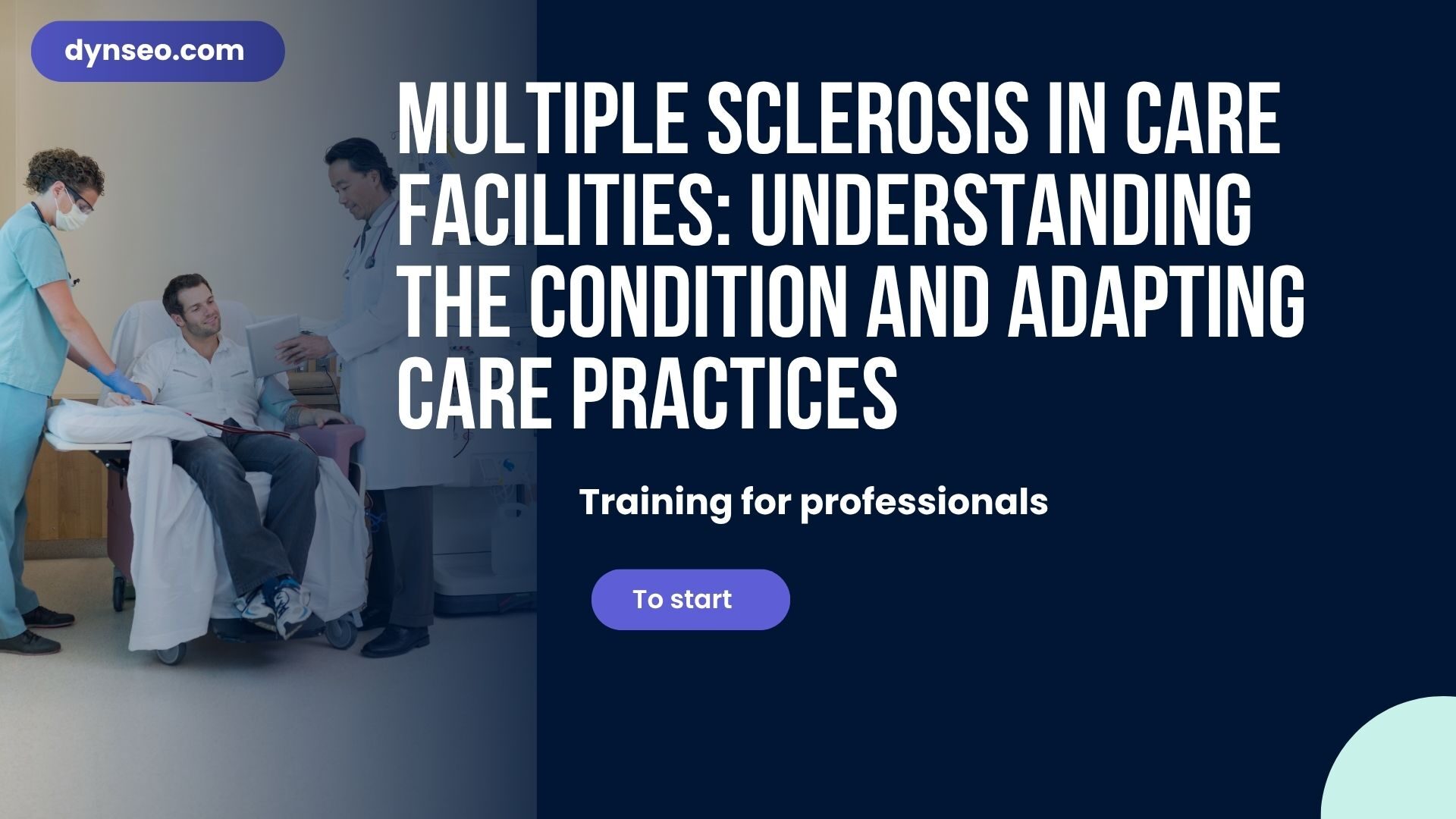
La sclérose en plaques (SEP) n'est pas une maladie que l'on résume en une phrase. Elle évolue par poussées, touche la motricité, la sensibilité, la vision, la fatigue, la mémoire et l'humeur, parfois tout à la fois, parfois par vagues imprévisibles. Accompagner une personne concernée dans un établissement — ou à domicile — demande de comprendre ce qui se joue derrière chaque symptôme, pour cesser d'improviser. C'est exactement ce que cette formation propose : un langage commun et des repères concrets, sans jamais se substituer au corps médical.
L'essentiel en 30 secondes
La formation « Sclérose en plaques en établissement : comprendre la maladie et adapter sa pratique professionnelle » est une formation en ligne de 8 modules et 32 leçons, conçue par DYNSEO pour les professionnels du soin et de l'accompagnement, et accessible aux familles et aidants qui veulent comprendre. Elle coûte 20 €, se suit à son rythme, et se termine par une évaluation finale.
- Pour qui — aides-soignants, AES, IDE, ASH, animateurs, professionnels d'EHPAD, MAS, FAM, SSR et services à domicile, mais aussi proches aidants sans prérequis médical.
- Ce qu'on y apprend — comprendre les mécanismes de la SEP, repérer les symptômes moteurs, sensoriels, cognitifs et émotionnels, adapter les soins, accompagner la fatigue, coordonner l'équipe et soutenir les familles.
- Durée — plusieurs heures au total, en leçons courtes à fractionner librement.
- Accès — immédiat après l'inscription, illimité dans le temps, sur ordinateur, tablette ou téléphone.
- Organisme — DYNSEO, organisme de formation certifié Qualiopi (N° 11757351875), attestation de fin de formation délivrée.
Pourquoi se former à la sclérose en plaques en établissement ?
La sclérose en plaques est une maladie inflammatoire chronique du système nerveux central. Elle abîme la gaine qui protège les fibres nerveuses, ce qui perturbe la transmission des messages entre le cerveau et le reste du corps. Résultat : des symptômes très variés, qui changent d'une personne à l'autre et d'un jour à l'autre. C'est précisément cette variabilité qui déstabilise les équipes : ce qui était vrai hier ne l'est plus forcément aujourd'hui.
Quelques repères, attribués à des sources reconnues, aident à mesurer l'enjeu. Ils ne remplacent pas un diagnostic, mais ils situent la maladie.
| Repère | Ordre de grandeur | Source |
|---|---|---|
| Personnes vivant avec une SEP dans le monde | environ 2,8 millions | MS International Federation, Atlas of MS 2020 |
| Personnes concernées en France | environ 120 000 | Inserm / Fondation ARSEP |
| Place parmi les causes de handicap | 1re cause de handicap non traumatique chez l'adulte jeune | Fondation ARSEP |
| Répartition femmes / hommes | environ 3 femmes pour 1 homme | Inserm |
| Âge le plus fréquent au diagnostic | le plus souvent entre 25 et 35 ans | Inserm / Fondation ARSEP |
Sources : MS International Federation, Atlas of MS 2020 ; Inserm ; Fondation ARSEP. Les chiffres sont des ordres de grandeur destinés à situer la maladie, pas des données individuelles.
Ce que la formation change dans la pratique
La SEP se déclare tôt : une partie des personnes accompagnées en établissement sont donc des adultes jeunes ou d'âge moyen, pas seulement des personnes âgées. Cela bouscule les habitudes d'un service pensé pour un autre public. Un professionnel formé sait faire la différence entre une fatigue liée à la maladie et un manque de motivation, entre une labilité émotionnelle d'origine neurologique et une « mauvaise humeur ». Il cesse d'interpréter chaque comportement comme un choix, et adapte son geste plutôt que de forcer.
Se former à la sclérose en plaques en établissement, ce n'est donc pas accumuler des connaissances théoriques : c'est acquérir des réflexes d'observation et d'ajustement qui protègent la personne accompagnée, sécurisent l'équipe et rassurent les familles. La formation ne remplace ni le neurologue, ni le médecin coordonnateur, ni le kinésithérapeute ou l'orthophoniste. Elle donne le vocabulaire pour les comprendre et les gestes du quotidien que personne n'a le temps d'expliquer.
Aucune formation en ligne ne pose de diagnostic ni ne décide d'un traitement : cela relève exclusivement du médecin. Devant un signe brutal et inhabituel — trouble de la conscience, difficulté respiratoire, chute avec traumatisme, aggravation soudaine — on applique le protocole de l'établissement et l'on contacte sans attendre les services d'urgence de votre pays. En cas de doute sur une poussée ou une complication, on observe, on note et on signale au professionnel de santé référent.
À qui s'adresse cette formation ?
La formation vise d'abord les professionnels qui accompagnent des personnes atteintes de SEP en établissement ou à domicile. Le vocabulaire reste accessible : aucun prérequis médical n'est exigé, ce qui la rend aussi utile aux proches aidants qui veulent comprendre ce que vit la personne. Quatre profils s'y retrouvent particulièrement.
Le soignant de proximité
Aide-soignant, AES, ASH : il est au contact quotidien pour la toilette, les transferts, les repas. Il a besoin de comprendre la fatigue, la spasticité et les troubles cognitifs pour aider sans faire à la place.
L'infirmier et l'encadrant
IDE, cadre de santé, médecin coordonnateur : il coordonne, surveille les traitements et forme son équipe. Il cherche un socle commun de connaissances pour harmoniser les pratiques du service.
The facilitator and the rehabilitation therapist
Facilitator, occupational therapist, psychomotor therapist: he designs adapted activities. He wants to adjust cognitive stimulation and effort to a condition where fatigue reigns.
The caregiver
Spouse, child, brother or sister: he accompanies daily and wants to decode what relates to the condition. No medical knowledge is required to follow the course.
Made for you / not made for you
| Your situation | This training… |
|---|---|
| You are welcoming for the first time a resident with MS and you lack reference points | ✔ Perfectly suitable |
| Your team wants to harmonize its practices around MS | ✔ Suitable — useful as a common foundation for the entire service |
| You are a relative and want to understand the words used by the medical team | ✔ Suitable |
| You are looking for an individualized treatment or rehabilitation protocol | ✘ No — this falls under the responsibility of the doctor and the care team |
| You want a recognized state diploma | ✘ No — this is a certificate of completion, not a diploma |
| You expect personalized individual follow-up | ✘ No — this is a self-directed course, to be followed at your own pace |
The detailed program, module by module
The training consists of 8 modules and 32 lessons, each short and targeted: we progress lesson by lesson, with time to assimilate in between. Here is the actual content, as it is structured on the DYNSEO platform, described by thematic blocks.
Understanding multiple sclerosis
- Neurological mechanisms of MS — what happens in the central nervous system and why the symptoms are so varied.
- The forms of MS — recognize to better support — relapsing-remitting form, progressive forms: understand the trajectory.
- The relapses — recognize, react, support — identify a relapse, adopt the right posture, report at the right time.
- The evolution of the disease over time — anticipate without dramatizing, adjust support to the stages.
Motor and sensory symptoms
- Motor disorders — spasticity, weakness, walking disorders — understand what limits movement to secure mobility.
- Sensory disorders — pain, paresthesia, touch disorders — recognize neuropathic pain and loss of sensitivity.
- Visual and oculomotor disorders — blurred vision, double vision, optic neuritis: adapt the environment.
- Bladder-sphincter and sexual disorders — a topic often silenced, to be approached with respect and discretion.
Fatigue and cognitive disorders
- Fatigue in MS — the most disabling consequence — understand a fatigue that has nothing to do with laziness.
- Adapting support to MS fatigue — break tasks down, alternate effort and rest, respect the signals.
- Cognitive disorders in MS — attention, working memory, processing speed: identify the difficulties.
- Adapting support to cognitive disorders in MS — simple instructions, visual cues, one step at a time.
Troubles émotionnels et psychiatriques
- La dépression dans la SEP — la distinguer du découragement, l'observer, la signaler au professionnel de santé.
- L'anxiété, la labilité émotionnelle et l'euphorie — comprendre l'origine neurologique de certaines réactions.
- L'impact psychologique de la maladie sur l'identité — accompagner la personne dans son rapport à elle-même.
- Soutenir sans envahir — la juste distance en SEP — être présent sans infantiliser ni prendre le contrôle.
Accompagner l'autonomie et les soins
- Les actes de la vie quotidienne — aider sans faire à la place — préserver l'autonomie qui reste, encourager sans forcer.
- Mobilisation, transferts et prévention des chutes — sécuriser les déplacements dans le respect des consignes du kinésithérapeute.
- Soins de la peau et prévention des complications — observer les zones à risque et transmettre à l'infirmier.
- Stimulation cognitive intégrée aux soins — glisser de la stimulation dans les gestes du quotidien, sans surcharge.
Les traitements de la SEP
- Les traitements de fond — comprendre pour mieux accompagner — savoir à quoi ils servent, sans se substituer au médecin.
- Les traitements symptomatiques à connaître — repérer les effets attendus et ceux à signaler.
- Les poussées et leur traitement — comprendre la prise en charge d'une poussée pour mieux accompagner.
- La rééducation — comprendre pour y contribuer — relayer le travail des rééducateurs au quotidien.
Coordination, équipe et familles
- L'équipe pluridisciplinaire autour de la personne SEP — qui fait quoi, et comment s'articulent les rôles.
- Observer, transmettre et alerter en SEP — noter les bons signes, transmettre efficacement, alerter au bon moment.
- Accompagner et soutenir les familles — écouter, informer dans son champ, orienter vers les bons interlocuteurs.
- Situations éthiques spécifiques à la SEP — respect du choix, dignité, juste distance dans les décisions.
Cas pratiques et consolidation
- Protocoles face aux situations les plus fréquentes — mobiliser les bons réflexes dans les cas courants.
- Gérer la chaleur et le phénomène d'Uhthoff — comprendre pourquoi la chaleur aggrave temporairement les symptômes.
- Mises en situation et jeux de rôle — ancrer les acquis par la pratique.
- Évaluation finale et ressources — vérifier l'essentiel avant de recevoir l'attestation, et retrouver les ressources utiles.
Ne parcourez pas tout d'un bloc. Suivez un module à la fois, et testez une seule chose sur le terrain avant de passer au suivant : une consigne raccourcie, un temps de repos glissé dans la toilette, une transmission plus précise. C'est la mise en pratique répétée, pas la quantité d'information, qui transforme durablement l'accompagnement.
Vous voulez voir le détail des 32 leçons ?
Le programme complet est consultable en ligne, et la formation est accessible immédiatement après l'inscription — pour vous ou pour toute votre équipe.
Accéder à la formationLe format et l'organisation
Tout est pensé pour un professionnel qui n'a pas de créneau garanti dans sa semaine, ni de temps de formation bloqué. Pas d'horaire, pas de classe virtuelle, pas de date limite : vous ouvrez la formation quand vous le pouvez, entre deux services ou le soir.
| Critère | Détail |
|---|---|
| Format | 100 % en ligne, leçons courtes |
| Contenu | 8 modules · 32 leçons · évaluation finale |
| Durée estimée | plusieurs heures, à fractionner librement |
| Rythme | Libre, sans date de fin imposée |
| Support | Ordinateur, tablette, smartphone |
| Accès | Immédiat après l'inscription, illimité |
| Niveau requis | Tous niveaux, aucun prérequis médical |
| Validation | Évaluation finale + attestation de fin de formation |
Le point important pour une équipe : l'accès reste ouvert dans le temps. Vous pouvez revenir sur la leçon consacrée à la fatigue le jour où un résident refuse une activité qu'il appréciait, des mois après avoir terminé le parcours. C'est souvent à ce moment-là, face à une situation concrète, que la leçon prend tout son sens. Cet accès illimité fait aussi de la formation un support de référence que l'on ré-ouvre à l'arrivée de chaque nouveau collègue.
Ce que vous saurez faire à la fin
Pas des connaissances théoriques rangées dans un tiroir : des réflexes utilisables dès le lendemain. Voici ce que vous devriez être capable de faire concrètement une fois le parcours terminé.
Décoder les symptômes
Distinguer ce qui relève de la maladie, de la fatigue ou de l'humeur — et cesser d'interpréter chaque comportement comme un choix ou un caprice.
Accompagner la fatigue
Fractionner les efforts, alterner activité et repos, respecter les signaux d'épuisement propres à la SEP sans culpabiliser la personne.
Sécuriser les soins
Réaliser transferts et mobilisations dans le respect des consignes du kinésithérapeute, et prévenir les chutes et les complications.
Soutenir sans envahir
Trouver la juste distance, encourager l'autonomie qui reste, aider sans faire à la place et sans infantiliser.
Observer et transmettre
Repérer les bons signes, les noter avec précision, transmettre à l'équipe et alerter le professionnel de santé au bon moment.
Accompagner les familles
Écouter, informer dans votre champ de compétence, orienter vers les bons interlocuteurs et respecter les repères éthiques.
Ces compétences sont ancrées par les mises en situation et les jeux de rôle du module 8, qui transforment la théorie en gestes concrets. À la fin, l'évaluation permet de vérifier que l'essentiel est acquis.
Qualiopi et attestation : ce que ça change pour vous
DYNSEO est un organisme de formation certifié Qualiopi, enregistré sous le numéro de déclaration d'activité 11757351875. Cette certification porte sur la qualité du processus de formation : clarté des objectifs pédagogiques, adaptation aux publics, qualification des intervenants, recueil des retours et amélioration continue.
Concrètement, pour un professionnel comme pour un établissement : cela signifie que le contenu n'est pas improvisé, qu'il est révisé et que les objectifs sont écrits avant d'être produits. À la fin du parcours, vous recevez une attestation de fin de formation à votre nom. Elle atteste de votre participation — ce n'est ni un diplôme d'État, ni une qualification professionnelle réglementée, et il est important de le dire clairement.
La certification Qualiopi peut permettre d'envisager une prise en charge dans le cadre du plan de développement des compétences. Les conditions dépendent de votre opérateur de compétences (OPCO) et de votre politique interne : elles sont à vérifier au cas par cas auprès de votre service RH avant l'inscription.
Tarif et inscription
La formation est proposée à 20 €. C'est un tarif volontairement accessible : l'objectif est qu'un professionnel puisse se former, et qu'un établissement puisse équiper une équipe entière, sans arbitrage budgétaire lourd. L'inscription se fait en quelques minutes, et l'accès est immédiat.
- Ouvrez la page de la formation et ajoutez-la au panier.
- Créez votre compte apprenant (ou connectez-vous si vous en avez déjà un) et validez le paiement.
- Vous êtes inscrit : la formation apparaît dans votre espace et la première leçon démarre immédiatement.
Aucune date d'entrée, aucune session à attendre. Si vous vous inscrivez un dimanche soir parce que c'est le seul moment calme de votre semaine, vous commencez dans la minute qui suit. Pour former plusieurs professionnels, il suffit d'inscrire chacun : le suivi de progression reste individuel.
Ce que cette formation n'est pas
Autant le dire franchement, cela évite les déceptions et cadre les attentes.
- Ce n'est pas un avis médical. Aucune leçon ne remplace le neurologue, le médecin coordonnateur ou l'équipe de rééducation. Le diagnostic, le pronostic et les décisions de traitement leur appartiennent.
- Ce n'est pas un protocole de soins personnalisé. La formation n'indique ni doses, ni textures, ni gestes de mobilisation à appliquer sans consigne : elle apprend à observer, à signaler et à appliquer les consignes du professionnel de santé.
- Ce n'est pas un accompagnement individuel. Il n'y a pas de suivi personnalisé inclus : c'est un parcours que vous suivez en autonomie, à votre rythme.
- Ce n'est pas un diplôme. L'attestation atteste d'une participation, pas d'une qualification professionnelle réglementée.
- Ce n'est pas exhaustif sur le plan scientifique. Le format court privilégie ce qui est actionnable au quotidien, pas l'exhaustivité de la recherche.
Les outils gratuits et l'application qui la complètent
La formation s'articule avec plusieurs ressources DYNSEO utilisables immédiatement, sans achat supplémentaire. Les outils suivants sont gratuits, imprimables et téléchargeables depuis le catalogue des outils :
- Fiche de suivi de séance — pour noter ce qui a été travaillé et ce qui a fatigué, séance après séance.
- Tableau de suivi des compétences — pour visualiser ce qui revient et ce qui progresse, semaine après semaine.
- Tableau de suivi des progrès (visuel) — pour objectiver des avancées souvent invisibles au jour le jour.
- Carnet de liaison — pour transmettre vos observations aux professionnels et aux familles sans rien oublier.
Côté numérique, la stimulation cognitive évoquée au module 5 peut s'appuyer sur JOE, l'application de stimulation cognitive DYNSEO pensée pour les adultes, avec de nombreux jeux de mémoire, d'attention et de logique et un suivi des résultats — un support adapté à un public jeune ou d'âge moyen, comme l'est souvent une personne atteinte de SEP. Vous pouvez également faire le point avec les tests cognitifs en ligne, et découvrir l'ensemble du catalogue des outils gratuits.
Pour aller plus loin sur la sclérose en plaques en établissement
Cet article présente la formation. Quatre autres articles approfondissent chacun un angle différent, en complément :
Situations du quotidienSclérose en plaques en établissement : 10 situations difficiles et comment y répondre
Boîte à outilsSclérose en plaques en établissement : activités, supports et aménagements concrets à mettre en place
Aides & interlocuteursSclérose en plaques en établissement : à qui s'adresser, quelles aides et comment tenir dans la durée
Le catalogue complet des formations DYNSEO propose également des parcours proches : accompagnement d'autres maladies neurologiques, stimulation cognitive, gestion des troubles du comportement, ou soutien aux aidants.
Questions fréquentes
Combien de temps dure la formation sur la sclérose en plaques ?
Comptez plusieurs heures au total pour les 8 modules, les 32 leçons et l'évaluation finale. Les leçons étant courtes, la plupart des apprenants étalent le parcours sur une à deux semaines, à raison d'un module par session. Il n'y a aucune obligation de rythme : l'accès reste ouvert après la fin du parcours, et vous pouvez revenir sur n'importe quelle leçon quand une situation concrète se présente sur le terrain. C'est d'ailleurs souvent à ce moment-là qu'une leçon révèle toute son utilité.
Faut-il des connaissances médicales pour la suivre ?
Non, aucune. La formation est classée « tous niveaux » et le vocabulaire médical est expliqué au fur et à mesure. Elle s'adresse en priorité aux professionnels du soin et de l'accompagnement, mais reste accessible aux proches aidants qui veulent comprendre la maladie. Vous n'avez pas besoin de savoir ce qu'est la spasticité ou le phénomène d'Uhthoff avant de commencer : expliquer clairement ces notions fait justement partie des objectifs des modules.
Recevrai-je une attestation à la fin ?
Oui. Après l'évaluation finale, une attestation de fin de formation à votre nom est délivrée par DYNSEO, organisme certifié Qualiopi (N° 11757351875). Cette attestation atteste de votre participation au parcours et peut être jointe à votre dossier professionnel ou à votre plan de développement des compétences. Elle ne constitue toutefois ni un diplôme d'État, ni une qualification professionnelle réglementée : elle témoigne d'une démarche de formation continue, pas d'un titre.
La formation peut-elle être prise en charge financièrement ?
Pour un particulier, la formation est achetée directement, à 20 €. Pour un professionnel ou un établissement, la certification Qualiopi de DYNSEO permet d'envisager une prise en charge dans le cadre du plan de développement des compétences ; les conditions dépendent de l'opérateur de compétences (OPCO) et de la politique interne de l'employeur. Nous vous recommandons de vérifier les modalités auprès de votre service ressources humaines avant l'achat, car aucun montant de prise en charge ne peut être garanti à l'avance.
Peut-on former toute une équipe avec cette formation ?
Oui. Chaque professionnel s'inscrit avec son propre compte, ce qui permet un suivi de progression individuel tout en partageant un socle commun de connaissances au sein du service. C'est un usage fréquent en établissement : harmoniser les pratiques autour de la SEP, faciliter l'intégration des nouveaux arrivants et disposer d'une référence commune que chacun peut ré-ouvrir. Pour un déploiement à plusieurs, rapprochez-vous de DYNSEO afin d'organiser les inscriptions et de vérifier les modalités adaptées à votre structure.
Cette formation a une visée pédagogique : elle aide à comprendre la sclérose en plaques et à adapter l'accompagnement. Elle ne remplace jamais l'avis d'un professionnel de santé. Le diagnostic, le pronostic et les traitements relèvent du médecin. En cas de doute sur l'état d'une personne, observez, notez, signalez au professionnel de santé référent, et en cas d'urgence contactez les services d'urgence de votre pays.
Supporting multiple sclerosis in institutions, with clear guidelines
With this multiple sclerosis training in institutions — 8 modules, 32 short lessons, unlimited access — you transform “ I don’t know how to react ” into confident actions, starting this week, for you and your entire team.
Discover the training — 20 €Did this content help you? Support DYNSEO 💙
We are a small team of 14 people based in Paris. For 13 years, we have been creating free content to help families, speech therapists, care homes and healthcare professionals.
Your feedback is the only way we know if our work is useful. A Google review helps us reach other families, caregivers and therapists who need it.
One action, 30 seconds: leave us a Google review ⭐⭐⭐⭐⭐. It costs nothing, and it changes everything for us.