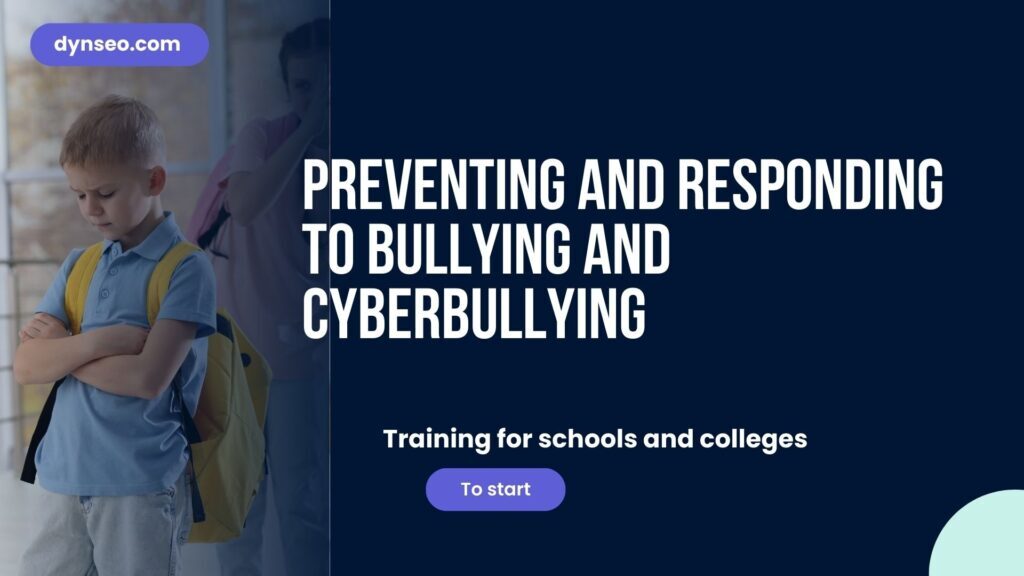
Training “Preventing and acting against school bullying and cyberbullying”: program, content, and who it is for
In a school setting, bullying rarely presents itself as such. It often occurs indirectly, in the form of a student who no longer wants to go to recess, a sudden drop in grades, a “lost” backpack for the third time, or a silence that settles where there used to be words. Three accurate observations, three signals that can be misread if no one on the team has ever learned to decode them. The training “Preventing and acting against school bullying and cyberbullying” precisely addresses this gap: providing education professionals with a clear framework and concrete actions.
This page details this online training DYNSEO: its content module by module, the professions it targets, its actual duration, its price, its deployment methods in teams — and the exact scope it covers. The goal is not to make you an isolated specialist, but to give you reliable benchmarks to identify, prevent, and act, at the right time and in the right way.
The essentials in 30 seconds
100% online training with 5 modules and 20 lessons (including a validation quiz), approximately 6 hours, aimed at teachers and educational staff in primary, middle, and high schools. Price: 90 €. Immediate and unlimited access.
- For whom — teachers, school counselors, educational assistants, school life staff, management, school health professionals, educators, and community workers.
- Objective — to understand, identify, prevent, and act in the face of bullying or cyberbullying situations.
- What is covered — mechanisms of bullying, warning signs, gathering testimonies, collective prevention, intervention protocols, specifics of the digital realm.
- What is not covered — the clinical diagnosis of psychological suffering, which falls under the responsibility of doctors and psychologists.
- Organization — DYNSEO, certified Qualiopi (N° 11757351875), certificate of completion issued.
The problem it solves on the ground
School bullying is recognized by the Ministry of National Education as a serious threat to the well-being and education of students: it is a repeated violence, in a relationship marked by an imbalance of power, which can take a verbal, physical, relational, or digital form. Cyberbullying extends this mechanism beyond the walls of the school: it follows the student into their room, at night, on weekends, without respite. What makes these situations so difficult to address is not their rarity: it is that they resemble, from a distance, something else.
| What is observed in class | Frequent interpretation | What it sometimes concerns |
|---|---|---|
| A student stays alone at every break | Shyness, solitary character | Exclusion organized by the group |
| Their results drop suddenly | Lack of work, laziness | Anxiety and mental load related to bullying |
| They arrive late or “forgets” their things | Forgetfulness, disorganization | Avoidance of feared routes or moments |
| They often complain of stomach aches in the morning | School refusal, acting | Somatization of a fear of going to school |
| Laughter erupts when they speak | Class atmosphere, joke | Ritualized humiliation, tolerated by the group |
| They check their phone anxiously | Screen addiction | Cyberbullying ongoing on social networks |
Each line of this table represents, in practice, a moment when a trained adult could have changed the course of events. The training teaches how to move from raw observation to accurate interpretation, and then to measured action. It does not turn the teacher into an investigator or a therapist: it gives them the clarity needed not to let things pass, and the method to react without worsening the situation.
Who it is aimed at
This training targets adults who, on a daily basis, are in contact with students and hold a privileged observation position. It has been designed for primary, middle, and high school, with accessible language and examples transferable to each level.
Teachers
Those who spend the most time with the class and see group dynamics unfold. The training provides them with observation benchmarks and a first response posture.
School life and CPE
At the crossroads of reports, they coordinate the follow-up. The intervention module structures their action in the early hours and over time.
AED and supervisors
Present in informal times — hallways, playground, cafeteria — where bullying often occurs out of the teachers' sight.
School health
Nurses and health personnel who receive somatic complaints: the training helps to connect a recurring symptom to a possible bullying situation, respecting their professional framework.
Management staff
A common foundation for the establishment, which facilitates a coherent response and coordination with official anti-bullying measures.
Educators and interveners
After-school facilitators, educators, associative interveners who accompany the same children at other times of the day.
Made for you / not made for you
| Your situation | This training… |
|---|---|
| You supervise students without ever having been trained in identifying harassment | ✔ Perfectly suitable |
| Your team reacts on a case-by-case basis and you want a common foundation | ✔ Suitable — this is the most common usage |
| You want to know what to do in the first 48 hours of a reported situation | ✔ Suitable — module 4 is dedicated to this |
| You are looking for clinical support for a student's psychological distress | ✘ Rather see a doctor or psychologist: the training guides, it does not heal |
| You are a parent, not an education professional | ✘ Partly — useful for understanding, but the angle remains professional |
| You are looking for a state diploma or a regulated qualification | ✘ No — this is a certificate of completion |
The training program “Preventing and acting against school harassment and cyberbullying”
The course includes 5 modules and 20 lessons, including a final validation quiz. The progression follows a simple and deliberate logic: understand, then identify, then prevent, then act, before addressing the specifics of the digital realm separately. Each lesson is short — about eleven to fifteen minutes — to fit within the actual available time of a teacher's day.
Understanding school harassment — definitions and mechanisms
- What is school harassment? Definition and criteria
- The actors of harassment — victim, perpetrator, witnesses
- Cyberbullying — specifics and new forms
- Reality of the phenomenon and common misconceptions
Identifying — warning signs and classroom observation
- Identifying signals in the victim student
- Observing the dynamics of the class group
- Gathering the student's voice — how and when
- Common detection errors and their consequences
Preventing — building a protective school environment
- The teacher's role in daily prevention
- Recognized collective prevention approaches
- Working with families in advance
- The school culture as a lever for sustainable prevention
Acting — intervention protocols in response to a reported situation
- The first 48 hours — what to do immediately
- Supporting the victim — assistance and follow-up over time
- Managing the perpetrator — without impunity or systematic exclusion
- Working with the class group after a harassment situation
Cyberbullying — specific interventions and digital education
- Documenting and reporting cyberbullying
- Media education and digital citizenship
- The DYNSEO tools to support students in emotional difficulty
- Assessment, self-evaluation, and personal action plan
The gathering of the student's voice (module 2) and the first 48 hours (module 4). The first defuses the most common mistake — asking too many questions, too quickly, in the wrong place — which can silence a child for a long time. The second transforms a moment of panic into a sequence of ordered actions, which protects both the student and the professional.
Give your team a common response to harassment
5 modules, 20 lessons, about 6 hours, unlimited access and a personalized certificate for each professional.
Discover the training — 90 €Format and organization
| Criterion | Detail |
|---|---|
| Format | 100 % online, short video lessons |
| Content | 5 modules · 20 lessons · validation quiz |
| Duration | About 6 hours in total |
| Pace | Free, no imposed end date |
| Support | Computer, tablet, smartphone |
| Access | Immediate after registration, unlimited over time |
| Required level | All levels, no prerequisites |
| Languages | 9 languages, including French, English, German, Spanish, Italian, Dutch, Portuguese |
| Validation | Certificate of completion |
| Price | 90 € per learner |
The asynchronous format addresses a constraint specific to the educational world: it is not possible to free an entire staff room for a whole day. The six hours are divided into sequences of about fifteen minutes, during available times — one hour of office hours, a late afternoon slot, a half-day set aside. Everyone progresses at their own pace, revisits a lesson when the situation actually arises in their class, and can find a specific point at any time thanks to unlimited access.
The final quiz is not a trick exam: it serves as active recall, to ensure that the essential benchmarks are in place before issuing the certificate. It is also a useful tool in team meetings, to establish a common vocabulary and a shared understanding of priorities.
What you will be able to do by the end
Identify warning signs
Distinguish between a temporary behavior and a concerning pattern of indicators, both in the victim and in the group-class dynamic.
Gather a student's voice
Know when, where, and how to approach a child, with the right words, without rushing them or promising the impossible.
Prevent on a daily basis
Establish habits in your class and in the institution that make harassment less likely and speaking up easier.
Act in the first hours
Carry out a sequence of ordered actions in response to a reported situation: protect the victim, report, document, support.
Address cyberbullying
Document the facts, know which official resources to direct to, and integrate digital education into your practice.
Work with families
Involve parents both before and after, without pitting families against each other, and direct them to the right contacts.
When a student confides, a welcoming phrase is better than a question: “Thank you for telling me, you did well. We will take care of it together.” ❌ To avoid: “Are you sure? Aren't you exaggerating a bit?”, “Don't tell anyone,” or any promise of secrecy that the framework does not allow to keep. For any sign of marked suffering, refer immediately to the doctor or psychologist: the diagnosis is never the teacher's responsibility.
Qualiopi, certification, and funding
DYNSEO is a certified training organization Qualiopi, registered under the activity declaration number 11757351875. The certification focuses on the quality of the process: defined educational objectives, adaptation to the target audiences, qualification of the trainers, collection of feedback, and continuous improvement of the content.
Each learner receives a certificate of completion in their name, to be added to the individual file and usable within the framework of professional development. It is neither a state diploma nor a regulated qualification: it is a certificate of participation in a training action, which reflects a real and traceable time of skill development.
Regarding funding, the Qualiopi certification is the condition that allows an employer to consider coverage under the skills development plan or by their skills operator. The rules, ceilings, and procedures vary according to statuses, branches, and funders: the only reliable approach is to have the quote and program validated by the HR department, the training department, or the funding organization before the purchase. No amount of coverage can be guaranteed in advance.
Deploying training in an establishment
The online format facilitates collective deployment, provided that it is not limited to sending a link to everyone. A shared training only has an effect if it leads to common practices.
- Set an observable objective. For example: to have, by the end of the term, a reporting protocol known to all. Without an objective, the training remains just a box checked.
- Block the time. Two fifteen-minute slots per week scheduled in the timetable are better than a directive of “do it when you can.”
- Designate a harassment referent. A person who advances a module in advance and leads five minutes of recap in the team meeting.
- Ground each module in reality. After module 2, review a case of speech collection together. After module 4, run through the protocol for the first 48 hours.
- Articulate with official devices. Link the training to the establishment's prevention plan and existing national resources, to avoid contradictory responses.
- Plan a follow-up in three months. What has really changed in practices? This distinguishes a useful training from a consumed training.
Several free DYNSEO resources extend this collective work: the emotional regulation toolkit for teens helps equip vulnerable students, and the cognitive restructuring sheet for anxiety supports the assistance of very anxious children, always as a complement — never as a replacement — for follow-up by a health professional.
Price and registration
The training is offered at 90 € per learner. The price is displayed in the visitor's currency according to the country of connection, but the reference value remains the same.
- Open the training page and add it to the cart.
- Create the learner account, or log in, then confirm the payment.
- Access is immediate: the training appears in the learner's space and the first lesson starts right away.
For deployment on multiple positions or a quote for an entire establishment, the contact page of the site allows obtaining a proposal adapted to the number of learners. You can also explore the entire training catalog to build a coherent path throughout the year.
What this training is not
- It does not make any diagnosis. Identifying discomfort is not assessing psychological suffering: the diagnosis and prognosis are the responsibility of the doctor and psychologist. The training teaches to observe, report, and refer, not to treat.
- It does not replace official devices. It articulates with the establishment's protocols and national resources for combating harassment, without substituting them.
- It does not grant any legal power. Disciplinary or judicial follow-ups are the responsibility of the competent authorities; the training helps document and report correctly.
- It is not a diploma. The certificate attests to participation, not to a regulated qualification.
- It is not an in-person training. There is no live trainer or group exchanges: it is an asynchronous video course, complemented by a quiz.
To go further
This article presents the training. Four deep dives extend each facet: a background guide to understand what is at stake, a collection of difficult everyday situations, a concrete toolkit, and a section on professional posture.
Everyday Situations10 difficult situations of school bullying and how to respond
ToolboxActivities, resources, and concrete adjustments to implement
Professional AttitudeTeamwork and skill development in the face of bullying
On the side of free resources, the application COCO offers children aged 5 to 10 games for cognitive stimulation and activities around emotions, useful for gently reopening the dialogue. The complete catalog of tools and the cognitive tests are freely accessible to complement your practice.
Frequently Asked Questions
How long does it take to complete the training ?
Count about six hours in total for the 5 modules and 20 lessons, including validation quizzes. Each lesson lasts about fifteen minutes, and most professionals spread the course over three to six weeks, with two short slots per week. Access remains open afterwards, with no end date : you can return to a specific lesson, such as speech collection or the first 48 hours, at the exact moment a situation arises in your class or establishment.
Does the training provide unlimited access ?
Yes. Once the registration is validated, access is immediate and unlimited in time. The training appears in the learner's space and can be accessed on a computer, tablet, or smartphone as many times as necessary. This lasting access is particularly useful on a subject like harassment : the references are better anchored when you can review a lesson just before acting, rather than memorizing everything at once. The quiz can also be retaken to verify your knowledge away from the first reading.
Do you receive a certificate at the end ?
Each learner receives a personalized training completion certificate, issued by DYNSEO, an organization certified Qualiopi under number 11757351875. This certificate attests to participation in the training action and can be added to the individual professional development file. It is neither a state diploma nor a regulated qualification, but a traceable and recognized document within a quality approach, particularly useful for highlighting the skills development of an educational team.
Can the training be funded ?
This is possible : DYNSEO's Qualiopi certification is generally the required condition for funding under the skills development plan or by a skills operator. The rules, ceilings, and procedures vary according to statuses, branches, and funders, and no amount can be guaranteed in advance. The reliable approach is to have the program and the quote validated by your HR department, your training department, or your funding organization before purchase.
Is there support in case of questions ?
Yes. For any questions about registration, access to the learner's space, or deployment on a larger scale in an establishment, the contact page of the DYNSEO website allows you to reach the team and obtain a tailored quote. Remember that the training equips you for identification and action, but is not intended to replace specialized advice : for any situation involving the immediate safety of a child, contact your country's emergency services and official child protection agencies without delay.
This page describes the content of a training action. Funding conditions and training obligations vary according to statuses and employers : check with your HR department or your funding organization. This content does not constitute medical or legal advice : for any signs of distress in a child, refer to a doctor or psychologist, and in case of immediate danger, contact your country's emergency services.
Move from an isolated reaction to a team response
With the training "Prevent and act against school bullying and cyberbullying", give each professional the guidelines to identify, prevent, and act: 5 modules, 20 lessons, unlimited access, and a personalized certificate.
Discover the training — 90 €Did this content help you? Support DYNSEO 💙
We are a small team of 14 people based in Paris. For 13 years, we have been creating free content to help families, speech therapists, care homes and healthcare professionals.
Your feedback is the only way we know if our work is useful. A Google review helps us reach other families, caregivers and therapists who need it.
One action, 30 seconds: leave us a Google review ⭐⭐⭐⭐⭐. It costs nothing, and it changes everything for us.