
Training Understanding autism in the workplace: program, content and reviews
Everything you need to know about the DYNSEO online training for managers, HR and teams — detailed program, skills acquired, Qualiopi certification.
Why training on autism in the workplace has become essential
For a long time, autism was perceived as a reality external to the business world. A childhood condition, severe, visible. Representations have evolved slowly — and often in the wrong direction, oscillating between the cliché of the asocial genius and the image of the totally dependent person. The reality is infinitely more nuanced, and this is precisely what the DYNSEO training allows to grasp.
The autistic spectrum is vast. It includes people who work, who have higher education, who manage teams — and who experience each workday with a considerable cognitive and social load, often invisible to their colleagues and superiors. These collaborators are often perceived as "difficult," "rigid," "uncommunicative" or "too detail-oriented" — qualifiers that mask a reality that the training allows to decode.
A legal framework that imposes knowledge
The law of February 11, 2005 for equality of rights and opportunities imposes on employers with more than 20 employees an obligation to employ disabled workers (OETH) at a rate of 6% of the workforce. Autism is a condition recognized as a disability — but the RQTH (Recognition of the Quality of Disabled Worker) can only be obtained and maintained in a professional context where the employee feels safe enough to declare their situation. Training managers is not just a humanitarian approach — it is also a lever to improve the declaration rate and fulfill the legal obligations of the company.
🏛️ What the law says about reasonable accommodations
Article L. 5213-6 of the Labor Code requires employers to take appropriate measures to enable a disabled worker to access or retain a job, provided that these measures do not impose a disproportionate burden. These "reasonable accommodations" may include adjustments to the position, the work environment, tools, or communication methods. For autistic employees, many of these accommodations are simple, low-cost — and radically effective. It is essential to know which ones.
Training Presentation: "Understanding Autism in the Workplace"
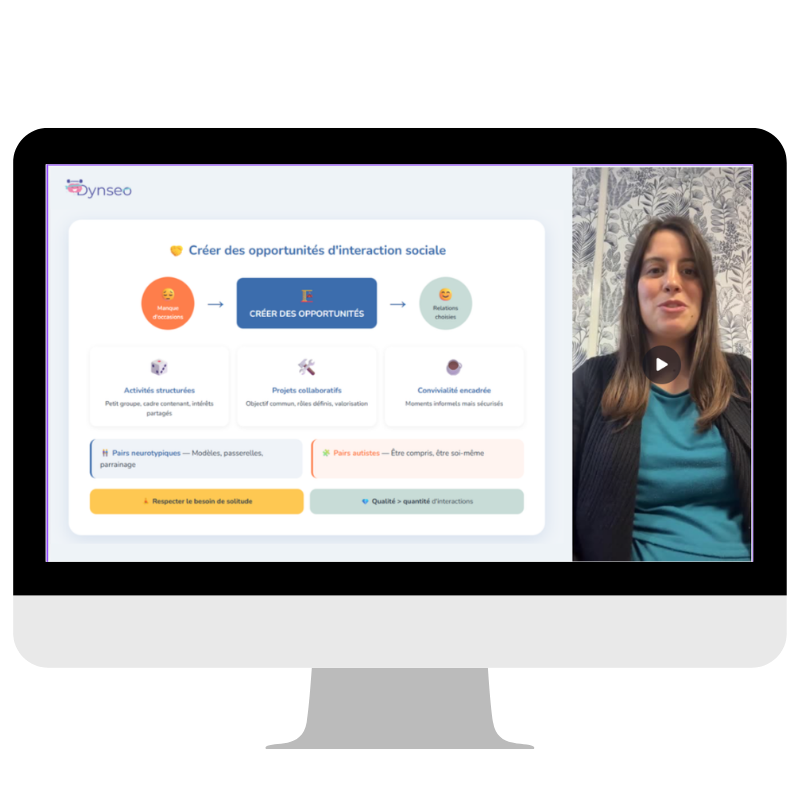
The training Understanding Autism in the Workplace developed by DYNSEO is a certified e-learning course, accessible online and at your own pace. It has been created by specialists in neurodiversity, with a constant focus on anchoring theoretical concepts in real professional situations — the situations that managers truly experience in the workplace.
🎓 Training Understanding Autism in the Workplace
Qualiopi certified training · Online · At your own pace · Aimed at managers, HR directors, disability referents, and teams
Access the training →
Who is this training for?
The training is designed for three main types of audiences. Operational managers who supervise or could supervise an autistic employee — whether they know it or not. HR professionals and disability referents responsible for implementing inclusion policies in their organization. All employees wishing to better understand neurodiversity to improve the collective functioning of their team.
No medical or psychological prerequisites are required. The ideal profile is that of a manager who wants to do better — not an expert who wants to specialize.
Detailed Training Program
Understanding the autistic spectrum: basics and realities
This introductory module allows for overcoming misconceptions about autism. It presents the concept of the spectrum, the history of its definition (from DSM-IV to DSM-5, including the removal of the Asperger diagnosis as a separate entity), the diversity of profiles, and current epidemiological data. The starting point: autism is not a disease but a different way of perceiving and processing information.
Autism at work: what really happens
This module gets to the heart of the professional subject. It describes the specific functioning that impacts the work context: literal communication and difficulties with the implicit, sensory sensitivity (noises, lights, smells), rigidity of routines as a safety mechanism, difficulties with cognitive flexibility, and masking — this exhausting mechanism by which many autistic individuals simulate neurotypical behaviors to "pass" in society.
The most common management mistakes — and how to avoid them
This central module of the training identifies the most common misunderstandings between neurotypical managers and autistic collaborators: the interpretation of silences, implicit feedback, unstructured meetings, last-minute changes, evaluations based on relational "soft skills." For each situation, the module offers a concrete alternative.
Reasonable accommodations and support
This module presents concrete accommodations, categorized by ease of implementation and type of professional situation. It covers the physical environment (workspace, noise-canceling headphones, lighting), communication (written instructions, structured feedback), organization (predictable scheduling, detailed brief before each new task), and social aspects (not imposing informal team activities, adapting onboarding).
Legal framework, RQTH and resources for further exploration
This final module covers the legal framework: 2005 law, employment obligation, reasonable accommodations in the legal sense, role of the occupational physician, RQTH procedure. It also offers additional resources to deepen the topic and useful contacts (associations, AGEFIPH, Cap Emploi).
The autistic spectrum in the workplace: diversity of profiles
One of the most important ideas conveyed by the training — and one of the least understood in companies — is the profoundly heterogeneous nature of the autistic spectrum. Two autistic individuals can have radically different functional profiles: one may be a brilliant engineer with an encyclopedic memory in their field and marked difficulties in informal social interactions; the other may possess fine empathy and extraordinary creativity but be completely exhausted by open spaces and vague action plans.
What is visible — and what is not
In the workplace, the manifestations of autism that are most perceptible to managers are often those that disrupt implicit social codes: not making eye contact during a conversation, taking statements literally, expressing opinions abruptly without perceiving any rudeness, or showing little expressive facial gestures during meetings. These behaviors are often misinterpreted: arrogance, disinterest, bad will.
What is not visible, however, is considerable: the constant effort expended to decode implicit social codes, the sensory overload caused by the work environment (open space is particularly challenging), the fatigue from masking — this process by which many autistic individuals "play" a neurotypical character all day long and collapse when they return home. This invisible aspect explains the vulnerability to burnout.
"I spent my days analyzing every exchange to guess what was really expected of me. I took notes during meetings to decode them in the evening. No one knew I was autistic. Everyone thought I was just 'a bit peculiar'."
Asperger syndrome at work: the most common profile
Even though the DSM-5 (2013) has unified all autistic profiles under a single label of "autism spectrum disorder," the term "Asperger" continues to be used to refer to autistic individuals without intellectual disability or significant language disorder. This is the profile most frequently encountered in the workplace — precisely because it is the most "invisible" and the most compatible with a traditional career path.
Individuals with this profile often exhibit very high skills in their area of expertise (the famous "monotropy" — an intense and lasting focus on areas of interest), great rigor, direct honesty, and remarkable reliability. These are considerable professional assets. Difficulties arise in navigating social ambiguities, unexpected changes in plans, vague feedback, and sensory-overloaded environments.
What an autistic employee experiences on a daily basis
Sensory overload: an invisible barrier to performance
For an autistic person, sensory information is not filtered in the same way as for a neurotypical person. Where a neurotypical brain "dials down" the ambient noises of an open space to focus on the task, the autistic brain may process all these sounds simultaneously — making concentration a very real challenge. The same applies to fluorescent light, perfumes, textures of professional clothing, and unanticipated physical contact.
These sensory overloads are not whims. They are documented neurological differences, which can result in accelerated fatigue, increasing irritability by the end of the day, and a decline in performance that has nothing to do with the employee's motivation or involvement.
💡 Simple arrangements, strong impact
Allowing the use of noise-canceling headphones or earbuds in open spaces is one of the simplest arrangements to implement and one of the most effective for autistic employees — and often, for all employees. It costs nothing organizationally, and can significantly reduce sensory overload and improve concentration.
Masking: the invisible exhaustion
Masking (or "camouflage") refers to the set of conscious and unconscious strategies that an autistic person deploys to appear neurotypical: observing the behaviors of others and replicating them, learning social scripts for recurring situations, forcing eye contact, suppressing self-regulating behaviors (stims) in public. This process is exhausting — and this fatigue accumulates.
An employee who seems to be "doing well" in a meeting but suddenly triggers an apparent burnout overnight is not unpredictable: they are exhausted from months or years of undetected and unsupported masking. Training allows managers to spot early signs of exhaustion in an autistic employee — and to act before a crisis occurs.
The impact on evaluations and career
Professional evaluations are designed to assess technical skills, certainly, but also relational, behavioral, and "cultural" skills that structurally disadvantage autistic people. "Knows how to integrate into the team," "Shows initiative in ambiguous situations," "Communicates proactively" — all criteria that do not measure the quality of work, but conformity to neurotypical codes.
⚠️ Indirect discrimination often unrecognized
Evaluating an autistic employee based on implicit social behavior criteria can constitute indirect discrimination under the law — a practice that, without discriminatory intent, produces an adverse effect on individuals due to their disability. Adapting evaluation criteria to focus on the actual results of work is not a favor to these employees: it is a requirement of fairness and, in some cases, a legal obligation.
Arrangements that change everything
One of the most important messages from DYNSEO training is that the vast majority of effective arrangements for autistic employees are simple, low-cost, and beneficial for the entire team. It is not about creating an exception — it is about improving management practices.
Systematic written instructions
Always confirm orally given instructions in writing. Write precise briefs for each new task, with explicit success criteria.
Predictable planning and anticipation
Notify as early as possible of changes in schedule or mission. Avoid last-minute decisions. Structure weekly agendas.
Adapted workspace
Allow noise-canceling headphones, a quiet space for tasks requiring sustained concentration, sensitivity to lighting and smells.
Direct and structured feedback
Provide precise, factual, and unambiguous feedback. Avoid polite formulations that dilute the message. "It was good" is not helpful — "the report was complete and delivered on time" is.
What companies gain by properly supporting these profiles
The question is not only ethical — it is also economic. Well-supported autistic employees have rare assets: exceptional rigor, outstanding attention to detail, the ability to stay focused on a complex task for long periods, an honesty that can be uncomfortable but valuable, and a creativity that takes unexpected paths.
Companies like SAP, Microsoft, EY, or L'Oréal have developed active recruitment and integration programs for autistic employees — not out of legal obligation, but because these profiles bring perspectives and skills to their teams that traditional recruitment does not capture. Training managers to welcome these profiles also opens the recruitment field to talents that remain largely underemployed today.
DYNSEO complementary training
The training on autism is part of a broader skills development program on neurodiversity and inclusion in the workplace. DYNSEO also offers ADHD training at work, which addresses the specifics of attention deficit disorder with or without hyperactivity in a professional context, Managing a neurodivergent employee training, which provides a cross-sectional view of neurodiversity, and Invisible disability training, to address the 80% of disabilities that are not visible.
All these trainings are accessible from the DYNSEO corporate inclusion training page.
Qualiopi certification: a guarantee of quality and eligibility for funding
DYNSEO trainings are certified Qualiopi, the national quality mark for professional training providers in France. This certification entitles funding from OPCOs (skills operators), the CPF (Personal Training Account), and the companies' skills development plans. In practical terms, this means that your company can finance this training through its training funds, without significant additional expense.
✅ What you have after the training
- Clear understanding of the autistic spectrum and its diversity
- Ability to identify signs of overload and burnout in an autistic employee
- Toolbox of reasonable accommodations tailored to your context
- Knowledge of the legal framework and employer obligations
- Recognized training certificate (Qualiopi certification)
- Resources for further exploration and useful contacts
🎓 Ready to make a difference in your team?
Join the managers and HR leaders who have taken the DYNSEO training on autism in the workplace. Online, at your own pace, Qualiopi certified.
Access the training →Frequently asked questions about the training and autism in the workplace
Is the training suitable for someone who knows nothing about autism?
Yes — this is actually the profile for which it is most useful. No prerequisites are necessary. The training starts from common (often erroneous) representations to gradually deconstruct them, using accessible language and concrete management situations.
How can you tell if a colleague is autistic without asking them directly?
You cannot — and you should not try to diagnose them. What the training teaches you is to identify behaviors that may signal a neurological difference, and to create a work environment that is secure enough for the person to feel free to talk about it if they wish. Diagnosis remains the responsibility of the healthcare professional and the employee.
Will accommodations for autistic people create jealousy within the team?
This is the most common question in training. The answer is twofold: first, confidentiality regarding the reasons for an accommodation is total — no one needs to know why a colleague benefits from a particular organization. Secondly, most accommodations (written instructions, clear feedback, calm environment) improve the work experience for the entire team, not just the person concerned.
Is this training eligible for funding through the CPF or the company's training funds?
Yes. DYNSEO's Qualiopi certification allows for coverage by the OPCOs according to the agreements in your sector, and potentially by the CPF. Contact your OPCO to check the applicable terms for your situation.
What is the duration of the training?
The training is designed to be followed at your own pace, online. The modules can be taken in several sessions according to your availability. It is accessible from any connected device.
Is there follow-up after the training?
The DYNSEO platform offers additional resources accessible after the training, as well as access to other training in the inclusion pathway. For companies wishing for more personalized support, corporate training packages are also available.
Conclusion: training is transforming
Understanding autism in the workplace is not about becoming a clinical expert. It is about learning to look differently — to see behind the behaviors that disturb the mechanisms that explain them, and to propose appropriate responses rather than hasty judgments. It is also about understanding that autistic colleagues often have rare strengths, and that the cost of their support is infinitely lower than that of their loss or burnout.
The DYNSEO training Understanding autism in the workplace offers this change of perspective — in just a few hours, online, certified. It is an investment in management quality, in the company's inclusion policy, and in the well-being of the teams.
Also discover our other trainings on the dedicated page for corporate inclusion trainings.