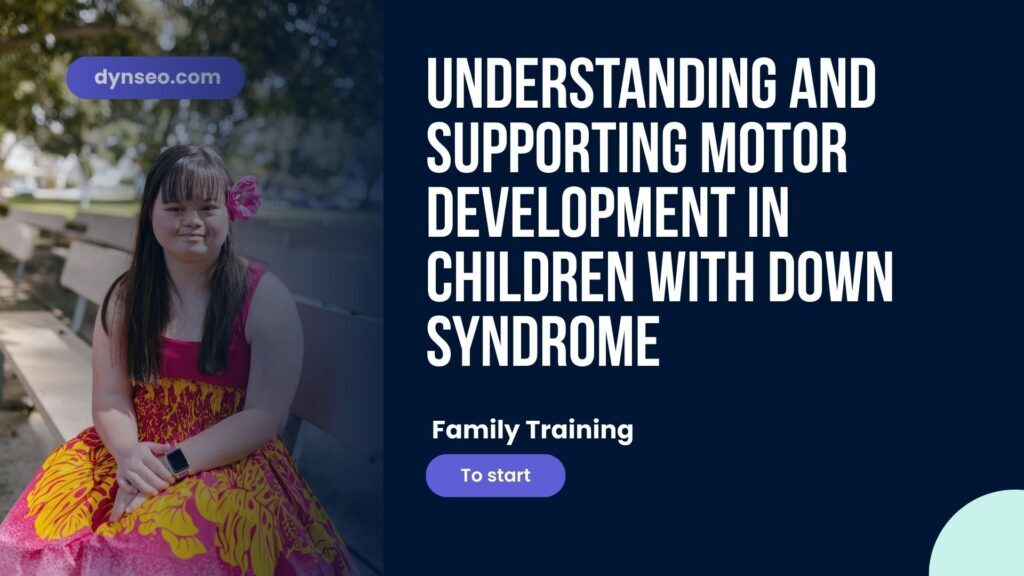
Understanding and stimulating motor development in Down syndrome: 10 difficult everyday situations and how to respond
Getting up from the mat, holding a spoon to the mouth, stepping over a threshold, standing still while putting on a coat: these are tiny gestures, yet they organize the days. Understanding and stimulating motor development in Down syndrome rarely happens in large technical sessions: it takes place in these dozens of small everyday scenes where one wonders, in the moment, what to do — should we help, wait, insist, let go?
In this article
The associated training
The cited resources
 Choice Wheel - DYNSEO Training Tools
Printable notebooks — SCARLETT Collection





Here are ten of these scenes, described as they really happen at home. For each one: what is actually happening on the body and brain side, the spontaneous reaction that worsens the situation — you have probably experienced it, and that's okay — then the step-by-step response that works, with the exact words to say and the gestures to prioritize. Nothing here replaces the physiotherapist, the psychomotor therapist, or the doctor who follows your child: these are guidelines for everyday life, between two appointments.
The essentials in 30 seconds
In children with Down syndrome, most everyday motor difficulties can be explained by well-identified particularities — especially hypotonia (lower muscle tone) and joint hyperlaxity. These are neither laziness nor a lack of will: understanding them completely changes the response to be provided.
- Three universally valid reflexes — secure the environment, lower the demands a notch, allow time and repeat often rather than for long.
- What almost always blocks — doing instead, forcing a gesture, comparing to other children, turning every moment into a rehabilitation session.
- Slowness is not refusal — a gesture costs more energy; the child tires quickly and seeks support.
- Play is the best driver — we progress more by climbing, dancing, and manipulating than by "doing exercises".
- Any new sign should be reported — to the doctor, the physiotherapist, or the psychomotor therapist, without waiting for the next assessment.
1. Sitting, he slumps and slides off his chair
8 a.m., breakfast. You sit him up straight in his chair. Two minutes later, he has slid down, his back rounded, his chin almost in the bowl, one leg folded under him. You straighten him up; he falls back down. You end up sighing: “sit up properly.”
What’s happening: hypotonia — a lower baseline muscle tone — is one of the most consistent characteristics of Down syndrome. Keeping the trunk upright requires constant muscular effort that the child cannot maintain for long. He is not slouching out of indiscipline: he is seeking support to compensate for a back that tires quickly. Poor seating then perpetuates the cycle, as a poorly positioned body works even harder.
- Adjust the seating before correcting the child. Feet should be flat on a stable support — a footrest, a box — and not dangling in the air. A well-positioned pelvis at the back of the seat changes everything.
- Look for the “90-90-90”. Hips, knees, and ankles around a right angle: this is the position that requires the least effort from the trunk. The physiotherapist or occupational therapist can check the precise adjustment of the seat.
- Turn the instruction into a short game. “Shall we do the big one?” while tapping the top of the back provides a bodily reference, where “sit up straight” remains an abstraction.
- Alternate positions. Don’t demand perfect seating throughout the meal: a few minutes of good posture, then allow for some support. It’s repetition that builds tone, not prolonged holding.
❌ To avoid: repeating “sit up straight” without changing the setup, letting feet dangle in the air, or placing the child in a seat that is too big “so he can grow into it.”
2. He stays seated playing and doesn’t stand up
Cousins of the same age are running around. He stays seated on the mat, very busy with his blocks, perfectly happy. You stand him up against the sofa; he immediately sits back down. A little inner voice whispers: “he makes no effort to move forward.”
What’s happening: motor milestones — sitting up, standing up, walking — occur on average later in children with Down syndrome, with significant variations from one child to another. Becoming vertical requires strength, balance, and confidence, three costly things when tone is low and joints are flexible. Staying seated is not giving up: it’s the very logical choice of the position where he best controls his body.
- Create desire rather than obligation. Place the coveted toy a little higher, on the edge of the sofa: the desire to grab it generates the movement much better than an imposed standing up.
- Provide stable supports. A solid coffee table, a heavy piece of furniture: the child pulls himself up and moves along the support at his own pace. Secure the corners and remove anything that tips over.
- Count small victories. Standing for three seconds longer than yesterday is real progress. Track these advancements, for example with an illustrated routine chart that makes the path visible.
- Let the professional guide the progression. The physiotherapist or psychomotor therapist indicates which positions to encourage and which to avoid according to the current stage: follow their instructions rather than inventing exercises.
❌ À éviter : comparer à voix haute avec les autres enfants, forcer la station debout en le maintenant de force, ou utiliser un trotteur suspendu sans l'avis du professionnel qui suit l'enfant.
3. À table, la cuillère lui échappe et tout tombe
Repas du soir. Il plonge la cuillère dans la compote, la porte vers la bouche : à mi-chemin, le poignet tourne, la cuillère se vide sur le bavoir. Trois tentatives, trois échecs. Vous n'y tenez plus, vous prenez la cuillère : « laisse, je vais le faire ».
Ce qui se joue : la motricité fine repose sur la stabilité de l'épaule et du poignet, plus difficile à obtenir quand le tonus est bas et les articulations lâches. Tenir un ustensile, doser la force, orienter le poignet : c'est une coordination complexe qui s'acquiert par la répétition. Chaque fois que vous prenez la cuillère à sa place, le geste réussit — mais l'enfant, lui, ne s'entraîne pas.
- Adaptez l'ustensile. Manche épais, cuillère un peu creuse, bol à bord relevé et à fond antidérapant : le matériel bien choisi transforme un échec en réussite. L'ergothérapeute peut conseiller le modèle adapté.
- Choisissez des textures qui pardonnent. Une purée épaisse ou une compote tient mieux sur la cuillère qu'un aliment liquide. On garde ces textures pour les moments d'apprentissage, sans jamais imposer une consistance décidée seul : le suivi de l'alimentation relève de l'équipe qui connaît l'enfant.
- Accompagnez la main sans la remplacer. Posez votre main sur la sienne pour guider le trajet, puis relâchez dès que le geste part. On aide au démarrage, pas jusqu'à la bouche.
- Fêtez chaque cuillère arrivée. « Tu l'as fait tout seul ! » Le plaisir de réussir est le meilleur moteur pour recommencer.
❌ À éviter : reprendre l'ustensile au premier ratage, essuyer la bouche à chaque bouchée, ou attendre un repas « propre » : à cet âge, le désordre fait partie de l'apprentissage.
4. Il s'assoit toujours en « W », jambes en arrière
Il joue par terre, très concentré. Ses jambes forment un W : les fesses au sol, les genoux devant, les pieds écartés vers l'arrière. Cette position semble le stabiliser parfaitement. Un jour, à la crèche, on vous dit : « il ne faudrait pas qu'il s'assoie comme ça ».
Ce qui se joue : l'assise en W offre une base très large, donc très stable — un vrai soulagement pour un enfant hypotonique qui doit fournir peu d'effort de tronc dans cette position. C'est justement pour cela qu'il l'adopte spontanément. L'inconvénient est qu'elle sollicite beaucoup les hanches et les genoux, déjà souples, et qu'elle limite les rotations du buste utiles au jeu et à l'équilibre. La question de la corriger — et comment — relève du professionnel.
- Proposez une alternative, ne réprimandez pas. Sans commentaire, replacez doucement les jambes devant, en tailleur ou allongées de côté. On remplace une habitude, on ne punit pas une position.
- Rendez les autres assises confortables. Un petit banc, un pouf ferme, un dossier : si l'enfant a un appui, il n'a plus besoin de la base large du W.
- Jouez sur les côtés. Placez les jouets légèrement à droite puis à gauche pour l'inciter à tourner le buste et à s'appuyer sur une main : ces rotations construisent l'équilibre.
- Suivez la consigne de l'équipe. Kinésithérapeute et psychomotricien évaluent l'articulation et vous disent précisément quoi encourager. Appliquez leur repère plutôt qu'une règle générale lue quelque part.
❌ To avoid : scolding the child every time, deciding alone that it is “ forbidden ”, or on the contrary, changing nothing while thinking that “ this is how it is good ”.
5. He falls often, bumps into things, we no longer dare to let him go
He has been walking for a short time. In the living room, he takes off, wobbles, catches himself, then falls on his bottom — or worse, forward, forehead against the furniture. The heart tightens every time. You end up following him step by step, hands outstretched, ready to catch him at all times.
What is at stake : balance requires quick muscle reactions to catch the body that is tipping. With lower tone and flexible ankles, these reactions are slower and falls are more frequent. Falling is part of learning to walk : it is by rebalancing that the body learns. But if you catch the child at every wobble, he never develops these reflexes — and he loses confidence.
There is also your own fear, perfectly legitimate. A child reads a parent's worry very well : a tense face and always outstretched arms send him the message that he is in danger, and this anticipation makes him tense in turn. Learning to contain your own alarm — without letting go of vigilance — is part of the support. We breathe, we remain calm on the surface, we let the child's body do its work on the small imbalances.
- Secure the space rather than the child. Protected furniture corners, rugs on the floor, tipping objects stored : a safe environment allows you to let go of the hand a little without danger.
- Stay close without holding on all the time. Accompany with a step back, ready to intervene in case of a real fall, but let the body catch itself on small imbalances.
- De-dramatize the fall without support. A “ hop, let's get up ! ” calmly is better than a scream of fright that instills fear. Your tone builds his confidence.
- Pay attention to shoes and feet. Good footwear supports the ankle ; ask for advice from the professional who follows the child rather than choosing alone.
❌ To avoid : walking with both hands under the armpits all the time, jumping at every loss of balance, or giving up slightly varied surfaces (grass, thick carpets) which also help with balance.
A new stiffness of the neck, unusual discomfort in turning the head, fatigue while walking that suddenly worsens, regression (the child loses a skill he had mastered), unexplained gait disturbances : these are reasons to consult without waiting for the next assessment. Down syndrome is sometimes accompanied by cervical spine peculiarities (atlanto-axial instability) that must be evaluated by a doctor before certain physical activities. In case of a fall with loss of consciousness or sudden neurological signs, contact the emergency services in your country.
Understanding the “ why ” of each gesture, step by step
The DYNSEO training “ Understanding and stimulating motor development in Down syndrome ” addresses these situations one by one : identifying hypotonia, adapting the environment, encouraging without forcing, working with professionals. 15 short lessons, 100 % online, at your own pace.
Discover the training — 20 €6. Exercises at home turn into conflict
The physiotherapist showed two movements to repeat every day. In the first week, the child follows. In the third week, as soon as he sees you take out the mat, he runs away, stiffens, cries. You hear yourself insisting: “Come on, just one more time, otherwise you won't progress.”
What’s happening: a repeated exercise becomes quickly tedious for a young child, especially if it touches on a difficulty. The body remembers the effort and the boredom, and it anticipates. The refusal is not free opposition: it’s a sign that the form needs to change, not the frequency. For the child, movement is learned through play much more than by “doing the exercises.”
- Hide the exercise in the game. The work on support is integrated into a cushion course; grasping, into a pouring game; balance, into a dance. The targeted movement remains the same, the label “rehabilitation” disappears.
- Shorten and repeat. Three times two minutes during the day is better than a long session endured. Always stop on a success, never on a cry.
- Give a choice, not an exit. “Shall we start with the frogs or the tunnel?” — offering two acceptable options avoids a standoff. A wheel of choices makes this concrete and fun.
- Rely on playful supports. Educational game applications like COCO, designed for children, combine motor challenges and attention; the child moves while playing, without experiencing the exercise as a constraint.
❌ To avoid: alarming predictions about the future, the imposed session when the child is tired, and the full-time rehabilitation role — you are first and foremost their parent, the relationship comes before performance.
7. He can't button, close, hold a pencil
The morning is pressing. He wants to close his coat by himself, struggles with the zipper, can't do it, gets frustrated. You are already late. You close it for him, quickly; he stiffens and refuses to move forward. The morning is starting off badly.
What’s happening: buttoning, pulling up a zipper, holding a pencil require fine motor skills and coordination of both hands, which are slower to develop when hand tone is low. The will is there — the child wants to do it alone — but the gesture is not yet following. Doing it for him solves the morning delay, but confirms to the child that he can't do it.
- Separate learning from urgency. Practice on the weekend, without a watch: that’s when he learns. A rushed morning is not the time for autonomy.
- Break down the gesture. You engage the button, he pushes it; you fit the zipper, he pulls. Let the child have the last step, the most rewarding, then gradually work back to the beginning.
- Facilitate with appropriate materials. Bigger buttons, ring pulls, Velcro to start: succeed first, then complicate. The occupational therapist recommends useful adaptations.
- Strengthen hands through play. Modeling clay, clothespins, stickers, threading beads work fine motor skills much better than a repeated dressing exercise; and the child enjoys it.
❌ To avoid: doing it for him at the first blockage, sighing or showing your annoyance, and introducing writing or the pencil too early: the grip is first built through play.
8. On the stairs, he doesn't place his feet well
You come home, bag in one hand, child in the other. In front of the stairs, he wants to go up by himself. He places both feet on the same step, grips the railing that is too high for him, hesitates, wobbles. You hold your breath at each step.
What is at stake: going up and down stairs requires putting all the body's weight on one leg, while lifting the other. It's a major challenge of balance and strength for a hypotonic child; placing both feet on each step is a logical and safe strategy, not a delay to be forcibly corrected. The alternation of feet will come later, with motor maturity.
- Adapt the grip. A railing at his height, or your hand as a support point, secures the ascent. We go up behind the child, we go down in front of him: this way we are always on the side of the fall.
- Accept the "two feet per step". It's a normal stage. We do not impose the alternation: we let it appear when balance allows.
- Practice on a single step. Going up and down a small step, a threshold, a low curb, while playing: we repeat the gesture in a safe context before the complete staircase.
- Verbalize the movement. “One foot… the other foot… we hold the railing”: naming each step helps the child organize his movement and reassure himself.
❌ To avoid: leaving the child alone on the stairs "to let him learn", rushing him down (the most unstable moment), or carrying him all the time to go faster — the stairs are excellent training when secured.
9. On a walk, he gets tired quickly and asks for the stroller
You set off on foot for a little outing. After a hundred meters, he slows down, sits on the sidewalk, stretches out his arms: “carry, carry.” You thought you would walk to the park. You hesitate between carrying him, getting the stroller out, or insisting that he continues.
What is at stake: walking costs more energy when each step requires extra muscle work to stabilize the body. Fatigue is real; the request to be carried is not a whim, but often a true signal of exhaustion. At the same time, carrying him all the time deprives the child of valuable training. The whole challenge is to find the right balance: walk a little, often, without going to the point of exhaustion that discourages.
A simple marker helps distinguish true exhaustion from mere desire for comfort: observe the quality of the walk, not just the complaints. A child who maintains a steady gait but asks to be carried is mainly seeking comfort; a child whose feet drag, who stumbles, whose torso slumps, is truly at the end of his resources. In the first case, we reignite the game and move forward a little more; in the second, we carry without hesitation. It is by observing your child, day after day, that you refine this marker.
- Set short and visible goals. “We walk to the red bench”: a reachable and concrete goal motivates more than an abstract distance. Then we congratulate the arrival.
- Alternate walking and resting. Bring the stroller as a relay, not as the only means: we walk a section, we rest, we go again. The journey becomes a succession of small successes.
- Make walking fun. Count the steps, follow the lines of the sidewalk, take “giant steps”: play shifts the focus from effort to pleasure.
- Respect true exhaustion. A child who slumps, drags his feet, or gets upset is at the end of his strength: we then carry him without guilt. Insisting teaches nothing, it discourages walking.
❌ To avoid : completely remove the stroller all at once “ to force him ”, push a truly exhausted child, or on the contrary, do everything in the stroller for convenience and deprive him of training.
10. At the park, he stays away from the games
The other children climb the slide, scale the structure, hang on. He stays close to you, in the sandbox, away from the motor games. You would like him to join in, you encourage him a bit : “ go play with the others ”. He comes back to stick to you.
What is happening : climbing and hanging require strength, balance, and confidence — precisely the most costly areas. The child feels he is less capable : staying back protects him from public failure. It is not a lack of desire to play, but a perfectly understandable caution. Forcing him in front of the other children increases his fear instead of calming it.
- Start small and away from the crowd. A game within his reach, at a calm moment in the park, without an audience : the first step of the slide with your hand, and then we go back down. We build confidence away from the eyes.
- Support the body, not just the words. Climb with him, hold him at the start, gradually let go. Feeling your physical presence reassures more than “ don't be afraid ”.
- Value every attempt, even tiny. “ You climbed the first step, well done ! ” The proud look of the parent matters more than the height reached.
- Look for suitable structures. Some parks offer low-height games, more accessible. We first choose what guarantees success, and then we dare to go higher.
❌ To avoid : pushing the child towards the games in front of others, comparing (“ look how they do it, they ”), or giving up outings to the park : it is an irreplaceable training ground, as long as we go at his pace.
The summary table
To print and keep handy in the first weeks : it is in the moment, when everything goes fast, that we forget what we understood in calm.
| Situation | ✅ The reflex to have | ❌ To avoid |
|---|---|---|
| He slips from his chair | Adjust the seat, feet flat, before correcting | Repeating “ sit up straight ”, feet in the void |
| He does not stand up | Create desire, offer stable supports | Forcing standing, comparing to others |
| The spoon slips from his hand | Appropriate utensil, guide then let go of the hand | Taking the spoon back at the first failure |
| Sitting in “ W ” | Offer an alternative, follow the physiotherapist's advice | Scolding, or changing nothing at all |
| He falls often | Secure the space, stay close without holding | Walking with hands under the arms all the time |
| Refusal of exercises | Hide the exercise in play, shorten | Imposed session, worrying predictions |
| Buttons and fasteners | Break down the action, practice outside of urgency | Doing it for him, sighing |
| Stairs | Ramp at his height, accept “ two feet per step ” | Leaving him alone, rushing the descent |
| Fatigue on walks | Short goals, alternate walking and resting | Removing the stroller all at once, forcing |
| Staying back at the park | Start small and away from the crowd, value every attempt | Pushing in front of others, comparing |
Before reacting, ask yourself a single question : does the difficulty come from the body, and not from the will ? In the vast majority of cases, yes. A response that adapts the environment and reduces the requirement a notch — rather than a response that pushes, corrects, or compares — defuses the situation and helps the child progress. We secure, we encourage, we repeat often ; and we let the professionals guide the progression.
Understanding and stimulating motor development on a daily basis: to go further
ToolboxActivities, resources, and concrete arrangements to implement daily
Support & contactsWho to contact, what support is available, and how to maintain it over time
The trainingProgram, content, and who the DYNSEO training on motor development is for
Several free resources accompany the situations described here. The illustrated routines chart makes the steps of the day visible and secures the child; the choices wheel diffuses power struggles by providing two acceptable options; the Down syndrome educational adaptation guide and the adapted communication sheet help rephrase instructions. On the playful stimulation side, the COCO application, designed for children, combines motor challenges and attention in a playful setting. Find everything in the free tools catalog and, to locate your child's support points, browse the cognitive tests offered by DYNSEO.
Frequently Asked Questions
My child walks later than others, is that concerning?
In children with Down syndrome, motor milestones like walking typically occur later, with significant variations from one child to another: this delay is expected and is not, in itself, a bad sign. What matters more is the progression: is the child continuing to acquire new movements, even slowly? Regular follow-up by the physiotherapist, psychomotrician, and doctor helps place your child on their own path. If in doubt, or if you observe stagnation or regression, discuss it with the team that follows them rather than comparing to other children.
Should you force a child who refuses to move?
No, forcing is almost always counterproductive: it instills fear and refusal, and damages the pleasure of movement, which is the true driver of progress. It is better to create desire — place a toy to grab, turn effort into play, offer a choice between two acceptable activities — and reduce the demand a notch to ensure success. A refusal often signals fatigue, fear of failure, or an ill-suited activity. We respect this signal, change the form, shorten; and we always stop on a success rather than on tears.
At what age should physiotherapy or psychomotricity begin?
This is a medical decision made with the team that follows the child; early support is often proposed. The role of the physiotherapist and psychomotrician is to assess tone, balance, and joints, then indicate which positions and movements to encourage according to the current stage. At home, your mission is not to conduct technical sessions, but to apply their instructions and incorporate movement into daily play. Ask them your concrete questions: frequency, useful movements, activities to avoid. They are the ones who adapt the program to your child.
Are motor games like tumbles or rolls safe?
Some activities that strongly engage the neck require caution: Down syndrome is sometimes accompanied by a particularity of the upper cervical spine (atlanto-axial instability) that must be evaluated by a doctor. Before allowing rolls, somersaults, trampolining, or certain sports, seek the opinion of the medical team that follows your child: they will tell you what is suitable for their situation. This does not mean depriving the child of physical activity; on the contrary: moving is essential. It is simply about choosing activities with the professional and reporting any stiffness or new discomfort in the neck.
How to know if a new motor difficulty warrants a consultation?
Quickly report any regression — the child loses a movement they had mastered —, worsening fatigue while walking, new stiffness or discomfort in the neck, limping, or an unexplained change in gait. Describe the observed scene precisely to the doctor, physiotherapist, or psychomotrician: concrete detail helps much more than a "they are regressing." In case of a fall with loss of consciousness or sudden neurological signs, contact your country's emergency services. Between two assessments, it is better to ask one question too many than to let a sign go unnoticed.
This article provides general guidelines for daily life. It does not replace a diagnosis, medical advice, or rehabilitation. Every child is different: for anything related to motor development, posture, nutrition, or physical activity, talk to the doctor, physiotherapist, and psychomotor therapist who follow your child.
Ten situations is a start: daily life has many more
Learning to understand and stimulate motor development in Down syndrome is mainly knowing what to do in these micro-scenes of everyday life: reading what is happening in the body, adapting the environment, encouraging without forcing, and working hand in hand with professionals. The DYNSEO training covers these guidelines step by step: 15 short lessons, 100% online, unlimited access, at your own pace. Certified organization Qualiopi (N° 11757351875), certificate of completion.
Discover the training — 20 €Did this content help you? Support DYNSEO 💙
We are a small team of 14 people based in Paris. For 13 years, we have been creating free content to help families, speech therapists, care homes and healthcare professionals.
Your feedback is the only way we know if our work is useful. A Google review helps us reach other families, caregivers and therapists who need it.
One action, 30 seconds: leave us a Google review ⭐⭐⭐⭐⭐. It costs nothing, and it changes everything for us.