
ADHD training at work: recognize and support — program, content and reviews
Everything you need to know about the DYNSEO online training dedicated to ADHD in the workplace — detailed program, skills acquired, Qualiopi certification.
Adult ADHD in the workplace: a poorly known and underestimated reality
ADHD — Attention Deficit Hyperactivity Disorder — has long remained a "child's" diagnosis. Scientific research over the last 20 years has profoundly revised this view: ADHD persists into adulthood in 50 to 65% of cases, and symptoms transform. The motor hyperactivity of the child gives way to a permanent internal restlessness, impulsivity in decisions, and difficulties in attention regulation that have very concrete impacts on professional life.
The fundamental problem is that the world of work is structurally poorly adapted to the ADHD brain. Noisy open spaces, changing schedules, unstructured meetings, vague deadlines, repetitive tasks without variation — all conditions that exacerbate ADHD symptoms and transform a potentially brilliant employee into someone who "cannot concentrate" and "lacks organization."
A often late diagnosis — and the professional consequences that follow
In France, the average age of diagnosis for adult ADHD exceeds 35 years. This gap means that many people have gone through years of professional difficulties without explanation — accumulating negative evaluations, dismissals, burnouts — before understanding that their brain functioned differently. This journey often generates low self-esteem, chronic anxiety, and distrust of the professional environment, which further complicates support.
🧠 ADHD is not a lack of willpower
It is one of the most important ideas conveyed by DYNSEO training. ADHD is a neurodevelopmental disorder with a documented neurobiological basis — differences in the regulation of dopamine and norepinephrine that affect executive functions. An ADHD employee who "forgets" a deadline or who "starts ten things without finishing one" is not lazy: their brain processes time management, working memory, and attention regulation differently. Managing without understanding this means responding to symptoms with moral judgments — and failing.
Presentation of DYNSEO training: "ADHD at work: recognize and support"
The training ADHD at work: recognize and support developed by DYNSEO is a certified e-learning course, accessible online at your own pace. It has been designed for managers and HR professionals who do not have a medical background but need to understand what ADHD is in a professional context — and especially, how to act appropriately and effectively.
🎓 ADHD at work training: recognize and support
Qualiopi certified training · Online · At your own pace · For managers, HR directors, and disability referents
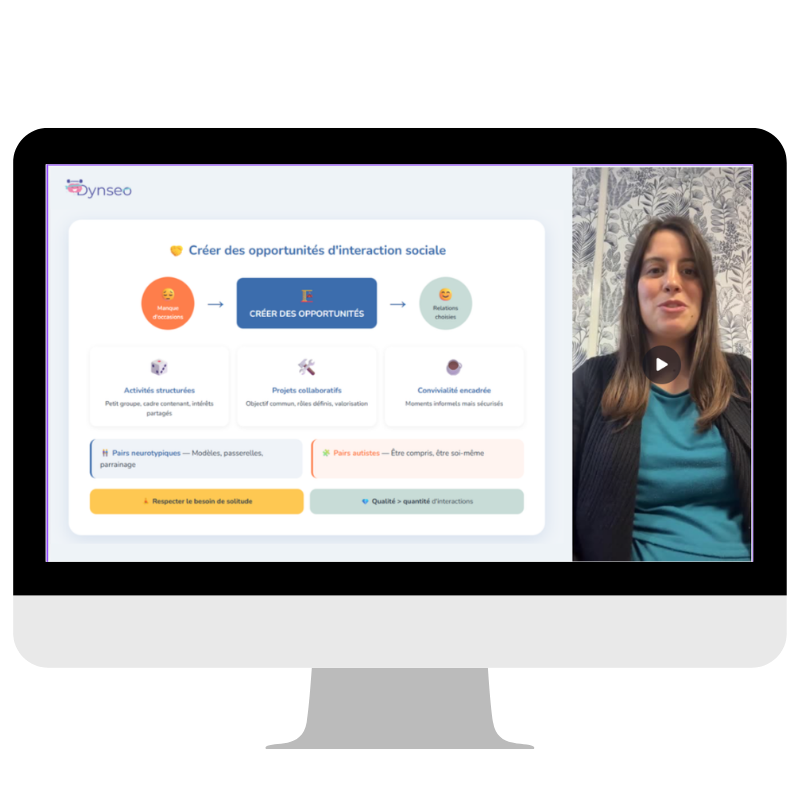
Access the training →
Who is this training for?
The training is primarily aimed at operational managers who supervise or could supervise an ADHD employee, HR professionals and disability referents responsible for inclusion policies, and all employees and executives who wish to better understand neurodiversity in their team. It can also benefit ADHD individuals themselves who want to better understand and articulate their functioning to their employer.
Detailed training program
Adult ADHD: what it really is
This introductory module deconstructs misconceptions and presents an accurate picture of adult ADHD. It covers the neurological bases, the three clinical presentations (inattentive, hyperactive-impulsive, combined), the actual prevalence in the adult population, and the difference between the presentation in children and adults. It sets the essential framework: ADHD is a neurobiological disorder, not a personality or motivation problem.
ADHD at work: recognizing manifestations
This central module precisely describes what ADHD produces in a professional context. Difficulties in time management, impaired working memory, impulsivity in decision-making, hypersensitivity to distractions, procrastination, and paralysis in the face of unstimulating tasks, variability in performance based on interest and urgency. It also presents masking — the compensatory strategies that many ADHD adults deploy to "pass" without revealing their difficulties, and the resulting exhaustion.
What the manager sees — and what is really happening
Practical module describing the most common friction situations between managers and ADHD employees, with a dual reading for each situation — managerial perception and neurological reality. This module is often cited as the most useful by participants: it changes the interpretative framework of behaviors that were previously perceived as lack of willpower.
Concrete adjustments: what really works
This module presents the most effective adjustments, ranked by ease of implementation. Detailed written briefs, protected concentration periods, direct and structured feedback, breaking down long tasks, managing deadlines, adapting meeting modalities. It also addresses hyperfocus — this state of intense concentration that ADHD can produce and which, when well-directed, generates exceptional performance.
Legal framework and resources
ADHD can be recognized as a disability and entitle one to RQTH (Recognition of the Quality of Disabled Worker), legal adjustments, and the OETH quota. This module covers the legal obligations of the employer, the role of the occupational physician, the RQTH procedure, and the available resources (AGEFIPH, specialized associations, professional networks).
The 3 ADHD profiles at work: recognizing the differences
ADHD presents itself in three clinical forms, which can coexist in the same person to varying degrees, and which evolve over time.
| Profile | What is seen in the workplace | What is often misinterpreted |
|---|---|---|
| Inattentive | Frequent forgetfulness, attention errors, difficulties in completing long tasks, seems "absent" | Laziness, lack of interest, incompetence — while attention is genuinely deficient |
| Hyperactive-impulsive | Restlessness, interrupts conversations, impulsive decisions, marked impatience | Arrogance, lack of respect, immature behavior — while impulsivity is neurological |
| Combined (most common) | Mix of the two, with marked variability in performance depending on context and stimulation | Unstable personality, inconsistent performance — while variability is a symptom of ADHD |
Masking and the invisible exhaustion of the ADHD employee
As with autism, masking is a central reality of adult ADHD in the workplace. Since childhood, many ADHD individuals have learned to develop compensatory strategies to hide their difficulties: arriving earlier at the office to finish what others do during normal hours, rereading their emails multiple times to avoid attention errors, frantically noting everything that is said to them to compensate for impaired working memory, putting in significant overtime to deliver on time despite procrastination.
This constant masking is exhausting. It explains why an ADHD employee may seem to "hold it together" for months or years, then suddenly collapse into burnout that appears incomprehensible to those who did not see the continuous effort hidden behind the deliverables.
"I worked twice as hard as my colleagues to produce the same result. Not because I was less competent — but because I was constantly fixing the gaps left by my attention. The diagnosis at 41 explained everything to me. And my manager's understanding after the diagnosis saved my career."
Hyperfocus: the unknown asset of the ADHD profile
Hyperfocus is the state in which an ADHD person can enter when the task is sufficiently stimulating or urgent. In hyperfocus, concentration is total, hours pass without the person noticing, and the quality of the work produced can be exceptional. It is the flip side of attention deficit — and it is one of the most underutilized assets of ADHD employees.
A manager who understands how hyperfocus works can use it wisely: assign high-value projects under conditions that favor this state (real deadline, high stakes, stimulating subject), and adapt the organization to minimize interruptions during these high productivity phases.
💡 Use hyperfocus as a lever
Identify the types of tasks that trigger hyperfocus in your ADHD employee — generally creative tasks, true emergencies, projects with a clear challenge. Creating the conditions for this state to express itself (no interruptions, quiet space or music, real deadline) can transform an "irregular" employee into a key player on high-stakes missions.
Concrete adjustments: what really works
Detailed written briefs
Always confirm oral instructions in writing. Detail deliverables, success criteria, and interim deadlines. ADHD working memory is impaired — writing compensates.
Protected concentration periods
Create blocks of time without meetings or interruptions for tasks requiring sustained concentration. Even 90 minutes a day is enough for a significant productivity gain.
Breaking down large tasks
Long tasks without intermediate milestones are particularly difficult with ADHD. Breaking them down into sub-tasks with interim due dates reduces procrastination.
Frequent and direct feedback
Rare and implicit feedback is particularly harmful. A short and regular check-in (even weekly for 15 minutes) with direct feedback on progress significantly improves performance.
What the law says about supporting ADHD employees
ADHD can be recognized as a disability and lead to RQTH (Recognition of the Quality of Disabled Worker) when it results in significant functional limitations in the work context. This recognition entitles one to legal adjustments, support from AGEFIPH for their funding, and counts towards the employer's OETH quota. The occupational physician plays a key role in this process — they can recommend adjustments confidentially without revealing the diagnosis to the employer.
✅ What you will master after the training
- Understand the 3 ADHD profiles and their specific manifestations in a professional context
- Identify signals of masking and exhaustion before burnout
- Implement the most effective concrete adjustments
- Adapt your feedback, briefing, and deadline management practices
- Use hyperfocus as a performance lever
- Know the legal framework and available resources
Complementary DYNSEO trainings
The ADHD training is part of DYNSEO's inclusion pathway in the workplace. It can be complemented by the training Understanding autism in the workplace, by the training Managing a neurodiverse employee for a transversal vision, and by the training Invisible disability. Find the entire catalog on the DYNSEO inclusion training page.
🎓 Ready to better support your ADHD employees?
DYNSEO training provides you with the concrete tools to manage differently — online, at your own pace, Qualiopi certified.
Access the training →Frequently asked questions about the training and ADHD in the workplace
Is the training suitable if I have no knowledge of ADHD?
Yes — this is precisely the audience for which it was designed. No medical prerequisites are necessary. The training starts from preconceived ideas to deconstruct them and gradually build a practical understanding of ADHD in a professional context.
How to approach the subject with a colleague whom I suspect has undiagnosed ADHD?
Do not address the diagnosis — which is not yours to make. Address the observed needs: "I noticed that written briefs suit you better. I will use them systematically." Or create an open space: "If you have ways of working that would help you function better, I am available to discuss it." It is not up to you to make a diagnosis, but to create the conditions for the person to talk about their needs.
Can an ADHD colleague hold management or executive positions?
Absolutely. Many people with ADHD are effective leaders — entrepreneurship, crisis management, and innovation are areas where ADHD characteristics (quick decision-making, creativity, resistance to routine) can be assets. Challenges arise more in highly administrative roles or in very rigid and repetitive environments.
Are ADHD accommodations fundable through OPCOs?
The training is Qualiopi certified and fundable by OPCOs, the CPF, and skills development plans. For the accommodations themselves, AGEFIPH can contribute to funding when the colleague has a RQTH. The occupational doctor is the first contact to identify accommodations and available funding.
How to manage an ADHD colleague during annual evaluations?
Focus the evaluation on actual results and deliverables rather than on behaviors (punctuality, apparent organization, behavior in meetings). Introduce documented interim objectives to avoid basing the evaluation solely on the final delivery. The DYNSEO training covers in detail the adaptation of evaluation practices for neuroatypical colleagues.
Conclusion: managing ADHD means managing better
Most effective accommodations for ADHD colleagues are good general managerial practices: clear instructions, direct feedback, predictable schedules, measurable objectives. Training managers on ADHD means training them to manage everyone more effectively.
But it is also — and above all — giving a chance to often brilliant colleagues who have spent years struggling against an unsuitable environment. The DYNSEO training ADHD at work: recognizing and supporting offers this change of perspective, in just a few hours, online, certified. An investment whose effects are measured in team performance, retention, and quality of life at work.