Animator in a medical-social structure:
job, missions and tools 2026
A profession in full evolution, essential to the well-being of residents — everything you need to know to practice, train, and equip yourself in 2026
Dans cet article
La formation associée
Les ressources citées
 Timer Visuel
 Scénarios sociaux
 Tableau de motivation - Outil Formation DYNSEO
The animator in a medical-social structure is much more than an activity organizer. They are the guarantor of social connection, cognitive stimulation, individual expression, and the overall well-being of residents. Whether in a nursing home with seniors affected by Alzheimer's disease, in an IME with children with disabilities, in an ESAT or in a MAS — each context requires specific skills, constant adaptability, and a solid professional posture. In 2026, this profession is undergoing significant transformation: new therapeutic approaches, digital tools, and strengthened regulatory requirements. This comprehensive guide provides you with all the keys to understand, practice, and excel in this essential role.
1. What is an animator in a medical-social structure?
The animator in a medical-social structure is a professional responsible for designing, organizing, and leading activities tailored to the residents or users of a care or social support establishment. Their role far exceeds the organization of leisure activities: they actively contribute to the overall therapeutic project, the maintenance of cognitive and physical abilities, the preservation of social connection, and the respect for the personal identity of each person supported.
📌 Facilitator ≠ caregiver: two complementary roles
The facilitator is not a caregiver in the clinical sense of the term. However, they contribute to the overall health of the residents through well-being, stimulation, and social connection. Their work complements that of nurses, caregivers, and psychomotor therapists — and it is this complementarity, when well-coordinated, that produces the best results for the residents.
2. Medical-social structures: diversity of practice contexts
Nursing home
Dependent elderly people. Focus on cognitive maintenance, family connection, dignity.
IME
Children and adolescents with mental disabilities. Educational activities, socialization.
ESAT
Disabled adults in a sheltered work environment. After-school activities, social skills.
MAS / FAM
Adults with multiple disabilities who are very dependent. Multisensory stimulation, alternative communication.
USLD
Long-term hospitalized patients. Light animation, maintaining connections, comfort.
SSIAD / SAAD
Home services. Animation, coordination with caregivers, maintaining social connections.
| Structure | Main audience | Animation challenges | Preferred approaches |
|---|---|---|---|
| Nursing home | Seniors 75+ years | Cognitive maintenance, combating isolation | Reminiscence Music therapy |
| IME | Disabled children/adolescents | Socialization, development | Art therapy Educational games |
| ESAT | Active disabled adults | Personal growth, social skills | Adapted sports |
| MAS/FAM | Adults with multiple disabilities | Sensory stimulation, comfort | Snoezelen |
3. The 6 missions of the medical-social facilitator
Assess the needs and abilities of each resident
Before proposing an activity, the facilitator must know the cognitive profile, interests, life history, physical abilities, and limitations of each person. This assessment is continuous and refines over the course of the relationship.
Design and plan the animation program
The facilitator designs a balanced program covering different spheres: cognitive, physical, social, cultural, and emotional. This program must be flexible and revisable based on feedback from the residents.
Facilitate with kindness and appropriate professional posture
The facilitator's posture (tone of voice, physical proximity, time management, reaction to failure or refusal) is crucial for residents to engage and feel safe.
Work in a multidisciplinary team
The facilitator collaborates with nurses, caregivers, coordinating doctors, psychologists, occupational therapists, and psychomotor therapists. They participate in synthesis meetings and co-construct personalized life projects.
Involve families and maintain connections
The facilitator is often the first point of contact for families during visits. They inform them about the activities their loved one participates in and invite them to get involved in certain workshops.
Evaluate and document the activities carried out
Traceability is an increasing requirement. The facilitator must document the activities carried out, the level of participation of each resident, and notable behavioral observations.
DYNSEO Progress Tracking Table
The progress tracking table allows the facilitator to easily document the evolution of each resident in the different areas worked on in animation. A simple, visual tool that can be shared with the entire multidisciplinary team.
Access the table4. A typical day of a facilitator in a nursing home
The visual timer: The DYNSEO visual timer tool is particularly useful for facilitators working with residents who have cognitive disorders or difficulties managing time. It allows for a visual representation of the duration of an activity and clearly structures the flow of a workshop.
5. Key skills of the medical-social facilitator in 2026
Clinical and pathological knowledge
Understanding the pathologies of residents (Alzheimer's disease, Parkinson's disease, Stroke, mental disabilities, autism) to adapt activities and collaborate effectively with the medical team.
Creativity and versatility
Mastering a wide repertoire of activities (music therapy, art therapy, gardening, board games, digital tools) and knowing how to improvise in the face of unforeseen events.
Adapted communication
Knowing how to communicate with people who have cognitive, sensory, or language disorders. Mastering the basics of non-verbal communication and emotional validation.
Mastery of digital tools
Using cognitive stimulation applications, adapted tablets, tracking software, and communication with families.
6. Therapeutic approaches: reminiscence, cognitive stimulation, and social scenarios
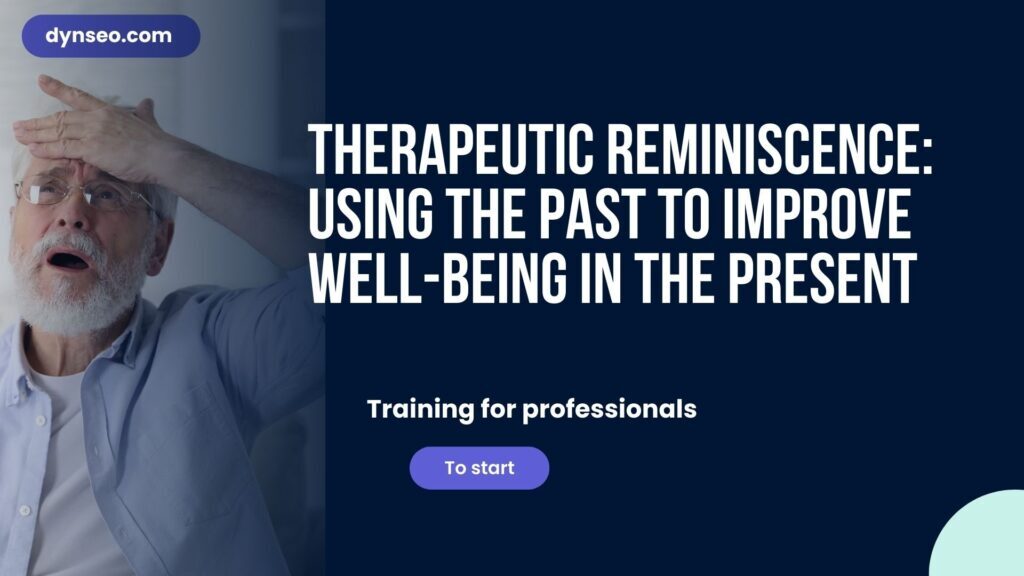
Training — Therapeutic reminiscence: revisiting the past to better live in the present
A comprehensive training to master therapeutic reminiscence: principles, techniques, adapted materials, and practical implementation. A powerful approach accessible to any facilitator.
Access the training →The SCARLETT application from DYNSEO is a reference tool for facilitators in nursing homes. Its adapted digital activities allow for individual or group stimulation, with progressively difficult levels and an interface accessible even for residents who are not familiar with digital technology. The E-Memories tool from DYNSEO allows for organizing reminiscence sessions based on photos and personal documents of the residents.
For residents with communication disorders or autism, the social scenarios from DYNSEO are valuable visual tools for preparing everyday situations and reducing social anxiety. The MY DICTIONARY application facilitates communication with residents who have language difficulties.
7. Designing a coherent annual program
Diagnosis of needs and gathering expectations
Analyze the profile of residents, ask the residents themselves about their desires when possible, and consult families and the care team.
Definition of general and specific objectives
The objectives must be precise and measurable, articulated to therapeutic challenges: "maintain verbal communication abilities," "reduce agitation behaviors in the late afternoon."
Planning activities and resources
Distribute activities throughout the year considering seasons, cultural and festive events, human resources, and budgetary constraints.
Continuous evaluation and adjustment
Evaluation is not just an annual report. Each session is an opportunity to observe what works and what needs to be adjusted. This fine observation feeds the continuous improvement of the program.
DYNSEO Motivation Table
The motivation table helps the facilitator visualize each resident's engagement in the proposed activities, identify preferences, and adjust the program based on actual appetites.
Download the table8. Digital animation in 2026
Touch tablets have significantly expanded the possibilities in medical-social animation. The SCARLETT application from DYNSEO is specially designed for seniors. It offers dozens of cognitive stimulation activities adapted to different levels of dependence. The online cognitive tests from DYNSEO allow for evaluating the cognitive functions of each resident and feeding into personalized life projects.
Training — Cognitive stimulation for seniors: practical ideas and implementation
All the techniques and tools to design and facilitate effective cognitive stimulation sessions, adapted to different levels of dependence and the most common pathologies in nursing homes.
Discover the training →9. Training and evolving in the profession
🎓 Reference diplomas
- BPJEPS Social Animation (level 4)
- DEJEPS Socio-Educational Animation (level 5)
- DUT / BUT Social Careers
- Professional License in Social Animation
- Short courses in gerontology
📈 Career advancements
- Lead facilitator / coordinator
- Head of the animation department of a group
- Trainer in medical-social animation
- Establishment management (after CAFERUIS)
- Expert in non-drug approaches
⚠️ Prevention of professional burnout: The profession of medical-social facilitator exposes one to significant emotional burden. Regular supervision, group practice analysis, and institutional psychological support are essential resources for enduring in the profession with kindness towards oneself.
Training — Supporting seniors differently: playing to stimulate and share
A practical training that shows how play — digital and non-digital — can transform activities in nursing homes and other structures. Approaches, tools, postures, and concrete cases.
Discover the training →“The medical-social facilitator is the professional who transforms a care place into a living space. Their work is measured in smiles, moments of presence, shared stories — and in how a resident feels recognized as a person, not as a patient.”
— Perspective of medical-social management teamsAn essential profession, gaining recognition
The facilitator in medical-social structures occupies an irreplaceable place in the well-being of the people they support. In 2026, this profession benefits from increasing recognition driven by scientific evidence of the effectiveness of non-drug approaches. Training, equipping oneself, and surrounding oneself with quality resources is choosing to practice this profession with the rigor and kindness it deserves.
Explore DYNSEO training for facilitators →FAQ — Frequently Asked Questions about the job of medical-social animator
Q1 What diploma is required to become an animator in a Nursing home?
There is no single mandatory diploma, but several training programs are recognized: the BPJEPS Social Animation (high school level), the DEJEPS (bac+2 level), the DUT/BUT Social Careers, or specialized training in gerontology. The VAE also allows for the recognition of significant professional experience through a diploma.
Q2 What is the difference between an animator and a psychomotrician in a Nursing home?
These two professionals are complementary. The psychomotrician is a paramedical health professional who conducts assessments and psychomotor rehabilitation sessions. The animator is not a caregiver: their role is to maintain social connections, personal expression, and the joy of living. In practice, they work closely together in designing life projects.
Q3 How to manage a resident who refuses to participate in activities?
The refusal to participate must always be respected. In the face of repeated refusals, the animator should seek to understand the reasons (fatigue, inappropriate activity, social anxiety) before proposing alternatives: individual activity, shorter format, or simply the supportive presence of the animator without requiring active participation.
Q4 How to evaluate the impact of activities on the well-being of residents?
Evaluation involves direct observation during sessions, verbal feedback from residents and families, nursing reports on general condition, and structured monitoring tools. Validated scales like the MMS can be used before/after an intensive activity period to objectify cognitive benefits.
Q5 What DYNSEO training programs are recommended for an animator in a Nursing home?
DYNSEO offers several suitable training programs: Supporting seniors differently, Cognitive stimulation for seniors, and Therapeutic reminiscence. These training programs are certified, accessible via e-learning, and directly applicable in facilities.
Did this content help you? Support DYNSEO 💙
We are a small team of 14 people based in Paris. For 13 years, we have been creating free content to help families, speech therapists, care homes and healthcare professionals.
Your feedback is the only way we know if our work is useful. A Google review helps us reach other families, caregivers and therapists who need it.
One action, 30 seconds: leave us a Google review ⭐⭐⭐⭐⭐. It costs nothing, and it changes everything for us.