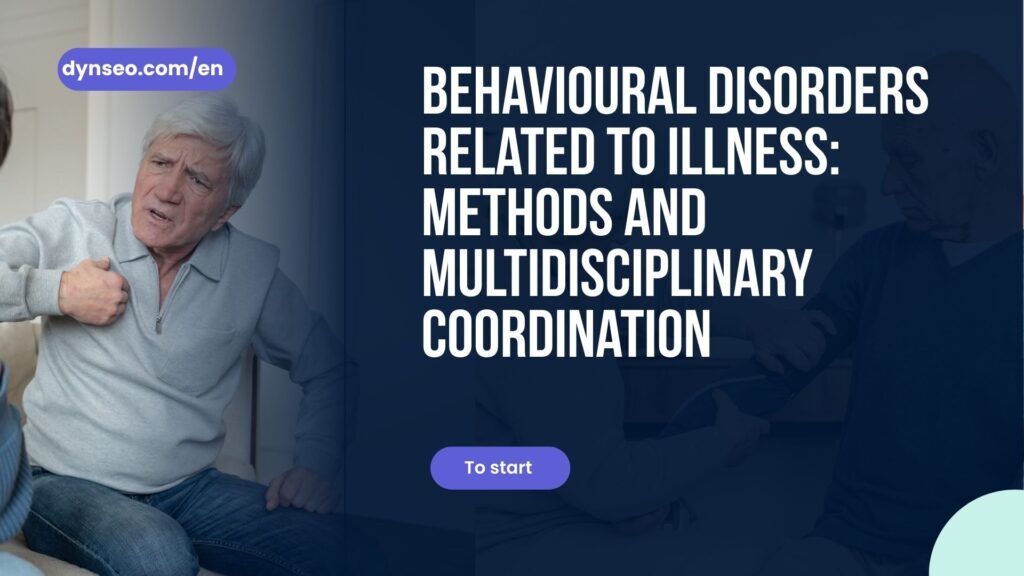
Behavioral disorders related to illness: methods and multidisciplinary coordination
Program, content, and benefits of the DYNSEO training — for health professionals and families supporting individuals with behavioral disorders related to a chronic or neurodegenerative illness.
Access the training →Dans cet article
La formation associée
Les ressources citées
 Carte signaux alerte - Formation DYNSEO
 Carte des besoins sensoriels TSA
 Plan de gestion des crises TSA
A resident who hits during bathing. An Alzheimer’s patient who refuses to eat. A person with frontotemporal dementia who makes hurtful remarks. A relative with Parkinson’s who explodes in anger during OFF phases. These behaviors — which caregiving teams and families often call "behavioral disorders" — are among the most exhausting, destabilizing, and poorly managed situations in supporting chronic and neurodegenerative illnesses. Yet, they are not inexplicable. They are not unpredictable. And above all, they are not inevitable. The DYNSEO training "Behavioral disorders related to illness: methods and multidisciplinary coordination" provides you with the methods to understand, prevent, and manage these situations — with kindness, effectiveness, and team coherence.
1. Behavioral disorders related to illness: reality and stakes
1.1 What are we talking about?
Behavioral disorders (BD) related to illness refer to all behavioral changes observed in a person suffering from a chronic or neurodegenerative illness — which are not directly attributable to the person's baseline personality, but are the result (often poorly understood) of their pathology or experiences. They cover a very broad spectrum: agitation and physical or verbal aggression, nighttime wandering, refusal of care, repetitive behaviors, shouting and vocalizations, sexual or social disinhibition, apathy and withdrawal, eating disorders, sleep disturbances affecting those around them.
What unites all these behaviors is that they are communications — often clumsy and misunderstood attempts by the person to express physical, emotional, or environmental suffering that they can no longer communicate otherwise. Understanding this fundamental dimension radically transforms the approach of caregivers and families.
1.2 Categories of behavioral disorders
Agitation and aggression
Physical (hitting, scratching, biting) or verbal (shouting, insulting). Often an expression of untreated pain or impossible communication.
Frequent cause: pain, fear, violation of personal spaceRefusal of care
Refusal of bathing, medication, food. Expression of a loss of autonomy experienced as humiliation or a misunderstanding of what is being done.
Frequent cause: loss of meaning, fear, lack of trustNighttime wandering
Walking without apparent purpose, often at night. May express spatial-temporal disorientation, inner agitation, or pain that prevents sleep.
Frequent cause: disorientation, pain, unmet needsApathy and withdrawal
Progressive disinterest in everything, decreased initiative, loss of reactivity. Often confused with depression — distinct but equally debilitating.
Frequent cause: understimulation, lack of meaning, depressionRepetitive behaviors
Asking the same questions, repeating the same actions, vocalizing continuously. Often an expression of unresolved anxiety or a need for security.
Frequent cause: anxiety, need for reassurance, very short memoryEating disorders
Refusal to eat, hyperphagia (eating everything in sight), eating non-food items (pica). Common symptom in frontotemporal dementia and certain stages of Alzheimer's disease.
Frequent cause: frontal pathology, sensory disorders, depression2. Understand before acting: the ABC analysis method
2.1 The principle of functional analysis
The ABC method (Antecedents — Behavior — Consequences) is the most widely used behavioral analysis tool in clinical neuropsychology and specialized care units. It is based on the principle that every behavior occurs within a context that preceded it (antecedent) and that every behavior is maintained by its consequences (reinforcement or extinction). Systematically analyzing this context allows for the identification of triggers for the behavior — and thus to act preventively rather than reactively.
What happened just before?
Time, place, people present, ongoing activity, recent change (new caregiver, meal moved, disruptive family visit).
What exactly happened?
Factual description of the behavior: duration, intensity, exact form. Avoid interpretations ("he was mean") — describe the facts ("he hit the caregiver with his left arm").
What happened afterward?
How did the caregivers/family react? Did the reaction reinforce or reduce the behavior? What happens after the behavior conditions its repetition.
What intervention to adapt?
Based on the analysis: modify the antecedents (change the time of care, the environment, the caregiver), and/or modify the consequences (do not reinforce the inappropriate behavior).
3. The DYNSEO training: methods and program
Behavioral disorders related to illness: methods and multidisciplinary coordination
This online certified training is aimed at health and medical-social professionals (nurses, nursing assistants, home helpers, educators, psychologists, health managers) as well as supporting families. It combines validated clinical methods for understanding and managing behavioral disorders, and concrete strategies for multidisciplinary coordination.
Access the training →3.1 The intervention methods taught
Distraction and redirection methods
Diverting attention from the behavior to a rewarding alternative activity. Particularly effective for repetitive behaviors and mild agitation.
Snoezelen and multisensory stimulation
Adapted sensory environment to reduce anxiety and agitation. Music, textures, soft lights, aromas — activation of sensory well-being.
Validation by Naomi Feil
Welcoming and validating the emotions expressed by the person rather than contradicting them. Particularly suitable for individuals with advanced dementia.
ABC analysis and modification of antecedents
Identifying and modifying the context that triggers the behavior. Acting upstream rather than reactively.
Care mapping and PERMA
Identifying unmet needs underlying the behaviors. Adapting the environment and care to individual preferences.
Nonviolent Communication adapted for dementia
Adapting tone, words, gestures, and posture to reduce confrontation and maintain cooperation during care.
3.2 What you will learn — module by module
📋 Complete training program
- Module 1 — Understanding BD: Neurology and psychology of behavioral disorders, communication as reading needs, misconceptions to deconstruct
- Module 2 — Identify and analyze: ABC method, observation grids, distinguishing primary (neurological) and secondary (situational) BD
- Module 3 — Non-drug methods: Distraction, redirection, validation, snoezelen, music therapy — indications and implementation
- Module 4 — Adapted communication: Posture, tone, words, gestures — communicating without triggering or worsening behaviors
- Module 5 — Crisis management: Intervention protocol in acute crisis situations, securing without coercion, alerting and documenting
- Module 6 — Multidisciplinary coordination: Sharing observations, building a coherent intervention plan, communicating with the family
- Module 7 — Caring for teams: Emotional impact of BD on caregivers, regulation strategies, burnout prevention
4. Multidisciplinary coordination: key to effectiveness
4.1 Why the team must speak with one voice
One of the most powerful factors in escalating behavioral disorders is the inconsistency of responses from the caregiving team. When one nurse manages a refusal of care in one way and her colleague in another, the person being supported does not know what to expect — which exacerbates anxiety and resistance behaviors. A team that applies the same protocol consistently, conveys the same information in the same way, and shares the same observations is a factor of safety and predictability for the person — which is one of the primary conditions for reducing behavioral disorders.
🎓 Train your team in managing behavioral disorders
The DYNSEO certified training provides you with the methods, tools, and team coherence to transform your approach to behavioral disorders — less exhaustion, fewer incidents, more quality of life for everyone.
5. DYNSEO tools and applications for managing BD
🚨 Alert signals map
Identify precursor behaviors of a crisis to intervene before escalation.
Download →🗺️ Sensory needs map
Identify hypersensitivities and adapt the environment to reduce sensory triggers.
Download →📋 Crisis management plan
Structured protocol for acute crisis situations — applicable to many profiles.
Download →🧰 Emotional regulation toolbox
Regulation strategies for caregivers AND the individuals being supported.
Download →🔄 Cognitive restructuring sheet
Identify and work on negative automatic thoughts — for caregivers post-incident.
Download →🟨 SCARLETT — Seniors
Cognitive stimulation for elderly people — calming activities that reduce agitation and maintain engagement with reality.
Discover SCARLETT →🟦 CLINT — Adults
For caregivers — maintaining one's own cognitive abilities in a profession with high emotional and cognitive load.
Discover CLINT →🟥 MY DICTIONARY — AAC
Alternative communication for people whose cognitive disorders are related to the inability to verbally communicate their needs.
Discover MY DICTIONARY →🤖 DYNSEO AI Coach
Questions about cognitive disorders, intervention methods, coordination — expert answers 24/7.
Discover the AI Coach →❓ Frequently Asked Questions about the training
What is the difference between a behavioral disorder and a normal "difficult" behavior?
A behavioral disorder related to illness is a behavior that represents a change from the person's previous personality and habits, which is understandable in light of the pathology, and which is not deliberately chosen. A "difficult behavior" unrelated to a pathology falls under different management. The distinction is crucial as it determines the type of appropriate response: in the first case, the medical or situational cause is sought and support is adapted; in the second, direct relational techniques can be used. The DYNSEO training helps to make this distinction.
Does the training offer protocols suitable for home care or only for facilities?
The training is applicable to all support contexts — Nursing home, USLD, SSIAD, home. The case studies and examples cover all these contexts. Some adaptations are specific to home care: coordination with a liberal network (nurse, general practitioner, physiotherapist) is different from internal coordination in a facility, and the training addresses both logics. Supporting families at home also find immediately applicable strategies.
How to manage repeated refusals of care without becoming authoritarian?
Refusal of care is one of the most frequent and delicate situations. The training offers several strategies: first, explore the cause (is the person afraid? are they in pain? do they not understand what is going to be done?), then propose adaptations (change the time, the caregiver, the way of doing it), use emotional validation ("I understand that this is not pleasant"), and if the refusal persists for a non-urgent care, respect the refusal and come back later. Forcing a non-urgent care physically generates escalation and a lasting loss of trust — and can constitute mistreatment.
How to document a behavioral incident in a useful way?
Useful documentation follows the ABC model: date and time, context (activity, people present, recent events), factual description of the behavior (without interpretation), caregiver's reaction, and evolution in the following minutes. This documentation allows the entire team to identify recurring patterns, adjust interventions, and communicate with the coordinating physician. The DYNSEO Session Follow-up Sheet offers a standardized format for this documentation.
When should medication be used for behavioral disorders?
The DYNSEO training is clear on this point: medications are never the first response to behavioral disorders, and they are never a standalone solution — they are always part of a comprehensive care plan that includes non-drug approaches. The use of medication is justified when non-drug approaches have been tried in a structured way without success, when the behavior poses an immediate danger to the person or those around them, or when there is a clearly identified psychiatric component (psychosis, severe depression). The decision is medical — not caregiving or familial.
How to take care of oneself as a caregiver facing recurring behavioral disorders?
The training dedicates an entire module to this question. Documented strategies include: post-incident debriefing (individual or team) to emotionally process what just happened, quick emotional regulation techniques (heart coherence, cognitive distancing), regular clinical supervision with a psychologist, support groups among caregivers, and institutional recognition of the emotional burden of the work. The Emotional Regulation Toolkit and the DYNSEO Cognitive Restructuring Sheet are concrete resources for this self-training in self-care.
Can this training be used for behavioral disorders in other pathologies (autism, traumatic brain injury)?
Yes. Although the training is focused on chronic and neurodegenerative diseases (Alzheimer's disease, Parkinson's, Stroke, MS), the analysis (ABC) and intervention (validation, distraction, adapted communication, multidisciplinary coordination) methods are transferable to other contexts where behavioral disorders are present — adult autism in institutions, traumatic brain injury, chronic psychiatric disorders. Participants working in these contexts report a strong applicability of the training to their daily practice.
Is the training fundable by my OPCO?
The Qualiopi certification of DYNSEO entitles professionals in the medico-social sector to funding from OPCO. OPCO Santé for professionals in the health and social sector (hospitals, Nursing homes, associations), OPCO ATLAS for other sectors. The training can also be integrated into a facility's skills development plan — an approach that allows for training an entire team with maximum coherence. Contact DYNSEO for personalized funding support.
Behavioral disorders related to the disease: methods and multidisciplinary coordination
Online, at your own pace, certified Qualiopi — to understand, prevent, and manage behavioral disorders with kindness, efficiency, and consistency.
Access the training →Did this content help you? Support DYNSEO 💙
We are a small team of 14 people based in Paris. For 13 years, we have been creating free content to help families, speech therapists, care homes and healthcare professionals.
Your feedback is the only way we know if our work is useful. A Google review helps us reach other families, caregivers and therapists who need it.
One action, 30 seconds: leave us a Google review ⭐⭐⭐⭐⭐. It costs nothing, and it changes everything for us.