Continuing Education in Autism for Occupational Therapists: Innovative Tools and Methods
Discover sensory approaches, integration techniques, and digital tools that are revolutionizing the occupational therapy management of individuals with ASD.
Dans cet article
Occupational therapy plays a central role in supporting autistic individuals. By working on autonomy, sensory regulation, and environmental adaptation, the occupational therapist directly contributes to improving the quality of life of children and adults with ASD. However, knowledge is rapidly evolving, and professionals must engage in continuous training to provide care based on the most recent evidence. This article explores the innovative tools and methods that every occupational therapist should master to effectively support autistic individuals.
🤝 The specific role of the occupational therapist in supporting ASD
The occupational therapist operates at the interface between the individual and their environment. Their goal is to enable the autistic person to carry out their daily activities as autonomously and satisfactorily as possible. This mission encompasses a wide range of skills that go far beyond mere motor rehabilitation and require in-depth training in the specifics of the autistic spectrum.
In the field of autism, the occupational therapist is often the reference professional for everything related to sensory integration. Sensory peculiarities affect nearly all autistic individuals and have a considerable impact on their ability to participate in daily life activities, school learning, and social interactions. Understanding the sensory profile of each individual and proposing adaptation strategies is therefore a major focus of occupational therapy intervention.
Sensory integration
Assessment and treatment of sensory peculiarities to improve regulation and participation in activities
Daily autonomy
Dressing, hygiene, eating, organization: making each daily gesture more accessible
Fine motor skills and handwriting
Developing coordination, manual dexterity, and graphomotor skills for schooling
The occupational therapist also works on fine motor skills, essential for school learning and autonomy. Many autistic children present motor coordination difficulties that impact writing, cutting, buttoning, or manipulating everyday objects. Continuous training allows the professional to master the most recent and effective techniques to work on these skills while respecting the pace and peculiarities of each child.
Finally, adapting the physical and human environment is an integral part of the occupational therapy mission. Whether at home, at school, or in a specialized facility, the occupational therapist analyzes barriers to participation and proposes concrete adjustments, technical aids, and compensatory strategies. This ecological approach, which takes into account the individual's real environment, is particularly relevant in the context of autism.
🔊 The sensory approach in occupational therapy: at the heart of care
The theory of sensory integration, developed by Jean Ayres in the 1970s, remains the reference framework for occupational therapy intervention with autistic individuals. However, this approach has significantly evolved over the decades, and occupational therapists must train in the latest advancements to offer interventions that align with current evidence.
Sensory assessment is the essential first step. The Dunn Sensory Profile, the Sensory Processing Measure, and structured clinical observation allow for the identification of the individual's sensory patterns: hypersensitivity, hyposensitivity, seeking stimulation, or sensory avoidance. Each profile is unique and requires an individualized response. The trained professional knows how to interpret these assessments and translate them into practical recommendations for the surrounding environment.
Modern sensory strategies
The concept of "sensory diet" has revolutionized the approach. It involves offering sensory activities tailored to the individual's profile throughout the day to maintain an optimal level of arousal. For a hypo-reactive child, this may include intense proprioceptive activities before a concentration period. For a hypersensitive child, regular sensory breaks in a calm space can prevent overload. This sensory programming, integrated into daily life, requires in-depth training and close collaboration with parents and teachers.
- Proprioceptive strategies: weighted blankets, heavy vests, motor pathways with resistance, pushing and pulling activities to regulate the nervous system
- Vestibular strategies: therapeutic swings, balance boards, controlled rotations to improve vestibular integration and coordination
- Tactile strategies: sensory bins, varied textures, progressive desensitization for children with tactile defensiveness
- Visual and auditory strategies: adapting lighting, using noise-canceling headphones, visual organization of the environment
💡 The sensory approach must be individualized
There is no universal recipe in sensory integration. What soothes one child may be a source of stress for another. The trained occupational therapist knows how to accurately assess the sensory profile, test different strategies, and continuously adjust their intervention based on the individual's reactions. Continuous training allows them to stay informed about new research data and innovative tools in this constantly evolving field.
Snoezelen environments and multisensory spaces
Snoezelen spaces, initially developed in the Netherlands, are increasingly used in supporting autistic individuals. These controlled environments offer adjustable visual, auditory, tactile, and olfactory stimuli that allow the individual to experience positive sensory experiences and develop their self-regulation capacity. The occupational therapist trained in this approach knows how to design sessions tailored to each individual's sensory profile and integrate these experiences into a comprehensive therapeutic project.
Training in the use of multisensory spaces includes mastering equipment (bubble columns, fiber optics, projectors, vibrating tables, aroma diffusers), knowledge of session protocols, and the ability to observe and interpret the individual's responses to adjust the environment in real-time.
🎯 Developing daily autonomy: methods and tools
Autonomy in daily life activities represents a major challenge for autistic individuals and their families. The occupational therapist has an arsenal of techniques and tools to facilitate the acquisition of these essential skills, taking into account the cognitive and sensory peculiarities of each individual.
Activity analysis adapted to ASD
Activity analysis is a fundamental skill of the occupational therapist. It involves breaking down each task into elementary steps and identifying the motor, cognitive, sensory, and social components involved. For autistic individuals, this analysis must integrate additional dimensions: the sensory tolerance required, the level of communication necessary, the cognitive flexibility demanded, and the management of the unexpected.
For example, dressing involves not only fine motor skills and bilateral coordination. For an autistic child, it may also involve tactile tolerance to clothing textures, the ability to follow a sequence of steps, flexibility to adapt their routine if a garment is unavailable, and sensory management in a potentially overstimulating environment (lighting, ambient noise). The trained occupational therapist integrates all these dimensions into their rehabilitation plan.
Visual supports and task structuring
Visual supports are an essential tool in occupational therapy for autistic individuals. Illustrated visual sequences, laminated checklists, visual timers, and routine charts help the person understand the steps of a task, follow the process, and anticipate the end of the activity. The trained occupational therapist knows how to create supports tailored to each person's level of understanding, using real photos, pictograms, or written words according to their abilities.
The TEACCH (Treatment and Education of Autistic and related Communication handicapped CHildren) structuring offers a particularly relevant framework for the occupational therapist. Its principles of visual organization of space and activities, temporal structuring, and clarification of expectations naturally integrate into occupational therapy practice and allow the autistic person to gain autonomy in a predictable and understandable environment.
🏗️ Adapting the environment: a key skill
Adapting the environment is one of the most effective and least intrusive interventions that the occupational therapist can propose. Rather than asking the person to adapt to an inadequate environment, we modify the environment to better meet their needs. This approach, fundamental in occupational therapy, takes on a particular dimension in the context of ASD where environmental factors have a considerable impact on the person's functioning.
Adapting the school environment
School is often a highly stimulating and unpredictable environment for an autistic child. The occupational therapist can recommend concrete adjustments: positioning in the classroom (away from the window and door), appropriate lighting, providing a noise-canceling headset, using a sensory cushion on the chair, organizing the desk with visual cues, creating a retreat space for moments of overload. These adaptations, simple to implement, can radically transform the child's school experience.
School environment
Classroom layout, adapted tools, positioning, and visual supports to enhance learning
Home environment
Space organization, visual routines, adaptation of the bedroom and common living areas
Work environment
Workstation layout, noise management, task structuring for professional integration
Adapting the home
At home, the occupational therapist supports the family in organizing the living space. The child's bedroom can be redesigned to offer a calming sleep space (neutral colors, dim lighting, absence of excessive visual stimuli) and a structured play area. The bathroom can be equipped with visual cues for the steps of personal hygiene. The kitchen can be adapted to allow the child to gradually participate in meal preparation. Each recommendation is personalized based on the sensory profile and specific needs of the person.
⚠️ The importance of home visits
A clinic evaluation is not enough to propose relevant adaptations. The trained occupational therapist knows that home visits and observation in a natural environment are essential to understand the real obstacles the person faces and to propose concrete and realistic solutions. This ecological dimension of the intervention is all the more crucial for autistic people as the transfer of skills from one environment to another can be particularly difficult.
💻 Innovative digital tools in occupational therapy
The digital revolution offers occupational therapists new tools to enrich their practice with autistic people. Cognitive stimulation applications, therapeutic games on tablets, and monitoring platforms allow for diversifying intervention supports, maintaining motivation, and collecting objective data on the person's progress.
The use of digital tools in occupational therapy does not replace direct intervention but complements it. The tablet can serve as a motivating support to work on fine motor skills (precision of movement, hand-eye coordination), executive functions (planning, organization, inhibition), or visuospatial skills. Moreover, the digital environment is often better tolerated by autistic people than traditional paper supports, as it is more predictable and less sensory-loaded.
Digital tools also allow for proposing exercises to be done between sessions, thus extending the benefits of the intervention. Parents can supervise these activities at home, which reinforces the generalization of learning and the family's involvement in the therapeutic process. The professional can then monitor performance remotely and adjust their recommendations accordingly.
🎮 COCO THINKS and COCO MOVES: an ally for the occupational therapist
The COCO THINKS and COCO MOVES program developed by DYNSEO is a particularly relevant tool for occupational therapists working with autistic children aged 5 to 10 years. It combines targeted cognitive activities and physical activities, with a mandatory alternation every 15 minutes that promotes sensory regulation and attention.
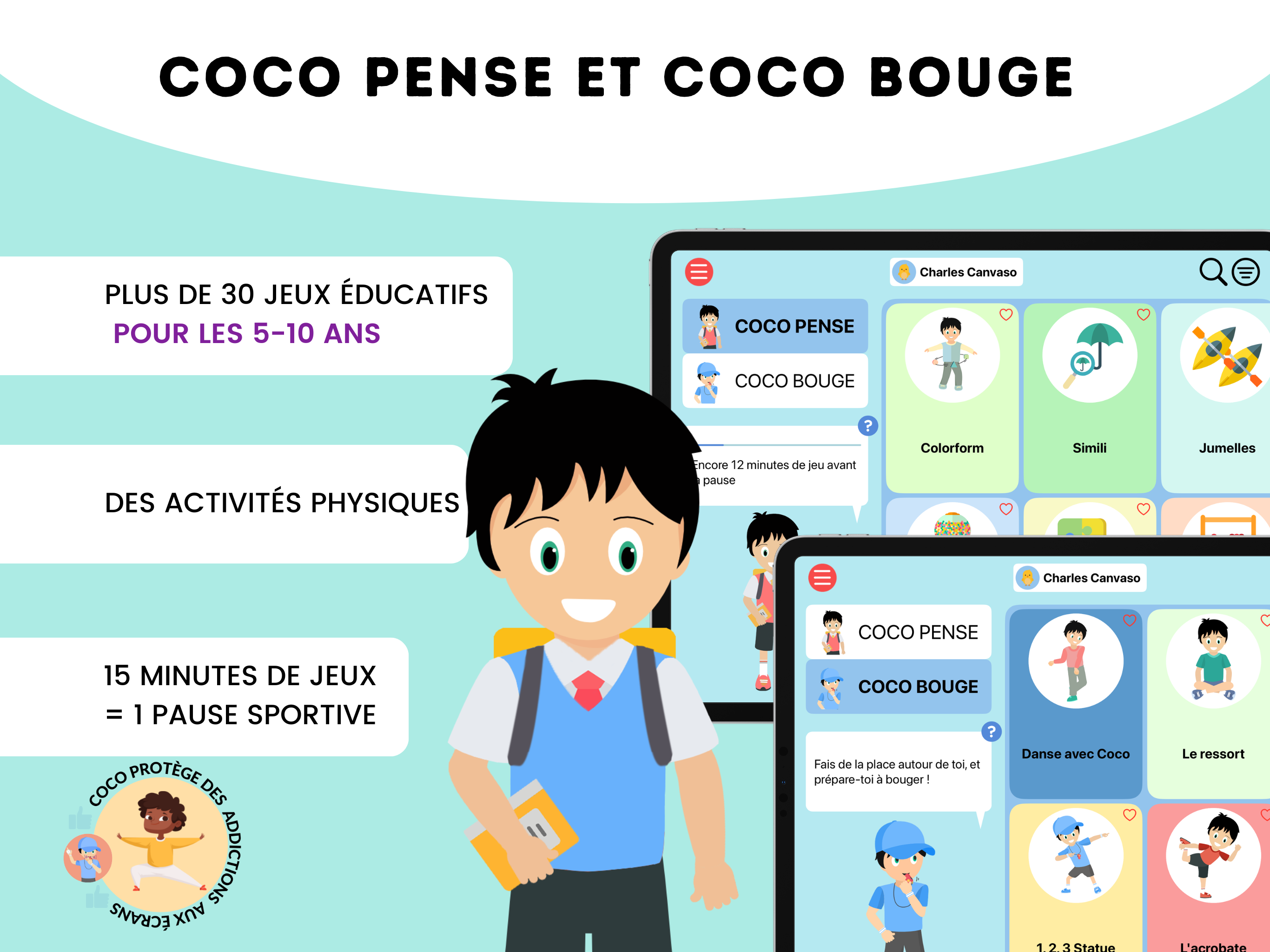
An adapted cognitive stimulation tool
The games offered by COCO target the essential cognitive functions that the occupational therapist works on during sessions: sustained and selective attention, working memory, planning, visuospatial reasoning, and mental flexibility. The very well-adapted levels of difficulty allow for proposing challenges in line with each child's abilities, thus avoiding frustration while maintaining stimulation. The occupational therapist can select the most relevant games based on the therapeutic objectives defined for each child.
The cognitive-motor alternation: an occupational therapy principle
One of COCO's strengths is its alternation between cognitive activities (COCO THINKS) and physical activities (COCO MOVES). This principle directly aligns with the foundations of occupational therapy, which considers that movement and cognition are closely linked. For autistic children, motor breaks allow for sensory regulation that subsequently optimizes cognitive performance. The occupational therapist can exploit this alternation during sessions or recommend the program for home use supervised by parents.
🎯 Discover COCO THINKS and COCO MOVES
A program of cognitive and motor stimulation with adapted levels, ideal for occupational therapists supporting autistic children. Mandatory alternation every 15 minutes between cognitive and physical activities.
Discover the COCO program →👥 Interdisciplinary work: the occupational therapist within the team
Supporting autistic people is inherently interdisciplinary. The occupational therapist collaborates with psychologists, speech therapists, psychomotor therapists, educators, and doctors to provide coordinated and coherent care. Continuing education must include this collaborative dimension, developing interprofessional communication skills and knowledge of each participant's roles.
The occupational therapist brings their unique expertise on sensory, motor, and functional aspects. Their observations and recommendations must be shared with the entire team to ensure coherence in interventions. For example, the sensory strategies recommended by the occupational therapist must be known and applied by all interveners, including teachers and parents. This transmission of know-how is an essential part of the occupational therapist's role and requires training and support skills for caregivers.
The guides offered by DYNSEO to support autistic children and support autistic adults are valuable complementary resources for professionals wishing to broaden their overall understanding of the needs of individuals with ASD.
🎓 Training with DYNSEO
DYNSEO offers a certified Qualiopi training “Supporting a child with autism: keys and solutions for daily life” that provides occupational therapists and other professionals with a comprehensive training framework on supporting individuals with ASD. This training addresses essential sensory, cognitive, behavioral, and environmental aspects for quality care.

The DYNSEO online training allows for valuable learning flexibility for practicing professionals. It combines theoretical contributions based on the most recent evidence and practical situations directly transposable to professional daily life. The occupational therapist will find keys to enrich their practice and better understand the global challenges of supporting ASD.
🎓 Train yourself in autism support
Qualiopi certified training accessible online, designed for all professionals supporting autistic individuals.
Discover the training →🎯 Conclusion
Continuing education in autism is essential for occupational therapists who wish to provide quality support to individuals with ASD. Advances in understanding sensory profiles, the development of innovative digital tools like COCO THINKS and COCO MOVES, and the evolution of interdisciplinary practices offer exciting new perspectives for the profession.
The occupational therapist trained in the specifics of ASD has a unique perspective and essential complementary skills within the support team. By continuously training, adopting digital tools, and closely collaborating with families and other professionals, they significantly contribute to the autonomy and quality of life of autistic individuals.
Train to better support:
Occupational therapy in the service of autonomy and well-being.
Did this content help you? Support DYNSEO 💙
We are a small team of 14 people based in Paris. For 13 years, we have been creating free content to help families, speech therapists, care homes and healthcare professionals.
Your feedback is the only way we know if our work is useful. A Google review helps us reach other families, caregivers and therapists who need it.
One action, 30 seconds: leave us a Google review ⭐⭐⭐⭐⭐. It costs nothing, and it changes everything for us.