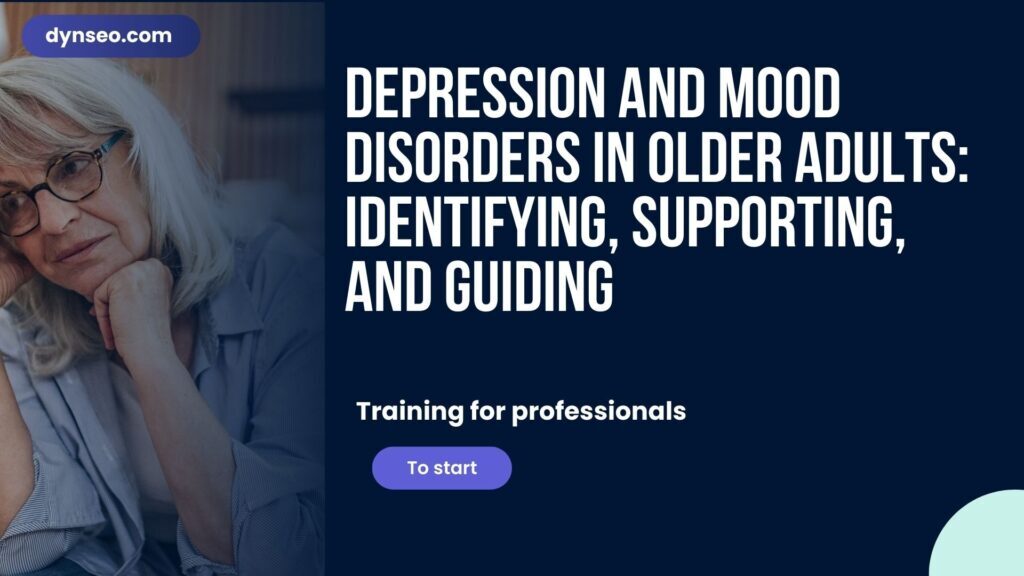
Depression and mood disorders in seniors: identify, support and guide
Senior depression is the most common psychiatric disorder after age 65 — and the most underdiagnosed. This guide provides relatives and professionals with the keys to recognize it and act effectively.
Access the training →Dans cet article
La formation associée
Les ressources citées
 Thermomètre des émotions
 Roue des choix - Outils Formation DYNSEO
 Décodeur d'Expressions Faciales
"He has lost interest in everything since entering the Nursing home." "She refuses to eat and no longer leaves her room." "He says he would rather die — but he has always been the type to dramatize." These phrases are spoken by thousands of families and caregivers without always recognizing what they signal: a depression, often severe, that manifests in an aging body with symptoms that do not always resemble the image we have of depression. Senior depression is the most common psychiatric disorder after age 65. It is also the most underdiagnosed — confused with normal aging, with dementia, with "character." And yet, it can be treated. It can be alleviated. And recognizing its signs early makes all the difference.
1. Senior depression: why it is so often missed
1.1 An atypical clinical picture in elderly people
Depression in elderly people often does not resemble depression in young adults. Instead of overt sadness and clear depressive mood, it frequently presents as somatic complaints (pain, fatigue, digestive disorders without organic cause), psychomotor slowing (slowness, mutism), pseudo-demential cognitive disorders (memory difficulties that improve with antidepressant treatment), irritability rather than sadness, or progressive social withdrawal. These atypical presentations explain why 50 to 70% of elderly depression cases go undiagnosed — neither by doctors, nor by families, nor by caregiving teams.
2. Warning signs to recognize
Progressive withdrawal and isolation
Abandonment of enjoyed activities, refusal to go out, no longer answering the phone, stays in their room. Often interpreted as "fatigue" or "character."
Appetite and sleep disturbances
Unexplained loss of appetite, weight loss, early morning insomnia (waking at 4 AM without falling back asleep) — classic signals of depression in elderly people.
Irritability and somatic complaints
Sadness may express itself through irritability, repeated physical complaints (pain, fatigue) without an identified organic cause — often the most misleading form.
Recently appeared cognitive disorders
Memory difficulties, intellectual slowing — which may be the first signs of depression (depressive pseudo-dementia) and improve with treatment.
Negative remarks about life and the future
"I am no longer of any use," "it would be better if I were dead," "I have done my time" — to be taken seriously and explored, never minimized.
Sudden behavioral change
A sudden and unexplained change in behavior or mood in an elderly person — even after an identifiable event (bereavement, entering a Nursing home) — warrants a psychiatric evaluation.
3. DYNSEO training — depression and mood in seniors
Depression and mood disorders in seniors: identify, support and guide
This online certified training is aimed at relatives of elderly people and health and medico-social professionals (nursing assistants, nurses, coordinating doctors, psychologists, educators, activity leaders) who work with seniors in Nursing homes, at home, or in consultation. It provides tools for identifying, communicating, and guiding in the face of senior depression.
Access the training →4. Distinguishing depression, dementia, and normal aging
5. What relatives and caregivers can do concretely
Listen without minimizing
Never say "it's normal at your age" or "don't worry, you have everything to be happy." Validate the suffering without reinforcing it.
Document observations
DYNSEO session follow-up sheet — note behaviors, appetite, sleep, remarks. Objective data for the doctor.
Refer to the doctor
Report observations to the treating or coordinating doctor — with concrete examples and not with "she is depressed."
Propose enjoyable activities
Small concrete activities that have already provided pleasure — music, photographs of old memories, adapted gardening. SCARLETT from DYNSEO can be suggested.
Maintain social connection
Regular visits even if the person does not ask. Caring presence without social performance required. The connection is therapeutic.
Take suicidal thoughts seriously
Any suicidal remark from a senior is a medical emergency — alert the doctor immediately. Seniors have a higher rate of acting on suicidal thoughts than young adults.
⚠️ Emergency: In elderly people, suicidal thoughts should be taken even more seriously than in other age groups — the lethality rate of attempts is higher and the "warning signs" are less obvious. Any remark such as "I no longer want to be here," "I have lived enough," "everyone would be better off without me" should lead to an urgent medical consultation — the same day if possible.
💙 Train yourself to identify and support senior depression
DYNSEO training provides you with concrete tools to recognize senior depression, adapt your communication, and guide effectively — online, at your own pace, Qualiopi certified.
6. DYNSEO tools and applications for supporting depressed seniors
🌡️ Emotion thermometer
Evaluate and communicate the emotional state of the senior — a regular check-in tool for caregivers.
Download →🎡 Choice wheel
Restore a sense of control and self-determination — essential in depression that generates learned helplessness.
Download →🎭 Facial expression decoder
Help caregivers read unexpressed emotional states in seniors with expression difficulties.
Download →📊 Skills tracking chart
Track the evolution of depressive state over time — measure progress and signal relapses.
Download →📋 Session follow-up sheet
Document daily observations for the doctor — factual basis for diagnosis and follow-up.
Download →🟨 SCARLETT — Seniors
Stimulating and engaging cognitive activities for depressed elderly people — maintaining alertness, connection with the world, and a sense of effectiveness. Recommended even in mild to moderate depressive phases.
Discover SCARLETT →🟦 CLINT — Adults
For younger seniors (65-75 years) with moderate depression — adapted cognitive stimulation, sessions of 15-20 minutes, non-patronizing adult interface.
Discover CLINT →🟥 MY DICTIONARY — CAA
For depressed elderly people with verbal expression difficulties (aphasia, depressive mutism) — expressing needs and emotions through pictograms.
Discover MY DICTIONARY →🤖 DYNSEO AI Coach
Questions about the senior's depression, resources, procedures — expert answers 24/7 for families and caregivers.
Discover the AI Coach →❓ Frequently Asked Questions about Depression in Seniors
Is depression normal with age?
No — it is one of the most damaging misconceptions. Depression is not an inevitable consequence of aging. Indeed, elderly people face cumulative losses (health, loved ones, autonomy) that are real trials — but the normal reactive sadness in response to these losses is different from a pathological depressive episode. Depression is an illness — not a "normal state" of aging — and it responds to treatment in 80% of cases. Accepting the depression of the senior as "normal" amounts to depriving a person of effective treatment.
How to distinguish depression from "normal" grief in a senior?
Grief is a normal and necessary reaction to loss — it involves sadness, crying, temporary withdrawal, but also moments of gradual recovery. Post-grief depression is distinguished by: a prolonged duration without improvement (more than 2 months without relief), an intensity that does not fluctuate (constantly dark, without moments of respite), total anhedonia (complete inability to feel pleasure), excessive feelings of guilt, and suicidal thoughts. Grief can trigger depression — and then treatment is indicated even if the cause is a real and legitimate loss.
My loved one says "I'm not depressed, I'm just tired" — how to react?
Denial of depression is very common among seniors, for several reasons: the current generation of seniors often lived in a culture where "mental health issues" were stigmatized, depression is experienced as a "weakness" to hide, and the somatic presentation of depression in seniors allows for "rationalizing" the symptoms. Approach: do not force the label "depression," but talk about concrete symptoms ("you seem very tired for weeks, you eat little, you sleep poorly — we could see the doctor to check that there is nothing physically to treat"). The doctor can then assess and propose treatment without the word "depression" necessarily being central.
Can antidepressants be prescribed to an elderly person?
Yes — antidepressants are effective in elderly people, with a response rate of 70 to 80%. However, the choice of the molecule is crucial: some classic antidepressants are contraindicated in seniors (notably tricyclics, STOPP list). SSRIs (selective serotonin reuptake inhibitors) like sertraline or citalopram are generally preferred. Initial doses are lower, the increase is more gradual, and the response time may be longer (4 to 6 weeks). Monitoring for side effects (hyponatremia, falls, drug interactions) is essential.
Can SCARLETT from DYNSEO help a depressed senior?
SCARLETT can play a complementary role in supporting the depressed senior by offering stimulating cognitive activities that: maintain engagement with the outside world, provide a sense of effectiveness and achievement (reinforced by visible results), structure time in a day that often lacks rhythm, and create an opportunity for positive social interaction (with a caregiver or a loved one). SCARLETT does not treat depression — that is the role of the doctor and psychiatrist — but it supports quality of life during and after the depressive phase.
How to manage a depressive entry into a Nursing home?
Entering a Nursing home is one of the most at-risk moments for depression in seniors — loss of home, separation from familiar objects, disruption of routines, feeling of loss of control over one's life. Prevention: prepare the entry gradually if possible (preliminary visits, personalization of the room), maintain frequent family ties in the first weeks, inform the caregiving team about habits, preferences, and appreciated activities, and closely monitor mood in the first 3 months — a period of maximum vulnerability. Psychological support from the outset, systematically offered, makes a documented difference.
How to talk about depression to the family of a senior in a Nursing home?
Communication with the family is crucial — and often difficult. Useful phrases for caregivers: "We have observed changes in your mother's mood and behavior for a few weeks — she is eating less, withdrawing more, and has made comments that concern us. We would like her to be evaluated by our doctor." Avoid judgments ("she is depressed because the family does not visit enough") and minimizations ("it's normal at her age"). Involve the family in the assessment and care plan — their knowledge of the person is valuable.
Are there effective non-drug treatments for senior depression?
Yes — and they complement antidepressants, or even suffice for mild to moderate depressions. Validated treatments: psychotherapy adapted for seniors (CBT, reminiscence therapy, acceptance therapy), regular and adapted physical activity (documented effectiveness on mood equivalent to a mild antidepressant), light therapy (effective for seasonal depression and rhythm disorders), animal-assisted therapy, art therapy, music therapy. Cognitive stimulation (SCARLETT, CLINT) also contributes to maintaining engagement and a sense of effectiveness. The combination of medication treatment + psychosocial interventions is the most effective.
Depression and mood disorders in seniors: identify, support, and guide
Online, at your own pace, certified Qualiopi — for relatives and professionals who want to recognize and effectively support senior depression.
Access the training →Did this content help you? Support DYNSEO 💙
We are a small team of 14 people based in Paris. For 13 years, we have been creating free content to help families, speech therapists, care homes and healthcare professionals.
Your feedback is the only way we know if our work is useful. A Google review helps us reach other families, caregivers and therapists who need it.
One action, 30 seconds: leave us a Google review ⭐⭐⭐⭐⭐. It costs nothing, and it changes everything for us.