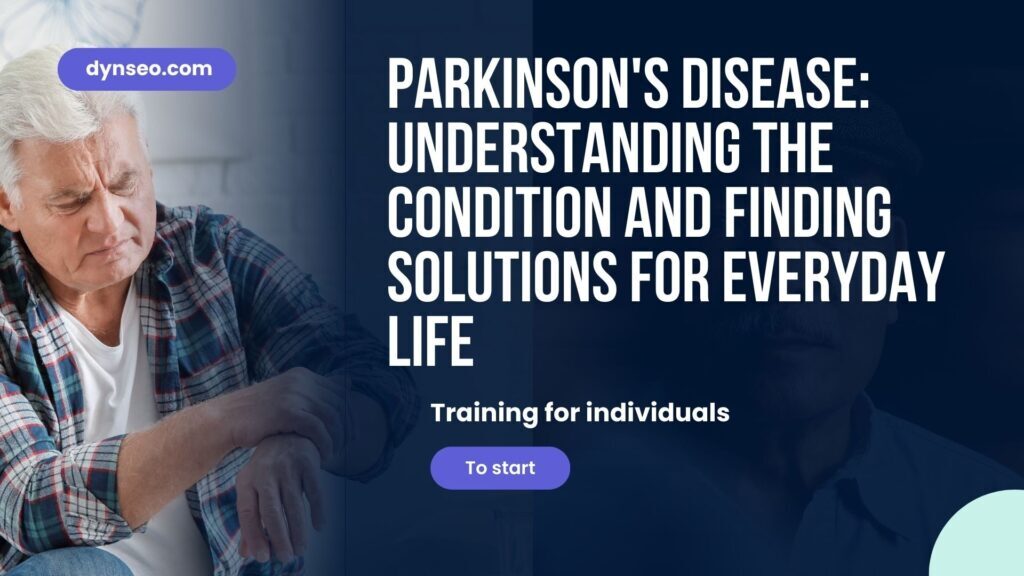
Formation « Parkinson : comprendre la maladie et trouver des solutions pour le quotidien » : programme, contenu et à qui elle s'adresse
Cette page décrit en détail la formation Parkinson en ligne DYNSEO « Parkinson : comprendre la maladie et trouver des solutions pour le quotidien » : ce qu'elle contient module par module, à qui elle est vraiment utile, combien de temps elle demande, ce qu'elle coûte, et — tout aussi important — ce qu'elle ne remplace pas. L'idée n'est pas de vous vendre un catalogue de belles promesses, mais de vous permettre de décider, en connaissance de cause, si ce parcours correspond à votre situation d'aidant.
Dans cet article
La formation associée
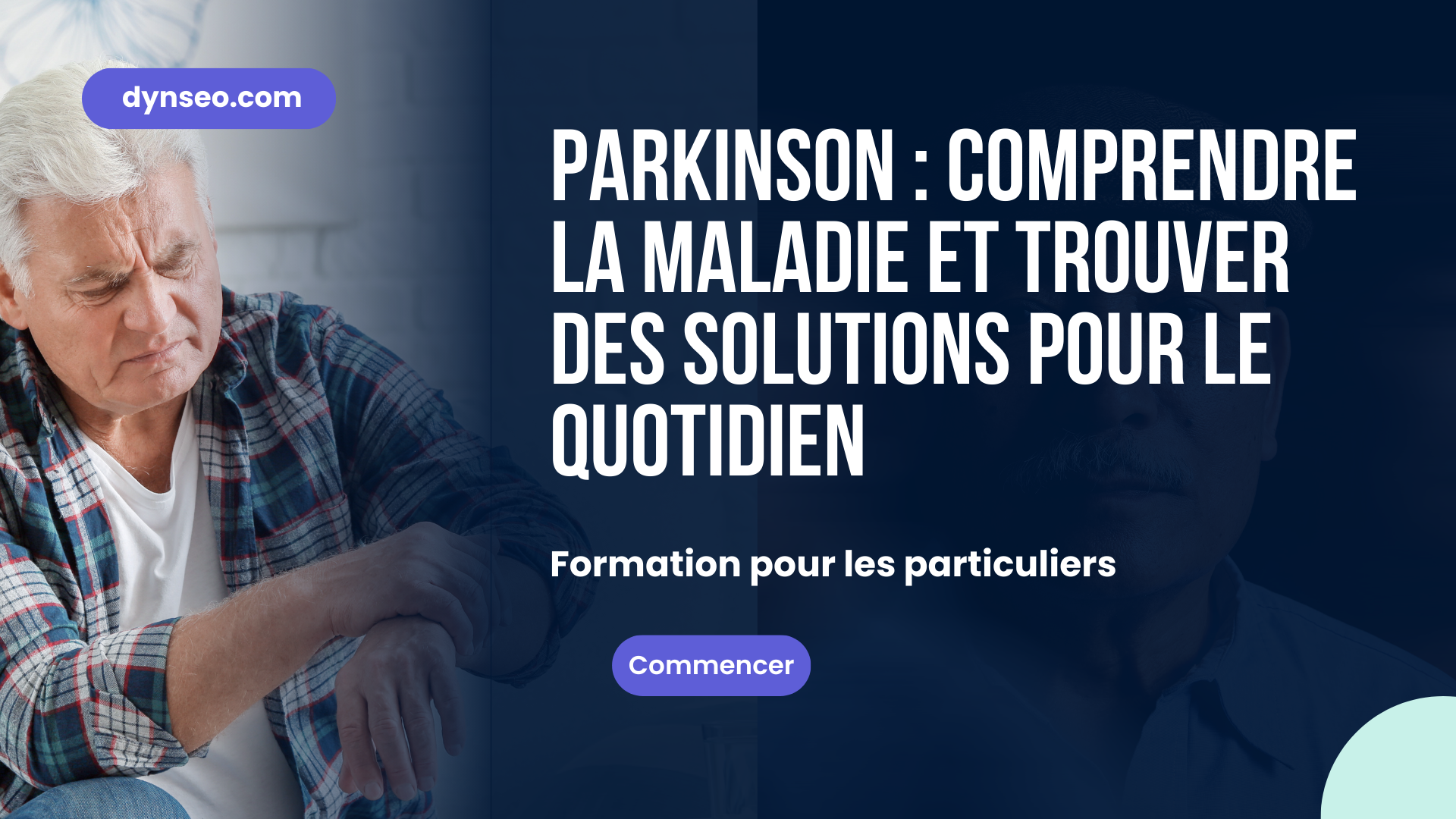
Quand un proche reçoit un diagnostic de maladie de Parkinson, l'entourage se retrouve souvent seul avec ses questions. Que va-t-il se passer ? Comment aider sans infantiliser ? Que dire quand les gestes deviennent lents ou que la voix baisse ? La consultation médicale répond au « quoi », rarement au « comment faire au quotidien ». C'est précisément cet espace que cette formation vient combler, avec un vocabulaire accessible et des gestes concrets, pensés pour des familles et non pour des soignants.
L'essentiel en 30 secondes
La formation « Parkinson : comprendre la maladie et trouver des solutions pour le quotidien » est une formation en ligne de 6 modules et 13 leçons, conçue par DYNSEO pour les familles et les aidants d'une personne atteinte de la maladie de Parkinson. Elle coûte 20 €, se suit à son rythme, et se termine par un quiz de validation.
- Pour qui — conjoint, enfant, frère ou sœur, ami proche d'une personne vivant avec Parkinson. Aucun prérequis médical.
- Ce qu'on y apprend — comprendre la maladie et ses stades, adapter les gestes du quotidien, gérer la fatigue, favoriser le mouvement et la stimulation, communiquer autrement, préserver l'aidant.
- Durée — environ 2 à 3 heures au total, en séquences courtes que l'on fractionne librement.
- Accès — immédiat après l'achat, illimité dans le temps, sur ordinateur, tablette ou téléphone.
- Organisme — DYNSEO, organisme de formation certifié Qualiopi (N° 11757351875), attestation de fin de formation délivrée.
Pourquoi se former quand on accompagne un proche ?
La maladie de Parkinson n'est pas une maladie rare, et elle s'installe dans la durée. Selon l'Organisation mondiale de la santé, c'est l'affection neurologique dont la prévalence augmente le plus vite dans le monde : l'OMS estimait à plus de 8,5 millions le nombre de personnes vivant avec Parkinson en 2019. En France, l'Inserm évoque de l'ordre de 270 000 personnes concernées et parle de la deuxième maladie neurodégénérative la plus fréquente après la maladie d'Alzheimer.
| Repère | Ordre de grandeur | Source |
|---|---|---|
| Personnes vivant avec Parkinson dans le monde | plus de 8,5 millions (2019) | Organisation mondiale de la santé |
| Dynamique mondiale | affection neurologique à la croissance la plus rapide | Organisation mondiale de la santé |
| Personnes concernées en France | de l'ordre de 270 000 | Inserm |
| Rang parmi les maladies neurodégénératives | 2e plus fréquente après Alzheimer | Inserm |
Sources : Organisation mondiale de la santé, fiche « Parkinson disease » ; Inserm, dossier d'information sur la maladie de Parkinson.
Derrière chacune de ces personnes, il y a presque toujours un proche qui devient aidant sans l'avoir choisi. Un conjoint qui adapte peu à peu la maison, un enfant qui s'inquiète à distance, un ami qui ne sait plus comment se comporter. La difficulté de Parkinson, c'est qu'elle avance lentement et par à-coups : certains jours tout semble à peu près normal, d'autres la lenteur, les tremblements ou la fatigue prennent toute la place. Sans repères, on interprète mal ces variations, on s'épuise, on culpabilise.
Suivre une formation Parkinson pensée pour les familles ne transforme pas un proche en thérapeute. Cela lui donne le langage commun pour dialoguer avec le neurologue, le médecin traitant, le kinésithérapeute ou l'orthophoniste, et les gestes du quotidien que personne n'a le temps d'expliquer en consultation. Comprendre pourquoi un mouvement se bloque, savoir comment aider sans faire à la place, reconnaître un signe qui doit être signalé : ce sont ces compétences-là qui changent l'ambiance à la maison, pas l'accumulation de savoirs théoriques.
Elle ne pose aucun diagnostic et ne remplace aucun soin. Tout changement inhabituel — chute, blocage soudain, confusion, difficulté à avaler, forte modification de l'humeur ou du sommeil — doit être observé, noté et signalé à l'équipe soignante. En cas de malaise ou de situation qui vous alarme, contactez sans attendre les services d'urgence de votre pays. Le diagnostic, le traitement et le pronostic relèvent uniquement des professionnels de santé.
À qui s'adresse cette formation ?
Elle est pensée pour la catégorie Famille du catalogue DYNSEO, et c'est un choix assumé : le vocabulaire, les exemples et les mises en situation s'adressent à des personnes qui ne sont pas soignantes et qui accompagnent au quotidien. Trois profils s'y retrouvent particulièrement.
Le conjoint
Il partage le quotidien et voit la maladie évoluer de l'intérieur. Il a besoin de distinguer ce qui vient de Parkinson, ce qui vient de la fatigue et ce qui vient du traitement, pour ajuster son aide sans épuiser personne.
L'enfant adulte
Souvent à distance, il coordonne les rendez-vous et s'inquiète entre deux visites. Il cherche des repères fiables pour savoir quoi observer, quoi signaler et comment soutenir le parent aidant principal.
L'entourage proche
Frère, sœur, ami, voisin qui donne un coup de main régulier. Il veut aider sans maladresse, comprendre pourquoi les gestes sont lents et savoir comment garder un lien vivant malgré la maladie.
Faite pour vous / pas faite pour vous
| Votre situation | Cette formation… |
|---|---|
| Un diagnostic de Parkinson vient d'être posé chez votre proche et vous ne savez pas par où commencer | ✔ Convient parfaitement |
| Vous accompagnez depuis plusieurs mois et vous vous sentez seul et fatigué | ✔ Convient — le module 3 est consacré au vécu des aidants |
| Vous voulez comprendre les mots employés par l'équipe médicale | ✔ Convient |
| Vous êtes soignant en établissement et cherchez un contenu pour votre pratique | ✘ Voir plutôt les parcours professionnels du catalogue |
| Vous cherchez un protocole de rééducation ou un ajustement de traitement | ✘ Non — cela relève de votre équipe soignante |
| Vous voulez un diplôme reconnu par l'État | ✘ Non — il s'agit d'une attestation de fin de formation, pas d'un diplôme |
We often believe that training is a luxury we don't have time to afford. It's the opposite: a few hours invested at the right moment can prevent weeks of trial and error, avoidable disputes, and actions that unnecessarily tire the person being supported. The best time to invest is at the very beginning.
The detailed program, module by module
The training consists of 6 modules and 13 lessons, each short: we progress lesson by lesson, with time to assimilate between two. Here is the actual content, as it is structured on the platform, described by thematic blocks.
Understanding the disease
- Understanding age-related pathologies — situating Parkinson's among neurological diseases, laying the groundwork to no longer confuse normal aging with signs of the disease.
- Symptoms, progression, and stages of the disease — slowness of movements, tremors, rigidity, but also less visible symptoms: fatigue, sleep, mood. Understanding that progression is gradual and unique to each individual.
- Common misconceptions to deconstruct — sorting out what we think we know and what professionals say, to stop supporting based on unfounded fears.
Daily life with Parkinson's
- Adapting gestures and activities — how to assist with dressing, meals, and mobility while allowing the person to do as much as possible by themselves for as long as possible.
- Managing fatigue and organization — identifying moments when energy is present, breaking the day into segments, avoiding overload, and respecting variations from day to day.
- Importance of movement and stimulation — why moving and regularly stimulating the mind is part of the support, in addition to and not instead of care.
The role of the entourage
- The experiences of relatives and caregivers — fatigue, guilt, fear of doing wrong: naming what you are going through to stop carrying it alone.
- Maintaining quality of life together — preserving time for oneself, redistributing tasks, accepting external help without seeing it as a failure.
- Encouraging positive communication — clear phrases, patience in the face of slowness, encouragement: what truly helps dialogue when the voice lowers or words come more slowly.
DYNSEO to support a person with Parkinson's
- DYNSEO applications for Parkinson's — how to use cognitive stimulation games as a regular activity support, adapted to the person's pace.
- The 8 essential things to remember — an actionable summary of the key points of the course, to keep in mind daily.
Role-playing scenarios
- Three role-playing scenarios — concrete everyday scenes analyzed step by step: what is happening, what helps, what worsens.
- Three other role-playing scenarios — other common scenarios to transpose what you have learned to your own reality.
Final quiz
- Quiz — a few questions to check that the essentials have been understood before receiving your certificate of completion.
Don't look at everything at once. Follow one module per evening, and test just one thing in between: a shorter sentence, a little more time left before responding instead, ten minutes of stimulation game. It's repetition that changes daily life, not the amount of information consumed at once.
Do you want to see the details of the 13 lessons ?
The complete program is available online, and the training is accessible immediately after registration — you start the first lesson right away.
Access the trainingThe format and organization
Everything is designed for a person who does not have a guaranteed time slot in their week. No schedule, no virtual class, no deadline : you open the training when the house is quiet, even late at night.
| Criterion | Detail |
|---|---|
| Format | 100% online, short lessons |
| Content | 6 modules · 13 lessons · final quiz |
| Estimated duration | 2 to 3 hours, to be divided freely |
| Rhythm | Free, no imposed end date |
| Support | Computer, tablet, smartphone |
| Access | Immediate after registration, unlimited |
| Required level | All levels, no medical prerequisites |
| Validation | Final quiz + certificate of completion |
The important point for a caregiver : access remains open. You can return to the lesson dedicated to communication on the day when your loved one is frustrated by not being understood, or to the role-playing scenarios when a scene from daily life puts you in difficulty, months after completing the course. It is often at that moment that the content makes the most sense.
The short duration is a pedagogical choice, not a shortcut. In the face of Parkinson's, a caregiver does not need a lecture on neurology : they need clear, immediately reusable references. Short lessons allow you to learn something, try it out, and then come back. It is this back-and-forth between the screen and real life that establishes new reflexes sustainably.
What you will be able to do at the end
Not just theoretical knowledge : actions. Here is what you should be able to do concretely once the course is completed.
Decode the symptoms
Distinguish what is related to the disease, fatigue, or treatment, and stop interpreting every slowness or mood change as a lack of will or rejection.
Adapt daily gestures
Assist with dressing, meals, or movements while allowing the person to do it themselves, without doing it for them too soon.
Manage fatigue
Identify the good moments of the day, break activities into parts, and respect "no" days without dramatizing.
Communicate differently
Allow time to respond, keep sentences clear, value efforts, and maintain dialogue when voice or words become more difficult.
Stimulate without exhausting
Establish a short routine of movement and cognitive stimulation, and identify when to stop.
Take care of yourself
Identify your own signs of exhaustion, ask for help, accept support, and preserve a space that remains yours.
A word about the concrete advice you will find there. Rather than vague instructions, the training emphasizes what is said and what is done. For example, in the face of a walking blockage, it is better to offer a simple reference — “let's go on the next step” — than to pull on the arm. ❌ To avoid : finishing sentences for the person, rushing the movement, or pointing out every tremor. What matters is never a medical protocol, but the right attitude, which can be reproduced calmly.
Qualiopi and certification: what it changes for you
DYNSEO is a Qualiopi certified training organization, registered under the activity declaration number 11757351875. This certification focuses on the quality of the training process: clarity of objectives, adaptation to audiences, qualification of trainers, collection of feedback, and continuous improvement.
In practical terms, for a family: this means that the content is not improvised, it is reviewed, and the educational objectives are set before being filmed. At the end of the course, you receive a certificate of completion in your name. It certifies your participation — it is neither a state diploma nor a regulated professional qualification, and it is important to state this clearly.
If you work in an institution or at home, the Qualiopi certification allows an employer to consider funding as part of the skills development plan. The conditions depend on your skills operator: they should be verified on a case-by-case basis with your HR service before registration.
Price and registration
The training is offered at €20. This is a deliberately accessible price for the "Family" training in the catalog: the goal is for a relative to be able to train without budgetary arbitration, at a time when expenses related to illness often start to accumulate.
- Open the training page and add it to your cart.
- Create your learner account (or log in if you already have one) and confirm the payment.
- You are registered: the training appears in your space and the first lesson starts immediately.
No entry date, no session to wait for. If you register on a Sunday evening because it's the only quiet moment of your week, you start right away. Access being unlimited, nothing obliges you to follow everything in one go: you come back when you need to.
What this training is not
Let's be frank, this avoids disappointments and respects your situation.
- This is not a medical opinion. No lesson replaces your neurologist, your general practitioner, or the rehabilitation team. The diagnosis, treatment, and prognosis belong to them.
- This is not a personalized rehabilitation program. The proposed activities are everyday stimulation benchmarks, never protocols for physiotherapy, speech therapy, or dosage.
- This is not individual support. There is no personalized follow-up included: it is a course that you follow alone, at your own pace.
- This is not a diploma. The certificate attests to participation, not professional qualification.
- This is not exhaustive from a medical standpoint. The short format prioritizes what is actionable at home, not scientific exhaustiveness.
Free tools and the app that complements it
The training is based on several DYNSEO resources that can be used immediately, without additional purchase. The following tools are free, printable, and downloadable from the tools catalog:
- Progress tracking chart (visual) — to objectify progress, often invisible day to day.
- Communication notebook — to share your observations with professionals without forgetting anything during consultations.
- Session tracking sheet — to note what has been worked on and what has caused fatigue.
- Skills tracking chart — to visualize what comes back, week after week.
On the digital side, module 4 relies on DYNSEO's cognitive stimulation applications. For a senior person with Parkinson's, SCARLETT offers a clean interface designed for easy use on a tablet, with memory, attention, and logic games and result tracking. For a younger or more tech-savvy adult, the application CLINT offers a wide range of stimulation games. You can also assess cognitive abilities through online cognitive tests. These resources do not replace care: they gently support a regular stimulation routine.
To go further on Parkinson's
This article presents the training. Four other articles delve into different angles, to be read as supplements:
Everyday SituationsParkinson's: 10 difficult everyday situations and how to respond
ToolboxParkinson's: activities, resources, and concrete adjustments to implement
Support & ContactsParkinson's: who to contact, what support is available, and how to sustain it over time
The complete catalog of DYNSEO training also offers related courses on aging, neurodegenerative diseases, and support for caregivers.
Frequently Asked Questions
How long does DYNSEO's Parkinson's training last?
Plan for about 2 to 3 hours in total for the 13 lessons and the final quiz. The lessons are short, so most learners spread the course over one to two weeks, with one module per evening. There is no obligation to keep a specific pace: access remains open after the course ends, and you can revisit any lesson as often as you wish, especially the situational exercises when a concrete difficulty arises at home.
Do I need medical knowledge to follow it?
No, none. The training is classified as "all levels" and is explicitly aimed at families and caregivers. The vocabulary is explained as you go: you do not need to know what bradykinesia or dyskinesia is before starting. Understanding the symptoms, their evolution, and common misconceptions is part of the first lessons of the module "Understanding the disease".
Will I receive a certificate at the end?
Yes. After passing the final quiz, a certificate of completion in your name is issued by DYNSEO, a Qualiopi certified organization (No. 11757351875). This certificate confirms your participation in the course. It does not constitute a state diploma or a regulated professional qualification: it is a proof of attendance, useful for keeping a record of your caregiver journey or, for a professional, in a training file.
Can the training be financially covered?
For an individual supporting a loved one, the training is purchased directly for €20. For a professional, DYNSEO's Qualiopi certification allows an employer to consider funding as part of the skills development plan; the conditions depend on the skills operator and should be verified with the HR department before purchase. No amount of aid can be guaranteed in advance: inquire on a case-by-case basis.
What support is available if I have questions during the training?
The training is a self-paced course that you follow at your own rhythm. For any technical difficulties — access, connection, lesson reading — the DYNSEO team can be contacted from the website. However, for medical questions concerning your loved one, you should always turn to the healthcare team: neurologist, primary care physician, physiotherapist, or speech therapist, who are the only ones qualified to make a diagnosis and adapt care.
This training is an educational support intended for relatives. It never replaces regular medical follow-up. Continue to honor appointments with the care team, note your observations in a liaison notebook, and report any unusual changes. It is the complementarity between professional care and your informed presence as a caregiver that makes the real difference every day.
Supporting a loved one with Parkinson's, with clear guidelines
With this Parkinson's training of 6 modules and 13 short lessons, available for unlimited access at €20, you transform “ I don't know how to help ” into simple and calm actions, starting this week.
Discover the training — €20Did this content help you? Support DYNSEO 💙
We are a small team of 14 people based in Paris. For 13 years, we have been creating free content to help families, speech therapists, care homes and healthcare professionals.
Your feedback is the only way we know if our work is useful. A Google review helps us reach other families, caregivers and therapists who need it.
One action, 30 seconds: leave us a Google review ⭐⭐⭐⭐⭐. It costs nothing, and it changes everything for us.