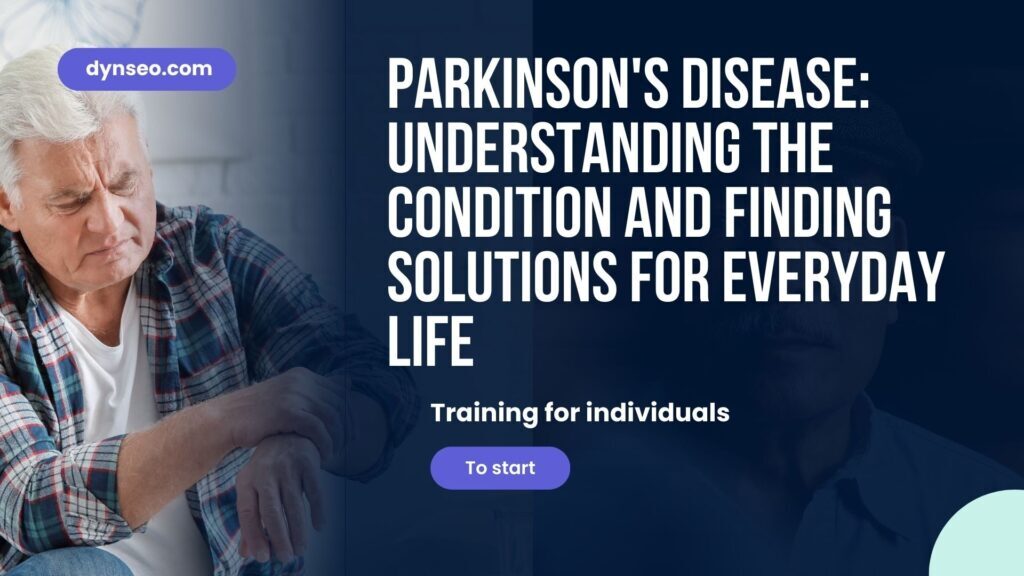
Caregiver for Parkinson's: 7 essential strategies for daily support
Supporting a loved one with Parkinson's disease requires specific skills — understanding non-motor symptoms, adapting the environment, supporting autonomy while ensuring safety. These 7 strategies provide concrete foundations.
Access the training →Dans cet article
La formation associée
Les ressources citées
 Thermomètre des émotions
 Roue des choix - Outils Formation DYNSEO
 Décodeur d'Expressions Faciales
Parkinson's disease is not just a motor disorder — it affects sleep, emotions, cognition, speech, and relationships. Supporting a loved one with Parkinson's requires a comprehensive understanding of the disease and strategies tailored to each symptom. These 7 strategies provide the most effective tools to improve daily life — for both the person with the disease and the caregiver.
The 7 strategies for the Parkinson's caregiver
Understand the medication "on" and "off" periods
The therapeutic windows of L-Dopa create oscillations between "on" periods (good mobility) and "off" periods (freezing, tremors). Organize important activities during "on" phases — hygiene care, meals, outings, consultations.
Adapt the environment to prevent falls
Remove rugs, install grab bars, optimize lighting, choose non-slip shoes. Falls are the leading cause of hospitalization and rapid decline in Parkinson's — prevention is worth infinitely more than treatment.
Maintain daily cognitive activity
Regular cognitive activity (SCARLETT from DYNSEO, memory games, reading, music) slows cognitive decline and improves mood. 15 to 20 minutes a day — during "on" phase, never forced.
Manage depression and mood disorders
Depression in Parkinson's is neurobiological — not "reactive". The DYNSEO Emotion Thermometer helps track emotional state and report depressive episodes to the doctor that require appropriate treatment.
Adapt verbal communication
Dysarthria (slurred and poorly articulated speech) often frustrates both parties. Strategies: never finish sentences for them, speak face to face, reduce background noise, use MY DICTIONARY if verbal communication becomes too difficult.
Maintain autonomy in activities
Excessive help accelerates decline — effective caregiving preserves autonomy in every activity where the person can still participate. The DYNSEO Wheel of Choices preserves decision-making power.
Take care of yourself as a caregiver
An exhausted caregiver can no longer help effectively. Caregiver support, support groups, psychological support, and maintaining personal activities — non-negotiable. The DYNSEO training dedicates an entire module to preventing caregiver burnout.
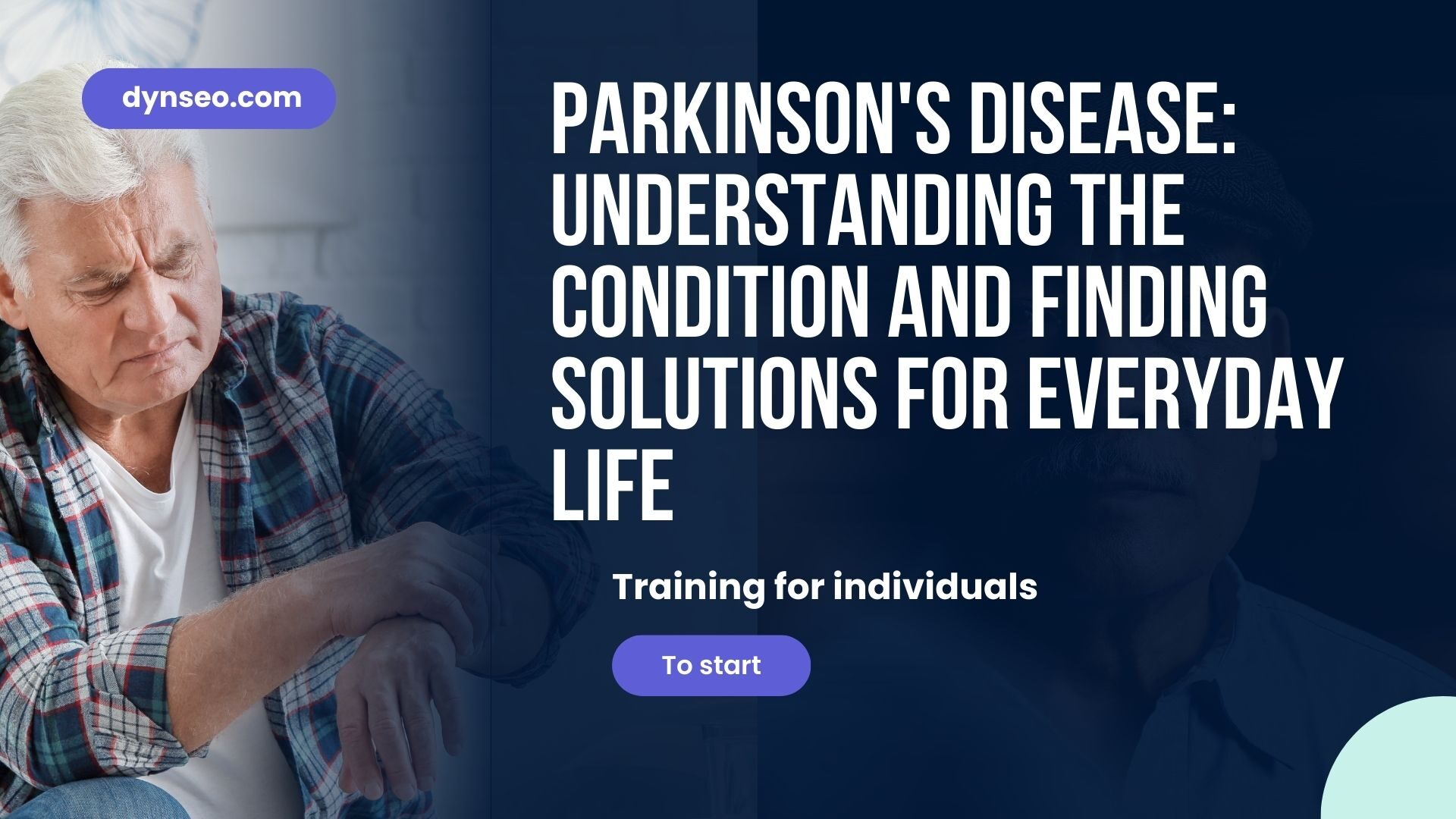
Parkinson's: understanding the disease and finding solutions for daily life
Online certified training for family caregivers and professionals (healthcare workers, educators, physiotherapists, speech therapists) who support people with Parkinson's. It deepens the 7 strategies of this guide with detailed protocols and case studies.
Access the training →The often overlooked non-motor symptoms for caregivers
Parkinson's disease is often summarized by its motor symptoms — tremors, rigidity, bradykinesia. But non-motor symptoms are often more disabling in daily life and less well known to caregivers. Recognizing them radically changes the quality of support.
🔍 The non-motor symptoms to absolutely know
- Depression and anxiety: present in 40 to 50 % of patients — neurobiological, not "reactive". Specific treatment available
- Cognitive disorders: slowing of thought, attention difficulties, executive dysfunction — worsen over time
- Sleep disorders: insomnia, daytime drowsiness, REM sleep behavior (nocturnal agitation) — exhausting for the caregiver
- Orthostatic hypotension: drop in blood pressure when standing up — cause of morning falls. Gradual rising, always
- Dysarthria and dysphagia: altered speech and swallowing difficulties — risk of choking to be closely monitored
- Severe constipation: often underestimated, source of discomfort and complications. Hydration, fiber, physical activity
The DYNSEO tools and applications for Parkinson's
🌡️ Emotion Thermometer
Track emotional state and detect depressive episodes — factual basis for the neurologist.
Download →🎡 Wheel of Choices
Preserve decision-making autonomy — a lever for dignity and quality of life.
Download →🎭 Facial Expression Decoder
Hypomimia (frozen face) masks emotions — this tool helps the caregiver not to confuse lack of expression with lack of emotions.
Download →📊 Skills Tracking Chart
Track the evolution of abilities over time — detect regressions before they become irreversible.
Download →📋 Session Tracking Sheet
Document care or activity sessions — factual basis for the medical team.
Download →🟨 SCARLETT — Seniors
Cognitive activities tailored for people with Parkinson's — maintain brain engagement, slow cognitive decline, enrich days. Sessions of 15-20 min during "on" phase.
Discover →🟦 CLINT — Adults
For early-stage Parkinson's patients or caregivers — tailored cognitive stimulation, non-patronizing adult interface.
Discover →🟥 MY DICTIONARY
For people with severe dysarthria — express needs and emotions through pictograms when speech becomes too difficult.
Discover →🤖 DYNSEO AI Coach
Questions about Parkinson's, aids, resources — expert answers 24/7 for caregivers and professionals.
Discover →🧠 Master the 7 strategies with the complete training
The DYNSEO training "Parkinson's: understanding and finding solutions" deepens each strategy with practical protocols — Qualiopi certified, online, at your own pace.
❓ Frequently Asked Questions — Parkinson Caregiver
What is the most urgent strategy to implement as soon as the diagnosis is made?
Fall prevention (strategy 2) — because falls are the main cause of rapid decline and hospitalization in Parkinson, and a good part is avoidable with simple modifications to the environment. Home audit (rugs, lighting, bathroom), grab bars, suitable shoes — to be implemented in the first weeks, without waiting for motor symptoms to progress.
How to manage my loved one's morning stiffness with Parkinson?
Morning stiffness is often related to the nighttime medication trough. Strategies: ask the neurologist for an adjustment of L-Dopa intake times to reduce this trough. Prepare to get up gradually — no sudden getting up, muscle activation time before standing up (exercises in bed). Water and medication within reach as soon as waking up. Warm shower in the morning to relax the muscles. Strategy 1 (understanding "on" and "off") is directly related to this management.
Is SCARLETT from DYNSEO really suitable for a person with advanced Parkinson?
SCARLETT is designed for fragile cognitive profiles, with a very accessible interface (large buttons, little text, audio instructions). For Parkinson patients: offer only during "on" phases, start with the most familiar activities, adjust the duration to the day's capacity (5 min may be sufficient in bad phases). The goal is not performance but maintaining cognitive engagement and stimulating pleasure — two things that remain accessible for a long time in the disease.
How to differentiate Parkinson's depression from normal reactive sadness?
Depression in Parkinson is often neurobiological — it sometimes even precedes motor symptoms and improves with appropriate antidepressant treatment. It is characterized by: persistent anhedonia (loss of pleasure in all activities), persistence without spontaneous improvement, associated cognitive disorders, and often significant anxiety. It requires specialized neurological evaluation — not just psychological support. Report to the neurologist any mood changes lasting more than 2 weeks.
How to use MY DICTIONARY with a Parkinson's patient whose speech is becoming difficult?
Introduce MY DICTIONARY gradually — before dysarthria becomes severe, so that the person gets used to the tool and builds their personalized pictogram vocabulary. Start with the most frequent needs (water, toilet, pain, medication). The speech therapist following the person can guide the introduction of MY DICTIONARY in addition to the work on speech — the two do not exclude each other.
Are there specific financial aids for caregivers of Parkinson's patients?
Yes — several schemes: Long-Term Illness for 100% coverage of care related to Parkinson. Disability Compensation Benefit for human, technical aids and home adaptations. AEEH if the person being helped is younger. And for the caregiver themselves: the close caregiver leave (3 months per year, renewable), the daily allowance for close caregivers (AJPA), and maintained retirement rights. France Parkinson and the disability rights assessment office are the two entry points for these procedures.
How to maintain a balanced couple relationship when you are the caregiver of your spouse with Parkinson?
This is one of the most difficult challenges — the shift from partner to caregiver role profoundly changes the relationship. Strategies: maintain couple activities "outside of illness" (outing, movie, special meal). Express your own needs. Accept outside help to delegate practical care — which frees up time for the relationship. Specialized psychological couple support can be valuable. And never forget: you help better when you are well yourself.
Can cognitive stimulation really slow decline in Parkinson?
Current data shows that regular cognitive activity is associated with slower cognitive decline in Parkinson — without being a foundational treatment. The hypothesis of "cognitive reserve" (a more stimulated brain compensates better for losses) is supported by several cohort studies. SCARLETT and CLINT from DYNSEO offer this stimulation in an accessible, engaging, and adaptable format — integrated into a daily routine, they contribute to a better overall quality of life.
Parkinson: understand and find solutions for daily life
Online training, at your own pace, certified Qualiopi — to master the 7 strategies and support effectively.
Access the training →Did this content help you? Support DYNSEO 💙
We are a small team of 14 people based in Paris. For 13 years, we have been creating free content to help families, speech therapists, care homes and healthcare professionals.
Your feedback is the only way we know if our work is useful. A Google review helps us reach other families, caregivers and therapists who need it.
One action, 30 seconds: leave us a Google review ⭐⭐⭐⭐⭐. It costs nothing, and it changes everything for us.