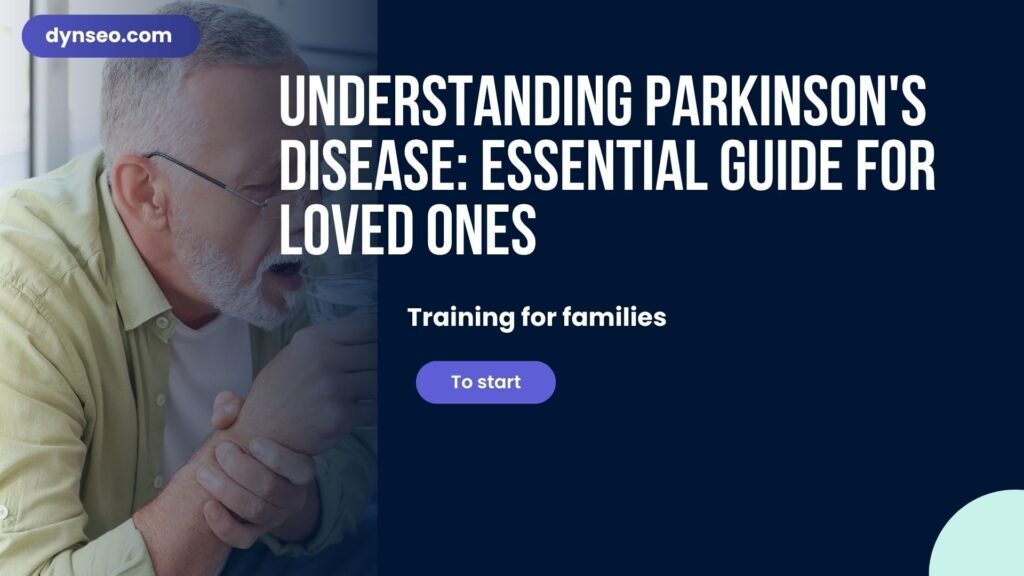
Caregiver for Parkinson's: 7 strategies to understand Parkinson's disease
Supporting a relative with Parkinson's disease starts with understanding it. Beyond the tremors, it's an entire daily routine to tame — and 7 concrete strategies to support without exhausting oneself.
Dans cet article
Les ressources citées
 Décodeur d'Expressions Faciales
 Thermomètre des émotions
 Roue des choix - Outils Formation DYNSEO
When Parkinson's disease enters a family, relatives often find themselves helpless in the face of a disease they thought they knew — "the tremors," one might think — which turns out to be much more complex and bewildering. Why is he blocked for a moment, agile the next? Why these moments of apathy, these restless nights, this weakening voice? Understanding the disease is the first and most powerful strategy for the caregiver: one can support better when one grasps what is happening. This guide offers 7 concrete strategies to understand Parkinson's disease and support a relative in daily life — without forgetting oneself. It is aimed at families, spouses, children, but also at professionals who wish to better support caregivers. Because a caregiver who understands is a more serene, more effective, and better protected caregiver.
1. Understanding Parkinson's: much more than tremors
1.1 A neurodegenerative disease with multiple faces
Parkinson's disease is a neurodegenerative disease: it results from the progressive disappearance of certain neurons in the brain, particularly those that produce dopamine, a chemical messenger essential for controlling movements. This decrease in dopamine explains the characteristic motor symptoms. But reducing Parkinson's to just tremors is a common mistake: not all patients tremble, and the disease has many non-motor symptoms that are often unknown, sometimes more disabling than movement disorders. It is a chronic disease that evolves slowly over many years, and whose expression varies greatly from person to person.
This variability is one of the great difficulties for those around. Two people with Parkinson's may present very different profiles: one may tremble a lot but maintain good autonomy for a long time, while the other may not tremble at all but suffer mainly from slowness, stiffness, and non-motor disorders. There is therefore no "typical" Parkinson's patient, and comparisons with other affected individuals — "so-and-so is doing much better than you" — are as unfair as they are useless. Supporting someone means understanding the disease as it manifests in your particular relative, in its own form and at its own pace. It is this individualized, attentive, and informed perspective that defines the quality of support.
1.2 Motor and non-motor symptoms
Understanding the diversity of symptoms helps the caregiver not to misinterpret what they observe. Here are the main manifestations, both motor and non-motor.
🤲 Resting tremor
Characteristic tremor, present at rest and decreasing during movement. Not all patients exhibit it.
🧊 Rigidity
Muscle stiffness that makes movements difficult and sometimes painful. Movements become jerky.
🐢 Slowness (akinesia)
Slowing down and difficulty initiating movements: getting up, walking, writing. Central symptom of the disease.
😶 Stiff face, weak voice
Reduced facial expression (which can be mistakenly taken for indifference) and a weakening voice. Frequent sources of misunderstandings.
😔 Mood disorders
Depression, anxiety, apathy (loss of drive, motivation). Very common and often confused with "letting go".
🧠 Cognitive disorders
Slowing of thought, attention and memory disorders, sometimes more pronounced at an advanced stage.
😴 Sleep disorders
Restless nights, insomnia, daytime drowsiness. Non-restorative sleep worsens fatigue and symptoms.
⚙️ Various disorders
Constipation, swallowing disorders, pain, fatigue, tension disorders: various symptoms to be aware of.
most common neurodegenerative disease after Alzheimer's disease
average age at diagnosis, although earlier forms exist
many symptoms (mood, sleep, cognition) are invisible but often very disabling
the disease progresses slowly: support is long-term, with different phases
⚠️ Absolutely to understand: the stiff face and weak voice of Parkinson's can give the impression that the person is indifferent, sad, or uninterested. This is false: behind this "mask," emotions are very much present and intact. Many misunderstandings and relational wounds arise from this misconception. Knowledge changes everything in the relationship.
2. The 7 strategies for Parkinson's caregivers
Here are the 7 key strategies to understand and support a loved one with Parkinson's. Each is then explored in the following sections.
Inform yourself to understand the disease
Know the motor and non-motor symptoms, the progression, the treatments. Understanding means stopping misinterpretation — and supporting more accurately.
Understand the "on/off" fluctuations
Abilities vary throughout the day, related to treatments. Anticipating these fluctuations avoids frustrations and misunderstandings.
Adapt communication
Weak voice, slowness, stiff face: adjust your way of exchanging, take your time, do not finish sentences, read non-verbal cues.
Support autonomy without overprotecting
Help just enough, let the person do what they can still do. Preserving autonomy is preserving dignity and morale.
Encourage physical and cognitive activity
Movement and brain stimulation are major allies. Moving and thinking regularly slows down deconditioning.
Identify and support non-motor symptoms
Mood, apathy, sleep, cognition: do not neglect them, report them to the medical team, understand them as symptoms and not choices.
Taking care of oneself, the caregiver
An exhausted caregiver can no longer provide support. Preserving one's energy, accepting help, and seeking support are essential strategies, not a luxury.
3. Strategy 2: understanding the "on / off" fluctuations
3.1 When abilities change throughout the day
One of the most confusing features of Parkinson's disease is the fluctuation of symptoms. Throughout the same day, the person can go from "on" phases — where they move relatively well, with treatments fully effective — to "off" phases — where they are slowed down, stiff, or blocked. These variations are related to the progression of the disease and the action of medications, whose effects rise and then fall. For an untrained relative, these changes may seem incomprehensible, even suspicious: "they could do it this morning, why not now?". Understanding that these fluctuations are a symptom of the disease, and not a lack of will or "bad faith," is essential to avoid frustration and tension.
3.2 The phenomenon of "freezing"
A particularly impressive phenomenon is "freezing": the person suddenly finds themselves "stuck to the ground," unable to initiate a step, often at the threshold of a door or during a turn. This is neither fear nor a voluntary blockage: it is a transient neurological dysfunction. A few tips can help to unblock it: counting out loud, marking a rhythm, stepping over a visual marker on the ground, taking a big step. Knowing these strategies prevents panic and allows for calm support. Keeping track of "on" and "off" moments with a tool like the DYNSEO session tracking sheet also helps to communicate with the neurologist to adjust treatments.
4. Strategy 3: adapting communication
4.1 Working with voice and face
Parkinson's disease often affects communication in two ways: the voice weakens and becomes monotone (this is called hypophonia), and the face loses expressiveness (the "Parkinsonian mask"). These two symptoms can severely disrupt exchanges. The person speaks more softly, they are constantly asked to repeat, which can discourage them from speaking. And their unexpressive face is misinterpreted by those around them as boredom, sadness, or indifference, while emotions are very much present. A few adaptations help: positioning oneself facing the person, in a calm environment, giving them time to speak, not finishing their sentences for them, and paying attention to non-verbal signals. The DYNSEO facial expression decoder can help better read these subtle signals.
4.2 Allowing space for emotions
Behind the mask, emotional life continues. Giving the person ways to express what they feel is valuable, especially when speaking becomes difficult. The DYNSEO emotion thermometer and the DYNSEO choice wheel provide simple visual supports to express a state, a need, a preference, without having to verbalize everything. For situations where communication becomes very difficult, the MY DICTIONARY app provides additional support.
✗ Inappropriate communication
- Interpreting a frozen face as indifference
- Becoming impatient with the slowness of speech
- Finishing sentences for the person
- Speaking in noise, without facing them
- Raising the voice believing "they can't hear"
- Giving up on exchanging, isolating the person
✓ Appropriate communication
- Knowing that emotions are intact behind the mask
- Allowing time, welcoming the rhythm
- Being patient, not anticipating speech
- Calm environment, face to face
- Listening attentively rather than shouting
- Maintaining connection and exchanges
5. Strategy 4: Supporting autonomy without overprotecting
Faced with the slowness and difficulties of the person, the caregiver's reflex is often to "do it for them" to go faster or relieve them. This is understandable, but this reflex, over time, can prove counterproductive: it accelerates the loss of autonomy, decreases the person's confidence, and increases the caregiver's burden. The right strategy is to help "just enough": let the person do what they can still do, even slowly, and only intervene where necessary. Taking the time, adapting the environment to facilitate actions (grab bars, easy clothing, adapted utensils), and valuing what the person achieves are powerful levers. Preserving autonomy is not harshness: it is respecting dignity and supporting morale.
This principle is all the more important as the loss of autonomy in Parkinson's is not linear: it depends on the "on/off" phases, good days and bad days. A person able to dress independently one morning may need help in the afternoon. The caregiver must therefore continuously adjust their assistance, closely aligned with the person's current abilities, rather than freezing a level of support "for safety." Too much help when the person could do it alone is as detrimental as not enough help when they are struggling. This fine adaptation requires observation and flexibility, but it is one of the keys to respectful support that maintains the autonomy and self-confidence of the loved one for as long as possible.
💡 Practical advice: many actions become easier with a little time and some tips rather than direct help. To initiate a blocked movement, one can use "external cues": a rhythm, counting, a visual cue. These strategies, which bypass the deficit by relying on other circuits of the brain, often restore to the person an autonomy that was thought to be lost.
🎓 Training: Understanding Parkinson's disease — essential guide for caregivers
✓ At your own pace
✓ Qualiopi Certified
Designed for caregivers (spouses, children, families) as well as for support professionals, this DYNSEO training gives you the keys to understand Parkinson's disease in all its dimensions — motor and non-motor symptoms, fluctuations, progression — and to provide daily support accurately: communication, autonomy, stimulation, and caregiver preservation. Online, at your own pace, and Qualiopi certified, it transforms worry into understanding and concrete strategies.
Discover the training →6. Strategy 5: encourage physical and cognitive activity
6.1 Movement, a major ally
Physical activity is one of the best-documented levers for supporting Parkinson's disease. Far from being contraindicated, it is actually highly recommended: it helps maintain mobility, balance, flexibility, limits deconditioning and rigidity, and also has beneficial effects on mood. Walking, gentle gymnastics, rhythmic activities (dance, for example, remarkably utilizes external cues), adapted exercises with a physiotherapist: there are many possibilities, to be adjusted with the care team and according to the person's abilities. The caregiver plays a key role in encouraging, supporting, and making these activities regular and enjoyable.
6.2 Stimulate the brain, gently and with pleasure
Beyond the body, the brain also benefits from stimulation. Parkinson's disease can be accompanied by a slowing of thought and attention or memory disorders. Regular cognitive stimulation — memory games, attention games, logic games, language games — helps maintain these functions, keep engagement, and preserve moments of pleasure and success, which are precious for morale. The application SCARLETT, designed for seniors and particularly adapted for those affected by Parkinson's, offers accessible games with large targets and simple instructions, for gentle stimulation without pressure.
7. Strategy 6: identify non-motor symptoms
7.1 Apathy is not laziness
Among non-motor symptoms, apathy is one of the most misunderstood. The person seems to have lost all drive, initiative, and interest — they remain seated, propose nothing, do not react. Those around them often interpret it as laziness, depression, or "letting go," and may become annoyed or saddened by it. However, apathy is a neurological symptom of the disease, related to dopamine deficiency: it is not a choice or a lack of will. Understanding it as such changes the response: instead of reproaching, one stimulates gently, proposes, supports, without blaming the person for something they cannot control.
7.2 Mood, sleep, cognition: do not overlook anything
Mood disorders (depression, anxiety), sleep, and cognition issues are common in Parkinson's disease and deserve the caregiver's full attention. They can sometimes be more debilitating than motor symptoms, and they are amenable to management. The caregiver's role is to identify them, not to trivialize them, and to report them to the medical team. Keeping track of changes with a tool like the DYNSEO Skills Tracking Table helps to objectify changes and discuss them usefully with caregivers.
| Non-motor symptom | Frequent misinterpretation | Caregiver's response |
|---|---|---|
| Apathy | “He is lazy / he is letting himself go” | Stimulate gently, propose, report |
| Frozen face | “She is indifferent / sad” | Know that the emotion is intact behind |
| Slowness | “He is doing it on purpose / he could go faster” | Give time, do not rush |
| Sleep disorders | “It's age / it's nothing” | Report, care for sleep hygiene |
| Anxiety / depression | “She is dramatizing” | Listen, support, guide towards care |
8. Strategy 7: take care of yourself, the caregiver
8.1 Caregiver burnout, a real risk
Supporting a loved one with Parkinson's over the long term — the disease progresses over years — exposes the caregiver to a real risk of physical and moral exhaustion, sometimes referred to as "caregiver burnout." Fatigue, isolation, anxiety, feelings of guilt, neglecting one's own life: the warning signs are numerous and often ignored by the caregiver themselves, who "hangs on" at all costs. However, taking care of oneself is not a luxury or selfishness: it is a condition for the sustainability of support. An exhausted caregiver can no longer provide proper support and risks compromising their own health.
8.2 Accepting help and seeking support
Some guidelines to preserve the caregiver: accept help and delegate (family, professionals, home helpers, day care), preserve time for oneself without guilt, maintain a social life and personal activities, and seek support (patient and caregiver associations, support groups, psychological support, respite platforms). Informing and training oneself — such as with a dedicated training — also helps to feel less helpless and more serene. And the caregiver can also allow themselves moments of relaxation and stimulation: the application CLINT offers, for example, a fun moment for oneself amidst a busy daily life.
🧭 The essentials to remember
Understanding Parkinson's disease means going beyond the cliché of tremors to grasp a much broader reality: motor and non-motor symptoms, "on/off" fluctuations, facial mask, apathy. The 7 strategies for caregivers — informing oneself, understanding fluctuations, adapting communication, supporting autonomy, encouraging physical and cognitive activity, identifying non-motor symptoms, and taking care of oneself — form a solid framework for providing accurate and lasting support. At the heart of it all: not confusing symptoms with choices, and preserving the relationship, dignity, and the caregiver themselves.
9. Understanding the evolution and role of treatments
9.1 A disease that evolves in stages
Parkinson's disease is chronic and progressive: it progresses slowly over many years, and its pace varies greatly from person to person. Schematic observations often show an initial phase where symptoms are mild and well-controlled by treatments (sometimes called the "honeymoon"), followed by a phase where fluctuations appear and treatment adjustments become more delicate, and finally a more advanced phase where autonomy decreases and support intensifies. Knowing these major stages helps the caregiver anticipate, not panic at every change, and adapt their support to the phase being experienced. Each journey being unique, these markers are indicative and not a fixed timeline.
9.2 Treatments, without substituting for doctors
The treatment of Parkinson's disease mainly relies on medications that compensate for the dopamine deficit, finely adjusted by the neurologist. Rehabilitation also plays a major role: physiotherapy for mobility and balance, speech therapy for voice and swallowing, occupational therapy for daily living adaptations. The caregiver's role is not to decide on treatments — that strictly falls to the medical team — but to observe, report changes and effects, ensure proper adherence to medication (timing is very important in Parkinson's), and facilitate access to various rehabilitations. Good coordination between the caregiver and the healthcare team is valuable for adjusting support.
⏰ The timing of medication matters: in Parkinson's disease, adhering to medication schedules directly influences the "on/off" fluctuations. A delay or a missed dose can trigger a difficult "off" phase. Helping the person strictly adhere to their schedule (reminders, pill organizer, routine) is one of the most useful concrete supports that a caregiver can provide — always within the framework of the doctor's prescription.
9.3 Preserving the relationship beyond the disease
A common pitfall over time is allowing the disease to invade the entire relationship: the caregiver becomes a "full-time caregiver," and the original bond — of couple, lineage, friendship — fades behind care and constraints. However, preserving this relationship beyond the disease is essential, for both the person and the caregiver. Continuing to share moments of pleasure, activities, memories, conversations that do not revolve around the disease; seeing the person before the patient; preserving roles and projects: these are all ways to keep the relationship alive. Parkinson's disease changes many things, but it should not erase the person or the bond that unites you.
✗ When the disease invades everything
- The relationship is reduced to care and constraints
- Only the "patient" is seen, not the person
- Conversations revolve solely around Parkinson's
- Shared moments of pleasure disappear
- The caregiver becomes exhausted and loses their own balance
✓ When we preserve the bond
- Care has its place, but does not consume everything
- The person is seen before the patient
- Joyful topics and projects are also shared
- Moments of pleasure and complicity are maintained
- Caregiver and loved one preserve their balance and bond
10. Daily scenarios
« It seems like he's bored when I talk to him »
« This morning he was walking, now he's stuck »
« I hold on, I have no choice »
11. DYNSEO tools for Parkinson's caregivers
🌡️ Emotion thermometer
To help the person express what they feel, even when speech and facial expressions are affected.
Download →🎡 Choice wheel
A visual aid to express needs and preferences without verbalizing everything.
Download →😊 Facial expression decoder
To better read the non-verbal signals behind the "Parkinsonian mask".
Download →📈 Skills tracking chart
To objectively assess the evolution of symptoms and discuss them usefully with the medical team.
Download →📝 Session tracking sheet
To note the "on/off" phases, activities, and observations to share with the neurologist.
Download →12. DYNSEO applications for Parkinson's
🟪 SCARLETT — Seniors & Parkinson
The reference application here: cognitive stimulation adapted for seniors and people affected by Parkinson's, with accessible games (large targets, simple instructions) for memory, attention, and language, gently and without pressure.
Discover SCARLETT →🟦 CLINT — Adults
For caregivers: a moment of stimulation and relaxation for oneself, and for younger adults affected by an early form of the disease.
Discover CLINT →🟥 MY DICTIONARY — Communication
When the voice weakens significantly or communication becomes difficult: support to express needs with visual aids.
Discover MY DICTIONARY →🟩 COCO — Children 5-10 years
For grandchildren: share moments of play and stimulation, and maintain a joyful intergenerational bond.
Discover COCO →🧠 Understand Parkinson's, support without exhausting yourself
Emotion thermometer, choice wheel, expression decoder, tracking sheets, and SCARLETT application — DYNSEO offers concrete tools to support a loved one with Parkinson's, gently.
❓ Frequently asked questions about Parkinson's disease and support
Parkinson's disease is not just about tremors?
No, and this is one of the most persistent misconceptions. Resting tremor is the most well-known symptom, but not all patients exhibit it. The disease includes three main motor symptoms — tremor, rigidity, and slowness of movement (akinesia) — along with many often-unknown non-motor symptoms: mood disorders (depression, anxiety, apathy), sleep disorders, cognitive disorders, pain, constipation, weak voice, and expressionless face. These non-motor symptoms can sometimes be more disabling than movement disorders. Understanding this diversity is essential for providing support without misunderstanding what is observed.
Why can my loved one do something in the morning but not in the afternoon?
This is the phenomenon of "on/off" fluctuations, characteristic of Parkinson's disease, especially as it progresses. Motor abilities vary throughout the day, linked to the effects of treatments that rise and then fall, and with the progression of the disease. In the "on" phase, the person moves relatively well; in the "off" phase, they are slowed down, stiff, and sometimes blocked. These variations are neither a lack of will nor "acting": they are symptoms. Understanding them allows for adapting important activities to the right times of the day and supporting difficult phases with calm and patience.
My loved one seems indifferent and sad — is it depression?
Two things need to be distinguished. On one hand, the "Parkinsonian mask": the face loses expressiveness due to the disease, which gives an impression of indifference or sadness while emotions are actually present behind this mask. On the other hand, depression and apathy are common and real non-motor symptoms of the disease, linked to brain changes. If you observe a lasting loss of drive, interest, or morale, it is important to discuss it with the medical team, as these disorders can be addressed. In any case, do not interpret these signs as laziness or voluntary disinterest: they are manifestations of the disease.
Should I do everything for my loved one to relieve them?
No, and this is a common trap. The reflex to "do it for them" comes from good intentions, but over time, it accelerates the loss of autonomy, decreases the person's confidence, and increases your burden as a caregiver. The right strategy is to help "just enough": let the person do what they can still do, even slowly, and only intervene where it is truly necessary. Taking the time, arranging the environment to facilitate actions, using tricks (rhythm, visual cues to unblock a movement), and valuing successes preserve autonomy and morale. Supporting autonomy is respecting dignity.
Is physical activity recommended or risky?
Physical activity is not only recommended, but it is one of the best-documented levers for supporting Parkinson's disease. It helps maintain mobility, balance, and flexibility, limits deconditioning and rigidity, and has positive effects on mood. Walking, gentle gymnastics, rhythmic activities like dance (which remarkably utilizes external cues), exercises with a physiotherapist: the possibilities are numerous. The key is to adapt the activity to the person's abilities, ideally with the advice of the care team, and to make it regular and enjoyable. As a caregiver, encouraging and supporting these activities is a valuable role.
Can cognitive stimulation help my loved one?
Yes. Parkinson's disease can be accompanied by a slowing of thought and attention or memory disorders. Regular cognitive stimulation — memory games, attention games, logic games, language games — helps maintain these functions, keep engagement, and preserve moments of pleasure and success, which are important for morale. The key is regularity and gentleness, without performance pressure. Applications like SCARLETT, designed for seniors and adapted for people affected by Parkinson's (large targets, simple instructions), allow for accessible stimulation. It does not replace medical and rehabilitation care, but it constitutes a beneficial complement.
How to avoid burnout as a caregiver?
Caregiver burnout is a real risk, as the disease progresses over many years. Taking care of oneself is not selfish: it is a condition for being able to continue providing support. Some guidelines: accept help and delegate (family, home helpers, day care, respite platforms), preserve time for oneself without feeling guilty, maintain a social life and personal activities, and seek support from patient and caregiver associations, support groups, or psychological support. Recognizing one's own warning signs (fatigue, isolation, irritability, anxiety) and not waiting until one is overwhelmed are essential. A caregiver who takes care of themselves can provide better and longer support.
Who is the DYNSEO training on Parkinson's disease aimed at?
The training "Understanding Parkinson's Disease: Essential Guide for Caregivers" is primarily aimed at family caregivers — spouses, children, families — who wish to better understand the disease to provide better support, as well as professionals in the support field (home helpers, life assistants, social and medical workers). It clearly explains without jargon the motor and non-motor symptoms, fluctuations, the progression of the disease, and especially concrete daily strategies: communication, autonomy, stimulation, and preserving the caregiver. Online, accessible at your own pace and Qualiopi certified, it transforms worry and misunderstanding into active understanding and serenity.
This article is for informational purposes and does not replace personalized medical advice. For any questions regarding symptoms, treatments, or the progression of the disease, please consult the healthcare team (primary care physician, neurologist) who is caring for your loved one. Patient and caregiver associations can also provide information and support.
🌟 Train yourself to better understand — and better support
Symptoms, fluctuations, communication, autonomy, stimulation, and support for the caregiver: the DYNSEO training "Understanding Parkinson's Disease" gives you all the keys — online, at your own pace, Qualiopi certified.
Did this content help you? Support DYNSEO 💙
We are a small team of 14 people based in Paris. For 13 years, we have been creating free content to help families, speech therapists, care homes and healthcare professionals.
Your feedback is the only way we know if our work is useful. A Google review helps us reach other families, caregivers and therapists who need it.
One action, 30 seconds: leave us a Google review ⭐⭐⭐⭐⭐. It costs nothing, and it changes everything for us.