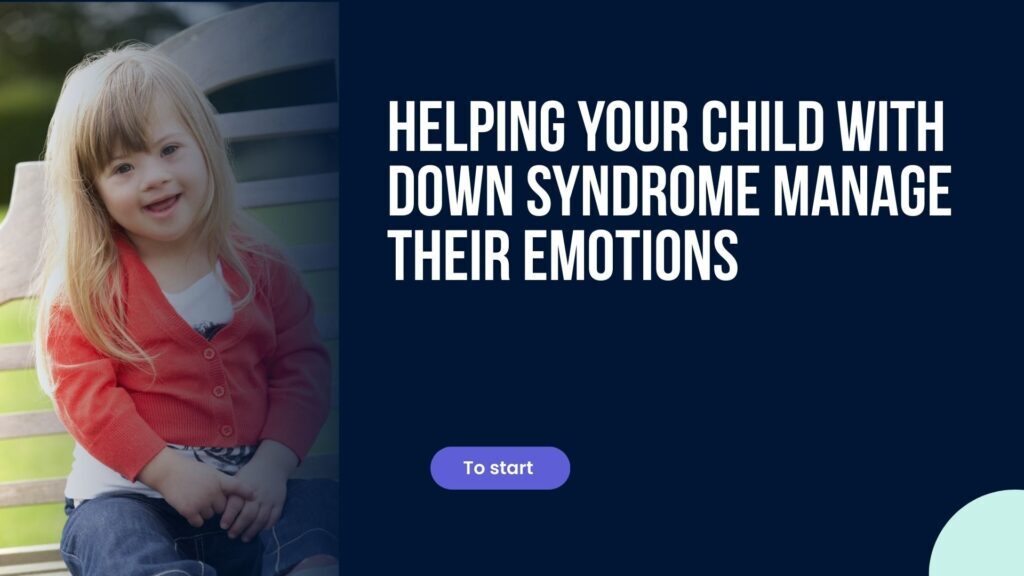
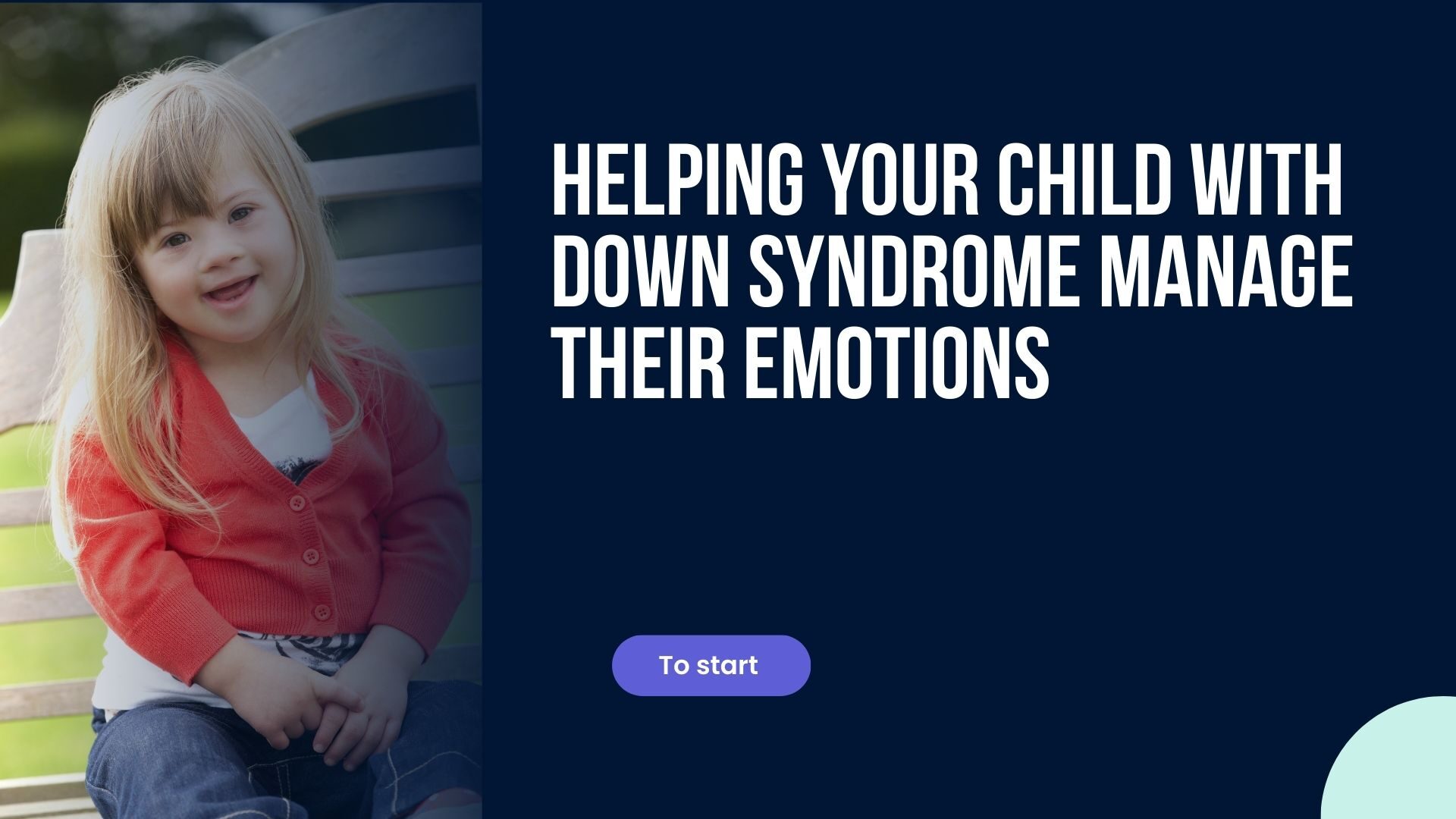
Helping your child with Down syndrome manage their emotions: daily support
Children with Down syndrome have a rich and intense emotional life. This practical guide supports families and professionals in learning emotional regulation — with kindness, suitable tools, and concrete strategies.
Access the training →Dans cet article
La formation associée
Les ressources citées
 Thermomètre des émotions
 Roue des choix - Outils Formation DYNSEO
He bursts into tears when told no. She refuses to change activities and lies on the floor. He repeats "it's not fair" on loop for twenty minutes. She is overwhelmed with joy when her friend arrives and can't stop laughing. Children with Down syndrome have an intense, authentic emotional life, often overflowing — and their ability to express what they feel is often their greatest strength. But this intensity requires specific learning in regulation: tools tailored to their cognitive processing style, a kind approach that respects their pace, and strategies that truly work in the reality of family life.
1. Emotional life in Down syndrome: understanding to better support
1.1 Intense, authentic emotions that are often difficult to regulate
Down syndrome (or Trisomy 21) is a chromosomal anomaly related to the presence of a third chromosome 21. Neurologically, it affects the development of certain brain structures involved in emotional regulation — particularly the connections between the amygdala (emotion center) and the prefrontal cortex (regulator). As a result: emotions often arrive with above-average intensity, and regulation mechanisms (inhibition, verbalization, relativization) develop more slowly and require more explicit and prolonged learning than in a neurotypical child.
This does not mean that children with Down syndrome are "more difficult" or "less able to control themselves" — it means they need explicit and patient teaching of emotional skills, with tools adapted to their processing style (visual, concrete, repetitive) and a supportive approach that values their emotional strengths.
2. Specific emotional characteristics of Down syndrome
Emotional intensity
Both positive and negative emotions come on strong and last longer. Joy can be explosive, sadness inconsolable, anger overwhelming.
Strategy: Emotion thermometer, validate before regulatingRigidity and difficulties with transitions
Changing activities, accepting a "no," adapting to the unexpected — transitions that can trigger intense crises in many children with Down syndrome.
Strategy: Illustrated routine chart, announce transitionsEmotional perseveration
The emotion lasts longer and "loops" — anger or sadness persists after the cause has disappeared. Difficult to explain, difficult to interrupt.
Strategy: Calm-down routines, Choice WheelStrong social empathy
High sensitivity to the moods of close people — picks up on parents' anxiety, a friend's sadness. This empathy is a strength that needs to be channeled.
Strategy: Name the adult's emotions to demystify themGap between understanding and expression
The child often understands more than they can express verbally — frustration when words are lacking to say what they feel.
Strategy: MY DICTIONARY, emotional pictograms, augmented communicationNeed for validation and emotional security
The child with Down syndrome often has an increased need for emotional validation — for their emotions to be recognized and accepted before seeking to regulate them.
Strategy: systematically validate before regulating3. DYNSEO training — helping your child with Down syndrome manage their emotions
Helping your child with Down syndrome manage their emotions
This online certified training is aimed at parents and families of children with Down syndrome, as well as professionals (educators, teachers, speech therapists, psychomotor therapists, caregivers) who support these children daily. It provides the foundations of emotional development in Down syndrome and concrete, tailored support strategies.
Access the training →4. Concrete strategies for supporting emotional regulation
Validate before regulating
"I see that you are very angry — it's normal to be angry when [what happened]." Validation of the emotion must precede any attempt at regulation. A child whose emotion is not recognized cannot calm down.
Visualized Emotion Thermometer
The DYNSEO Emotion Thermometer — with suitable expressive faces — helps the child identify and point out their emotional state without having to verbalize it.
Illustrated calm-down routine
A visual sequence displayed in the calm space: 1) go to their corner / 2) breathe / 3) choose a calming activity / 4) say when they are ready to return. Learned outside of crisis, practiced outside of crisis.
The Regulation Choice Wheel
The DYNSEO Choice Wheel offers calming strategies that the child chooses — developing self-determination even in moments of emotional difficulty.
Anticipate difficult transitions
Announce activity changes 5-10 minutes in advance. Visual timer to visualize the end. DYNSEO illustrated routine chart to make the day predictable and secure.
Adapted communication during the crisis
During the crisis: short and simple words, calm voice, slow gestures. MY DICTIONARY from DYNSEO if verbal expression is impossible. No arguing. Kind presence.
5. Emotionally secure environment
Predictable morning routine
A morning without surprises reduces anticipatory anxiety. Illustrated routine chart displayed in the bathroom or kitchen.
Accessible calm space
Corner with cushion, stuffed animal, calming sensory object — accessible at all times, non-punitive. The child chooses to go there.
Daily regulation activities
Drawing, music, adapted physical activity — emotional regulators integrated into the routine, not just offered in crisis.
Adult co-regulation
The calm adult allows the child to regulate by synchronizing. Soft voice, slow rhythm, visible breathing — regulation is "transmitted".
Daily emotional language
Name emotions within the family throughout the day ("I am happy today because...", "I am a bit tired tonight...") — model what you want to teach.
Bedtime ritual
Moment of emotional verbalization of the day — "the best moment of the day", "something that made you angry" — in a simple and playful format.
💛 What works in communication with a child with Down syndrome in crisis
- Do: get down to their level (squat), calm and slow voice, simple and short words
- Do: name the observed emotion ("you are very angry")
- Do: offer the calm space with a gesture, not a verbal command
- Do: wait for the biological crisis to pass (90 seconds) before acting
- Avoid: long explanations during the crisis — verbal processing is saturated
- Avoid: "calm down" — command impossible to execute without a tool
- Avoid: punishments related to the emotion itself (anger, crying) — punish the expression, not the behavior
💛 Support your child with the right tools
The DYNSEO training "Helping your child with Down syndrome manage their emotions" gives you concrete strategies to transform daily life — online, at your own pace, Qualiopi certified.
6. DYNSEO tools and applications for children with Down syndrome
📚 Down syndrome educational adaptation guide
Adapting teaching to the cognitive profile of Down syndrome — for teachers and parents who support learning.
Download →💬 Adapted communication sheet for Down syndrome
Adapting your way of communicating to the child's profile — simple words, short sentences, visual supports.
Download →🗓️ Illustrated routine chart
Making the day predictable and secure — the basic tool to reduce anxiety during transitions.
Download →🌡️ Emotion thermometer
Identify and communicate emotional state — illustrated version adapted for children with Down syndrome.
Download →🎡 Choice Wheel
Calm-down strategies chosen by the child — developing emotional self-determination.
Download →🗂️ Complete catalog
50+ tools for the educational and emotional support of children with Down syndrome.
See all →🟩 COCO — Children
Adaptive cognitive stimulation for children with Down syndrome — memory, attention, executive functions. Accessible interface, short sessions, adaptive progression. Recommended 4-5 times/week.
Discover COCO →🟥 MY DICTIONARY — AAC
Alternative and Augmentative Communication — for children with Down syndrome with limited verbal communication. Express emotions and needs through pictograms with speech synthesis.
Discover MY DICTIONARY →🟦 CLINT — Adults
For parents — maintain their own cognitive and emotional resources in intense daily parenting support.
Discover CLINT →🤖 DYNSEO AI Coach
Questions about Down syndrome, emotional regulation, resources — expert answers available 24/7 for families and professionals.
Discover the AI Coach →❓ Frequently asked questions about emotion management in Down syndrome
Do children with Down syndrome have the same emotions as other children?
Yes — children with Down syndrome feel all human emotions: joy, sadness, anger, fear, surprise, disgust. What is different is how these emotions are processed and regulated — often with greater intensity, longer persistence, and sometimes more direct expression (less social filtering). Far from being "emotionless" or "always happy" children (a particularly reductive stereotype), children with Down syndrome have a rich and complex emotional life that deserves to be taken seriously and supported with care.
How to react when my child with Down syndrome has a meltdown in public?
The priority is physical safety and reducing sensory overload (moving away from crowds, finding a calm space). Ignore the looks from bystanders — your child needs your calm presence, not your social management of others' gazes. Your calmness is the first regulatory tool: stay grounded, breathe, use a soft voice. Offer the calm space or a known calming strategy. After the meltdown, analyze the context to prevent it next time — too much noise? Hunger? Poorly announced transition? The meltdown is information, not a failure.
How to teach the Emotion Thermometer to a child with Down syndrome?
Teaching the Emotion Thermometer should be explicit, repeated, and especially practiced outside of crisis moments — when the child is calm and available. Steps: introduce the tool with expressive photos or drawings. Practice daily ("Look, you are happy — would you point to number 4 on the thermometer"). Start with 3 levels (red/orange/green) before increasing. Use the tool during positive moments as well as difficult ones. Regular practice outside of crises is what allows the child to use it in challenging situations.
At what age can we start teaching emotional regulation?
From a very young age — even before the child can verbalize. Between 0 and 3 years: adult co-regulation is the main learning. When the parent remains calm, the child learns that intense emotions pass. Between 3 and 6 years: name the emotions, introduce simple visual supports (3 levels), calming routines. From 6-7 years: Emotion Thermometer, Choice Wheel, identifying triggers. Learning never stops — strategies become more sophisticated with the child's cognitive development.
How to coordinate strategies between home and school?
Consistency between environments is crucial for the child with Down syndrome — using the same tools and words at home and school creates a reassuring continuum. Practical tools: daily communication notebook, sharing DYNSEO tools with the teacher and the AESH, regular ESS meetings with all stakeholders. Invest time in September to align approaches with the entire team around the child — it's an investment that reduces crises throughout the year.
Does MY DICTIONARY really help children with Down syndrome express their emotions?
Yes — especially for children with Down syndrome whose gap between understanding and verbal expression is significant. MY DICTIONARY allows them to "point" to an emotion on a pictogram when words do not come — reducing the communication frustration that often fuels meltdowns. Studies on AAC in Down syndrome show that using augmentative supports does not delay the development of oral language — on the contrary, it reduces the pressure on verbal communication and can facilitate its emergence. A specialized speech therapist can guide the implementation.
How to explain Down syndrome and emotions to siblings?
With age-appropriate honesty. With young children: "Your brother/sister's brain learns differently — emotions come stronger for him/her, and he/she is learning to manage them just like you learned to walk or read." With older children: explain Down syndrome, the neurological difference, and the strategies used. Involve siblings in certain strategies (pointing to the thermometer together, offering the calm space) — value their positive role. Also validate their own experiences — impatience, shame sometimes, love — without denying the complexity of living with a sibling with Down syndrome.
Is COCO from DYNSEO suitable for children with Down syndrome?
Yes — COCO is specially designed for the cognitive profiles of children who learn differently, with an adaptive progression that adjusts to the child's level, short sessions (15 minutes) suited to attention capacities, an accessible visual interface, and non-competitive activities that do not generate performance anxiety. The skills worked on (working memory, attention, cognitive flexibility) directly support the development of emotional skills — better memorizing strategies, better focusing attention on internal signals, better adapting to changes. Recommended 4-5 sessions per week for optimal effect.
Helping your child with Down syndrome manage their emotions
Online, at your own pace, certified Qualiopi — for families and professionals who want to support emotional regulation with the right tools and the right posture.
Access the training →Did this content help you? Support DYNSEO 💙
We are a small team of 14 people based in Paris. For 13 years, we have been creating free content to help families, speech therapists, care homes and healthcare professionals.
Your feedback is the only way we know if our work is useful. A Google review helps us reach other families, caregivers and therapists who need it.
One action, 30 seconds: leave us a Google review ⭐⭐⭐⭐⭐. It costs nothing, and it changes everything for us.