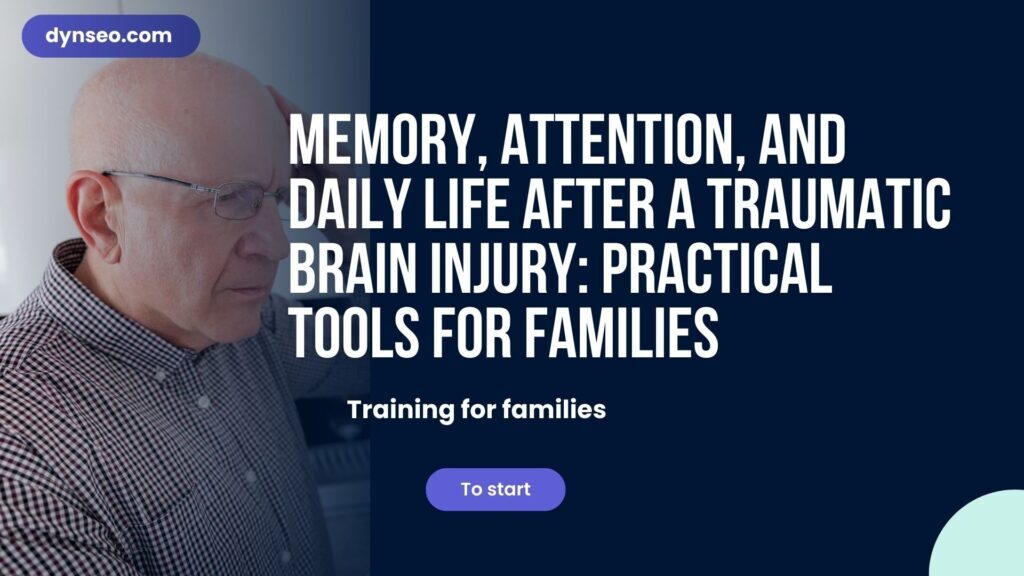
Life after a traumatic brain injury: memory, attention, and daily life — practical tools for families
After a traumatic brain injury, the person "comes back" — but they have sometimes changed. Forgetfulness, concentration difficulties, fatigue, irritability: invisible aftereffects that disrupt daily life. Understanding and equipping them means regaining family balance.
Dans cet article
La formation associée
Les ressources citées
 Tableau 3 colonnes
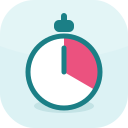 Timer Visuel
 Tableau de motivation - Outil Formation DYNSEO
 Thermomètre des émotions
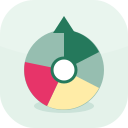 Roue des choix - Outils Formation DYNSEO
“Physically, he is recovered. But it’s not quite him anymore.” This phrase is spoken by so many families after a traumatic brain injury. Because beyond the visible aftereffects, a traumatic brain injury often leaves invisible traces: memory disorders, concentration difficulties, intense fatigue, personality changes, irritability. These cognitive and behavioral aftereffects, sometimes more destabilizing than physical aftereffects, transform the daily life of the person and their entire family. Loved ones often find themselves helpless, without a manual, facing difficulties they do not always understand, which put their patience and love to the test. This article is primarily aimed at families, but also at the professionals who support them: it aims to understand the cognitive aftereffects of traumatic brain injury (memory, attention, organization), and especially to discover practical tools and concrete strategies to support the person in daily life and preserve family balance.
1. Understanding traumatic brain injury and its aftereffects
1.1 What is a traumatic brain injury?
A traumatic brain injury (TBI) occurs when a blow to the head (road accident, fall, sports accident, assault) damages the brain. The severity varies considerably: from mild trauma (concussion) to severe trauma with prolonged coma. But even an apparently "mild" trauma can leave lasting cognitive aftereffects, often underestimated because they are invisible. The brain is the organ of thought, memory, attention, emotions, and behavior: an injury, even limited, can therefore impact all of these functions and profoundly transform the life of the person and their loved ones. It is this diversity of affected functions that explains why two traumatic brain injuries never really resemble each other.
After the hospital phase and initial rehabilitation comes the return home — a moment often eagerly awaited, but which reveals the extent of the changes. It is in daily life that the aftereffects fully manifest: forgetfulness, difficulties organizing one’s day, fatigue that arises unexpectedly, mood swings. The family then becomes the primary support, on the front lines, often unprepared for it. It is precisely this moment, and this role of loved ones, that this article aims to support, with clear guidelines and concrete tools.
This gap between the hospital and home often surprises. In the hospital, in a structured, supervised, and protected environment, the person may seem to be doing well. Back home, confronted with the complexity and unpredictability of real life — managing time, tasks, relationships, and unforeseen events — the difficulties come to light. Many families describe this moment as a second ordeal, sometimes more destabilizing than the accident itself, because no one had prepared them for it. Knowing that this gap is normal and expected already helps to cope better with it, and to understand that these difficulties are not a "relapse" but the reality of the aftereffects, which reveal themselves in daily life.
people hospitalized each year in France for a traumatic brain injury
cognitive and behavioral sequelae are often more enduring than physical sequelae
relatives are the primary support on a daily basis, often without preparation or instructions
the brain can reorganize: progress remains possible with stimulation and time
1.2 “It's not quite him anymore”: the mourning of the past
One of the most difficult trials for families is the feeling that the person has changed. A traumatic brain injury can alter character, mood, and reactions, to the point that relatives sometimes feel like they are living with someone different. This transformation is bewildering and painful, and it often comes with a genuine mourning: the mourning of the “before” person, of the relationship as it was, of shared plans. Recognizing and accepting this mourning, without guilt, is an important step on the journey. It is not a betrayal of the person to acknowledge that they have changed: on the contrary, it is the condition for loving and supporting them as they are today. And it must be emphasized: recognizing the change does not preclude hope. With time, rehabilitation, and stimulation, progress is possible, and the person continues to evolve. Supporting means holding together these two truths: accepting what is, while supporting what may still come.
👉 An essential message for families: difficult behaviors are not directed against you. Irritability, impulsivity, lack of initiative are not choices or rejections: they are direct consequences of the brain injury. Understanding this does not eliminate the difficulty, but profoundly changes the way it is experienced — and prevents feeling personally attacked or responsible.
2. Cognitive sequelae in daily life
To effectively support a loved one, it is important to understand which functions are affected and how they manifest in everyday life. Here are the main cognitive sequelae of traumatic brain injury.
🧠 Memory disorders
Frequent forgetfulness, difficulty retaining new information, remembering an appointment, or following instructions. Recent memory is often the most affected.
🎯 Attention disorders
Difficulty concentrating, maintaining a task, filtering distractions. The person “zones out” quickly, especially in noise or fatigue.
📋 Executive functions
Difficulty planning, organizing, starting an action, adapting. Lack of initiative is often mistakenly taken for laziness.
😴 Fatigue
Intense cognitive fatigue: thinking, concentrating, interacting is exhausting. It fluctuates and severely limits daily activities.
😤 Behavioral disorders
Irritability, impulsivity, disinhibition, emotional lability. Changes that weigh heavily on family life and relationships.
2.1 Memory and attention: the heart of the difficulties
Memory and attention disorders are at the heart of the consequences of traumatic brain injury and their daily repercussions. The person forgets what has just been said to them, loses track of a conversation, does not remember an appointment, repeats the same questions. These forgetfulness issues are neither due to a lack of will nor disinterest: they are real neurological dysfunctions. Attention disorders worsen the situation: the person is easily distracted, cannot complete a task, "zones out" as soon as there is noise or too much information. Fatigue, ever-present, further amplifies these difficulties.
The good news is that these difficulties can be largely compensated for by strategies and tools. One does not "repair" a failing memory through willpower, but alleviates it by relying on external supports: planners, lists, reminders, visual cues. This is the purpose of the practical tools we will see later. The principle is simple: what is noted or displayed no longer needs to be memorized, freeing the person from the stress and failure associated with forgetfulness, and restoring their autonomy.
It is important not to confuse "working on" memory and "compensating" for its difficulties. Constantly asking the person to "make an effort to remember" is not only ineffective but also a source of failure and discouragement: one does not strengthen a damaged memory like one strengthens a bicep, and putting it in repeated difficulty only erodes its confidence. Cognitive stimulation has its place — in a playful form, without pressure, and in addition to rehabilitation — but it does not replace compensatory tools, which remain the key to daily autonomy. The two approaches are complementary: one maintains functions in the long term, while the other allows for living and acting now despite the difficulties.
2.2 Behavioral changes: understanding to live better
Behavioral and mood changes are often what weighs most heavily on families. Irritability (the person gets upset over trivial matters), impulsivity (they act or speak without thinking), disinhibition (they say or do things they would never have done before), lack of initiative (they remain passive, with no apparent desire): all these behaviors are consequences of brain injury, particularly affecting the areas that regulate emotions and self-control. Understanding them as consequences, and not as flaws or rejections, is essential — for the person being supported as well as for the mental health of their loved ones.
2.3 Fatigue: the missing fuel
Fatigue deserves a special place, as it conditions everything else. After a traumatic brain injury, thinking, concentrating, memorizing, and socially interacting requires a considerable effort from the injured brain — much more than for an intact brain. The result: the person tires quickly, sometimes after what seems trivial (a conversation, shopping, a visit). This cognitive fatigue has nothing to do with laziness; it is a real lack of "brain fuel." It fluctuates throughout the day, often more pronounced in the late afternoon, and it exacerbates all other symptoms: a tired brain forgets more, concentrates less, and irritates more easily.
For families, understanding this fatigue changes a lot of things. It prevents pushing the person "for their own good" when they are at their limit, which would only worsen exhaustion and trigger tensions. Instead, it invites planning important activities at times of better energy (often in the morning), breaking tasks down, scheduling regular rest periods, and accepting that a busy day may be followed by a "low" day necessary for recovery. Respecting fatigue is not giving in to laziness: it is intelligently managing a limited resource, a condition for the person to function at their best capacity at the moment.
3. Practical tools for daily life
3.1 Compensate rather than correct
The fundamental principle of home support is compensation: rather than trying to "make work" a failing memory or attention (which leads to failure and discouragement), external tools are put in place to take over the affected functions. This approach, both more effective and more respectful, transforms daily life. The table below illustrates the contrast between an approach that vainly solicits and an approach that intelligently compensates.
This idea of compensation is liberating because it shifts the objective. One no longer seeks for the person to "become like before" through sheer will — an unrealistic goal and a source of frustration for everyone — but rather for them to live and act as best as they can despite their difficulties, thanks to adapted supports. It is exactly like the logic of glasses for a nearsighted person: one does not ask them to "make an effort to see better," one provides them with a tool that compensates. Cognitive compensatory tools play the same role for memory and organization. Adopting this perspective soothes family relationships: one stops expecting the impossible and exhausting oneself with reproaches, to instead implement, together, concrete solutions that work.
✗ Without compensatory tools
- “Make an effort to remember!”
- Repeated forgetfulness, missed appointments
- Unfinished tasks, disorganization
- Stress, feelings of failure, disputes
- The person loses confidence and autonomy
- Exhaustion and tension in the family
✓ With compensatory tools
- Agenda, lists, reminders take over
- Appointments noted and reminded, reduced forgetfulness
- Tasks broken down and followed step by step
- Less stress, more successes
- The person regains confidence and autonomy
- Calmness and family balance restored
3.2 Tools for memory and organization
Several simple tools support memory and organization on a daily basis. The DYNSEO 3-column Board helps structure a task or a day by distinguishing what needs to be prepared, done, and checked — a valuable support for a person whose executive functions are weakened. The DYNSEO Visual Timer makes time concrete, helps to gauge efforts and respect fatigue, and structures the alternation between activity and rest. Combined with an agenda, lists, and reminders (on paper or on smartphone), these tools relieve memory and organization, and restore autonomy to the person.
3.3 Tools for motivation and emotions
Lack of initiative and emotional disorders also call for tools. The DYNSEO Motivation Board values efforts and successes, supports engagement, and helps to re-engage an apathetic person without being abrupt. The DYNSEO Emotion Thermometer allows the person to express their state and helps the family better anticipate moments of tension. The DYNSEO Choice Wheel facilitates decisions and restores control, which is valuable in the face of difficulties with initiative and frustration.
💡 Practical advice for families: establish a stable and visible “external routine” — a board in the kitchen with the day's schedule, an agenda always in the same place, displayed lists. Regularity and visibility work wonders: they relieve the person's memory, reduce forgetfulness and conflicts, and limit the mental load on relatives, who no longer have to “carry everything” in their heads instead of their parent.
Memory, attention, and daily life after a Traumatic Brain Injury: practical tools for families
This online training is primarily aimed at families and caregivers, as well as the professionals who support them. It teaches you to understand the cognitive sequelae of traumatic brain injury and provides practical tools to support memory, attention, and organization in daily life. At your own pace, 100% online, certified Qualiopi.
Discover the training →4. Concrete strategies for daily life
4.1 To support memory
Beyond tools, a few simple strategies help cope with memory disorders. Establishing stable routines (same gestures, same times, same places) reduces the memorization load. Write everything down immediately rather than "relying on your memory." Break information into small units and repeat them. Associate information with cues (an object placed in plain sight, an alarm). And above all, do not dramatize forgetfulness or blame it: a forgotten item recalled with kindness is much better experienced than a forgotten item punished, which adds stress and worsens difficulties.
A particularly useful strategy is to always store important objects in the same place (keys on a dedicated hook, papers in a specific tray, medications in a pill organizer with compartments). What seems obvious for an intact brain becomes a lifesaver for a failing memory: the person no longer has to "remember" where they placed their belongings; they know that everything has its fixed place. Similarly, externalizing appointments and tasks on a single shared medium (a unique family calendar rather than scattered notes) prevents forgetfulness and duplicates, and reduces everyone's mental load. These strategies require neither cognitive effort nor sophisticated technology: just regularity and consistency, to be patiently established as family habits.
4.2 To support attention
Attention disorders can be compensated by reducing demands: a calm environment, free from noise and distractions, one task at a time (avoiding multitasking), short and clear instructions, regular breaks before fatigue. It is unnecessary and counterproductive to ask a person with a damaged brain to do several things at once or to concentrate for long periods without breaks: respect their current abilities, break tasks down, and adjust the pace. The visual timer is a valuable ally here to regulate periods of effort and rest.
4.3 To preserve family balance
Supporting a loved one after a traumatic brain injury is challenging, and the health of caregivers is a major issue. A few principles help sustain over time: do not carry everything alone (accept help, delegate, seek professionals and associations), preserve time for oneself without guilt, understand that difficult behaviors are not directed against oneself, and join family groups in the same situation to break isolation. An exhausted caregiver is no longer effective: taking care of oneself is not selfishness; it is a condition for being able to continue providing support.
It is also essential not to forget oneself as a person and as a couple or family. After a traumatic brain injury, the relationship can shift to an exclusively "caregiver-care recipient" dynamic, where one sees oneself only as a caregiver and patient. Preserving moments of shared pleasure, enjoyable activities, times when one is no longer in "doing" but in "living together," is vital for the relationship as well as for everyone's morale. Tools for playful stimulation, games, and adapted outings can contribute to this: they recreate positive moments and remind us that, despite difficulties, life goes on and retains its flavor. This balance between necessary support and the preservation of emotional bonds is one of the major challenges of daily life after a TBI.
⚠️ Well-being vigilance: caregiver burnout after a traumatic brain injury is common and serious. If you feel overwhelmed, isolated, or at your wit's end, it is not a failure: it is a sign that you need to seek support. Talk to a healthcare professional, a support organization for families of brain injury survivors, or your doctor. You do not have to bear this alone.
5. Daily life after a TBI: concrete examples
Nothing speaks better to families than lived situations. The three examples below illustrate the most common difficulties — memory, lack of initiative, behavioral disorders — and show how understanding the consequences and implementing tools transform daily life. Each time, the same shift: a behavior initially experienced as a flaw or an attack reveals itself to be a consequence, and the right response soothes what the reproach aggravated.
Julien, 28, forgets everything since his accident
Mrs. P. "does nothing" since her TBI
Mr. T. gets angry over nothing and hurts his loved ones
6. Supporting recovery: DYNSEO tools and applications
6.1 Cognitive stimulation and plasticity
The brain has a capacity for reorganization — plasticity — that allows for progress after a traumatic brain injury, sometimes long after the accident. This plasticity is supported by stimulation: the repetition of adapted activities helps maintain and engage the affected functions (memory, attention). Fun cognitive stimulation complements rehabilitation (speech therapy, occupational therapy, neuropsychology) and offers, at home, a pleasant and regular way to support recovery — without performance pressure, in enjoyment and validation.
For families, these applications present a dual interest. On one hand, they provide a stimulation support that can be offered at home, between rehabilitation sessions, to maintain functions over time. On the other hand — and this is often underestimated — they can become a shared and enjoyable moment: playing a game together, encouraging, congratulating, laughing at a game creates a bond and changes the atmosphere. In a daily life that is often heavy, where the relationship risks being reduced to assistance and constraints, these playful moments are precious. They remind that the person remains capable of succeeding, progressing, enjoying — and that the family can share more than just difficulties.
🟦 CLINT — Adults
Designed for adults: targeted exercises in memory, attention, logic, and language, adaptable to each person's level and energy. An ideal fun complement to rehabilitation after a traumatic brain injury.
Discover CLINT →🟪 SCARLETT — Seniors
For elderly people or in institutions: gentle and validating cognitive stimulation, adapted to more fragile or fatigable profiles.
Discover SCARLETT →🟥 MY DICTIONARY — Communication
For people with expression difficulties after a TBI: expressing a need, a feeling, an emotion when words are lacking.
Discover MY DICTIONARY →🟩 COCO — Children 5-10 years
For concerned children and adolescents, or family contexts: short and fun activities to stimulate executive functions.
Discover COCO →6.2 Practical supports for daily life
🧪 Understand and track difficulties
To tailor support as accurately as possible, it is useful to understand which functions are affected and preserved. The DYNSEO cognitive tests allow for simple identification (memory, attention) that complements the assessment of professionals, helps target strategies, and track progress over time — an encouraging follow-up, as progress after a TBI is often slow and consists of small steps that would go unnoticed without benchmarks.
7. Train to support a loved one
Supporting a loved one after a traumatic brain injury, without having been prepared, is one of the most destabilizing situations there is. Understanding the aftereffects, knowing how to react, implementing the right tools, preserving family balance: all of this can be learned. The DYNSEO training "Memory, attention, and daily life after a Traumatic Brain Injury: practical tools for families" has been specifically designed for loved ones. Fully online and accessible at your own pace, Qualiopi certified, it provides you with clear knowledge and, above all, concrete tools that can be directly applied at home. It is also aimed at professionals who support these families. Training is about moving away from feelings of helplessness and regaining ways to act — for the benefit of your loved one as well as your own balance.
🧠 Find ways to act daily
Understand the aftereffects, equip memory and attention, preserve family balance: with the certification training designed for families and DYNSEO tools, transform feelings of helplessness into concrete and calm support.
❓ Frequently Asked Questions about Daily Life after a Traumatic Brain Injury
Why has my loved one "changed" after their traumatic brain injury?
Because the brain, the organ of personality, emotions, and behavior, has been damaged. The traumatic brain injury can alter character, mood, and reactions to the point that loved ones feel they are living with someone different. This is neither intentional nor a rejection: it is a direct consequence of the injury. This transformation is often accompanied by a genuine mourning — that of the "previous" person — which is important to recognize and embrace, without guilt. Accepting that the person has changed is the condition for supporting them as they are today.
Are my loved one's forgetfulness issues due to a lack of will?
No, absolutely not. Memory disorders are real neurological dysfunctions, not disinterest or laziness. The person does not "choose" to forget; their damaged brain can no longer retain certain information, particularly the most recent. Blaming them for their forgetfulness ("I've already told you!") adds stress and suffering, and worsens the difficulties. The right approach is to compensate: calendars, lists, reminders, visual cues that take over from memory and relieve the person — and the family.
How to react to a lack of initiative?
The lack of initiative (the person remains passive, with no apparent desire) is a frequent consequence related to the impairment of executive functions — not laziness or "letting go." Blaming them for it is counterproductive and causes them to withdraw further. It is better to structure and support: propose activities with visual support, break down tasks, initiate action gently, and value every success, no matter how small, to maintain motivation. A motivation chart can help gently reignite engagement. Consistency and recognition are key.
How to manage irritability and anger?
First by understanding that they are a consequence of the brain injury, not a personal attack. This awareness helps immensely to avoid becoming defensive or feeling targeted. Next, by anticipating triggers (fatigue, noise, overload increase irritability), staying calm in the face of outbursts (not responding to escalation), and gently de-escalating. Tools like the emotion thermometer help the person express their tension before an explosion. If behavioral issues are severe, support from professionals (neuropsychologist, psychiatrist) is important.
What concrete tools can be implemented at home?
The most effective are simple compensatory tools: a large visible board (kitchen, entrance) with the day's schedule, a calendar always in the same place, displayed lists, reminders on the phone. The 3-column board helps structure tasks, the visual timer helps manage efforts and respect fatigue, and the motivation chart supports engagement. The principle: what is noted or displayed no longer needs to be memorized. These "external routines" relieve the person's memory, reduce forgetfulness and conflicts, and lighten the mental load of loved ones.
Is recovery still possible years later?
Yes. While recovery is often fastest in the first months and years, the brain retains a capacity for reorganization (plasticity) that allows for progress, sometimes long after the accident. The condition is stimulation: repeating adapted activities maintains and engages the affected functions. Rehabilitation (speech therapy, occupational therapy, neuropsychology) and playful cognitive stimulation, practiced regularly, support this recovery. Therefore, one should never conclude too quickly that "there's nothing more to be done" — progress, even slow, remains possible.
How to cope as a caregiver without exhausting myself?
Caregiver burnout is common and serious after a traumatic brain injury. A few principles help to cope: do not carry everything alone (accept help, delegate, seek professionals and associations), preserve time for yourself without guilt, understand that difficult behaviors are not directed against you, and join family groups in the same situation to break isolation. If you feel overwhelmed or at your wits' end, talk to a healthcare professional or an association: it is not a failure, but a necessary step. Taking care of yourself is a condition for being able to continue supporting.
Who is the DYNSEO training on traumatic brain injury aimed at?
It has been designed primarily for families and caregivers facing the daily consequences of a traumatic brain injury, as well as for the professionals who support them. Fully online and accessible at your own pace, it is Qualiopi certified. It provides clear knowledge about cognitive consequences (memory, attention, organization) and especially practical tools directly applicable at home, as well as guidelines to preserve family balance and the well-being of caregivers. It is a valuable resource to overcome feelings of helplessness.
🌟 Support your loved one with concrete and caring tools
From understanding the aftermath to daily strategies, including the certified training designed for families and DYNSEO tools (3-column board, timer, motivation, stimulation applications), find ways to take action and preserve the balance of the whole family.
Did this content help you? Support DYNSEO 💙
We are a small team of 14 people based in Paris. For 13 years, we have been creating free content to help families, speech therapists, care homes and healthcare professionals.
Your feedback is the only way we know if our work is useful. A Google review helps us reach other families, caregivers and therapists who need it.
One action, 30 seconds: leave us a Google review ⭐⭐⭐⭐⭐. It costs nothing, and it changes everything for us.