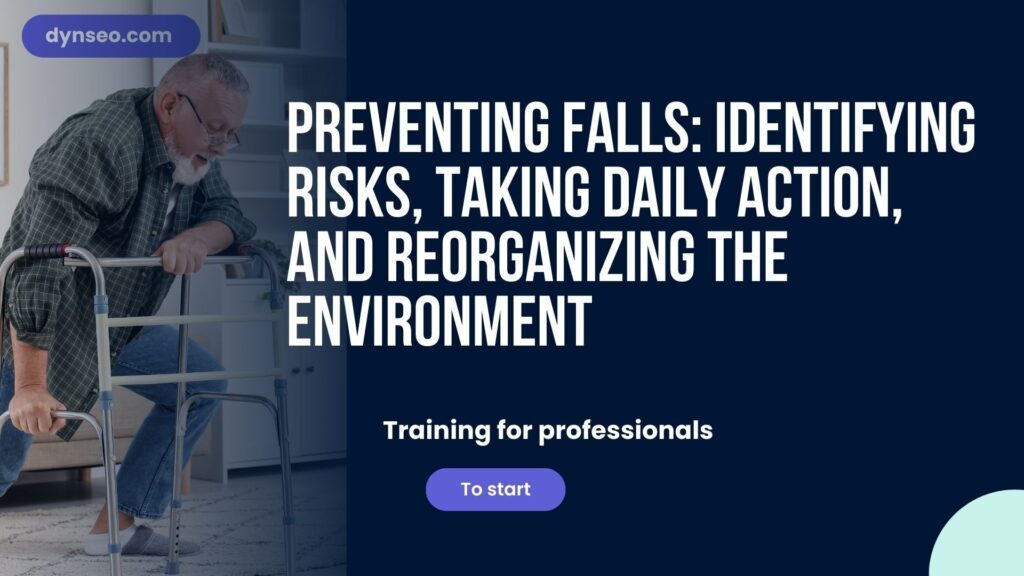
Preventing Falls: The Complete Guide to Understanding What’s at Stake
A caregiver enters a room at 6:30 AM and finds a resident sitting on the floor, against the foot of the bed, perfectly calm. “ I got up to go to the bathroom, and then I found myself here. ” No one heard anything. In the next hallway, a man who was walking very well the day before now refuses to get out of his chair : he is afraid. These two scenes, seemingly unrelated, tell the same story. They show that a fall is almost never a simple isolated accident, but the culmination of a chain of factors that can, to a large extent, be understood and anticipated.
In this article
The associated training

Our printable notebooks



C'est exactement l'objet de ce guide : prévenir les chutes, ce n'est pas surveiller plus, c'est comprendre mieux. Comprendre ce qui se joue dans le corps, dans la tête et dans l'environnement d'une personne au moment où elle bascule, pourquoi certaines situations sont plus dangereuses que d'autres, et ce qui distingue une prévention réellement efficace d'une accumulation de précautions inutiles. Ce texte s'adresse aux professionnels des établissements, du soin, du médico-social, mais aussi aux équipes éducatives et aux entreprises : partout où l'on accompagne des personnes fragilisées, le raisonnement reste le même.
L'essentiel en 30 secondes
Une chute résulte presque toujours de la rencontre entre des fragilités de la personne et un environnement inadapté, à un moment précis. Elle n'est ni une fatalité de l'âge, ni un simple manque d'attention.
- Les facteurs de risque se cumulent : équilibre, vue, médicaments, dénutrition, peur, éclairage, sol, chaussage. Plus ils s'additionnent, plus le risque grimpe.
- La chute est un signal : elle révèle souvent un problème sous-jacent — infection, effet indésirable, trouble neurologique — qu'il faut chercher, pas seulement une maladresse.
- La peur de tomber est un facteur de chute à part entière : elle réduit l'activité, affaiblit les muscles et augmente le risque réel.
- Ce qui aide vraiment : l'activité physique adaptée, la révision des traitements par le médecin, l'aménagement du lieu de vie, la stimulation de l'équilibre et de la vigilance.
- Ce qui ne sert à rien, voire nuit : immobiliser « pour protéger », multiplier les interdits, entraver la marche. On sécurise sans priver de mouvement.
What are we talking about exactly
The word « fall » seems obvious, and that's precisely the problem : it encompasses very different realities. Falling by slipping on a wet floor has nothing to do with slowly collapsing because the legs can no longer support, which also has nothing to do with a sudden loss of consciousness. To prevent effectively, one must first know what one is talking about.
The World Health Organization defines a fall as the act of finding oneself involuntarily on the ground or at a lower level, regardless of one's will. This deliberately broad definition includes falls “from one's height” — the most frequent among elderly people — such as falls from a bed, an armchair, or a step. It also reminds us that we are not only talking about the person who collapses : finding oneself on the ground after slowly sliding down a wall is indeed a fall, even without violent impact.
A major public health issue
According to the World Health Organization, falls are the second leading cause of death from unintentional injury worldwide, and it is adults over 60 who pay the heaviest toll from fatal falls. In France, Santé publique France regularly reminds us that falls are the leading cause of mortality from everyday accidents among elderly people, ahead of road accidents for this age group. Beyond the numbers, what strikes professionals is the frequency of non-fatal but serious consequences : fractures, hospitalization, loss of autonomy, entry into institutions.
Here, we must be honest about the data. Many figures circulate, often distorted over time. What is solidly established and documented by recognized organizations is the magnitude of the phenomenon and its severity among elderly people. The exact proportions vary according to the sources, the studied populations, and the methods. Retain the underlying message : the issue is major, underestimated, and a significant portion of these falls is preventable.
Isolated fall, repeated falls, post-fall syndrome
Differentiating three situations completely changes the understanding of a fall :
| Situation | What it means | The reflex to have |
|---|---|---|
| Isolated fall, clear cause | An obvious mechanical cause (rug, obstacle), with no other signs | Correct the environment, remain attentive to a possible repetition |
| Repeated falls | Several falls over a short period : strong warning signal | Report for medical investigation of an underlying cause |
| Post-fall syndrome | After a fall, the person freezes, withdraws, no longer dares to get up | Identify quickly : this is a functional emergency, not a whim |
The post-fall syndrome deserves particular attention. In the days following a fall, some people develop a true stupor : they cling, refuse to put their foot down, adopt a backward-leaning posture when trying to stand up. This is not bad will : it is a protective reaction that, if it settles in, quickly leads to bed rest, muscle wasting, and loss of walking ability. Recognizing it early and alerting is part of the actions that change the prognosis.
What a fall costs, beyond the injury
Reducing the fall to the fracture it can cause is to miss the essential. The physical injury, when it occurs, is only the visible part. What weighs the heaviest in a life trajectory is often the aftermath: the loss of confidence, the voluntary restriction of movements, the withdrawal from activities that brought pleasure, the isolation that follows. A person who has fallen once frequently changes their way of living, even without physical sequelae. They go out less, sit more, ask for help with tasks they used to manage alone. This silent shift comes at the cost of autonomy and morale long before it shows up on an X-ray.
For relatives and teams, a fall also has an invisible cost: guilt, the temptation to excessively monitor, the tension that creeps into relationships. Understanding that the fall is not someone's fault, but the result of multiple factors, defuses much of this tension and allows for calm reasoning rather than reacting emotionally.
The mechanisms at play, explained simply
To understand a fall, an image helps: that of a tightrope walker. Standing and walking is a constant balancing act that continuously mobilizes three major systems. When one falters, the others compensate. When several weaken at the same time, the tightrope walker falls. In a frail person, it is never just one thread that breaks: it is the simultaneous wear of several.
The three pillars of balance
Vision
It informs the brain of the body's position in space and detects obstacles. Diminished vision, cataracts, poor lighting: and the first reference point disappears, especially at night.
The inner ear
The vestibular system detects head movements and the sense of gravity. Its disorders cause dizziness and instability, often worsened during position changes.
Proprioception
The sensors in the feet, joints, and muscles constantly indicate the body's position without us thinking about it. Neuropathy, common with diabetes, shuts down this third reference point.
These three systems send their information to the brain, which integrates it and instantly commands the muscles to correct the slightest imbalance. It is this "conductor" that explains why falls also concern cognitive functions: if attention is captured elsewhere, if information processing slows down, the correction comes too late. We then fall not due to muscle weakness, but because the reaction time has lengthened.
Why talking to someone who is walking can make them fall
A well-known phenomenon among geriatricians illustrates all this: some people stop walking as soon as they are spoken to. This is not trivial distraction. Walking, for a frail brain, is no longer automatic: it becomes a task that requires attention. Adding a conversation means asking for two complex tasks at the same time from already limited resources. The body "drops" the least conscious task: walking. Concretely, this means that a busy corridor, a moment of agitation, or a question asked during a transfer actually increases the risk.
The spiral of fragility
The most important mechanism to grasp is a spiral, because it is self-sustaining. A first fall, or even the simple fear of falling, leads to moving less. Moving less weakens the muscles and stiffens the joints. Weaker muscles make balance more precarious. A more precarious balance increases the risk of falling and fear. And the loop closes, a notch lower. Understanding this spiral is understanding why "protective" immobilization is a false good idea: by reducing movement to avoid falling, we are precisely creating the conditions for the next fall.
The underestimated role of medications
Among the factors that weaken balance, treatments occupy a particular place, because they are frequent, cumulative, and often invisible in daily observation. Some medications affect alertness, blood pressure, or balance: sleeping pills, tranquilizers, certain heart or blood pressure treatments, among others. The more different medications a person takes — what is called polypharmacy — the more interactions and side effects multiply. A treatment that has been recently introduced or increased is a major point of attention: a fall that occurs in the days following a change in treatment should systematically raise this issue.
It is not up to you to adjust anything: the review of treatments is the responsibility of the doctor and the pharmacist. But your observation is crucial to trigger it. Reporting that a person has been more drowsy in the morning for a few days, that they stagger when getting up, or that they complain of dizziness can lead to a reevaluation that alone will reduce the risk. Here again, the field professional sees what the prescription does not say.
Looking for "the" cause of a fall often leads to a dead end. The right question is: what factors added up that day? A sleeping pill from the night before, an emerging urinary infection, forgotten glasses, a slippery floor, and a pressing need at night can, together, be enough where each taken in isolation would not have caused anything.
Signs to know, and what is not
Prevention requires spotting before. However, the warning signs of a fall risk are often subtle and go unnoticed if one does not know how to name them. Conversely, some behaviors mistaken for signs of danger are not. Sorting them out avoids two symmetrical errors: negligence and overprotection.
Signals that should alert
- A changing gait: not shorter steps, feet apart, hesitation at the start, tendency to brush against walls or seek support.
- Difficulties getting up from a chair without using the armrests, or needing several attempts.
- A new grip on furniture, handles, or the arm of the companion, whereas the person moved freely before.
- Dizziness when getting up, turning around, after meals, or at the end of the day.
- An unexplained decrease in activity: the person goes out less, participates less, remains seated; often the first sign of fear of falling.
- "Near-falls": they barely caught themselves. A near-fall counts as much as a fall: it is a free trial before the accident.
What looks like a sign but isn't necessarily one
Not all slowness is a risk, and not all caution is pathological fear. A person who holds onto a handrail on a staircase is doing exactly what they should. A person who walks slowly but steadily, without hesitation or imbalance, is not necessarily at high risk. Confusing appropriate caution with fragility leads to overprotection, which deprives movement and actually makes one more fragile. The useful reference is not speed itself, but the change: what was fluid and is no longer.
| Observation | Too quick interpretation | More accurate reading |
|---|---|---|
| The person walks slowly | “She is going to fall, we need to sit her down” | Slow but stable walking: letting her walk is protective |
| She is holding onto the handrail | “She is no longer autonomous” | She is using an appropriate support: a good reflex to encourage |
| She has fallen once, without severity | “It's nothing, she slipped” | Every fall deserves to be recorded and its context analyzed |
| She refuses to get up since her fall | “She is being difficult” | Possible post-fall syndrome: to be reported without delay |
| She stumbles upon waking from a nap | “She is still asleep” | Hypotension or effect of a medication: to be observed and reported |
Night, a time of all risks
One point deserves to be isolated, because it concentrates a significant share of falls: at night and in the early morning. The scenario is almost always the same — getting up to go to the bathroom, in the dark, half-awake, sometimes under the effect of a sleeping pill from the night before, with a drop in blood pressure when moving from lying down to standing. All risk factors converge in a single moment. That’s why a decisive part of prevention occurs here: a lit path to the bathroom, lighting that activates automatically, visual markers, a reachable aid object, and learning the reflex to sit for a moment before standing up. Noticing that a person gets up several times at night, and why, often points to a correctable cause.
A fall with a blow to the head, sharp pain in the hip or shoulder, a deformation of a limb, an inability to get up, new confusion or unusual drowsiness after the fall require immediate application of your facility's emergency procedure and contacting your country's emergency services. Never forcefully lift a person suspected of having a fracture: secure, reassure, alert.
Preconceived ideas, dismantled one by one
Fall prevention is a field saturated with established beliefs, sometimes relayed in good faith by experienced professionals. Some are not only false but counterproductive. Here are a few of the most tenacious ones.
“Falling is normal as we age”
This is the most dangerous preconceived idea because it discourages action. Aging increases the risk, it's true, but it does not make falling inevitable. Public health organizations emphasize the largely preventable nature of a significant portion of falls. Treating a fall as an inevitability of age means giving up on seeking its cause — often correctable — and allowing the spiral to set in.
« Pour éviter qu'elle tombe, il vaut mieux qu'elle bouge moins »
Exactement l'inverse. Réduire le mouvement affaiblit les muscles et l'équilibre, et augmente le risque à moyen terme. L'activité physique adaptée est l'une des mesures dont l'efficacité est la mieux documentée pour prévenir les chutes. Immobiliser protège l'instant présent et sacrifie l'avenir.
« Les barrières de lit et les contentions évitent les chutes »
Les dispositifs qui entravent sont un sujet strictement encadré, qui relève d'une prescription et d'une évaluation médicale, jamais d'une décision d'organisation. Les barrières de lit, notamment, peuvent transformer une chute de faible hauteur en chute par-dessus la barrière, plus grave. La question ne se règle pas ici : elle se pose à l'équipe et au médecin, dans le cadre des recommandations en vigueur.
« Elle a des chaussons bien chauds, c'est parfait »
Le chaussage est un facteur de chute sous-estimé. Des chaussons souples, sans tige, sans maintien du talon, semelle lisse, sont confortables mais instables. Un pied mal tenu, qui glisse dans le chausson, c'est un appui incertain à chaque pas. Le confort ressenti n'est pas un gage de sécurité.
« Si elle a peur de tomber, c'est qu'elle est prudente, tant mieux »
La prudence est utile ; la peur de tomber, quand elle s'installe, est un facteur de risque à part entière. Elle pousse à restreindre les déplacements, alimente la spirale de la fragilité, et augmente paradoxalement le risque réel. Repérer et accompagner cette peur fait partie intégrante de la prévention : on ne se contente pas de s'en réjouir.
Elles partagent la même erreur : confondre sécurité et immobilité. La bonne prévention ne cherche pas à empêcher de bouger ; elle cherche à rendre le mouvement plus sûr. C'est un renversement complet de perspective, et c'est tout l'enjeu d'une culture professionnelle solide sur le sujet.
Transformer ces repères en gestes professionnels
18 leçons, 100 % en ligne et à votre rythme, pour repérer les risques, agir au quotidien et réorganiser l'environnement de vie. De la théorie de ce guide à des adaptations concrètes, applicables dès le lendemain dans votre structure.
Découvrir la formation — 150 €Ce que disent la recherche et les recommandations
La bonne nouvelle, c'est que la prévention des chutes est l'un des domaines de la gériatrie où l'on dispose du plus de connaissances solides. Les recommandations des autorités de santé, en France comme à l'international, convergent sur plusieurs points. Les connaître permet de ne pas naviguer à l'instinct.
Évaluer le risque, plutôt que réagir après coup
La Haute Autorité de santé, en France, et l'Organisation mondiale de la santé recommandent une approche fondée sur le repérage du risque avant la première chute grave. Plusieurs signaux simples orientent vers un risque élevé : un antécédent de chute dans l'année, une difficulté à se lever d'une chaise sans les mains, une peur de tomber exprimée, une polymédication. Ces repères ne remplacent pas une évaluation par un professionnel, mais ils déclenchent l'attention et le signalement au bon moment.
Les interventions multifactorielles gagnent
Puisqu'une chute est multifactorielle, la prévention efficace l'est aussi. La recherche montre de façon convergente qu'agir sur un seul levier donne des résultats limités, alors que combiner plusieurs actions — activité physique, révision des traitements, correction de la vue, aménagement du domicile ou de la chambre — produit un effet nettement supérieur. Il n'existe pas de mesure miracle isolée ; il existe des faisceaux de mesures cohérentes.
| Lever | What research says | Who acts |
|---|---|---|
| Adapted physical activity | One of the best-documented levers, particularly balance work and strengthening | Physiotherapist, APA teacher, daily team |
| Medication review | Some treatments increase the risk; their reevaluation can reduce it | Doctor, pharmacist |
| Vision correction | Optimized vision improves landmarks and reduces risk | Ophthalmologist, optician |
| Environmental adjustment | Effective especially when combined with other measures and tailored to the person | Occupational therapist, team, family |
| Vitamin D and nutrition | Medical subject: supplementation is subject to evaluation, not an initiative | Doctor |
Consistency over time takes precedence over flashy actions
Another lesson runs through the recommendations: prevention is not a one-time operation but a continuous practice. A day of awareness, an isolated assessment, or an adjustment made once and then forgotten produces little. What works is the integration of vigilance and good practices into the daily routine of all professionals, regularly reevaluated. This demand for consistency explains why team training and sharing a common culture are as important as material devices: a perfectly arranged environment does not protect if daily actions continue to weaken.
The decisive role of cognitive stimulation
A more recent lesson directly concerns the subject: balance is not just a matter of muscles, it is also a matter of the brain. Since walking mobilizes attention and information processing, maintaining these functions contributes to stability. Activities that challenge attention, reaction speed, and dual-tasking fit into this logic. This is where a cognitive stimulation application like SCARLETT, designed for seniors, finds its place in a comprehensive approach: not as a treatment for falls, but as training for the resources that contribute to balance. Cognitive tests can, beforehand, help to identify some of these abilities.
You will see precise percentages of risk reduction circulating. They vary greatly depending on studies, populations, and protocols, and are often cited out of context. What is robust is the sense of the effect: combined interventions reduce risk. For a precise figure applied to a situation, refer to up-to-date official recommendations and the healthcare professional.
The main stages of the journey, and what to expect
Preventing falls is not decided in one action, but in a journey that goes from identification to continuous adjustment. Describing it helps teams know where they stand and what comes next.
- Identification. Everything starts with daily observation: changes in gait, near-falls, expressed fear, decreased activity. This is the primary role of those present closest, often before any formal assessment.
- Evaluation. Identification triggers an evaluation by competent professionals: balance and walking assessment, review of treatments, vision check, search for medical causes. This step is not your responsibility, but your precise reporting makes it possible.
- Action plan. The multidisciplinary team defines a set of coherent and personalized measures: adapted physical activity, adjustments, treatment modifications, walking aid equipment. Combination takes precedence over isolated measures.
- Implementation in daily life. This is where the essence lies: applying instructions, securing without immobilizing, encouraging movement, adjusting moments and places of risk. Prevention lives in ordinary actions, not in documents.
- Monitoring and adjustment. Prevention is reevaluated: each fall, each near-fall, each change is tracked and analyzed. Is what has been put in place holding? Does it need adjustment? The journey is a loop, not a straight line.
What to expect, concretely
It must be said clearly so as not to discourage the teams: prevention reduces risk, it does not bring it down to zero. A fragile person may fall despite exemplary prevention. The goal is not zero risk — which only exists at the cost of immobilization, which is itself harmful — but the best possible balance between safety and autonomy. A fall that occurs despite appropriate and documented measures is not a failure of the team; it is sometimes the price of a life that continues to move. What matters is that each fall informs the next adjustment.
A dated and located fact — “found sitting on the floor near the bed at 6:30 AM, says they got up to go to the bathroom, no pain, got up with help” — is worth infinitely more than a terse “fell.” It is this precision that allows the team and the doctor to identify a pattern: nighttime falls, the link with a treatment, a recurring time of day. The tracking sheet helps structure these observations.
Preventing falls: what really helps, what is useless
Once the mechanisms are understood, the most practical question remains: where to put your energy? Not all measures are equal. Some, very visible and reassuring, contribute little; others, more discreet, truly change things.
What really helps
Keep moving, every day
Encourage walking, regular getting up, daily tasks performed by the person themselves. Movement maintains muscles and balance: it is the most powerful lever.
Light and clear
A well-lit path to the bathroom at night, clear floors, no slippery rugs, objects within reach. The environment does a large part of the work.
Good footwear
Closed shoes, holding the heel, with non-slip soles, also worn indoors. A detail that weighs heavily with each step.
Maintain attention
Stimulating vigilance and the ability to do two things at once supports balance. Also, avoid engaging someone who is walking at a delicate moment.
Arrange, room by room
The environment is a concrete, immediate, and often low-cost lever. Looking at it room by room, through the eyes of a fragile person, reveals dangers that are no longer seen due to familiarity.
| Location | What causes falls | What secures without depriving movement |
|---|---|---|
| Bedroom | Bed too high or too low, obstacles on the floor, darkness | Adjusted bed height, clear and lit path, accessible switch |
| Bathroom | Wet floor, lack of support, slippery rug | Non-slip floor, support bars installed by a professional, rug fixed or removed |
| Hallways | Clutter, insufficient lighting, deceptive shiny floors | Clear passage, regular lighting, supports along the way |
| Toilets | Seat too low, distance, nighttime journey | Raised seat if prescribed, proximity, night light on the path |
| Living spaces | Wires, thresholds, unstable chairs, objects out of reach | Fixed cables, marked thresholds, stable seating with armrests |
A simple rule guides all these adjustments: the arrangement must make the action possible, not replace it. A well-placed support bar allows for continued independence; an armchair that swallows the person prevents them from getting up. The difference between the two is the entire philosophy of prevention. And these arrangements benefit from being decided with the person concerned: imposed, they are often circumvented; explained and co-constructed, they are adopted.
The right words and gestures
Prevention also depends on the way of doing things. Here are some concrete examples :
- Before helping someone to stand up, warn them : « I will help you to stand up. First, place both feet firmly on the ground, use the armrests for support, and straighten up when you are ready. » Give them time, do not pull on the arm.
- Upon waking or getting out of bed, mark a sitting pause : « Stay seated for a moment, to regain your bearings, before standing up. » This short delay limits discomfort when standing.
- During a movement, avoid asking a question that requires thinking while walking. Speak beforehand, or once stopped.
- After a near-fall, do not minimize or dramatize : « You caught yourself well. Let's look together at what may have caused you to lose your balance. » Then trace and signal.
❌ To avoid : « Be careful, don't fall ! » said at the moment the person is getting up. This very common phrase captures attention, creates tension, and fuels the fear of falling : it often produces the opposite of the desired effect. Guide with positive and concrete instructions, not with anxiety-inducing warnings.
What is useless, even harmful
| Frequent reflex | Why it is ineffective or harmful | Instead |
|---|---|---|
| Sitting "for safety" | Accelerates muscle loss and loss of walking ability | Secure the movement, not eliminate it |
| Multiplying prohibitions | Generates fear, opposition, and loss of confidence | Adapt the environment to make the action possible |
| Repeating "be careful" | Causes anxiety without giving useful instructions | Give a precise and positive instruction |
| Doing it for them to be quick | Deprives them of valuable daily training | Assist at the just necessary level, not one step more |
| Improvising a restraint or barrier | Serious risk and strict regulatory framework | Refer to the team and the doctor |
The thread is always the same. Preventing falls effectively is not about adding layers of protection until the person can no longer move : it is about removing obstacles to safe movement. Whenever a measure reduces autonomy without real safety benefits, it deserves to be questioned. And to equip teams on a daily basis, DYNSEO offers a catalog of free tools that helps structure observation and monitoring.
What falls under you, the team, the medical
One of the most frequent barriers to good prevention is the ambiguity about roles : one does not act, believing it is not their responsibility, or one acts where they should pass the baton. Clarifying each person's perimeter unlocks many situations.
| Your daily role | What falls under the multidisciplinary team | What is strictly medical |
|---|---|---|
| Observe and describe dated facts | Cross observations and identify recurring patterns | Investigate a medical cause for repeated falls |
| Secure the immediate environment | Define a personalized prevention plan | Reassess and adjust treatments |
| Encourage movement and autonomy | Coordinate physiotherapy, occupational therapy, physical activity, activities | Evaluate balance, vision, nutrition |
| Apply mobilization and walking assistance instructions | Ensure continuity between teams and substitutes | Decide on a restrictive measure, within the legal framework |
| Report any fall and any near-fall | Regularly reassess the measures in place | Make a diagnosis and inform about the prognosis |
Your position close to the person makes you an irreplaceable sensor: you see what no one else sees, at moments when no one else is there. But this proximity comes with a clear limit: observing, securing, applying, and reporting, yes; diagnosing, prescribing, deciding on restraint, or modifying treatment, no. This is not a devaluation: it is the condition of a prevention chain where each link does exactly what it does best. A precise observation transmitted at the right time is worth more, for the safety of the person, than any isolated initiative outside of their perimeter.
At the end of this journey, a thread emerges. Preventing falls is not about piling up precautions until the person no longer moves; it is about understanding what is at play — in the body, in the mind, in the environment, and in treatments — to make movement safer without ever extinguishing it. It is about early detection, precise description, reporting to the right interlocutor, arranging appropriately, and encouraging autonomy even when caution dictates accompaniment. Successful prevention is not measured by the number of prohibitions imposed, but by a person's ability to continue living, moving, and participating, with a managed risk rather than one denied. It is a team effort, patient, never definitively acquired, where shared knowledge makes the difference. And it is precisely this common culture, from detection to daily action, that dedicated training allows to be anchored sustainably within a structure.
To go further
Everyday situations10 difficult everyday situations and how to respond to them
ToolboxActivities, resources, and concrete arrangements to implement
Professional postureTeamwork, transmissions, and skill development
On the resource side: the session tracking sheet and the skills tracking table help structure the observations described in this guide, and the application SCARLETT helps maintain the attention and vigilance that contribute to balance. These free tools are part of the DYNSEO catalog, alongside all the trainings.
Frequently Asked Questions
Why does a person fall when they were walking well the day before?
Because a fall most often results from factors that accumulate at a specific moment, not from continuous deterioration. A new medication, an emerging infection, a sleepless night, a slippery floor, or a pressing need can be enough to tip an already precarious balance. This is also why a sudden fall in a stable person should prompt a search for a cause: it is often the first visible sign of an underlying problem. We observe, we describe the context precisely, and we report so that a medical evaluation can identify what has changed.
Is the fear of falling really a problem?
Yes, and it is a major one. When fear sets in, the person moves less, which weakens their muscles and balance, thereby increasing the actual risk of falling: it is a self-sustaining spiral. This fear often follows a first fall but can appear without a visible cause. Detecting it — decreased activity, gripping, refusal to go out — is part of prevention. We respond by securing without immobilizing, encouraging movement in small steps, and reporting, as appropriate support exists. Simply seeing it as caution would be a mistake.
Should we prevent a person at risk from moving alone?
No, except for specific and individual medical instructions. Immobilizing to protect accelerates muscle wasting, worsens balance, and increases medium-term risk: it is counterproductive. The goal is not to eliminate movement but to make it safer: lighting, clear floors, proper footwear, adapted walking aids, well-placed supports. Devices that hinder movement fall under a prescription and strict regulatory framework, never an organizational decision. The right question is not "how to prevent them from moving" but "how to allow them to move safely."
Are slippers really a factor in falls?
Often, yes. Soft slippers, without heel support, with smooth soles, are comfortable but allow the foot to slip and provide uncertain support with each step. The comfort felt does not guarantee stability. We favor closed shoes that hold the heel well, with non-slip soles, worn even indoors. It is a simple, low-cost measure, often overlooked, and it affects every step of the day. However, care must be taken to respect the person's habits and comfort: change should be proposed and explained, not imposed.
Can we really prevent falls, or is it inevitable with age?
A significant portion of falls is preventable: this is a constant message from public health organizations. Aging increases risk but does not make falling fatal. Acting on multiple levers at once — physical activity, reviewing treatments with a doctor, correcting vision, adapting the living environment, maintaining attention — reduces risk in a documented way. However, prevention never brings it down to zero without immobilization, which would be detrimental. The realistic goal is the best possible balance between safety and autonomy, re-evaluated over time.
This guide is intended for general professional information. It does not replace a clinical assessment, the protocols of your organization, or individual prescriptions. Any decision regarding treatments, swallowing, restrictive devices, or diagnosis falls under the responsibility of healthcare professionals. In case of doubt about a specific situation, refer to your supervision and the caregiving team.
From knowledge to practice: equip your entire team
This guide provides the benchmarks to understand and prevent falls. The training translates them into concrete actions: 18 lessons, 100% online, unlimited access, with a certificate of completion. Certified organization Qualiopi (N° 11757351875).
Discover the training — 150 €Did this content help you? Support DYNSEO 💙
We are a small team of 14 people based in Paris. For 13 years, we have been creating free content to help families, speech therapists, care homes and healthcare professionals.
Your feedback is the only way we know if our work is useful. A Google review helps us reach other families, caregivers and therapists who need it.
One action, 30 seconds: leave us a Google review ⭐⭐⭐⭐⭐. It costs nothing, and it changes everything for us.