--dyn-bleu:#5e5ed7;
--dyn-bleu-fonce:#5268c9;
--dyn-vert:#a9e2e4;
--dyn-jaune:#ffeca7;
--dyn-rose:#e73469;
--dyn-encre:#1d1d2e;
--dyn-gris:#5c5c72;
--dyn-fond:#f6f6fd;
--dyn-ombre:0 6px 24px rgba(29,29,46,.08);
--dyn-ombre-forte:0 12px 34px rgba(94,94,215,.22);
--dyn-radius:18px;
font-family:"Inter","Segoe UI",system-ui,-apple-system,"Helvetica Neue",Arial,sans-serif;
color:var(--dyn-encre);
line-height:1.68;
font-size:clamp(16px,1.05vw + 13px,18px);
max-width:860px;
margin:0 auto;
padding:0 4px;
-webkit-font-smoothing:antialiased;
}
.dbi-art-c4f9ba .dyn-article * {box-sizing:border-box;}
.dbi-art-c4f9ba .dyn-article h1, .dbi-art-c4f9ba .dyn-article h2, .dbi-art-c4f9ba .dyn-article h3, .dbi-art-c4f9ba .dyn-article h4 {
color:var(--dyn-encre);line-height:1.22;margin:0 0 .5em;font-weight:800;letter-spacing:-.015em;
}
.dbi-art-c4f9ba .dyn-article h1 {font-size:clamp(1.65rem,3.4vw,2.35rem);margin-top:.4em;}
.dbi-art-c4f9ba .dyn-article h2 {font-size:clamp(1.35rem,2.4vw,1.75rem);margin-top:2.1em;padding-top:.2em;}
.dbi-art-c4f9ba .dyn-article h3 {font-size:clamp(1.1rem,1.7vw,1.28rem);margin-top:1.5em;font-weight:700;}
.dbi-art-c4f9ba .dyn-article p {margin:0 0 1.05em;}
.dbi-art-c4f9ba .dyn-article a {color:var(--dyn-bleu-fonce);text-decoration:underline;text-underline-offset:3px;}
.dbi-art-c4f9ba .dyn-article a:hover {color:var(--dyn-rose);}
.dbi-art-c4f9ba .dyn-article a:focus-visible {outline:3px solid var(--dyn-bleu);outline-offset:2px;border-radius:4px;}
.dbi-art-c4f9ba .dyn-article ul, .dbi-art-c4f9ba .dyn-article ol {margin:0 0 1.05em;padding-left:1.25em;}
.dbi-art-c4f9ba .dyn-article li {margin-bottom:.45em;}
.dbi-art-c4f9ba .dyn-article strong {font-weight:700;}
.dbi-art-c4f9ba .dyn-article img {max-width:100%;height:auto;display:block;}
.dbi-art-c4f9ba .dyn-pagehead {
position:relative;overflow:hidden;border-radius:var(--dyn-radius);
padding:30px 24px 28px;margin:0 0 1.5em;box-shadow:var(--dyn-ombre);
}
@media(min-width:720px) {
.dbi-art-c4f9ba .dyn-pagehead {padding:44px 44px 40px;}
}
.dbi-art-c4f9ba .dyn-pagehead::after {
content:"";position:absolute;right:-80px;top:-80px;width:250px;height:250px;border-radius:50%;
background:rgba(255,255,255,.14);pointer-events:none;
}
.dbi-art-c4f9ba .dyn-pagehead > * {position:relative;z-index:1;}
.dbi-art-c4f9ba .dyn-pagehead--bleu {background:linear-gradient(135deg,var(--dyn-bleu) 0%,var(--dyn-bleu-fonce) 100%);color:#fff;}
.dbi-art-c4f9ba .dyn-pagehead--bleu h1 {color:#fff;}
.dbi-art-c4f9ba .dyn-pagehead--bleu .dyn-pagehead__cat {color:var(--dyn-jaune);}
.dbi-art-c4f9ba .dyn-pagehead--bleu .dyn-pagehead__lead {color:rgba(255,255,255,.93);}
.dbi-art-c4f9ba .dyn-pagehead--bleu .dyn-pagehead__meta {color:#fff;}
.dbi-art-c4f9ba .dyn-pagehead--bleu .dyn-pagehead__meta li {background:rgba(255,255,255,.18);}
.dbi-art-c4f9ba .dyn-pagehead--eau {background:linear-gradient(135deg,var(--dyn-vert) 0%,#cfeff1 100%);color:var(--dyn-encre);}
.dbi-art-c4f9ba .dyn-pagehead--eau .dyn-pagehead__cat {color:var(--dyn-rose);}
.dbi-art-c4f9ba .dyn-pagehead--eau .dyn-pagehead__lead {color:#3b4a5c;}
.dbi-art-c4f9ba .dyn-pagehead--eau .dyn-pagehead__meta li {background:rgba(255,255,255,.62);}
.dbi-art-c4f9ba .dyn-pagehead--jaune {background:linear-gradient(135deg,var(--dyn-jaune) 0%,#fff7d6 100%);color:var(--dyn-encre);}
.dbi-art-c4f9ba .dyn-pagehead--jaune .dyn-pagehead__cat {color:var(--dyn-rose);}
.dbi-art-c4f9ba .dyn-pagehead--jaune .dyn-pagehead__lead {color:#5a5240;}
.dbi-art-c4f9ba .dyn-pagehead--jaune .dyn-pagehead__meta li {background:rgba(255,255,255,.68);}
.dbi-art-c4f9ba .dyn-pagehead__cat {
display:inline-block;font-size:.76rem;font-weight:800;letter-spacing:.12em;
text-transform:uppercase;margin-bottom:.9em;
}
.dbi-art-c4f9ba .dyn-pagehead h1 {margin:0 0 .5em;}
.dbi-art-c4f9ba .dyn-pagehead__lead {font-size:clamp(1.02rem,1.4vw,1.16rem);margin:0 0 1.3em;}
.dbi-art-c4f9ba .dyn-pagehead__meta {
display:flex;flex-wrap:wrap;gap:8px;list-style:none;padding:0;margin:0;
font-size:.83rem;font-weight:600;
}
.dbi-art-c4f9ba .dyn-pagehead__meta li {border-radius:999px;padding:5px 13px;}
.dbi-art-c4f9ba .dyn-hero {
background:linear-gradient(135deg,#ffffff 0%,var(--dyn-fond) 100%);
border-radius:var(--dyn-radius);
box-shadow:var(--dyn-ombre);
overflow:hidden;
margin:0 0 2.2em;
}
.dbi-art-c4f9ba .dyn-hero__grid {display:grid;grid-template-columns:minmax(0,1fr);}
@media(min-width:720px) {
.dbi-art-c4f9ba .dyn-hero__grid {grid-template-columns:42% minmax(0,1fr);}
}
.dbi-art-c4f9ba .dyn-hero__media {position:relative;background:var(--dyn-vert);}
.dbi-art-c4f9ba .dyn-hero__media img {width:100%;height:100%;object-fit:cover;aspect-ratio:16/9;}
@media(min-width:720px) {
.dbi-art-c4f9ba .dyn-hero__media img {aspect-ratio:auto;min-height:100%;}
}
.dbi-art-c4f9ba .dyn-hero__eyebrow {
display:inline-block;background:var(--dyn-rose);color:#fff;font-size:.72rem;font-weight:800;
letter-spacing:.09em;text-transform:uppercase;padding:6px 13px;border-radius:999px;margin-bottom:.7em;
}
.dbi-art-c4f9ba .dyn-hero__body {padding:22px 22px 24px;}
@media(min-width:720px) {
.dbi-art-c4f9ba .dyn-hero__body {padding:28px 30px;}
}
.dbi-art-c4f9ba .dyn-hero__title {font-size:clamp(1.12rem,2vw,1.42rem);font-weight:800;margin:0 0 .55em;line-height:1.25;}
.dbi-art-c4f9ba .dyn-hero__title a {color:var(--dyn-encre);text-decoration:none;}
.dbi-art-c4f9ba .dyn-hero__title a:hover {color:var(--dyn-bleu);}
.dbi-art-c4f9ba .dyn-hero__pitch {font-size:.97rem;color:var(--dyn-gris);margin:0 0 1em;}
.dbi-art-c4f9ba .dyn-badges {display:flex;flex-wrap:wrap;gap:7px;margin:0 0 1.1em;padding:0;list-style:none;}
.dbi-art-c4f9ba .dyn-badges li {
background:#fff;border-radius:999px;padding:5px 12px;font-size:.79rem;font-weight:600;
color:var(--dyn-bleu-fonce);box-shadow:0 2px 8px rgba(29,29,46,.07);
}
.dbi-art-c4f9ba .dyn-hero__actions {display:flex;flex-wrap:wrap;gap:10px;align-items:center;}
.dbi-art-c4f9ba .dyn-btn {
display:inline-block;background:var(--dyn-bleu);color:#fff !important;text-decoration:none !important;
font-weight:700;padding:13px 26px;border-radius:999px;box-shadow:var(--dyn-ombre-forte);
transition:transform .15s ease,background .15s ease;text-align:center;
}
.dbi-art-c4f9ba .dyn-btn:hover {background:var(--dyn-bleu-fonce);transform:translateY(-2px);color:#fff !important;}
.dbi-art-c4f9ba .dyn-btn--ghost {
background:#fff;color:var(--dyn-bleu-fonce) !important;box-shadow:0 2px 10px rgba(29,29,46,.09);
}
.dbi-art-c4f9ba .dyn-btn--ghost:hover {background:var(--dyn-jaune);color:var(--dyn-encre) !important;}
.dbi-art-c4f9ba .dyn-hero__price {font-weight:800;color:var(--dyn-rose);font-size:1.02rem;margin-left:2px;}
.dbi-art-c4f9ba .dyn-hero--pastel {background:var(--dom-fond);}
.dbi-art-c4f9ba .dyn-pastel {display:grid;grid-template-columns:auto minmax(0,1fr);gap:18px;align-items:start;padding:22px;}
@media(min-width:720px) {
.dbi-art-c4f9ba .dyn-pastel {gap:24px;padding:30px 32px;}
}
.dbi-art-c4f9ba .dyn-pastel__icone {
flex:0 0 auto;width:74px;height:74px;border-radius:22px;background:#fff;
display:flex;align-items:center;justify-content:center;font-size:34px;line-height:1;
box-shadow:0 4px 14px rgba(29,29,46,.10);
}
@media(min-width:720px) {
.dbi-art-c4f9ba .dyn-pastel__icone {width:88px;height:88px;font-size:40px;}
}
.dbi-art-c4f9ba .dyn-pastel__domaine {
display:inline-block;background:#fff;border-radius:999px;padding:4px 12px;
font-size:.74rem;font-weight:800;letter-spacing:.08em;text-transform:uppercase;
color:var(--dom-texte);margin-bottom:.6em;
}
.dbi-art-c4f9ba .dyn-hero--pastel .dyn-hero__eyebrow {background:var(--dom-texte);}
.dbi-art-c4f9ba .dyn-hero--pastel .dyn-btn {background:var(--dom-texte);}
.dbi-art-c4f9ba .dyn-hero--pastel .dyn-btn:hover {filter:brightness(.92);}
.dbi-art-c4f9ba .dyn-hero--pastel .dyn-btn--ghost {background:#fff;color:var(--dom-texte) !important;}
.dbi-art-c4f9ba .dyn-hero--pastel .dyn-badges li {color:var(--dom-texte);}
.dbi-art-c4f9ba .dyn-hero--pastel .dyn-hero__price {color:var(--dom-texte);}
.dbi-art-c4f9ba .dyn-dom--memoire {--dom-fond:#e9e9fb;--dom-texte:#5268c9;}
.dbi-art-c4f9ba .dyn-dom--attention {--dom-fond:#dcf2f4;--dom-texte:#1b7f86;}
.dbi-art-c4f9ba .dyn-dom--logique {--dom-fond:#ece9fb;--dom-texte:#5e5ed7;}
.dbi-art-c4f9ba .dyn-dom--langage {--dom-fond:#ffe8d9;--dom-texte:#b35a2a;}
.dbi-art-c4f9ba .dyn-dom--emotions {--dom-fond:#fdeaf1;--dom-texte:#c0295a;}
.dbi-art-c4f9ba .dyn-dom--apprentissage {--dom-fond:#fff3cd;--dom-texte:#8a6a13;}
.dbi-art-c4f9ba .dyn-dom--autonomie {--dom-fond:#e4f2ea;--dom-texte:#25795c;}
.dbi-art-c4f9ba .dyn-tldr {
background:var(--dyn-vert);border-radius:var(--dyn-radius);padding:22px 24px;margin:0 0 2em;
}
.dbi-art-c4f9ba .dyn-tldr h2 {margin:0 0 .5em;font-size:1.1rem;text-transform:uppercase;letter-spacing:.06em;}
.dbi-art-c4f9ba .dyn-tldr p {margin-bottom:.8em;}
.dbi-art-c4f9ba .dyn-tldr ul {margin-bottom:0;padding-left:1.1em;}
.dbi-art-c4f9ba .dyn-toc {background:var(--dyn-fond);border-radius:var(--dyn-radius);padding:20px 24px;margin:0 0 2.2em;}
.dbi-art-c4f9ba .dyn-toc p {font-weight:800;margin:0 0 .6em;font-size:.9rem;text-transform:uppercase;letter-spacing:.07em;color:var(--dyn-bleu-fonce);}
.dbi-art-c4f9ba .dyn-toc ol {margin:0;padding-left:1.2em;}
.dbi-art-c4f9ba .dyn-toc li {margin-bottom:.3em;}
.dbi-art-c4f9ba .dyn-cards {display:grid;gap:14px;grid-template-columns:repeat(auto-fit,minmax(230px,1fr));margin:1.4em 0 1.8em;}
.dbi-art-c4f9ba .dyn-card {
background:#fff;border-radius:var(--dyn-radius);padding:20px 20px 18px;box-shadow:var(--dyn-ombre);
}
.dbi-art-c4f9ba .dyn-card h3 {margin:0 0 .45em;font-size:1.03rem;}
.dbi-art-c4f9ba .dyn-card p {margin:0;font-size:.94rem;color:var(--dyn-gris);}
.dbi-art-c4f9ba .dyn-card__icon {font-size:1.5rem;display:block;margin-bottom:.35em;line-height:1;}
.dbi-art-c4f9ba .dyn-module {
background:#fff;border-radius:var(--dyn-radius);box-shadow:var(--dyn-ombre);
padding:20px 22px;margin:0 0 14px;
}
.dbi-art-c4f9ba .dyn-module__head {display:flex;align-items:center;gap:12px;margin-bottom:.7em;}
.dbi-art-c4f9ba .dyn-module__num {
flex:0 0 auto;width:38px;height:38px;border-radius:12px;background:var(--dyn-bleu);color:#fff;
display:flex;align-items:center;justify-content:center;font-weight:800;font-size:1rem;
}
.dbi-art-c4f9ba .dyn-module__title {margin:0;font-size:1.05rem;font-weight:800;}
.dbi-art-c4f9ba .dyn-module ul {margin:0;padding-left:1.15em;font-size:.95rem;}
.dbi-art-c4f9ba .dyn-module li::marker {color:var(--dyn-rose);}
.dbi-art-c4f9ba .dyn-tablewrap {overflow-x:auto;-webkit-overflow-scrolling:touch;margin:1.3em 0 1.9em;border-radius:var(--dyn-radius);box-shadow:var(--dyn-ombre);background:#fff;}
.dbi-art-c4f9ba .dyn-article table {width:100%;border-collapse:collapse;min-width:460px;font-size:.94rem;}
.dbi-art-c4f9ba .dyn-article thead th {
background:var(--dyn-bleu);color:#fff;text-align:left;padding:13px 16px;font-weight:700;font-size:.9rem;
}
.dbi-art-c4f9ba .dyn-article tbody td {padding:12px 16px;vertical-align:top;border-top:1px solid #ececf7;}
.dbi-art-c4f9ba .dyn-article tbody tr:nth-child(even) td {background:#fbfbff;}
.dbi-art-c4f9ba .dyn-article th:first-child {border-top-left-radius:var(--dyn-radius);}
.dbi-art-c4f9ba .dyn-article th:last-child {border-top-right-radius:var(--dyn-radius);}
.dbi-art-c4f9ba .dyn-oui {color:#1a8f6b;font-weight:700;}
.dbi-art-c4f9ba .dyn-non {color:var(--dyn-rose);font-weight:700;}
.dbi-art-c4f9ba .dyn-note, .dbi-art-c4f9ba .dyn-alerte {border-radius:var(--dyn-radius);padding:18px 22px;margin:1.5em 0;}
.dbi-art-c4f9ba .dyn-note {background:var(--dyn-jaune);}
.dbi-art-c4f9ba .dyn-alerte {background:#fdeef3;}
.dbi-art-c4f9ba .dyn-note p:last-child, .dbi-art-c4f9ba .dyn-alerte p:last-child {margin-bottom:0;}
.dbi-art-c4f9ba .dyn-note strong, .dbi-art-c4f9ba .dyn-alerte strong {display:block;margin-bottom:.3em;font-size:1rem;}
.dbi-art-c4f9ba .dyn-cta {
background:var(--dyn-bleu);border-radius:var(--dyn-radius);padding:26px 24px;margin:2.2em 0;
color:#fff;text-align:center;box-shadow:var(--dyn-ombre-forte);
}
.dbi-art-c4f9ba .dyn-cta h3 {color:#fff;margin:0 0 .4em;font-size:clamp(1.1rem,2vw,1.35rem);}
.dbi-art-c4f9ba .dyn-cta p {color:rgba(255,255,255,.92);margin:0 0 1.1em;font-size:.97rem;}
.dbi-art-c4f9ba .dyn-cta .dyn-btn {background:#fff;color:var(--dyn-bleu) !important;box-shadow:none;}
.dbi-art-c4f9ba .dyn-cta .dyn-btn:hover {background:var(--dyn-jaune);color:var(--dyn-encre) !important;}
.dbi-art-c4f9ba .dyn-steps {list-style:none;counter-reset:dyn;padding:0;margin:1.4em 0 1.8em;display:grid;gap:12px;}
.dbi-art-c4f9ba .dyn-steps li {
counter-increment:dyn;background:#fff;border-radius:var(--dyn-radius);box-shadow:var(--dyn-ombre);
padding:16px 20px 16px 62px;position:relative;font-size:.96rem;
}
.dbi-art-c4f9ba .dyn-steps li::before {
content:counter(dyn);position:absolute;left:18px;top:15px;width:30px;height:30px;border-radius:10px;
background:var(--dyn-jaune);color:var(--dyn-encre);display:flex;align-items:center;justify-content:center;
font-weight:800;font-size:.9rem;
}
.dbi-art-c4f9ba .dyn-faq {background:var(--dyn-fond);border-radius:var(--dyn-radius);padding:6px 24px 20px;margin:1.4em 0 0;}
.dbi-art-c4f9ba .dyn-faq h3 {font-size:1.05rem;margin-top:1.4em;}
.dbi-art-c4f9ba .dyn-faq p {font-size:.96rem;}
.dbi-art-c4f9ba .dyn-serie {display:grid;gap:12px;margin:1.4em 0 1.8em;}
.dbi-art-c4f9ba .dyn-serie a {
display:block;background:#fff;border-radius:var(--dyn-radius);box-shadow:var(--dyn-ombre);
padding:15px 20px;text-decoration:none;color:var(--dyn-encre);font-weight:600;font-size:.96rem;
transition:transform .15s ease;
}
.dbi-art-c4f9ba .dyn-serie a:hover {transform:translateX(4px);color:var(--dyn-bleu);}
.dbi-art-c4f9ba .dyn-serie span {display:block;font-size:.82rem;font-weight:600;color:var(--dyn-rose);text-transform:uppercase;letter-spacing:.06em;margin-bottom:2px;}
@media(prefers-reduced-motion:reduce) {
.dbi-art-c4f9ba .dyn-article * {transition:none !important;}
}{
"@context": "https://schema.org",
"@graph": [
{
"@type": "Article",
"headline": "Prévenir les chutes : activités, supports et aménagements concrets à mettre en place",
"inLanguage": "fr",
"author": {
"@type": "Organization",
"name": "DYNSEO",
"url": "https://www.dynseo.com/"
},
"publisher": {
"@type": "Organization",
"name": "DYNSEO",
"url": "https://www.dynseo.com/"
},
"image": "https://www.dynseo.com/wp-content/uploads/2026/03/Autisme-en-etablissement-Accompagnement-Global-13.jpg"
},
{
"@type": "FAQPage",
"mainEntity": [
{
"@type": "Question",
"name": "À quelle fréquence faut-il pratiquer les activités de prévention des chutes ?",
"acceptedAnswer": {
"@type": "Answer",
"text": "La régularité prime sur la quantité. Un peu chaque jour protège davantage qu'une longue séance hebdomadaire. Visez un temps quotidien, même court, en alternant équilibre, renforcement et attention pour ne pas fatiguer toujours les mêmes capacités. Une routine répartie sur la semaine, comme le tableau proposé plus haut, permet de couvrir tous les registres sans surcharge. L'essentiel est de rattacher l'activité à un repère fixe de la journée pour qu'elle soit réellement suivie. En cas de fatigue, de douleur ou de baisse de forme, on allège et on demande l'avis du professionnel de santé."
}
},
{
"@type": "Question",
"name": "Combien de temps doit durer une séance ?",
"acceptedAnswer": {
"@type": "Answer",
"text": "Mieux vaut court et régulier que long et occasionnel. Une session de 10 à 15 minutes le matin, complétée par un temps de 5 minutes dans la journée, suffit pour un travail quotidien. Une activité qui dépasse la capacité d'attention ou d'endurance de la personne devient contre-productive : elle génère fatigue et découragement. Observez les signes de lassitude et arrêtez avant l'épuisement. La durée idéale est celle où la personne reste engagée et réussit la plupart de ses essais. On peut allonger progressivement au fil des semaines, à condition que la réussite reste stable et que le professionnel de santé le valide."
}
},
{
"@type": "Question",
"name": "Comment maintenir la motivation dans la durée ?",
"acceptedAnswer": {
"@type": "Answer",
"text": "La motivation tient à trois leviers. D'abord la réussite : on calibre l'activité pour que la personne réussisse souvent, car l'échec répété fait abandonner. Ensuite la visibilité des progrès : un tableau de suivi visuel, où l'on voit sa courbe s'améliorer, encourage plus qu'un discours. Enfin le plaisir : la danse, le ballon, la musique ou une activité à plusieurs sont bien mieux suivis qu'un exercice perçu comme une contrainte médicale. Valorisez chaque petit progrès concret, rattachez l'activité à un moment agréable de la journée, et variez les propositions pour éviter la lassitude."
}
},
{
"@type": "Question",
"name": "Quel matériel faut-il vraiment prévoir ?",
"acceptedAnswer": {
"@type": "Answer",
"text": "Très peu, et souvent rien de spécifique. Une chaise stable sans roulettes, un couloir dégagé, un plan de travail solide pour prendre appui et un ballon léger en mousse couvrent la majorité des activités. Une tablette avec une application de stimulation cognitive complète utilement le volet attention. Côté sécurité, l'important n'est pas le matériel sophistiqué mais des appuis stables toujours à portée de main, un sol non glissant et un bon éclairage. Pour l'aménagement, barres d'appui, tapis antidérapants et veilleuses représentent un investissement modeste au regard du risque évité. Le reste relève surtout d'organisation et de régularité."
}
},
{
"@type": "Question",
"name": "À partir de quel âge ou de quel état commencer ?",
"acceptedAnswer": {
"@type": "Answer",
"text": "Il n'y a pas d'âge pour agir : la prévention est utile aussi bien chez une personne encore autonome qui veut le rester que chez une personne déjà fragilisée. Ce qui change, c'est l'intensité et l'encadrement, pas le principe. Plus l'équilibre est précaire, plus les activités se font près d'un appui et sous surveillance rapprochée. Une chute passée, une peur de tomber, une hospitalisation récente ou un traitement qui étourdit sont autant de signaux pour renforcer la prévention. Dans tous les cas, l'évaluation par un médecin ou un kinésithérapeute oriente le choix des activités et leur progression."
}
}
]
}
]
}
Preventing falls: activities, resources, and concrete adjustments to implement
« We would like to prevent falls, but we don't know concretely what to install, with what equipment, or how much time to dedicate to it. » This is the phrase that comes up in almost every team, and it reveals a real gap : recommendations exist, but concrete activities are lacking. Preventing falls is not just about installing grab bars : it is a combination of activities, resources, and adjustments that can be implemented starting tomorrow, with available means.
Dans cet article
La formation associée
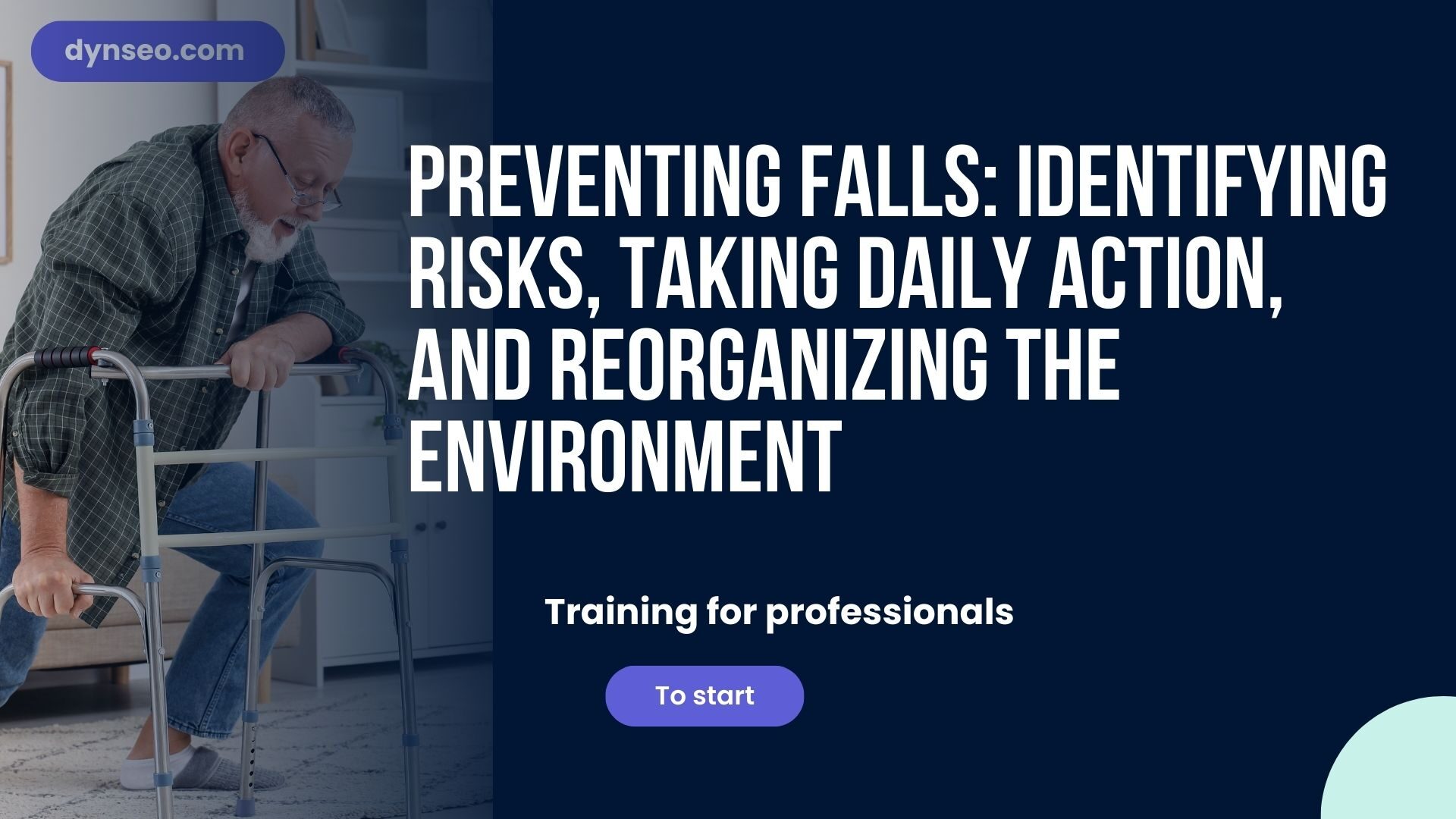
This article is a toolbox. You will find twelve activities described step by step, a typical routine over a week, room-by-room adjustments, free downloadable resources, and the exact role of digital technology. The common thread: simple materials, precise gestures, and concrete references, designed for professionals in establishments, home services, medical-social structures, or communities that support elderly people at risk of falling.
The essentials in 30 seconds
Effective fall prevention is not an isolated workshop: it is a set of regular activities, follow-up resources, and environmental adjustments that reinforce each other.
- The main lever — work on balance, leg strength, and attention a little each day, rather than a lot once a week.
- The materials — a stable chair, a clear hallway, a ball, a stopwatch: most activities cost almost nothing.
- The environment first — lighting, contrasts, organization, and visual cues produce immediate and lasting effects.
- Track to progress — a session sheet and a tracking table transform scattered exercises into a real program.
- The role of the healthcare professional — any physical activity program should be validated with a doctor or physiotherapist; this guide offers references, not prescriptions.
Preventing falls: activities, tools, and the method that works
A fall almost never has a single cause. It most often results from an accumulation: a balance that weakens, legs that lose strength, vision that declines, a medication that causes dizziness, a slippery rug, and insufficient light in the hallway. That is why an isolated action always disappoints. Preventing falls requires acting simultaneously on the person, their activities, and their environment, with the right tracking tools.
According to the World Health Organization, falls are one of the leading causes of injury among elderly people. The good news, widely emphasized by Public Health France in its work on healthy aging, is that a large part of the risk is modifiable: adapted physical activity, housing adjustments, and identifying risk factors are recognized levers. In other words, what you implement makes sense.
The guiding principle can be summed up in one sentence: regularity takes precedence over intensity. Ten minutes of balance exercises each day provide more protection than a long weekly session that is quickly forgotten. A muscle that is no longer used atrophies; a postural reflex that is no longer engaged dulls. In contrast, short and daily engagement maintains abilities without exhausting the person or the team.
Even before implementing activities, a time for assessment changes everything. Observe what, in the person and around them, increases the risk: declining vision, recent medication, a fear of falling that leads to less movement, poorly lit housing, inappropriate footwear. This assessment is not medical: it involves looking concretely at daily life and noting weaknesses. It then guides the choice of activities and adjustments: the same levers are not targeted for a person who lacks strength as for someone who is losing confidence in their walking. It is this intersection of assessment, activities, and environment that strengthens an approach.
Aucune des activités décrites ci-dessous ne remplace un avis médical. Avant tout programme d'activité physique, l'accord du médecin traitant et, quand c'est possible, l'évaluation d'un kinésithérapeute ou d'un professionnel en activité physique adaptée sont indispensables. En cas de douleur, de malaise, de vertige ou de déséquilibre inhabituel, arrêtez l'activité, sécurisez la personne et signalez immédiatement. Pour une chute avec traumatisme ou perte de connaissance, contactez les services d'urgence de votre pays.
Non pas « quel exercice est le plus complet ? » mais « quel est le plus petit défi que cette personne peut relever aujourd'hui en réussissant la plupart de ses essais ? ». La prévention des chutes se joue dans cet ajustement fin : assez de difficulté pour progresser, assez de réussite pour continuer.
12 activités concrètes à mettre en place dès demain
Chaque activité est décrite selon le même schéma : objectif, matériel, durée, déroulé, une variante plus facile, une variante plus difficile et le signe qui montre que ça fonctionne. Toutes se pratiquent en sécurité, à proximité d'un appui stable, et se valident avec le professionnel de santé qui suit la personne.
Le lever de chaise répété
- Objectif — renforcer les cuisses et les fessiers, les muscles clés du relevé et de l'équilibre debout.
- Matériel — une chaise stable, sans roulettes, dossier contre un mur.
- Durée — 5 minutes, une à deux fois par jour.
- Déroulé — assis au bord de la chaise, pieds bien à plat, se lever puis se rasseoir lentement, en contrôlant la descente. Enchaîner selon les capacités, avec des pauses.
- Variante plus facile — s'aider des accoudoirs ou surélever l'assise avec un coussin ferme.
- Variante plus difficile — croiser les bras sur la poitrine pour ne plus s'aider des mains, puis ralentir encore la descente.
- Signe que ça marche — la personne se relève de son fauteuil dans la journée sans prendre appui, ou avec moins d'effort.
- ❌ À éviter — une chaise à roulettes ou un tabouret : le premier prérequis est la stabilité de l'appui.
Le report du poids d'un pied sur l'autre
- Objectif — réveiller les réactions d'équilibre latérales, celles qui rattrapent un déséquilibre sur le côté.
- Matériel — un plan de travail ou le dossier d'une chaise pour poser les mains.
- Durée — 3 à 4 minutes.
- Déroulé — debout, pieds écartés de la largeur des hanches, transférer doucement le poids sur la jambe droite, revenir au centre, puis sur la gauche. Mouvement lent, contrôlé, sans à-coups.
- Variante plus facile — garder les deux mains posées sur l'appui.
- Variante plus difficile — ne poser qu'une main, puis un seul doigt, puis rien du tout si l'équilibre le permet.
- Signe que ça marche — la personne tient le report du poids plus longtemps sans se rattraper à l'appui.
The station on one foot, near a support
- Objective — work on unipodal balance, which is heavily engaged with each step and when crossing an obstacle.
- Equipment — a solid work surface or a support bar, never an unstable piece of furniture.
- Duration — a few seconds per foot, repeated, over 3 minutes.
- Procedure — one hand on the support, slightly lift one foot off the ground and hold the position for a few seconds, then switch sides.
- Easier variant — simply lighten the support of the foot without fully lifting it.
- Harder variant — release the hand from the support, then close the eyes for a moment only if safety is total and the support is within immediate reach.
- Sign that it works — the holding time increases and walking gains confidence.
- ❌ To avoid — propose this activity without immediate support within reach.
Walking in the corridor with markers
- Objective — maintain endurance, stride length, and confidence in walking.
- Equipment — a clear corridor, accessible handrails, possibly markers on the ground.
- Duration — 5 to 10 minutes, once a day.
- Procedure — a fixed, known route at a comfortable pace, announcing the markers encountered. Observe the regularity of the stride and posture.
- Easier variant — walk along a handrail, over a short distance.
- Harder variant — increase the distance, add a half-turn midway, or walk by placing the heels first then the toes.
- Sign that it works — the route is covered faster, or further, with less fatigue.
Walking with dual tasking
- Objective — prepare the brain to manage walking and attention simultaneously, as in real life where one walks while talking or carrying an object.
- Equipment — a secure corridor, a companion nearby.
- Duration — 3 to 5 minutes.
- Procedure — walk while performing a small mental task: naming first names, counting backwards by twos, listing fruits. Stay ready to secure.
- Easier variant — stop walking during the mental task, then resume.
- Harder variant — carry a light object at the same time, or add a change of direction.
- Sign that it works — the person no longer systematically slows down when spoken to while walking.
- ❌ To avoid — impose the dual task on a person whose balance is very precarious without support or close assistance.
Rising on toes and heels
- Objective — strengthen the calves and ankle muscles, essential for shock absorption and propulsion.
- Equipment — a work surface to place the hands.
- Duration — 3 minutes.
- Procedure — standing, hands placed, rise onto the tips of the toes, return, then lean back on the heels while lifting the toes. Chain slowly.
- Easier variant — reduce the amplitude and lean firmly with both hands.
- Harder variant — lighten the support, or hold for a moment at the top of the movement.
- Sign that it works — the person ascends a step or curb with more ease.
Le franchissement d'obstacles au sol
- Objectif — entraîner le geste d'enjamber, celui qui manque souvent au moment de passer un seuil ou un câble.
- Matériel — des repères plats et souples posés au sol (bandes en mousse, feuilles épaisses), jamais des objets durs ou glissants.
- Durée — 4 à 5 minutes.
- Déroulé — disposer quelques repères espacés dans le couloir et marcher en les enjambant, sous surveillance et près d'une main courante.
- Variante plus facile — un seul repère, très fin, à franchir en tenant l'appui.
- Variante plus difficile — espacer les obstacles de façon irrégulière pour obliger à ajuster le pas.
- Signe que ça marche — les seuils de la vie quotidienne sont franchis sans accrochage.
- ❌ À éviter — utiliser des objets rigides ou glissants comme obstacles : ils deviennent eux-mêmes un danger.
Le ramassage d'objet contrôlé
- Objectif — réapprendre à se baisser et se relever sans perdre l'équilibre, un moment à haut risque de chute.
- Matériel — un objet léger posé sur une chaise ou un tabouret bas, un appui à portée.
- Durée — 3 minutes.
- Déroulé — se pencher pour saisir l'objet en gardant une main sur l'appui, puis se redresser lentement. On commence haut avant de descendre plus bas.
- Variante plus facile — l'objet reste à hauteur de la taille.
- Variante plus difficile — descendre progressivement l'objet vers le sol, toujours avec appui et selon l'avis du kinésithérapeute.
- Signe que ça marche — ramasser un objet tombé ne provoque plus d'appréhension.
Les échanges de ballon assis ou debout
- Objectif — travailler la coordination œil-main, les réactions posturales et l'anticipation, dans une activité conviviale.
- Matériel — un ballon léger en mousse, deux à quatre participants.
- Durée — 5 à 10 minutes.
- Déroulé — se passer le ballon en variant les trajectoires : à droite, à gauche, un peu plus haut, un peu plus loin, ce qui oblige à se réajuster.
- Variante plus facile — jouer assis, avec des passes lentes et annoncées.
- Variante plus difficile — jouer debout, ajouter une consigne (dire un mot à chaque réception).
- Signe que ça marche — les rattrapages sont plus vifs et la personne se rééquilibre seule après un geste ample.
La danse et le mouvement en musique
- Objectif — entretenir la mobilité, le rythme et le plaisir de bouger, souvent plus motivant qu'un exercice classique.
- Matériel — une enceinte, un espace dégagé, des chaises pour ceux qui restent assis.
- Durée — 10 à 15 minutes.
- Déroulé — proposer des mouvements simples sur une musique familière : balancements, pas latéraux, mouvements de bras, assis ou debout selon les capacités.
- Variante plus facile — tout se fait assis, en mobilisant surtout le haut du corps.
- Variante plus difficile — ajouter des déplacements et des changements de direction, sécurisés par la proximité d'appuis.
- Signe que ça marche — la participation dure plus longtemps et l'humeur s'améliore nettement.
Ankle mobility and the awakening of the arch
- Objective — improve ankle flexibility and foot sensitivity, balance sensors that are often neglected.
- Equipment — a chair, possibly a small soft ball to roll under the foot.
- Duration — 4 minutes.
- Procedure — sitting, draw circles with the tip of the foot, bring back and point the foot, then gently roll a ball under the sole.
- Easier variant — limit to flexion and extension movements of the foot.
- Harder variant — perform the movements standing, one hand on a support.
- Sign that it works — walking seems smoother, less stiff at the feet.
Attention training and reaction speed
- Objective — support the cognitive functions involved in walking: attention, processing speed, ability to react to the unexpected.
- Equipment — a tablet with a cognitive stimulation app, or simple attention games on paper.
- Duration — 10 to 15 minutes, a fixed time slot.
- Procedure — propose attention and reaction exercises adapted to the level, with a gradual adjustment of difficulty.
- Easier variant — slow exercises, with short instructions and only one element to monitor.
- Harder variant — increase the number of elements to process and the required speed.
- Sign that it works — the person reacts faster to an unexpected event and manages walking better in a busy environment.
It is neither its difficulty nor its duration: it is the success rate. If the person fails more than once in three attempts, the level is too high and they will give up. It is better to have an activity deemed too simple by the facilitator than one that causes the person to fail and discourages them. We only increase the difficulty when success is stable.
Structure your fall prevention approach
The training "Preventing falls: identifying risks, acting daily, and reorganizing the environment" details, in 18 lessons, how to identify risk factors, build suitable activities, and rearrange living spaces. 100% online, at your own pace, unlimited access. Certified organization Qualiopi (No. 11757351875), certificate of completion.
Discover the training — 150 €A typical routine over a week
An isolated activity does not prevent anything: it is regularity that protects. Here is an example of distribution over a week, to be adjusted according to the person's capabilities and the opinions of health professionals. The idea is not to do a lot one day, but a little each day, alternating balance, strength, and attention to never tire the same area.
| Jour | Le matin (10-15 min) | Dans la journée (5 min) |
|---|---|---|
| Lundi | Lever de chaise répété + report du poids | Marche en couloir avec repères |
| Mardi | Échanges de ballon + mobilité des chevilles | Attention et vitesse (tablette) |
| Mercredi | Station sur un pied + montées sur pointes et talons | Marche en double tâche |
| Jeudi | Danse et mouvement en musique | Ramassage d'objet contrôlé |
| Vendredi | Franchissement d'obstacles + report du poids | Marche en couloir avec repères |
| Samedi | Lever de chaise + échanges de ballon | Mobilité des chevilles |
| Dimanche | Marche plaisir, plus longue, à rythme libre | Repos actif : étirements doux |
Ce tableau n'est qu'une trame. Trois principes le rendent efficace : placer les activités exigeantes le matin, quand la vigilance est meilleure ; alterner les registres pour éviter la lassitude ; et prévoir un jour plus léger. Surtout, on trace ce qui a été réalisé : sans trace, la routine s'effrite dès la première semaine chargée.
Accrochez la routine à un moment déjà existant : le lever de chaise juste avant le déjeuner, la marche après le café, l'exercice d'attention en début d'après-midi. Une activité rattachée à un repère de la journée est bien plus suivie qu'une activité « quand on aura le temps », qui n'arrive jamais.
Aménager l'environnement, pièce par pièce
On peut renforcer l'équilibre autant qu'on veut : si le sol glisse et que le couloir est plongé dans la pénombre, le risque reste élevé. L'aménagement de l'environnement offre le meilleur rapport effet/coût de toute la prévention. La plupart des mesures ci-dessous sont peu coûteuses et produisent un bénéfice immédiat.
| Location | What is problematic | What we implement |
|---|---|---|
| Room | Nocturnal getting up in the dark, objects out of reach, rugs | Switch or night light accessible from the bed ; illuminated path to the toilet ; remove unsecured rugs ; glasses and water within reach |
| Bathroom | Wet floor, transfers, prolonged standing | Grab bars, non-slip mats, shower seat, floor dried promptly, materials prepared in advance |
| Hallways | Clutter, shiny floors, lack of markers | Clear passage at all times, continuous handrails, enhanced lighting, contrasting visual markers at intersections |
| Kitchen | Items stored too high or too low, slippery floor | Store commonly used items at hand height, wipe immediately, avoid climbing on a chair or stool |
| Living room / common room | Wires on the floor, chairs too low, uneven lighting | Group and secure cables, choose firm seating with armrests, standardize the lighting |
| Everywhere | Low contrasts, insufficient lighting, noise | Enhance contrasts and general lighting, mark steps, limit background noise that distracts attention : immediate benefit, almost no cost |
Four levers are present everywhere : light, contrasts, organization, and visual markers. Sufficient and uniform lighting eliminates shadowy areas where the foot hesitates. Strong contrasts help to identify a step, an edge of furniture, a handle. An obstacle-free organization clears the passage. Visual markers indicate changes in level and support points. Together, they transform a living space into a protective environment.
Too soft slippers, worn soles, and overly long clothing are frequent and easily correctable causes of falls. Check the footwear : a closed shoe, holding the heel, with a non-slip sole, is part of prevention just like room arrangements.
The free DYNSEO supports and how to use them
Activities without follow-up remain scattered activities. For a prevention program to last over time and progress, it is necessary to track : what has been done, how the person reacted, what evolves. DYNSEO provides free supports, freely accessible, directly useful here.
The session follow-up sheet
To note, after each activity, the date, what was proposed, the level used, success, and an observation. In a few lines, it transforms an isolated activity into exploitable data. To be used here to track balance and walking activities day after day. Download the session follow-up sheet.
The skills tracking table
To objectify progress over several weeks : time holding on one foot, number of chair stands, walking distance, ease of turning. Ideal for spotting progress or, conversely, a warning signal to convey. Download the skills tracking table.
The progress tracking table (visual)
A visual support that makes progress readable for the person themselves. Seeing their curve improve is a powerful motivator, often more effective than any verbal encouragement. Download the progress tracking table.
The liaison notebook
To coordinate the stakeholders: physiotherapist, home helper, family, care team. Each person notes their observations, which avoids contradictory instructions and secures transmissions over time. Download the liaison notebook.
The rule of thumb: choose one or two tools, not four. A tool that is actually filled out every day is better than a pile of abandoned sheets. Always store them in the same place, accessible to the entire team. The complete catalog of free tools allows you to go further according to your needs.
Fill out a short tool immediately after the activity, with a concrete observation note (“held for 8 seconds on the right foot, hesitation to the left”). Review it each week to adjust.
Multiplying the tools to the point of spending more time filling them out than doing the activity, or noting vague impressions (“average session”) that will not help anyone decide on the next steps.
Digital: which application, for which exercise
Digital does not replace real physical activity or the physiotherapist. It provides two things that are difficult to obtain otherwise: automatic adjustment of difficulty and a trace of results that can be used to track progress. Regarding fall prevention, its main interest lies in the cognitive aspect: attention, reaction speed, management of dual tasks.
| Application | Public | Usage for fall prevention |
|---|---|---|
| SCARLETT | Seniors, Alzheimer's disease and Parkinson's disease | Priority application here: simplified interface, attention, speed and visual tracking exercises adapted for elderly people, in short and regular sessions |
| CLINT | Adults, mental health, after a Stroke | Individual sessions of 15 minutes to maintain attention and executive functions in younger adults |
For this usage, prioritize SCARLETT with a fixed slot of 10 to 15 minutes per day, focusing on attention and processing speed exercises: these are what support walking in a busy environment and reacting to the unexpected. Three conditions for this to work: one profile per person to keep the level just right, a fixed slot rather than usage at will, and a designated person to set up and follow through. Without a referent, a tablet ends up in a drawer in a few weeks.
You can also start by assessing the initial capabilities using the cognitive tests offered by DYNSEO: they provide a useful benchmark for choosing the right level of exercise and measuring progress later.
The 5 mistakes to avoid
Some mistakes negate the benefits of everything else. Knowing them prevents losing weeks of work.
- Trying to do too much at once. A long exhausting session once a week does not protect; it discourages and often leads to giving up. Prevention relies on the regularity of small daily sessions.
- Aiming too high "to avoid infantilizing". The intention is good, the effect is public failure followed by abandonment. We calibrate to a level where the person succeeds in most of their attempts, and then we increase.
- Neglecting the environment. Working on balance while a mat slips and a corridor remains dark is like patching a leak while leaving the tap open. Both go together.
- Not tracking anything. Without a tracking sheet, we no longer know what has been done or what is progressing: the routine crumbles at the first replacement or the first busy weekend.
- Acting without the healthcare professional. A physical activity program should be validated with a doctor or physiotherapist. Ignoring pain, dizziness, or a change in condition risks the opposite of what we want to prevent.
To go further
Everyday SituationsPreventing falls: 10 difficult situations and how to respond
Professional PosturePreventing falls: teamwork and skill development
The TrainingProgram, content and who the "Preventing Falls" training is for
These in-depth resources complement the toolkit presented here: the in-depth guide to understand the mechanisms, concrete situations to react at the right moment, and the professional posture to anchor the approach within a team. The DYNSEO trainings and the catalog of free tools remain accessible at any time.
Frequently Asked Questions
How often should fall prevention activities be practiced ?
Regularity is more important than quantity. A little every day protects more than a long weekly session. Aim for a daily time, even short, alternating balance, strengthening, and attention to avoid always tiring the same abilities. A routine spread over the week, like the table proposed above, allows covering all areas without overload. The key is to link the activity to a fixed point in the day so that it is actually followed. In case of fatigue, pain, or a drop in form, lighten the load and seek the advice of a healthcare professional.
How long should a session last ?
Short and regular is better than long and occasional. A session of 10 to 15 minutes in the morning, supplemented by a 5-minute time during the day, is sufficient for daily work. An activity that exceeds the person's attention or endurance capacity becomes counterproductive : it generates fatigue and discouragement. Observe signs of weariness and stop before exhaustion. The ideal duration is one where the person remains engaged and succeeds in most of their attempts. It can be gradually extended over the weeks, provided that success remains stable and the healthcare professional validates it.
How to maintain motivation over time ?
Motivation relies on three levers. First, success : calibrate the activity so that the person often succeeds, as repeated failure leads to abandonment. Next, the visibility of progress : a visual tracking chart, where one can see their curve improving, encourages more than words. Finally, pleasure : dance, ball, music, or a group activity are much better followed than an exercise perceived as a medical constraint. Value every small concrete progress, link the activity to a pleasant moment of the day, and vary the proposals to avoid weariness.
What equipment should really be planned ?
Very little, and often nothing specific. A stable chair without wheels, a clear hallway, a solid work surface for support, and a lightweight foam ball cover the majority of activities. A tablet with a cognitive stimulation app usefully complements the attention aspect. In terms of safety, the important thing is not sophisticated equipment but stable supports always within reach, a non-slip floor, and good lighting. For setup, grab bars, non-slip mats, and night lights represent a modest investment considering the risk avoided. The rest mainly involves organization and regularity.
From what age or condition to start ?
There is no age to take action : prevention is useful for both a still autonomous person wanting to remain so and a person already weakened. What changes is the intensity and supervision, not the principle. The more precarious the balance, the closer the activities are done to a support and under close supervision. A past fall, a fear of falling, a recent hospitalization, or a treatment that causes dizziness are all signals to strengthen prevention. In all cases, evaluation by a doctor or physiotherapist guides the choice of activities and their progression.
In summary, preventing falls relies on the combination of three pillars : regular and well-calibrated activities, tracking tools to objectify progress, and adjustments that make the environment protective. None of these pillars is sufficient alone ; together, they truly reduce risk. Start small, track what you do, adjust with the healthcare professional, and establish regularity : it is what protects.
The proposals in this article are general guidelines for informational purposes. They do not replace the advice of a doctor, nor the assessment of a physiotherapist or a professional in adapted physical activity, nor the protocols of your organization. Any physical activity program must be validated in advance. In case of pain, discomfort, dizziness, or a fall with trauma, secure the person, report immediately, and contact emergency services in your country if needed.
Move from scattered activities to a real prevention approach
The training “Preventing Falls: Identifying Risks, Acting Daily, and Rearranging the Environment” provides you with the complete method: 18 lessons, 100% online, at your own pace, unlimited access. You will leave with adapted activities, tracking materials, and an immediately applicable layout plan. Certified organization Qualiopi (No. 11757351875), training completion certificate.
Discover the training — 150 €