
Schools
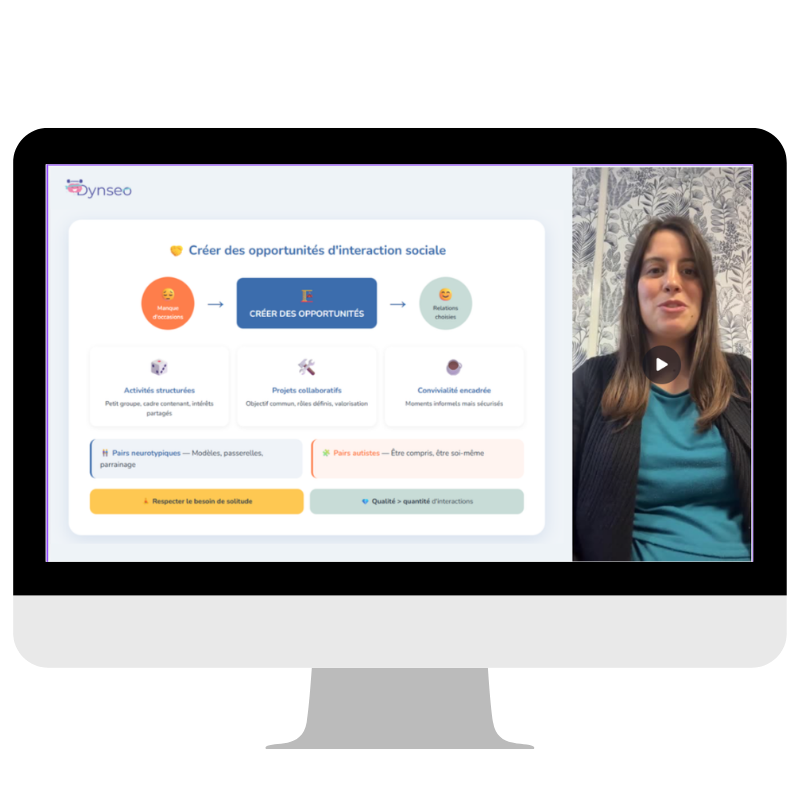
Train your educational teams with our 100% online courses, designed by experts in cognitive sciences. Accessible 24/7, our training adapts to the pace of each teacher, AESH, and school staff.
- ✓ 13 years of expertise in cognitive and educational training
- ✓ Unlimited access to the e-learning platform
- ✓ Fundable OPCO — possible coverage
Why choose e-learning?
E-learning is revolutionizing the ongoing training of teachers and educational teams: train without disrupting the school schedule.
Flexible
In the evening, on weekends, or during school holidays, at your own pace.
Accessible everywhere
Computer, tablet, or mobile. No travel, no replacement needed.
Concrete
Practical cases in class, simulations, ready-to-use tool sheets.
Certified
Qualiopi certificates, possible OPCO funding, completion tracking.
✅ Training available
Immediate access, Qualiopi certified e-learning, downloadable materials. Possible OPCO funding.
DYS disorders: understanding and adapting your teaching
👉 Discover
ADHD: concrete strategies for the classroom
Understanding ADHD, managing impulsivity and inattention, adapting the environment, regulation techniques, active breaks COCO MOVES.
👉 DiscoverBullying & cyberbullying: pHARe protocol
Identify, intervene, support. pHARe protocol, speech collection, family coordination, student ambassador training.
👉 Discover🚀 Next trainings: vote!
Click to vote. Your choice helps us prioritize the development of the most requested trainings.
Autism spectrum disorders in school
Understanding autistic functioning, structuring the environment, visual supports, managing sensory crises, adapted communication.
Preventing school dropout
Weak signals, observation grids, motivational interviews, peer tutoring, strengthened links with families.
Non-native students: inclusion and FLS
Visual supports, MON DICO application, valuing multilingualism, adapting assessments, supporting non-French-speaking families.
Nonviolent Communication in class
CNV principles, conflict management, caring posture, reformulation, creating a calm and respectful classroom climate.
Supporting a student with Down syndrome
Cognitive profile, pedagogical adaptations, social inclusion, COCO tools, family-school-SESSAD collaboration.
School anxiety and school phobia
Identify signs of anxiety, differentiate between phobia and absenteeism, gradual return protocol, reassure student and family.
HPI Students: Understand and Differentiate
HPI profiles, boredom and paradoxical dropout, educational enrichment, emotional management, avoid stereotypes.
Class Management and School Climate
Benevolent authority, structuring rituals, managing disruptions, educational coherence, prevent behavioral escalation.
AESH: Posture and Daily Missions
Regulatory framework, professional positioning, collaboration with the teacher, student autonomy, difficult situations.
Pedagogical Differentiation in Heterogeneous Classrooms
Diagnostic assessment, needs groups, work plans, peer tutoring, adaptations without overload for the teacher.
Behavioral Disorders at School
Opposition, crises, aggression: understanding the functions of behavior, de-escalation techniques, intervention plan, family partnership.
Motor Disability and Accessibility in Class
Adapt the space and materials, fatigue and pain, compensatory digital tools, paramedical coordination.
Inclusive Digital: Tablets and COCO
Use COCO THINKS and COCO MOVES in class, create personalized pathways, integrate digital into pedagogical adaptations.
ULIS Coordination: Driving Inclusion
Role of the coordinator, inclusive timetable, PPS and GEVASCO, teacher-AESH partnership, externalized class projects.
Attention Disorders without Hyperactivity (ADD)
Often invisible inattentive profile, identification, specific adaptations different from classic ADHD, support without stigmatizing.
Grief and Trauma in Children
Identify signs, adapt your posture, support without rushing, when to guide, support the whole class.
Epilepsy at School: Knowing How to React
Types of seizures, first aid gestures, PAI, adapt the timetable, reassure classmates, effects of treatments.
Developing Psychosocial Skills
Empathy, cooperation, emotional management, self-esteem: ready-to-use workshops integrated into school programs.
Pictograms and MY DICTIONARY at school
Communication through images for non-verbal or allophone students, MY DICTIONARY application, personalized supports.
School-family relationship: educational partnership
Successful interviews, announcing a difficulty, involving without blaming, managing disagreements, families distanced from school.
Intellectual disability: adapting practices
Varied cognitive profiles, simplifying without infantilizing, realistic goals, socialization and autonomy, visual tools.
Deaf and hard of hearing students in class
Adapting communication, classroom placement, visual supports, hearing aids, sign language interpreter, lip reading.
Prevention of peer bullying
Training student ambassadors, empathy workshops, restorative justice, creating a protective and caring school climate.
Visuo-spatial disorders and dyspraxia
Detection, graphic and digital adaptations, geometry and alternative writing, compensating without devaluing.
Assessing without excluding: inclusive assessment
Adapting assessment methods, exam accommodations, valuing skills, formative assessment in the service of inclusion.
Prevention of teacher burnout
Warning signs, stress management, mental load, emotional regulation, building sustainable protective habits.
💡 Use cases & concrete benefits
Discover how our training transforms the daily lives of educational teams
CE2 teacher with dyslexic student
Julie, a CE2 teacher, feels helpless in front of Léo, 8 years old, diagnosed with dyslexia. Her adaptations are empirical.
Julie has acquired concrete strategies: OpenDyslexic font, syllabic segmentation, visual tools. She uses COCO games for cognitive breaks.
- Léo reads 2x faster after 3 months
- Restored self-esteem
- Reassured and involved parents
- Techniques reused for 3 other DYS students
School counselor facing bullying
Marc, a school counselor, discovers a case of cyberbullying but does not know the exact intervention protocol.
Marc masters the pHARe protocol, knows how to gather the victim's testimony, involve witnesses, and coordinate with families.
- Protocol applied in 48h (vs 2 weeks)
- Victim effectively supported
- Student ambassador training launched
- 3 other situations detected and addressed
AESH with oppositional ADHD student
Sophie supports Nathan, 9 years old with ADHD and oppositional behavior. The crises are daily and exhausting.
Sophie understands Nathan's triggers, anticipates risky situations, uses de-escalation techniques, and offers COCO MOVES breaks.
- Crises reduced by 3 in 1 month
- Nathan stays in class 80% of the time (vs 40%)
- Calm relationship with the teacher
- Parents trained in the same techniques
High school team: massive dropout
The vocational high school reports 22% absenteeism in the first year. The team does not detect weak signals early enough.
Shared observation grid, individual interviews at the first sign, peer tutoring, strengthened family links.
- Absenteeism reduced to 12% in 6 months
- 15 "re-engaged" students out of 18 identified
- Improved classroom climate
- Sustainable system
School with non-native children
The school welcomes 12 UPE2A students. Teachers lack tools to include them in regular classes.
Systematic visual supports, MON DICO application, promotion of multilingualism, adapted assessments.
- DELF A1 in 8 months for all
- Successful inclusion: 10/12 in regular class
- Promotion of cultures of origin
- Non-native parents more involved
Fully trained institution
The middle school wants to improve inclusion but practices are heterogeneous. Each teacher does it "their way".
25 teachers create a common culture: shared adaptations, common tools, generalized CNV, educational coherence.
- Family satisfaction: +45%
- Exclusions halved
- 3 neighboring establishments trained
- "Inclusive School" label obtained
📋 Receive the catalog & a quote
Tell us your needs: we will get back to you quickly.
📚 Selected training courses (0)
💬 What they say
Testimonials from teachers, AESH and educational teams trained with DYNSEO
❓ Frequently asked questions
Everything you need to know about our training for schools
Who are these trainings for?
Teachers, AESH, CPE, directors, ULIS coordinators, EN psychologists, school nurses. No prerequisites.
How does e-learning work?
100% online, at your own pace. Short videos, quizzes, practical scenarios, PDF tool sheets. Duration 2h to 4h. Access 24/7, 6 months.
Possible funding?
Qualiopi certified training, eligible for OPCO and institutional training plan. Support for file preparation. -15% from 5 people.
Certificate at the end?
Qualiopi certificate after passing the final test (70%). Personal, valid for your professional file and your institution.
Suitable for all levels?
Content adapted for elementary, middle, and high school. Each training specifies the relevant levels and specifics by cycle.
Train an entire team?
Recommended institutional formula: everyone at their own pace, then collective time to harmonize practices. -15% from 5 registered.
COCO applications included?
The trainings explain how to use COCO THINKS and COCO MOVES in class. Separate tablet licenses. Free demos.
Can I train during the holidays?
Yes! Unlimited access for 6 months. Many teachers train in the evening or during school holidays, at their own pace.
Educational support?
Email assistance within 48 hours for any technical or educational questions. Exchange forum among learners on certain trainings.
Compliant with National Education?
Content aligned with official recommendations: inclusive school, pHARe protocol, AESH reference framework, common core.
Immediate access?
Login details sent within 5 minutes after payment. Accessible 24/7, computer, tablet, or smartphone.
Satisfaction guarantee?
Full refund within 14 days without justification if the training does not meet your expectations.