Dynseo proposes
PARKINSON’S DISEASE with the ROLLING BALL, CLINT and SCARLETT

Parkinson is a neurodegenerative disease whose causes are still unknown. The main symptoms motorically occur through tremors, weakness or slowness in movements. But we can associate to them also sleeping disorders, depression or, in the most severe cases, cognitive deterioration.
The Dynseo team is very involved in helping people with Parkinson’s disease. That’s why we have developed several applications which can be used for motor and cognitive stimulation of a person with Parkinson’s disease.
Did you know it? In Italy, there are about 6,000 cases of Parkinson every year.
Stage 1

Slow movements
Stiffness
Tremors

The Rolling Ball
Stage 2
“Honeymoon” period
Temporary regression of symptoms

The Rolling Ball
Stage 3
Motor fluctuations (“on-off” times)
Involuntary movements

The Rolling Ball
Stage 4
More severe motor disorder
Cognitive disorders

Clint and Scarlett
DYNSEO APPS FOR PARKINSON’s disease
The Rolling Ball offers a diverse range of 8 games cleverly designed to perfect fine motor skills.

Scarlett (easier version) and Clint (harder version) offer a variety of more than 30 memory games, specially designed to stimulate all cognitive functions in a playful way.
IN THIS GUIDE
01.
Motricity games with The Rolling Ball (stages 1, 2, 3)
Exploring motor skills exercises specifically designed for Parkinson‘s disease allows you to adapt and help maintain mobility and alleviate motor symptoms, thus offering personalized solutions to improve the quality of life of patients or loved ones at home.
02.
Cognitive games with Joe and Edith (stage 4)
Cognitive degradation in Parkinson‘s disease can present a complex challenge, affecting memory, attention, and executive functions, thus requiring appropriate management to mitigate its impact on the daily life of the person and their loved ones. Discover Joe and Edith‘s games.
03.
Adapted training programs
Tailored training programs to target cognitive functions and train at your own pace at home. 15 minutes a day for 4 weeks will be enough for you!
04.
Depression in Parkinson’s disease
Depression is common in people with Parkinson‘s disease, which can worsen motor symptoms and impair quality of life. Multidisciplinary care, including medical follow–up and psychological support, is crucial to address this often underestimated component of the disease.
I would like to receive the complete guide to supporting people suffering from PARKINSON’S disease
with THE ROLLING BALL, CLINT and SCARLETT




01.
MOTOR SKILLS GAMES WITH THE ROLLING BALL (STAGE 1, 2, 3)
Discover the most suitable games for people with Parkinson’s disease.

Resist the wind

Chase the circles

Follow the line
FORMS OF PARKINSON
Working with people with Parkinson’s is possible with activities adapted to their needs. Parkinson is a neurodegenerative disease which causes motor difficulties, but with a targeted stimulation it is possible to rehabilitate the person and the deterioration associated to the disease can be delayed. The motor disorders are often asymmetric, that is, in just one part of the body and they can affect different body areas (legs, arms, hands…). These disorders can appear in different moments of the day and with a different duration and intensity.
The type of activity depends, therefore, on the current disorder and on the disease severity. The Rolling Ball can be used with all the people affected by Parkinson’s and it can be adapted to each situation.
The Rolling Ball is an application to work on fine motor skills. By using the tablet‘s tilt function to move the ball across the screen and perform a variety of exercises, you activate not only fine motor skills, but also hand–eye coordination as well as muscle tone control.
This fun and interactive approach offers an engaging way to improve these essential skills. In the context of Parkinson‘s disease, where movement management and coordination are often affected, regular work on fine motor skills can contribute significantly to maintaining physical functionality and improving quality of life.

Stage 1 of Parkinson’s disease
At this stage, the first symptoms of the disease begin to appear: slowness in movements, rigidity and tremors. These symptoms don’t necessarily affect people’s daily life.
Resist the wind
Keep the ball in the central area of the screen while facing the wind.
Thanks to this game, you can stimulate the movement control in different forms.
The wind can come from left or from right: the person has to adapt the tablet’s inclination to the wind’s direction which is indicated by the white lines. The appearance of the wind is aleatory and it involves a continuous adaptation of the movement.

Chase the circles
In this game, you make the ball roll through different circles. You can adjust several parameters: ball speed, ball size, etc.
At first, the person has to use his or her visual scanning to identify the circle’s position and the visual-spatial ability to imagine the trajectory that the ball has to do to reach the circle.

Then, the person has to use the bimanual capabilities to incline the tablet and to move the ball. It is important to coordinate both hands because an unbalanced inclination can give an inaccurate direction.
Finally, once you reach the circle, another circle appears and the excercise resumes. You stimulate, therefore, the modulation of muscle tone because the ball must change direction quickly and so the tablet’s inclination must be adapted.
Stage 2 of Parkinson’s disease
This stage is called “honeymoon” because the symptoms are milder, almost inexistent, as if there was a regression of the disease. However, this stage is temporary and the symptoms will appear. You can take advantage of this stage in order to continue to stimulate the motricity and to learn to better control the movements in the future.

Follow the line
Follow the line with the ball.
In this game, you can select straight lines (from left to right and vice versa, from the top down and vice versa or even diagonally) or a mixed route where there will be all the directions.
You also stimulate the movement control and the regulation of muscle tone because the ball not only has to reach a final goal, but it has also to exactly follow the path traced. The adaptation of the movement is, therefore, fundamental.
The adaptation is not only in the direction, but also in the speed to give to the ball. In the straight segments, the person can incline more the tablet and give a more important speed, but approaching to the change of direction, the person has to reduce the speed to better manage the movement.

Face the current
Score as many goals as possible, all while going upstream.
Thanks to this game, you can stimulate several cognitive function.
To move the balloon, you stimulate the bimanual skills, but also the muscle tone because in the water there is the current (represented by the white lines) which rejects the balloon. The “power” to put in the inclination of the tablet must be proportional to the force of the current.
The presence of the current makes the game useful in a situation of bradykinesia because if the person fails to quickly adapt the inclination and the power, the balloon will be blown back.
Finally, you stimulate the attention because the person has to concentrate on the trajectory to reach the net, on the obstacles and on the force of the current at the same time.
Stage 3 of Parkinson’s disease
In this stage, there is a reappearance of the symptoms which may occur through a slowdown of the movement or the presence of involuntary movements. In this stage, there is a “motor fluctuation”, so the symptoms can alternate and appear at different times of day.

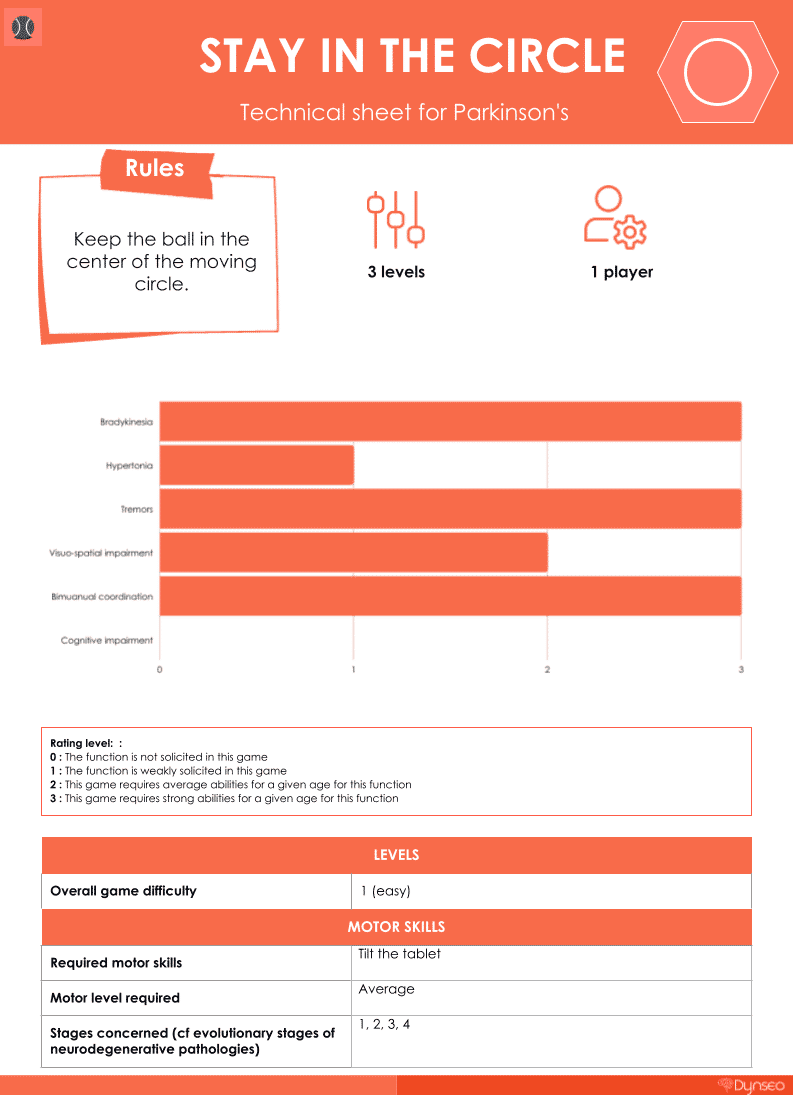
Stay in the circle
Keep the ball inside the circle while it is moving.
This game is very useful at this stage because it can be used regardless of the symptoms.
If the person makes involuntary movements, he or she will make the ball come out from the circle. So the person will have to get to control these movements and to find a strategy to quickly find the balance. This stimulation is still effective if the person has tremors.
In addition, the circle changes direction in a random way, so you also stimulate the attention and the reflexes.

Keep it at the center
Keep the ball at the center of the screen.
In the middle of the screen there is a black spot, consequently if the ball moves, the person will have a reference point to find the correct position. You can, therefore, work on the use of the feedback to modify the movement.
Although the goal is to keep the tablet stable, the hands will make small movements anyway. So you stimulate the modulation and the regulation of muscle tone.
02.
COGNITIVE GAMES WITH CLINT AND SCARLETT (STAGE 4)
Cognitive deterioration in Parkinson‘s disease can lead to difficulties in executive functions, memory and attention, significantly impacting patients‘ quality of life.

Congested Parking

Hunting Intruders

Noah's Ark
Cognitive impairment is a complex and often underestimated aspect of Parkinson‘s disease. Although the disease is primarily associated with motor symptoms, many patients also experience cognitive difficulties over time. These difficulties can manifest as problems with memory, attention, reasoning, and decision–making, which can have a significant impact on their ability to lead an independent daily life. Sometimes these cognitive impairments can be the result of the direct effect of the disease on the brain, while in other cases, they can be exacerbated by factors such as stress, depression, or the side effects of medications. Cognitive degradation in Parkinson‘s disease requires thorough assessment and appropriate management, including non–pharmacological interventions such as cognitive stimulation, rehabilitation, and psychological support to help patients maintain their quality of life and mental well–being.

Clint, your brain coach
A more difficult version to improve cognitive function dynamically

Scarlett, your memory coach
An easier version to train at your own pace and without checking
Clint and Scarlett offer a variety of more than 30 memory games, specially designed to playfully stimulate all cognitive functions. In the context of Parkinson‘s disease monitoring, where the preservation of cognitive function is paramount, these apps play a critical role in keeping the brain active and engaged.

Games adaptation to the needs of Parkinson’s disease
Slowing of thinking
In Parkinson’s, the slowness occurs not only at the level of motricity, but it can also affect the thinking. To improve this function, you can do activities which stimulate the neuronal activation, that is, activities which transmit different stimulus and which require a quick response of the brain.
ColorForm
Find the shape or color according to the model.
This game demands a quick research to find the correct shape or color. The person has to use his or her visual skills to identify the features of each object, then the eye-hand coordination to click on the right answer.

In the medium and difficult levels, you can stimulate the rapidity in changing the mental patterns. In these levels, the goal can change at every round (10 rounds per match). So the person has to pay attention to the request, for example if he or she has to search for the color, he or she has to activate the concept of “color”, but if then the person has to search for the shape, he or she has to inhibit the concept of “color” and activate the concept of “shape”.
Hunting Intruders
Find the intruder between the words.
The person has to read four suggestions and search for the connection between three of them to find the intruder.
By reading the proposed words, the person must access his semantic memory quickly to give meaning to the words. She/he then has to make several logical associations between the words to find the connection.

In addition, once the person has found the common point, he or she still has to analyze the fourth word to make sure that it does not fall within the same category as the others.
The thinking is therefore stimulated in different forms and you also stimulate the speed of information processing in order to find and remember all information.
Visual skills
In Parkinson’s, the person can have difficulties in visual perception. He or she can also have disorders of the axis of the body which prevent the person from having a correct perception of himself or herself in space. The two disorders can be connected and generate difficulties of orientation because the person is unable to perceive his or her movement in space and she or he can’t neither find external reference points.
Crazy Waterfall
Identify the differences between the proposed sequence and the model.
First, you stimulate visual perception since the person has to analyze the symbols presented to spot the differences. The symbols present do not have a precise meaning, so the person must analyze them well to perform the task.

In this way, you stimulate the perception and visual analysis of new objects, which are essential for finding one‘s way around in new places.
You also stimulate eye saccade, which is the rapid movement of the eye from one stimulus to another. This movement is essential for good visual perception and to have reference points.
Clint the pirate
Have Clint move to bring him back to his treasure.
Thanks to this game you stimulate the visual perception as the person has to spot Clint, the treasure and the obstacles present on the map.

You stimulate the creation of mental images since the person has to imagine the trajectory of each movement to find the right direction.
To find the fastest route, you also stimulate planning.
Finding a route or creating mental images of places and movement stimulate orientation skills.
You stimulate the motor skills of the fingers since the person has to press the right arrow to make Clint move.
Organization
In the most severe stage of Parkinson‘s disease, organizational difficulties can be seen. This disorder can be influenced by slowness of thinking and movement. As a result, the person is unable to coordinate his or her thoughts and actions, which become disorganized. Organizational difficulties can also manifest themselves in the organization of an activity or personal affairs.
Congested Parking
Move the cars to get the yellow car out of the parking lot.
The person must use their visual perception skills to analyze the position of cars, their size, and the room they have to move. Then, she has to create mental images to imagine the possible movements of the cars and their consequences.

Thanks to this game, you can stimulate several skills necessary for good organization.
In addition, to solve this puzzle and find the right sequence to bring out the yellow car, you also stimulate logic and planning.
Finally, to move the cars, the person has to slide their finger across the screen and stimulate their finger motor skills.
Granny Cooks
Memorize the steps or the ingredients in the recipes which are proposed.
Thanks to this game, you can stimulate the organization of an activity and this is essential to keep autonomy.

In the first phase, the game shows the recipe and the person has to memorize the ingredients. You can stimulate sequencing in the “recipe“ mode (remembering the procedure) or verbal or visual memory in the “ingredients“ mode (remembering ingredients).
You stimulate attention: this cognitive function allows you to maintain concentration from the beginning to the end of the activity and therefore to execute all the steps correctly.
Finally, you can use the game to discover and memorize a recipe, and then try to make it for real. In this way you can integrate motor stimulation (cutting vegetables, mixing ingredients…).
Movement
The main symptoms of Parkinson‘s remain those related to motor skills. Scarlett allows to stimulate these skills through different games. It is possible to use the Scarlett app to stimulate only the motor skills of the fingers.
Noah’s Ark
Slide the animals, in pairs, into the ark.
The use of animals makes it easy to recognize images and therefore allows this game to be used in the presence of visual impairments.
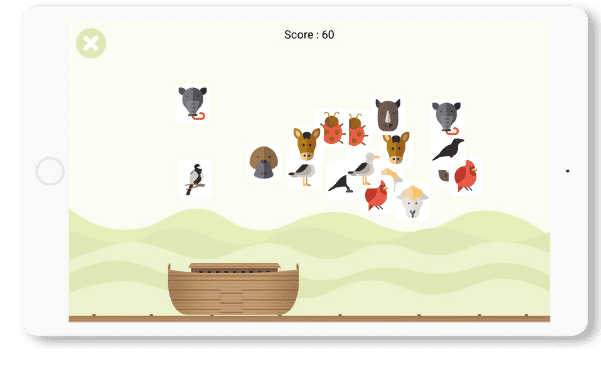
At first, you stimulate visual scanning because the person has to look at all the animals present. Then you work on matching skills to find the pairs of animals.
Once the pairs of animals are found, the person must use hand–eye coordination and finger motor skills to select the right animal and slide it into the ark.
Ask to take the first animal with one finger and the second animal with another finger. You can stimulate fine motor skills (use the index finger first, then the middle finger) or bimanual skills (use the left hand first, then the right hand).
Flushing
Move the sidebar to bounce the ball.
In this game you have to use finger motor skills, but also other cognitive functions.

The ball moves in different directions so you stimulate attention and visual scanning.
You also stimulate hand–eye coordination to touch the bar. The ball is always in motion so the precision of the touch is fundamental.
You can stimulate finger motor skills by asking you to touch the bar with a different finger or to alternate between the right and left hands.
03.
ADAPTED TRAINING PROGRAMS
A personalized training program is essential in Parkinson‘s disease because it allows you to target the specific needs of each individual, thus promoting optimal recovery and improved quality of life.

Pop Balloons

Panurge

Twins
Joe accompanies you in your training with a specific program over 4 weeks. Every week you will find sessions and rest days, with games to do. Just 15 minutes of activity is enough to improve!
In addition, to support you in the best possible way, the program offers advice on how to adapt the exercise, make it more fun or share it with your loved ones.

At the end of each program, you will find pages explaining the importance of each game offered. You will discover the definition of cognitive function as well as its different components.
Clint offers practical advice to improve your cognitive functions (attention, memory, language, etc.) according to your needs. You‘ll also find suggestions for adapting the games.

Pop Balloons
In this game, the person has to move the arch to pop the balloons of the right color.
By encouraging hand–eye coordination and precision of movement, it can help improve dexterity and fine motor skills, which are often affected by the disease. In addition, by providing cognitive and visual stimulation, this game could help maintain mental abilities and slow the cognitive decline associated with Parkinson‘s. Finally, its convenience and availability on tablets could facilitate access to exercise and allow patients to train at home independently, thus strengthening adherence to rehabilitation programs.

Panurge
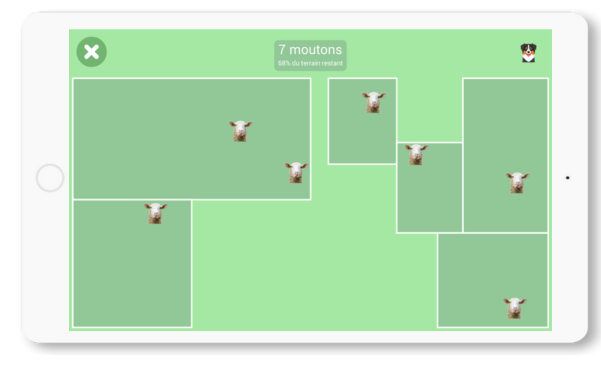
In this game, the person has to draw lines to create enclosures.
By encouraging precision of movement and hand–eye coordination, it can help improve dexterity and fine motor skills, skills often impaired by disease. In addition, by providing cognitive and visual stimulation, this game can help maintain cognitive function and delay its decline.
Twins
In this game, the person has to memorize the place of the pairs.
By boosting memory and cognitive function, it can help slow the cognitive decline associated with the disease. In addition, by providing a fun and entertaining activity, this game can promote patients‘ emotional and mental well–being.

04.
DEPRESSION IN PARKINSON’S DISEASE
Depression is a common concern in Parkinson‘s patients, requiring special attention to improve quality of life and mental well–being.

Mole Invasion

Shape Box

Crazy Chessboard
In the context of Parkinson‘s disease, depression is an often underestimated but significant component that can have a considerable impact on patients‘ quality of life. Motor and non–motor symptoms of the disease, such as decreased mobility, sleep disturbances, and cognitive changes, can contribute to the onset of depression. In addition, psychological adjustments related to the management of a chronic illness can also be triggers. Depression can not only worsen existing motor symptoms, but it can also lead to decreased motivation, loss of interest in daily activities, and a deterioration in overall quality of life. Therefore, it is crucial that patients with Parkinson‘s disease receive appropriate support, including regular medical follow–up and psychological support, in order to effectively manage depression and improve their overall well–being.
Here are 10 tips to combat depression in Parkinson‘s disease:
- Establish a routine: Having a daily routine can provide structure and a sense of stability.
- Seek social support: Staying connected with loved ones and participating in social activities can help prevent isolation and boost morale.
- Eat a healthy diet: A balanced diet can have a positive impact on mood and energy.
- Practice relaxation: Meditation, deep breathing, and other relaxation techniques can help reduce stress and promote relaxation.
- Express your emotions: Talk to a friend, family member, or healthcare professional about your feelings. Communication can help alleviate some of the emotional burden.

TWO-PERSON GAMES
Parkinson‘s can be associated with mood disorders that can go as far as depression. Scarlett and Clint offer cognitive stimulation activities in the form of a game, so the activity becomes fun and calming. Games can influence mood in a positive way. In addition, Scarlett and Clint offer to play in pairs, where the screen is split in two and each person plays on their side of the screen. This way, you can share the activity and maintain a positive relationship.
Moles Invasion
Tap on the 3 types of moles according to the instructions as soon as they appear on the screen.
The person must use their visual scanning skills to spot moles. Then she has to analyze the image to find out which mole has appeared.
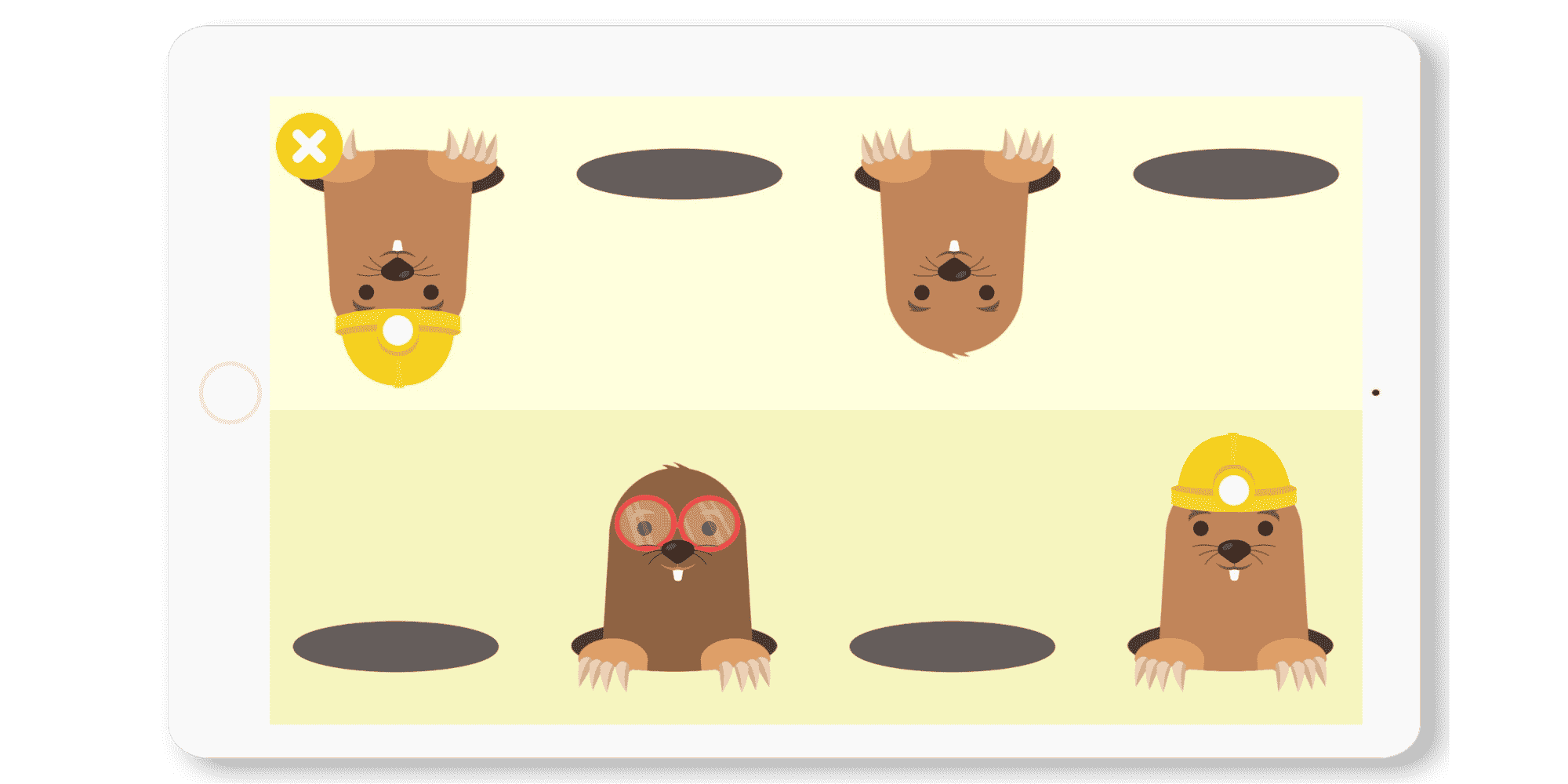
Thanks to this game you stimulate the motor skills of the fingers to touch the moles, but also the activation and inhibition of movement: do not touch the moles with the glasses, touch the normal moles once and touch the moles twice with the helmet. This game offers the possibility of playing in pairs to share a moment together and maintain a positive relationship.
Shapebox
Spot the same shape or color as the model.
To recognize the correct shape or color, the person must use the visual perception in order to identify the objects and analyze them (geometric features and color).

This game allows to play in pairs because the images flow in the middle of the screen and everyone has in his side a button to click when he finds the right shape or color.
In this way, you can share the activity and create a positive competition because the game is fast (10 shapes to find) and so you can make several matches in the same session.
Therefore, you can stimulate cognitive functions and the relationship at the same time.
Crazy Chessboard

When you have Parkinson‘s disease, you may have several symptoms, more or less severe. It is therefore important to adapt and personalize the work and support, therapeutic or familiar, to help the person regain his or her skills or slow down cognitive and motor degradation. Dynseo offers several solutions for people with Parkinson‘s: The Rolling Ball (for motor stimulation), Clint and Scarlett (for cognitive stimulation).
And, thanks to Dynseo, the follow–up of the person with Parkinson‘s is not only limited to physical rehabilitation, but is also focused on the relationship. When a person has a disease, such as Parkinson‘s, it is very important to remember that before being a patient or a sick person, it is a person for whom the relational side is very important.
You can try The Rolling Marble, Clint or Scarlett for free for 7 days. You will then be able to subscribe with the different formulas we offer: either our offer for individuals, or our offer for professionals.
DISCOVER THE APPS

Here are the technical sheets of the games presented, with the cognitive functions stimulated by game