
Structures & Services for Elderly People
Train your teams in Nursing home, retirement homes, assisted living facilities and home care services with our 100% online courses, designed by experts in cognitive sciences. Accessible 24/7, our training adapts to the pace of each caregiver, home helper, activity leader, and psychologist.
- ✓ 13 years of expertise in cognitive stimulation for seniors
- ✓ Unlimited access to the e-learning platform
- ✓ Fundable by OPCO — possible coverage

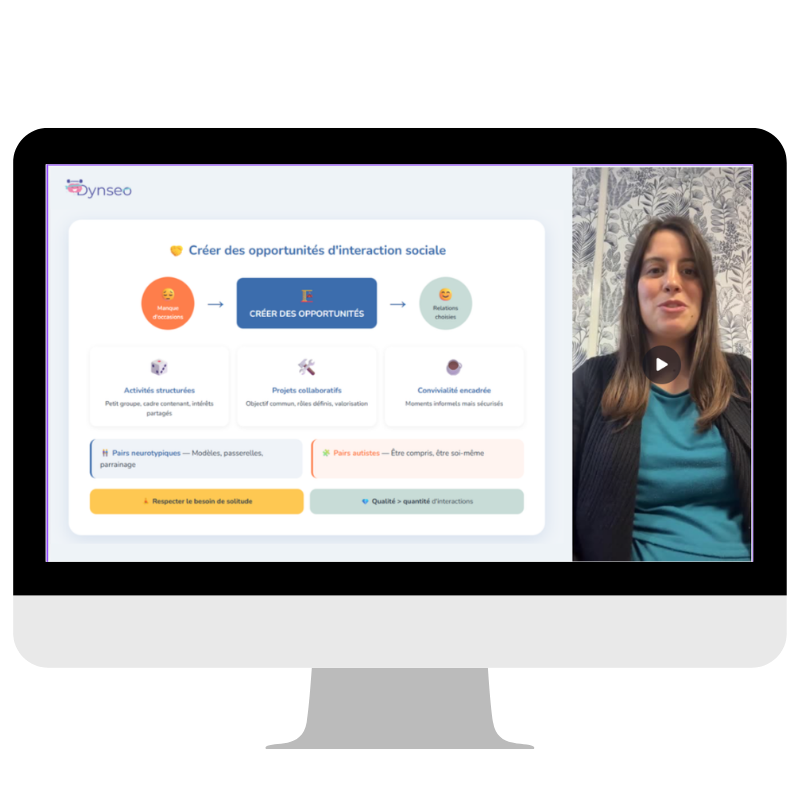
Why choose e-learning?
The reality on the ground does not always allow teams to be freed up: e-learning trains effectively without disrupting the service.
Flexible
At your own pace, in short sessions, without immobilizing the team.
Accessible everywhere
Computer, tablet, or mobile, at the office or at home.
Concrete
Practical cases, situational exercises, scripts, and ready-to-use tools.
Traceable
Completion tracking, certificates, and Qualiopi certifications.
✅ Trainings available
Immediate access, e-learning, downloadable materials. OPCO funding possible.
Alzheimer's disease: understanding and supporting
Concrete benchmarks, adapted communication, prevention of behavioral disorders, daily routines, and digital tools for daily support.
👉 DiscoverBehavioral disorders in elderly people
Identify the causes of disorders, de-escalation techniques, professional posture, crisis prevention, and family support.
👉 DiscoverCognitive stimulation adapted for seniors
Ready-to-use activities, adaptation by cognitive profile, individual and collective animation with the applications SCARLETT and CLINT.
👉 Discover🚀 Next trainings: vote!
Click to vote. Your choice helps us prioritize the development of the most requested trainings.
End of life: support and posture
Ethical benchmarks, communication with residents and families, pain management, prevention of professional burnout.
Prevention of professional burnout
Signs of burnout, emotional regulation, team cohesion, managing mental load in daily life.
Alzheimer-related diseases
FTD, Lewy, vascular dementia: specific symptoms, differences with Alzheimer's, adaptations by pathology.
Depression and mood disorders
Masked depression, differentiate depression and dementia, active listening, daily remotivation strategies.
Effective memory workshops
Design, animate and evaluate memory workshops adapted to the different cognitive profiles of residents.
Mild Alzheimer's stimulation
Cognitive exercises adapted to the mild stage, preserve autonomy, strengthen confidence, slow decline.
Moderate/severe Alzheimer's stimulation
Sensory activities, non-verbal communication, maintain emotional ties in advanced stages of the disease.
Therapeutic reminiscence
Reminiscence techniques, life stories, personalized supports to revive memories and well-being.
Tablets and SCARLETT application
Master the SCARLETT application, create personalized programs, animate tablet workshops for seniors.
Agitation and wandering
Understand the causes, calming techniques, secure wandering, alternatives to restraint.
Refusal of care: gentle negotiation
Analyze the causes of refusal, adapt the approach, compassionate negotiation, respect the resident's pace.
Aggression: de-escalation
Prevent escalation, verbal de-escalation techniques, protect oneself, post-crisis team management.
Non-verbal communication
Body language, eye contact, relational touch: create a bond without words with non-communicative residents.
Parkinson: global support
Motor and cognitive symptoms, adapted exercises, fall prevention, maintaining mobility and autonomy.
Music therapy and singing workshops
Benefits of music, organizing singing workshops, leveraging preserved musical memory in seniors.
Pictograms and MY DICTIONARY
Communication through images, MY DICTIONARY application, creating personalized supports for non-verbal residents.
Dignity: prevention and quality
Regulatory framework, alert signals, prevention tools, building a sustainable culture of dignity.
Adapted physical activities for seniors
APA principles, gentle gym in a chair, secure exercises, progression and motivation of seniors.
💡 Use cases & benefits concrete
Discover how our training transforms the daily lives of teams in Nursing homes, residences, and at home
Caregiver facing the agitation of an Alzheimer's resident
Nadia, caregiver in a Nursing home, dreads each bath with Mrs. Dupont, 84 years old, moderate stage Alzheimer's. The resident screams, pushes hands away, scratches. The team considers restraint.
Nadia understands that the agitation is related to the misunderstanding of the action. She adopts a sequenced approach: eye contact, gentle touch before care, verbalization of each step, familiar music in the background.
- Calm baths in 2 weeks
- Restraint avoided permanently
- Scratches reduced to zero
- Technique shared with the night team
Activity leader restarting her memory workshops
Claire, activity leader in a senior residence, offers memory workshops but the residents disengage after 10 minutes. Participation is declining, management questions the usefulness.
Claire adapts the exercises by cognitive profile using the EDITH application: visual games for some, musical quizzes for others. She alternates between individual and group sessions, with a maximum of 20 minutes.
- Participation doubled in 1 month (from 8 to 16 residents)
- Sessions spontaneously extended by the residents
- Families requesting EDITH for home
- Management convinced: 2nd tablet purchased
Home care assistant facing refusal of care at home
Fatima intervenes at Mr. Bernard's home, 79 years old, early stage Alzheimer's. He refuses the shower, medications, sometimes even food. Mr. Bernard's daughter is distraught and considers placement.
Fatima identifies the opportune moments, negotiates gently, offers alternatives (washcloth instead of shower), ritualizes meals with memory foods. She also trains the daughter in the same techniques.
- Refusal of care reduced by 4 times in 6 weeks
- Mr. Bernard remains at home (placement avoided)
- Daughter reassured and equipped for daily life
- Improved coordination with the treating physician
Psychologist in Nursing home and aphasic resident post-Stroke
Mrs. Martin, 72 years old, has not spoken since her Stroke. She cries, isolates herself, refuses activities. The team no longer knows how to communicate with her, frustration is mutual.
The team installs the MY DICTIONARY application on a tablet with personalized pictograms: pain, thirst, desires, emotions. Relational touch is integrated into care. A code of simple gestures is shared with the entire team.
- Mrs. Martin communicates her basic needs in 3 days
- Daily crying replaced by smiles
- Return to group activities in 2 weeks
- Family moved and grateful
Night team facing sundowning
In the Nursing home, 5 residents with Alzheimer's disease are agitated every evening between 5 PM and 8 PM: wandering, shouting, attempts to escape. The night team is exhausted, and turnover is high.
The team implements a twilight protocol: dim lighting from 4:30 PM, soft music, warm snacks, secure wandering paths, soothing sensory activities with SCARLETT in relaxation mode.
- Agitation episodes reduced by 60% in 1 month
- Escapes: zero since the protocol
- Stabilized night team (0 departures in 6 months)
- Protocol adopted by 2 Nursing homes of the same group
Complete Nursing home: annual training plan
The Nursing home Les Tilleuls (68 beds) has a caregiver absenteeism rate of 18%. Families complain about the lack of activities. The HAS evaluation is approaching, and management is looking to structure the quality approach.
42 professionals trained in 3 months through e-learning. Harmonized protocols, daily SCARLETT workshops, enriched transmissions, personalized support project for each resident.
- Absenteeism reduced to 11% (–7 points)
- Family satisfaction: +38% on the annual questionnaire
- Successful HAS evaluation with mention
- Training budget optimized thanks to OPCO funding
📋 Receive the catalog & a quote
Tell us your needs: we will get back to you quickly.
📚 Selected training (0)
💬 What they say
Testimonials from Nursing home professionals trained with DYNSEO
❓ Frequently asked questions
Everything you need to know about our Nursing home training
Who are these trainings for?
All Nursing home teams: nursing assistants, nurses, activity leaders, psychologists, managers. No prerequisites.
How does e-learning work?
100% online, at your own pace. Videos, quizzes, PDFs. Duration 2h to 4h. Access 24/7, 6 months.
OPCO funding?
Qualiopi trainings, eligible for OPCO Santé. Support for the application. -15% from 5 people.
Certificate at the end?
Qualiopi certificate after passing the final test (70%). Named, recognized by ARS and HAS.
Suitable for small Nursing homes?
Modular content for 30 to 120 beds, tools adapted to your resources.
Train an entire team?
Group formula, each at their own pace then collective exchange. -15% from 5.
DYNSEO tools included?
Trainings explain the use of SCARLETT and CLINT. Separate licenses, free demos.
Access duration?
6 months unlimited. Review modules, download materials, pause between sessions.
Educational support?
Email assistance within 48h. Forum for exchange between learners.
Compliant with HAS?
HAS recommendations respected: Alzheimer's disease, good treatment, behavioral disorders.
Immediate access?
Credentials within 5 min after payment. 24/7, all supports.
Satisfaction guarantee?
Full refund within 14 days without justification.