--dyn-bleu:#5e5ed7;
--dyn-bleu-fonce:#5268c9;
--dyn-vert:#a9e2e4;
--dyn-jaune:#ffeca7;
--dyn-rose:#e73469;
--dyn-encre:#1d1d2e;
--dyn-gris:#5c5c72;
--dyn-fond:#f6f6fd;
--dyn-ombre:0 6px 24px rgba(29,29,46,.08);
--dyn-ombre-forte:0 12px 34px rgba(94,94,215,.22);
--dyn-radius:18px;
font-family:"Inter","Segoe UI",system-ui,-apple-system,"Helvetica Neue",Arial,sans-serif;
color:var(--dyn-encre);
line-height:1.68;
font-size:clamp(16px,1.05vw + 13px,18px);
max-width:860px;
margin:0 auto;
padding:0 4px;
-webkit-font-smoothing:antialiased;
}
.dbi-art-ed5c67 .dyn-article * {box-sizing:border-box;}
.dbi-art-ed5c67 .dyn-article h1, .dbi-art-ed5c67 .dyn-article h2, .dbi-art-ed5c67 .dyn-article h3, .dbi-art-ed5c67 .dyn-article h4 {
color:var(--dyn-encre);line-height:1.22;margin:0 0 .5em;font-weight:800;letter-spacing:-.015em;
}
.dbi-art-ed5c67 .dyn-article h1 {font-size:clamp(1.65rem,3.4vw,2.35rem);margin-top:.4em;}
.dbi-art-ed5c67 .dyn-article h2 {font-size:clamp(1.35rem,2.4vw,1.75rem);margin-top:2.1em;padding-top:.2em;}
.dbi-art-ed5c67 .dyn-article h3 {font-size:clamp(1.1rem,1.7vw,1.28rem);margin-top:1.5em;font-weight:700;}
.dbi-art-ed5c67 .dyn-article p {margin:0 0 1.05em;}
.dbi-art-ed5c67 .dyn-article a {color:var(--dyn-bleu-fonce);text-decoration:underline;text-underline-offset:3px;}
.dbi-art-ed5c67 .dyn-article a:hover {color:var(--dyn-rose);}
.dbi-art-ed5c67 .dyn-article a:focus-visible {outline:3px solid var(--dyn-bleu);outline-offset:2px;border-radius:4px;}
.dbi-art-ed5c67 .dyn-article ul, .dbi-art-ed5c67 .dyn-article ol {margin:0 0 1.05em;padding-left:1.25em;}
.dbi-art-ed5c67 .dyn-article li {margin-bottom:.45em;}
.dbi-art-ed5c67 .dyn-article strong {font-weight:700;}
.dbi-art-ed5c67 .dyn-article img {max-width:100%;height:auto;display:block;}
.dbi-art-ed5c67 .dyn-pagehead {
position:relative;overflow:hidden;border-radius:var(--dyn-radius);
padding:30px 24px 28px;margin:0 0 1.5em;box-shadow:var(--dyn-ombre);
}
@media(min-width:720px) {
.dbi-art-ed5c67 .dyn-pagehead {padding:44px 44px 40px;}
}
.dbi-art-ed5c67 .dyn-pagehead::after {
content:"";position:absolute;right:-80px;top:-80px;width:250px;height:250px;border-radius:50%;
background:rgba(255,255,255,.14);pointer-events:none;
}
.dbi-art-ed5c67 .dyn-pagehead > * {position:relative;z-index:1;}
.dbi-art-ed5c67 .dyn-pagehead--bleu {background:linear-gradient(135deg,var(--dyn-bleu) 0%,var(--dyn-bleu-fonce) 100%);color:#fff;}
.dbi-art-ed5c67 .dyn-pagehead--bleu h1 {color:#fff;}
.dbi-art-ed5c67 .dyn-pagehead--bleu .dyn-pagehead__cat {color:var(--dyn-jaune);}
.dbi-art-ed5c67 .dyn-pagehead--bleu .dyn-pagehead__lead {color:rgba(255,255,255,.93);}
.dbi-art-ed5c67 .dyn-pagehead--bleu .dyn-pagehead__meta {color:#fff;}
.dbi-art-ed5c67 .dyn-pagehead--bleu .dyn-pagehead__meta li {background:rgba(255,255,255,.18);}
.dbi-art-ed5c67 .dyn-pagehead--eau {background:linear-gradient(135deg,var(--dyn-vert) 0%,#cfeff1 100%);color:var(--dyn-encre);}
.dbi-art-ed5c67 .dyn-pagehead--eau .dyn-pagehead__cat {color:var(--dyn-rose);}
.dbi-art-ed5c67 .dyn-pagehead--eau .dyn-pagehead__lead {color:#3b4a5c;}
.dbi-art-ed5c67 .dyn-pagehead--eau .dyn-pagehead__meta li {background:rgba(255,255,255,.62);}
.dbi-art-ed5c67 .dyn-pagehead--jaune {background:linear-gradient(135deg,var(--dyn-jaune) 0%,#fff7d6 100%);color:var(--dyn-encre);}
.dbi-art-ed5c67 .dyn-pagehead--jaune .dyn-pagehead__cat {color:var(--dyn-rose);}
.dbi-art-ed5c67 .dyn-pagehead--jaune .dyn-pagehead__lead {color:#5a5240;}
.dbi-art-ed5c67 .dyn-pagehead--jaune .dyn-pagehead__meta li {background:rgba(255,255,255,.68);}
.dbi-art-ed5c67 .dyn-pagehead__cat {
display:inline-block;font-size:.76rem;font-weight:800;letter-spacing:.12em;
text-transform:uppercase;margin-bottom:.9em;
}
.dbi-art-ed5c67 .dyn-pagehead h1 {margin:0 0 .5em;}
.dbi-art-ed5c67 .dyn-pagehead__lead {font-size:clamp(1.02rem,1.4vw,1.16rem);margin:0 0 1.3em;}
.dbi-art-ed5c67 .dyn-pagehead__meta {
display:flex;flex-wrap:wrap;gap:8px;list-style:none;padding:0;margin:0;
font-size:.83rem;font-weight:600;
}
.dbi-art-ed5c67 .dyn-pagehead__meta li {border-radius:999px;padding:5px 13px;}
.dbi-art-ed5c67 .dyn-hero {
background:linear-gradient(135deg,#ffffff 0%,var(--dyn-fond) 100%);
border-radius:var(--dyn-radius);
box-shadow:var(--dyn-ombre);
overflow:hidden;
margin:0 0 2.2em;
}
.dbi-art-ed5c67 .dyn-hero__grid {display:grid;grid-template-columns:minmax(0,1fr);}
@media(min-width:720px) {
.dbi-art-ed5c67 .dyn-hero__grid {grid-template-columns:42% minmax(0,1fr);}
}
.dbi-art-ed5c67 .dyn-hero__media {position:relative;background:var(--dyn-vert);}
.dbi-art-ed5c67 .dyn-hero__media img {width:100%;height:100%;object-fit:cover;aspect-ratio:16/9;}
@media(min-width:720px) {
.dbi-art-ed5c67 .dyn-hero__media img {aspect-ratio:auto;min-height:100%;}
}
.dbi-art-ed5c67 .dyn-hero__eyebrow {
display:inline-block;background:var(--dyn-rose);color:#fff;font-size:.72rem;font-weight:800;
letter-spacing:.09em;text-transform:uppercase;padding:6px 13px;border-radius:999px;margin-bottom:.7em;
}
.dbi-art-ed5c67 .dyn-hero__body {padding:22px 22px 24px;}
@media(min-width:720px) {
.dbi-art-ed5c67 .dyn-hero__body {padding:28px 30px;}
}
.dbi-art-ed5c67 .dyn-hero__title {font-size:clamp(1.12rem,2vw,1.42rem);font-weight:800;margin:0 0 .55em;line-height:1.25;}
.dbi-art-ed5c67 .dyn-hero__title a {color:var(--dyn-encre);text-decoration:none;}
.dbi-art-ed5c67 .dyn-hero__title a:hover {color:var(--dyn-bleu);}
.dbi-art-ed5c67 .dyn-hero__pitch {font-size:.97rem;color:var(--dyn-gris);margin:0 0 1em;}
.dbi-art-ed5c67 .dyn-badges {display:flex;flex-wrap:wrap;gap:7px;margin:0 0 1.1em;padding:0;list-style:none;}
.dbi-art-ed5c67 .dyn-badges li {
background:#fff;border-radius:999px;padding:5px 12px;font-size:.79rem;font-weight:600;
color:var(--dyn-bleu-fonce);box-shadow:0 2px 8px rgba(29,29,46,.07);
}
.dbi-art-ed5c67 .dyn-hero__actions {display:flex;flex-wrap:wrap;gap:10px;align-items:center;}
.dbi-art-ed5c67 .dyn-btn {
display:inline-block;background:var(--dyn-bleu);color:#fff !important;text-decoration:none !important;
font-weight:700;padding:13px 26px;border-radius:999px;box-shadow:var(--dyn-ombre-forte);
transition:transform .15s ease,background .15s ease;text-align:center;
}
.dbi-art-ed5c67 .dyn-btn:hover {background:var(--dyn-bleu-fonce);transform:translateY(-2px);color:#fff !important;}
.dbi-art-ed5c67 .dyn-btn--ghost {
background:#fff;color:var(--dyn-bleu-fonce) !important;box-shadow:0 2px 10px rgba(29,29,46,.09);
}
.dbi-art-ed5c67 .dyn-btn--ghost:hover {background:var(--dyn-jaune);color:var(--dyn-encre) !important;}
.dbi-art-ed5c67 .dyn-hero__price {font-weight:800;color:var(--dyn-rose);font-size:1.02rem;margin-left:2px;}
.dbi-art-ed5c67 .dyn-hero--pastel {background:var(--dom-fond);}
.dbi-art-ed5c67 .dyn-pastel {display:grid;grid-template-columns:auto minmax(0,1fr);gap:18px;align-items:start;padding:22px;}
@media(min-width:720px) {
.dbi-art-ed5c67 .dyn-pastel {gap:24px;padding:30px 32px;}
}
.dbi-art-ed5c67 .dyn-pastel__icone {
flex:0 0 auto;width:74px;height:74px;border-radius:22px;background:#fff;
display:flex;align-items:center;justify-content:center;font-size:34px;line-height:1;
box-shadow:0 4px 14px rgba(29,29,46,.10);
}
@media(min-width:720px) {
.dbi-art-ed5c67 .dyn-pastel__icone {width:88px;height:88px;font-size:40px;}
}
.dbi-art-ed5c67 .dyn-pastel__domaine {
display:inline-block;background:#fff;border-radius:999px;padding:4px 12px;
font-size:.74rem;font-weight:800;letter-spacing:.08em;text-transform:uppercase;
color:var(--dom-texte);margin-bottom:.6em;
}
.dbi-art-ed5c67 .dyn-hero--pastel .dyn-hero__eyebrow {background:var(--dom-texte);}
.dbi-art-ed5c67 .dyn-hero--pastel .dyn-btn {background:var(--dom-texte);}
.dbi-art-ed5c67 .dyn-hero--pastel .dyn-btn:hover {filter:brightness(.92);}
.dbi-art-ed5c67 .dyn-hero--pastel .dyn-btn--ghost {background:#fff;color:var(--dom-texte) !important;}
.dbi-art-ed5c67 .dyn-hero--pastel .dyn-badges li {color:var(--dom-texte);}
.dbi-art-ed5c67 .dyn-hero--pastel .dyn-hero__price {color:var(--dom-texte);}
.dbi-art-ed5c67 .dyn-dom--memoire {--dom-fond:#e9e9fb;--dom-texte:#5268c9;}
.dbi-art-ed5c67 .dyn-dom--attention {--dom-fond:#dcf2f4;--dom-texte:#1b7f86;}
.dbi-art-ed5c67 .dyn-dom--logique {--dom-fond:#ece9fb;--dom-texte:#5e5ed7;}
.dbi-art-ed5c67 .dyn-dom--langage {--dom-fond:#ffe8d9;--dom-texte:#b35a2a;}
.dbi-art-ed5c67 .dyn-dom--emotions {--dom-fond:#fdeaf1;--dom-texte:#c0295a;}
.dbi-art-ed5c67 .dyn-dom--apprentissage {--dom-fond:#fff3cd;--dom-texte:#8a6a13;}
.dbi-art-ed5c67 .dyn-dom--autonomie {--dom-fond:#e4f2ea;--dom-texte:#25795c;}
.dbi-art-ed5c67 .dyn-tldr {
background:var(--dyn-vert);border-radius:var(--dyn-radius);padding:22px 24px;margin:0 0 2em;
}
.dbi-art-ed5c67 .dyn-tldr h2 {margin:0 0 .5em;font-size:1.1rem;text-transform:uppercase;letter-spacing:.06em;}
.dbi-art-ed5c67 .dyn-tldr p {margin-bottom:.8em;}
.dbi-art-ed5c67 .dyn-tldr ul {margin-bottom:0;padding-left:1.1em;}
.dbi-art-ed5c67 .dyn-toc {background:var(--dyn-fond);border-radius:var(--dyn-radius);padding:20px 24px;margin:0 0 2.2em;}
.dbi-art-ed5c67 .dyn-toc p {font-weight:800;margin:0 0 .6em;font-size:.9rem;text-transform:uppercase;letter-spacing:.07em;color:var(--dyn-bleu-fonce);}
.dbi-art-ed5c67 .dyn-toc ol {margin:0;padding-left:1.2em;}
.dbi-art-ed5c67 .dyn-toc li {margin-bottom:.3em;}
.dbi-art-ed5c67 .dyn-cards {display:grid;gap:14px;grid-template-columns:repeat(auto-fit,minmax(230px,1fr));margin:1.4em 0 1.8em;}
.dbi-art-ed5c67 .dyn-card {
background:#fff;border-radius:var(--dyn-radius);padding:20px 20px 18px;box-shadow:var(--dyn-ombre);
}
.dbi-art-ed5c67 .dyn-card h3 {margin:0 0 .45em;font-size:1.03rem;}
.dbi-art-ed5c67 .dyn-card p {margin:0;font-size:.94rem;color:var(--dyn-gris);}
.dbi-art-ed5c67 .dyn-card__icon {font-size:1.5rem;display:block;margin-bottom:.35em;line-height:1;}
.dbi-art-ed5c67 .dyn-module {
background:#fff;border-radius:var(--dyn-radius);box-shadow:var(--dyn-ombre);
padding:20px 22px;margin:0 0 14px;
}
.dbi-art-ed5c67 .dyn-module__head {display:flex;align-items:center;gap:12px;margin-bottom:.7em;}
.dbi-art-ed5c67 .dyn-module__num {
flex:0 0 auto;width:38px;height:38px;border-radius:12px;background:var(--dyn-bleu);color:#fff;
display:flex;align-items:center;justify-content:center;font-weight:800;font-size:1rem;
}
.dbi-art-ed5c67 .dyn-module__title {margin:0;font-size:1.05rem;font-weight:800;}
.dbi-art-ed5c67 .dyn-module ul {margin:0;padding-left:1.15em;font-size:.95rem;}
.dbi-art-ed5c67 .dyn-module li::marker {color:var(--dyn-rose);}
.dbi-art-ed5c67 .dyn-tablewrap {overflow-x:auto;-webkit-overflow-scrolling:touch;margin:1.3em 0 1.9em;border-radius:var(--dyn-radius);box-shadow:var(--dyn-ombre);background:#fff;}
.dbi-art-ed5c67 .dyn-article table {width:100%;border-collapse:collapse;min-width:460px;font-size:.94rem;}
.dbi-art-ed5c67 .dyn-article thead th {
background:var(--dyn-bleu);color:#fff;text-align:left;padding:13px 16px;font-weight:700;font-size:.9rem;
}
.dbi-art-ed5c67 .dyn-article tbody td {padding:12px 16px;vertical-align:top;border-top:1px solid #ececf7;}
.dbi-art-ed5c67 .dyn-article tbody tr:nth-child(even) td {background:#fbfbff;}
.dbi-art-ed5c67 .dyn-article th:first-child {border-top-left-radius:var(--dyn-radius);}
.dbi-art-ed5c67 .dyn-article th:last-child {border-top-right-radius:var(--dyn-radius);}
.dbi-art-ed5c67 .dyn-oui {color:#1a8f6b;font-weight:700;}
.dbi-art-ed5c67 .dyn-non {color:var(--dyn-rose);font-weight:700;}
.dbi-art-ed5c67 .dyn-note, .dbi-art-ed5c67 .dyn-alerte {border-radius:var(--dyn-radius);padding:18px 22px;margin:1.5em 0;}
.dbi-art-ed5c67 .dyn-note {background:var(--dyn-jaune);}
.dbi-art-ed5c67 .dyn-alerte {background:#fdeef3;}
.dbi-art-ed5c67 .dyn-note p:last-child, .dbi-art-ed5c67 .dyn-alerte p:last-child {margin-bottom:0;}
.dbi-art-ed5c67 .dyn-note strong, .dbi-art-ed5c67 .dyn-alerte strong {display:block;margin-bottom:.3em;font-size:1rem;}
.dbi-art-ed5c67 .dyn-cta {
background:var(--dyn-bleu);border-radius:var(--dyn-radius);padding:26px 24px;margin:2.2em 0;
color:#fff;text-align:center;box-shadow:var(--dyn-ombre-forte);
}
.dbi-art-ed5c67 .dyn-cta h3 {color:#fff;margin:0 0 .4em;font-size:clamp(1.1rem,2vw,1.35rem);}
.dbi-art-ed5c67 .dyn-cta p {color:rgba(255,255,255,.92);margin:0 0 1.1em;font-size:.97rem;}
.dbi-art-ed5c67 .dyn-cta .dyn-btn {background:#fff;color:var(--dyn-bleu) !important;box-shadow:none;}
.dbi-art-ed5c67 .dyn-cta .dyn-btn:hover {background:var(--dyn-jaune);color:var(--dyn-encre) !important;}
.dbi-art-ed5c67 .dyn-steps {list-style:none;counter-reset:dyn;padding:0;margin:1.4em 0 1.8em;display:grid;gap:12px;}
.dbi-art-ed5c67 .dyn-steps li {
counter-increment:dyn;background:#fff;border-radius:var(--dyn-radius);box-shadow:var(--dyn-ombre);
padding:16px 20px 16px 62px;position:relative;font-size:.96rem;
}
.dbi-art-ed5c67 .dyn-steps li::before {
content:counter(dyn);position:absolute;left:18px;top:15px;width:30px;height:30px;border-radius:10px;
background:var(--dyn-jaune);color:var(--dyn-encre);display:flex;align-items:center;justify-content:center;
font-weight:800;font-size:.9rem;
}
.dbi-art-ed5c67 .dyn-faq {background:var(--dyn-fond);border-radius:var(--dyn-radius);padding:6px 24px 20px;margin:1.4em 0 0;}
.dbi-art-ed5c67 .dyn-faq h3 {font-size:1.05rem;margin-top:1.4em;}
.dbi-art-ed5c67 .dyn-faq p {font-size:.96rem;}
.dbi-art-ed5c67 .dyn-serie {display:grid;gap:12px;margin:1.4em 0 1.8em;}
.dbi-art-ed5c67 .dyn-serie a {
display:block;background:#fff;border-radius:var(--dyn-radius);box-shadow:var(--dyn-ombre);
padding:15px 20px;text-decoration:none;color:var(--dyn-encre);font-weight:600;font-size:.96rem;
transition:transform .15s ease;
}
.dbi-art-ed5c67 .dyn-serie a:hover {transform:translateX(4px);color:var(--dyn-bleu);}
.dbi-art-ed5c67 .dyn-serie span {display:block;font-size:.82rem;font-weight:600;color:var(--dyn-rose);text-transform:uppercase;letter-spacing:.06em;margin-bottom:2px;}
@media(prefers-reduced-motion:reduce) {
.dbi-art-ed5c67 .dyn-article * {transition:none !important;}
}{
"@context": "https://schema.org",
"@graph": [
{
"@type": "Article",
"headline": "Formation « Prévenir les chutes : repérer les risques, agir au quotidien et réorganiser l’environnement » : programme, contenu et à qui elle s'adresse",
"inLanguage": "fr",
"author": {
"@type": "Organization",
"name": "DYNSEO",
"url": "https://www.dynseo.com/"
},
"publisher": {
"@type": "Organization",
"name": "DYNSEO",
"url": "https://www.dynseo.com/"
},
"image": "https://www.dynseo.com/wp-content/uploads/2026/03/Autisme-en-etablissement-Accompagnement-Global-13.jpg"
},
{
"@type": "FAQPage",
"mainEntity": [
{
"@type": "Question",
"name": "Combien de temps faut-il pour suivre la formation ?",
"acceptedAnswer": {
"@type": "Answer",
"text": "Comptez environ quatre heures au total pour les 4 modules et les 18 leçons, introduction et conclusion comprises. Les vidéos étant courtes, la plupart des professionnels étalent le parcours sur deux à quatre semaines, à raison de deux créneaux d'une vingtaine de minutes par semaine. L'accès reste ensuite ouvert de façon illimitée : on peut revenir sur une leçon précise au moment exact où la situation se présente sur le terrain, par exemple juste avant l'aménagement d'une chambre ou après une chute à analyser en équipe."
}
},
{
"@type": "Question",
"name": "La formation apprend-elle des gestes médicaux ou de rééducation ?",
"acceptedAnswer": {
"@type": "Answer",
"text": "Non, et c'est volontaire. La formation porte sur la prévention au quotidien : repérer les facteurs de risque, sécuriser les transferts dans le respect des consignes, réaménager l'environnement et réagir après une chute. Elle ne propose aucun protocole de rééducation de l'équilibre ni aucun geste médical. Ces domaines relèvent du kinésithérapeute, de l'ergothérapeute et du médecin. Le parcours apprend précisément à travailler en articulation avec ces professionnels : observer, signaler, appliquer les consignes et renvoyer au professionnel de santé pour tout diagnostic ou décision de soin."
}
},
{
"@type": "Question",
"name": "La formation peut-elle être financée par l'employeur ?",
"acceptedAnswer": {
"@type": "Answer",
"text": "C'est envisageable : DYNSEO est un organisme de formation certifié Qualiopi, condition généralement requise pour une prise en charge au titre du plan de développement des compétences ou par un opérateur de compétences. Les règles, les plafonds et les procédures varient toutefois selon les pays, les branches et les financeurs. Aucun montant ne peut être garanti à l'avance : la démarche fiable consiste à faire valider le programme et le devis par votre service RH ou votre organisme financeur avant l'inscription, afin de connaître précisément les conditions applicables à votre situation."
}
},
{
"@type": "Question",
"name": "Peut-on inscrire toute une équipe ?",
"acceptedAnswer": {
"@type": "Answer",
"text": "Oui. Chaque professionnel dispose de son propre compte apprenant et reçoit une attestation nominative, ce qui permet de verser les justificatifs aux dossiers individuels et de nourrir la démarche de prévention de l'établissement. La prévention des chutes gagne d'ailleurs beaucoup à être travaillée collectivement, avec un langage commun. Pour un déploiement sur plusieurs postes ou un devis à l'échelle d'un service, passez par la page contact du site : une proposition adaptée au nombre d'apprenants et à votre organisation peut être établie."
}
},
{
"@type": "Question",
"name": "Faut-il des connaissances préalables ?",
"acceptedAnswer": {
"@type": "Answer",
"text": "Non. La formation est classée tous niveaux et ne demande aucun prérequis. Elle part de la réalité des chutes et de leurs causes, expliquées simplement, avant d'aller vers les gestes de prévention, l'aménagement des lieux et la conduite à tenir. Elle convient aussi bien à un professionnel qui découvre le sujet qu'à un professionnel expérimenté souhaitant structurer, actualiser et harmoniser ce qu'il a appris sur le terrain. L'accès illimité permet en outre de revenir sur les notions à tout moment, sans pression de calendrier."
}
}
]
}
]
}
Formation « Prévenir les chutes : repérer les risques, agir au quotidien et réorganiser l’environnement » : programme, contenu et à qui elle s'adresse
Une chute n'arrive presque jamais par hasard. Sur le terrain, elle est souvent l'aboutissement d'une série de petits signaux passés inaperçus : un tapis qui glisse, un traitement récemment modifié, une personne qui s'agrippe désormais aux meubles pour traverser sa chambre, une lumière trop faible dans le couloir la nuit. La formation prévenir les chutes de DYNSEO part précisément de là : apprendre à lire ces signaux avant l'accident, plutôt qu'à réagir une fois la personne au sol.
Dans cet article
La formation associée
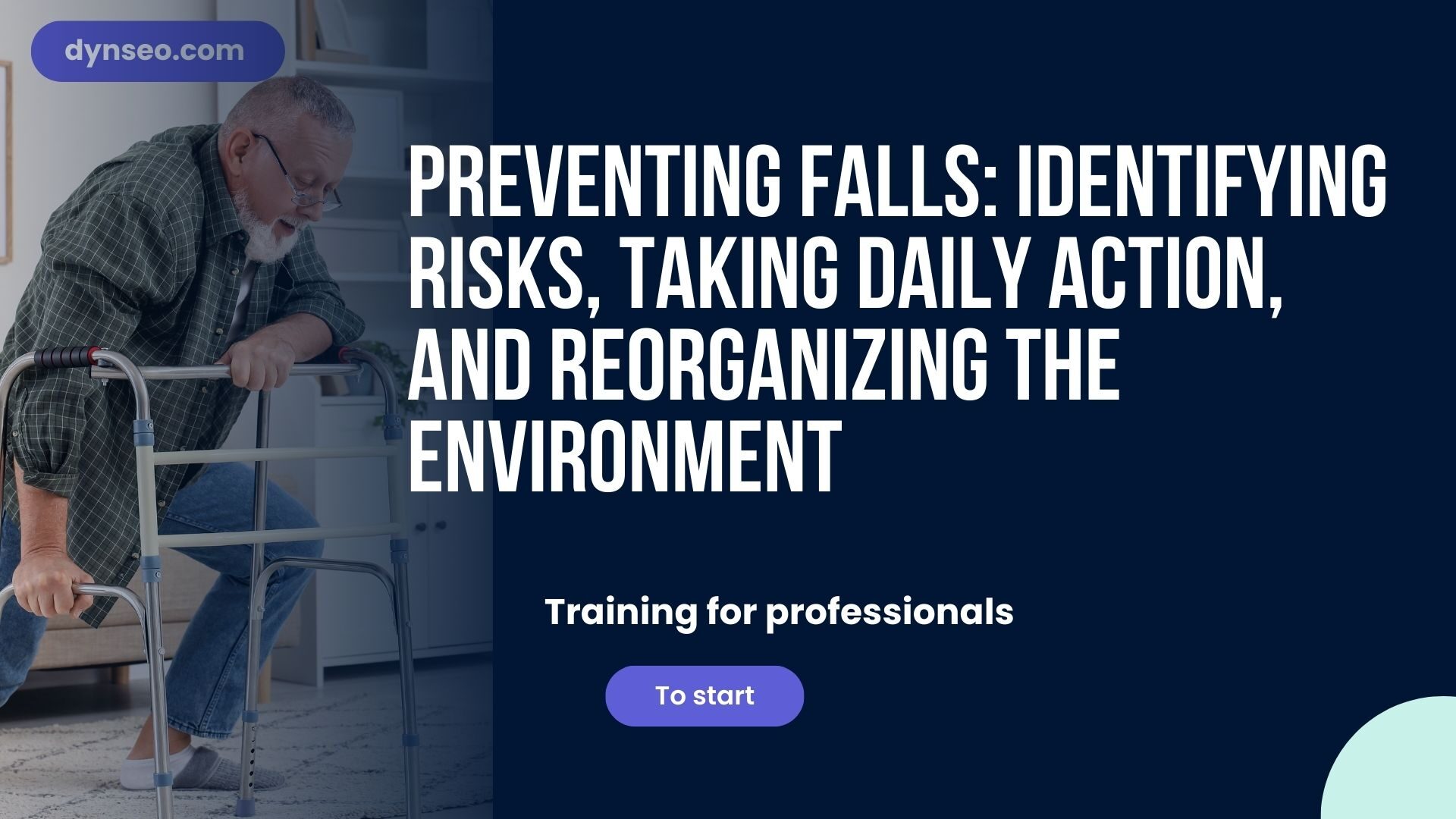
Cette page détaille la formation en ligne DYNSEO « Prévenir les chutes : repérer les risques, agir au quotidien et réorganiser l'environnement » : son programme module par module, les métiers auxquels elle s'adresse, sa durée réelle, son tarif, les modalités de déploiement en équipe — et, tout aussi important, ce qu'elle ne couvre pas. L'objectif est de vous donner les éléments concrets pour décider si elle correspond à votre besoin, sans survente ni promesse abstraite.
L'essentiel en 30 secondes
Formation en ligne de 4 modules et 18 leçons (16 leçons plus une introduction et une conclusion), soit environ 4 heures, destinée aux professionnels qui accompagnent des personnes âgées à risque de chute, en établissement comme à domicile. Tarif : 150 €. Accès immédiat et illimité.
- Pour qui — aides-soignants, auxiliaires de vie, infirmiers, animateurs, ergothérapeutes en appui, accompagnants en EHPAD, en résidence senior et en aide à domicile.
- Objectif — savoir repérer les facteurs de risque, adopter les bons gestes au quotidien, réorganiser l'environnement et réagir correctement après une chute.
- Ce qui est couvert — épidémiologie et facteurs de risque, prévention pendant les soins et les transferts, aménagement du domicile et de l'établissement, conduite à tenir et prévention de la récidive.
- Ce qui ne l'est pas — la rééducation de l'équilibre, geste par geste, qui relève du kinésithérapeute et de l'ergothérapeute.
- Organisme — DYNSEO, certifié Qualiopi (N° 11757351875), attestation de fin de formation délivrée.
Le problème qu'elle résout sur le terrain
Selon l'Organisation mondiale de la santé, les chutes constituent la deuxième cause de décès par traumatisme non intentionnel dans le monde, et les personnes de plus de 60 ans en sont les premières victimes. Derrière ce constat, il y a une réalité de terrain que tout professionnel du grand âge connaît : une chute ne se résume presque jamais à un accident isolé. C'est souvent le premier maillon d'une spirale — hospitalisation, perte de mobilité, peur de retomber, repli, puis nouvelle chute.
Le paradoxe, c'est que les signaux d'alerte sont fréquemment visibles à l'avance. Ils passent inaperçus non par négligence, mais parce qu'ils sont interprétés comme autre chose. Le tableau ci-dessous illustre ces confusions courantes, celles-là même que la formation apprend à corriger.
| Ce qui est observé | Interprétation fréquente | Ce dont il s'agit souvent |
|---|---|---|
| La personne longe les murs et s'appuie aux meubles | Habitude, prudence excessive | Perte d'équilibre débutante, à signaler |
| Elle refuse de sortir de sa chambre le soir | Fatigue, mauvaise humeur | Peur de tomber après une première chute |
| Elle marche plus lentement depuis peu | Vieillissement normal | Effet d'un traitement récent, à réévaluer |
| Elle se lève brusquement puis vacille | Impatience | Hypotension au lever, facteur de chute |
| Elle bute sur le seuil de la salle de bain | Inattention | Éclairage insuffisant, sol mal contrasté |
| Elle ne porte plus ses lunettes | Coquetterie, oubli | Baisse de vision majorant le risque |
Chaque ligne représente un ajustement possible : une observation transmise à temps, un rendez-vous médical anticipé, un meuble déplacé, une veilleuse installée. C'est tout l'enjeu de la formation : passer du constat après coup à l'anticipation, en équipe et au quotidien.
À qui s'adresse la formation prévenir les chutes
La prévention des chutes n'est le métier de personne en particulier et le sujet de tout le monde. Elle se joue dans les gestes de chacun : au moment du transfert, pendant la toilette, lors d'un accompagnement aux toilettes la nuit, dans le choix d'une paire de chaussons. Cette formation s'adresse donc à l'ensemble des professionnels qui gravitent autour de la personne âgée.
Aides-soignants
Toilette, transferts, aide au lever : les moments où le risque de chute est le plus élevé et où le bon geste change tout.
Auxiliaires de vie et aide à domicile
Souvent seuls au domicile : la formation donne des repères pour repérer les dangers du logement et alerter la famille.
Infirmiers
Surveillance des facteurs de risque, vigilance sur les traitements, coordination avec le médecin et les rééducateurs.
Animateurs
Proposer des activités qui entretiennent l'équilibre et la confiance en soi, sans mise en échec ni prise de risque inutile.
Accompagnants en résidence et EHPAD
Repérer les zones à risque dans les espaces communs et les chambres, et faire remonter les points d'amélioration.
Cadres et responsables qualité
Un socle commun pour toute l'équipe, avec attestations individuelles à verser au dossier et à la démarche de prévention.
Faite pour vous / pas faite pour vous
| Votre situation | Cette formation… |
|---|---|
| Vous accompagnez des personnes âgées à risque sans avoir jamais été formé à la prévention des chutes | ✔ Convient parfaitement |
| Votre équipe veut un langage commun et des réflexes partagés autour du risque de chute | ✔ Convient — c'est l'usage le plus fréquent |
| Vous cherchez à structurer le repérage et la transmission des situations à risque | ✔ Convient — modules 1 et 2 dédiés |
| Vous voulez apprendre la rééducation de l'équilibre geste par geste | ✘ Voir plutôt un kinésithérapeute ou un ergothérapeute |
| Vous êtes un proche aidant, pas un professionnel | ✘ En partie — utile, mais pensée d'abord pour les professionnels |
| Vous cherchez un diplôme d'État ou une qualification réglementée | ✘ Non — il s'agit d'une attestation de fin de formation |
Le programme : 4 modules, 18 leçons
Le parcours suit une logique simple et progressive : comprendre d'où vient le risque, agir pendant les soins, transformer l'environnement, puis savoir réagir et éviter la récidive. Les leçons sont courtes, sous forme de vidéos, et une introduction ouvre le parcours tandis qu'une conclusion le referme.
Comprendre les chutes — épidémiologie et facteurs de risque
- Introduction
- La chute chez la personne âgée — réalité et conséquences
- Les facteurs intrinsèques de risque
- Les facteurs extrinsèques et médicamenteux
- Évaluer le risque de chute — outils et démarche clinique
Prévenir au quotidien — gestes professionnels et surveillance
- Les moments à risque dans la journée
- Les gestes préventifs lors des soins et des transferts
- Surveiller et anticiper les signes précurseurs
- La contention — recours exceptionnel et encadrement strict
Réorganiser l'environnement — aménagements du domicile et de l'établissement
- Les zones à risque dans l'établissement
- Aménager le domicile d'une personne âgée à risque
- Les équipements et aides techniques de prévention
- Impliquer la personne et sa famille dans la prévention
Après la chute — conduite à tenir et prévention de la récidive
- La conduite à tenir immédiatement après une chute
- L'analyse systématique de la chute
- Prendre en charge la peur de tomber
- Les outils DYNSEO pour soutenir les capacités motrices et cognitives
- Conclusion
Les facteurs extrinsèques et médicamenteux (module 1), parce qu'ils révèlent des causes de chute que l'on ne soupçonnait pas — un sol glissant, un traitement récent, des chaussons inadaptés ; et la peur de tomber (module 4), sujet longtemps sous-estimé, qui explique une grande partie des pertes d'autonomie après une première chute. À noter : la leçon sur la contention insiste sur son caractère exceptionnel et son encadrement strict par un médecin, jamais sur une pratique de routine.
Donner à votre équipe les bons réflexes anti-chute
4 modules, 18 leçons, environ 4 heures, accès immédiat et illimité, attestation nominative pour chaque professionnel.
Découvrir la formation — 150 €Format et organisation
| Critère | Détail |
|---|---|
| Format | 100 % en ligne, leçons vidéo courtes |
| Contenu | 4 modules · 18 leçons (dont introduction et conclusion) |
| Durée | Environ 4 heures au total |
| Rythme | Libre, sans date de fin imposée |
| Support | Ordinateur, tablette, smartphone |
| Accès | Immédiat après inscription, illimité dans le temps |
| Niveau requis | Tous niveaux, aucun prérequis |
| Validation | Attestation de fin de formation |
| Tarif | 150 € par apprenant |
Le format asynchrone répond à une contrainte propre au médico-social et à l'aide à domicile : on ne peut pas immobiliser une équipe entière une journée complète. Les quatre heures se découpent en séquences de quinze à vingt minutes, à intégrer sur les temps disponibles, entre deux tournées ou pendant un temps calme. Chacun avance à son rythme, revient sur une leçon au moment où la situation se présente réellement sur le terrain, et reprend là où il s'était arrêté.
Ce découpage a un autre avantage : il permet de relier immédiatement le contenu à la pratique. Après la leçon sur les moments à risque dans la journée, il est facile de regarder d'un œil neuf le lever du matin ou l'accompagnement du soir ; après la leçon sur l'aménagement du domicile, une visite chez une personne accompagnée devient un repérage concret des dangers.
Ce que vous saurez faire à la fin
La formation vise des compétences observables, applicables dès le lendemain. Il ne s'agit pas d'accumuler des connaissances théoriques, mais de changer des gestes et des réflexes du quotidien.
Repérer les facteurs de risque
Distinguer ce qui tient à la personne (équilibre, vision, traitements) et ce qui tient à l'environnement, et savoir ce qui doit être signalé.
Sécuriser les transferts
Adopter les gestes préventifs lors du lever, de la toilette et des déplacements, en respectant les consignes de l'établissement.
Réaménager un lieu de vie
Identifier les zones à risque d'une chambre, d'un couloir ou d'un domicile, et proposer des aménagements simples et concrets.
Réagir après une chute
Appliquer la conduite à tenir immédiate, alerter selon les procédures et contribuer à l'analyse de l'événement.
Apaiser la peur de tomber
Reconnaître ce syndrome fréquent, en parler avec la personne et l'accompagner sans la surprotéger ni la restreindre inutilement.
Transmettre et impliquer
Écrire une observation exploitable, associer la personne et sa famille à la démarche, et renvoyer au professionnel de santé quand c'est nécessaire.
Avant d'aider une personne à se lever, on lui laisse quelques instants assise au bord du lit, pieds au sol, et on lui dit simplement : « Prenez votre temps, on se lève doucement ensemble. » Ce court délai limite le vertige au lever, un déclencheur classique de chute. ❌ À éviter : tirer la personne par le bras pour la mettre debout d'un coup, geste qui déséquilibre et peut blesser l'épaule.
Qualiopi, attestation et financement
DYNSEO est un organisme de formation certifié Qualiopi, enregistré sous le numéro de déclaration d'activité 11757351875. La certification porte sur la qualité du processus de formation : objectifs pédagogiques clairement définis, adaptation aux publics accueillis, qualification des intervenants, recueil des appréciations et amélioration continue des contenus.
Chaque apprenant reçoit, à l'issue du parcours, une attestation de fin de formation nominative. Elle se verse au dossier individuel de formation et s'intègre à la démarche qualité de l'établissement ou du service. Il faut être clair sur son statut : ce n'est ni un diplôme d'État ni une qualification réglementée, mais bien une attestation de participation à une action de formation.
Côté financement, la certification Qualiopi est la condition qui permet à un employeur d'envisager une prise en charge, par exemple au titre du plan de développement des compétences ou par son opérateur de compétences. Les règles, les plafonds et les procédures varient selon les pays, les branches professionnelles et les financeurs. La seule démarche fiable consiste à faire valider le devis et le programme par le service RH ou l'organisme financeur avant l'inscription : aucun montant d'aide ne peut être présenté ici comme acquis d'avance.
Déployer la formation dans une équipe
Le format en ligne facilite grandement le déploiement collectif, à une condition : ne pas se contenter d'envoyer un lien et d'attendre. La prévention des chutes est un sujet d'équipe, et c'est en équipe que la formation produit ses effets.
- Fixez un objectif observable. Par exemple : repérer et signaler systématiquement les moments à risque de chaque résident d'ici deux mois. Sans objectif, la formation reste une case cochée.
- Bloquez le temps. Deux créneaux de vingt minutes par semaine, inscrits au planning, valent mieux qu'une consigne floue de « faire quand vous pouvez ».
- Désignez un référent chute. Une personne qui avance un module en amont et anime cinq minutes d'échange en réunion d'équipe.
- Faites atterrir chaque module dans le réel. Après le module 3, organisez un tour des chambres pour repérer les dangers ensemble ; après le module 4, revoyez le circuit de déclaration d'une chute.
- Archivez les attestations au fur et à mesure, dans le dossier de formation, avec la date d'achèvement.
- Prévoyez un point à trois mois. Qu'est-ce qui a réellement changé dans les pratiques et dans l'environnement ? C'est ce qui distingue une formation utile d'une formation seulement consommée.
Tarif et inscription
La formation est proposée à 150 € par apprenant. L'accès est immédiat, illimité dans le temps, et se fait depuis un ordinateur, une tablette ou un smartphone.
- Ouvrez la page de la formation et ajoutez-la au panier.
- Créez le compte apprenant, ou connectez-vous, puis validez le paiement.
- L'accès est immédiat : la formation apparaît dans l'espace apprenant et la première leçon démarre aussitôt.
Pour un déploiement sur plusieurs postes ou un devis à l'échelle d'un établissement, la page contact du site permet d'obtenir une proposition adaptée au nombre d'apprenants. Vous pouvez aussi consulter l'ensemble du catalogue des formations DYNSEO pour construire un parcours cohérent sur plusieurs thématiques du grand âge.
Ce que cette formation n'est pas
- Elle ne remplace pas la rééducation. Le travail de l'équilibre, de la force musculaire et de la marche relève du kinésithérapeute et de l'ergothérapeute ; la formation apprend à s'articuler avec eux, pas à faire à leur place.
- Elle ne délivre aucune compétence médicale. L'évaluation diagnostique, la révision des traitements et la décision thérapeutique restent du ressort du médecin. La formation apprend à observer, à signaler et à appliquer les consignes.
- Elle n'enseigne pas la contention comme une solution. La leçon dédiée en présente au contraire le caractère exceptionnel et l'encadrement strict, sous décision médicale.
- Ce n'est pas un diplôme. L'attestation atteste d'une participation, pas d'une qualification réglementée.
- Ce n'est pas une formation présentielle. Il n'y a pas de formateur en direct ni d'atelier physique : c'est un parcours vidéo asynchrone, à suivre à son rythme.
Pour aller plus loin
Situations du quotidien10 situations difficiles du quotidien et comment y répondre
Boîte à outilsActivités, supports et aménagements concrets à mettre en place
Posture professionnellePosture professionnelle, travail en équipe et montée en compétences
Plusieurs ressources gratuites DYNSEO complètent directement cette formation : la fiche de suivi de séance et le tableau de suivi des compétences pour structurer les observations et le repérage des situations à risque. Le catalogue complet des outils est en libre accès, et les tests cognitifs aident à situer les capacités d'attention et d'orientation, souvent liées au risque de chute. Pour l'entretien des capacités motrices et cognitives évoqué au module 4, l'application EDITH, conçue pour les seniors, propose des exercices adaptés et progressifs.
Questions fréquentes
How long does it take to complete the training ?
Count about four hours in total for the 4 modules and the 18 lessons, including the introduction and conclusion. Since the videos are short, most professionals spread the course over two to four weeks, with two slots of about twenty minutes per week. Access remains open indefinitely : you can return to a specific lesson at the exact moment the situation arises in the field, for example just before arranging a room or after a fall to analyze as a team.
Does the training teach medical or rehabilitation gestures ?
No, and this is intentional. The training focuses on daily prevention : identifying risk factors, securing transfers while respecting guidelines, rearranging the environment, and reacting after a fall. It does not offer any balance rehabilitation protocols or medical gestures. These areas fall under the responsibility of the physiotherapist, occupational therapist, and doctor. The course specifically teaches how to work in coordination with these professionals : observing, reporting, applying guidelines, and referring to the healthcare professional for any diagnosis or care decision.
Can the training be funded by the employer ?
This is possible : DYNSEO is a training organization certified Qualiopi, which is generally a requirement for funding under the skills development plan or by a skills operator. However, the rules, ceilings, and procedures vary according to countries, sectors, and funders. No amount can be guaranteed in advance : the reliable approach is to have the program and quote validated by your HR department or funding organization before registration, in order to know the specific conditions applicable to your situation.
Can an entire team be registered ?
Yes. Each professional has their own learner account and receives a named certificate, which allows for the submission of supporting documents to individual files and supports the establishment's prevention approach. Fall prevention greatly benefits from being worked on collectively, with a common language. For deployment across multiple positions or a quote for a department, please go through the contact page of the site : a proposal tailored to the number of learners and your organization can be established.
Are prior knowledge and skills required ?
No. The training is classified for all levels and requires no prerequisites. It starts from the reality of falls and their causes, explained simply, before moving on to preventive gestures, rearranging spaces, and the conduct to follow. It is suitable for both a professional discovering the subject and an experienced professional wishing to structure, update, and harmonize what they have learned in the field. Unlimited access also allows for revisiting concepts at any time, without calendar pressure.
This page describes the content of a training action. The funding conditions and training obligations vary by country and employer: check with your HR department or your funding organization. This content does not constitute medical advice: in case of a serious fall or doubt about a person's condition, contact your country's emergency services without delay.
Make fall prevention a team reflex
With DYNSEO's fall prevention training: 4 modules, 18 lessons, approximately 4 hours, 100% online, unlimited access, and a personalized Qualiopi certificate for each professional.
Discover the training — 150 €Did this content help you? Support DYNSEO 💙
We are a small team of 14 people based in Paris. For 13 years, we have been creating free content to help families, speech therapists, care homes and healthcare professionals.
Your feedback is the only way we know if our work is useful. A Google review helps us reach other families, caregivers and therapists who need it.
One action, 30 seconds: leave us a Google review ⭐⭐⭐⭐⭐. It costs nothing, and it changes everything for us.