DYS Disorders in Primary School:
Recognize, Understand and Support
In this guide — excerpt from a DYNSEO webinar on DYS disorders in primary school — we will provide you with keys to support your students suffering from DYS disorders. There is a first part on the signs of each disorder and the difficulties encountered in class, followed by a practical part with advice and adaptation ideas to implement.
This guide — excerpt from a DYNSEO webinar on DYS disorders in primary school — offers an exploration of each DYS disorder, its mechanisms, and its signs in class, followed by adaptations and tools available to support these children towards success. The goal is not to standardize approaches but to provide teachers and parents with the keys to personalize the support of each child according to their specific profile.
Dans cet article
La formation associée
1. The Different DYS Disorders — Signs and Mechanisms
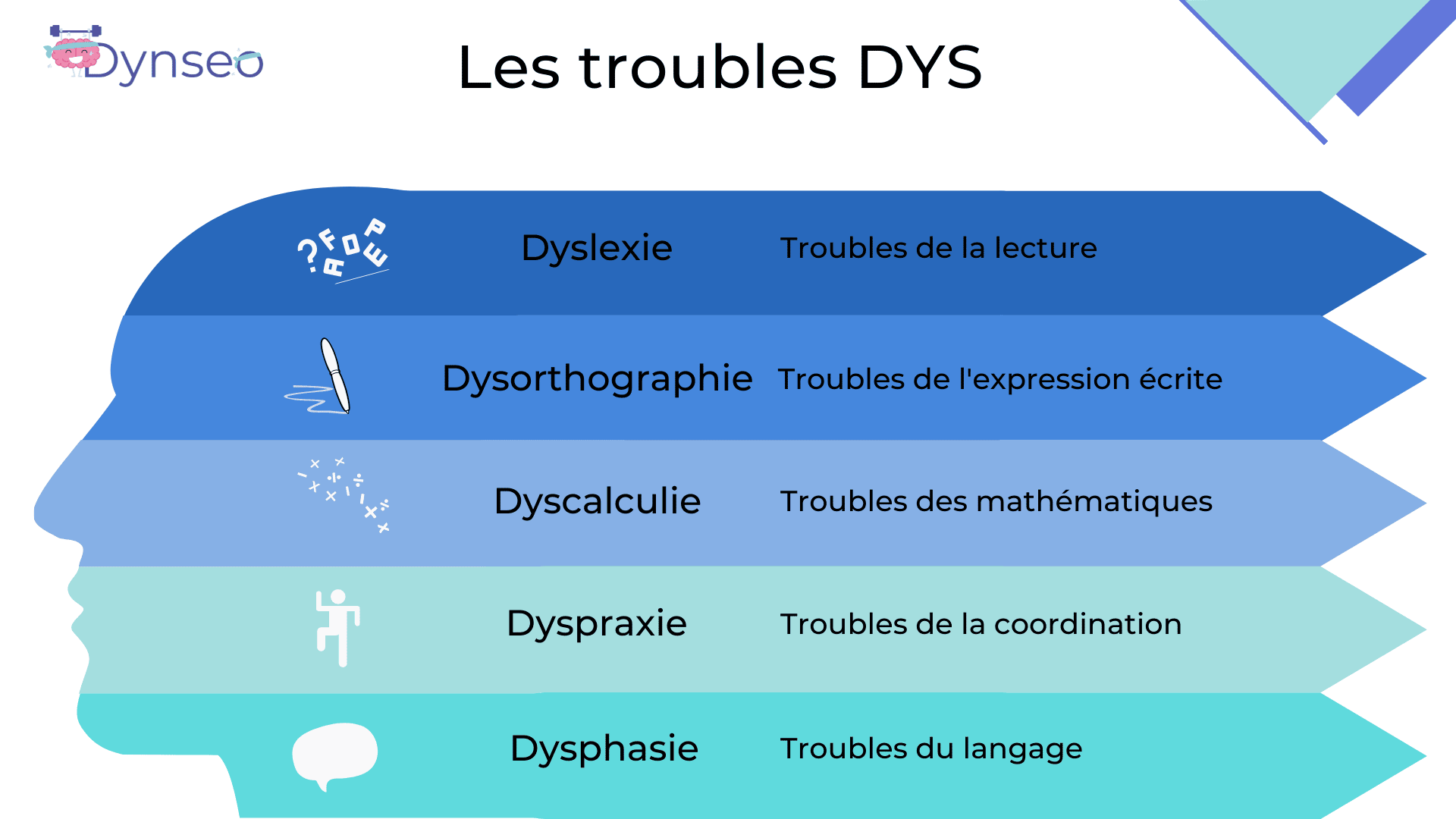
Dyslexia
The different types of dyslexia
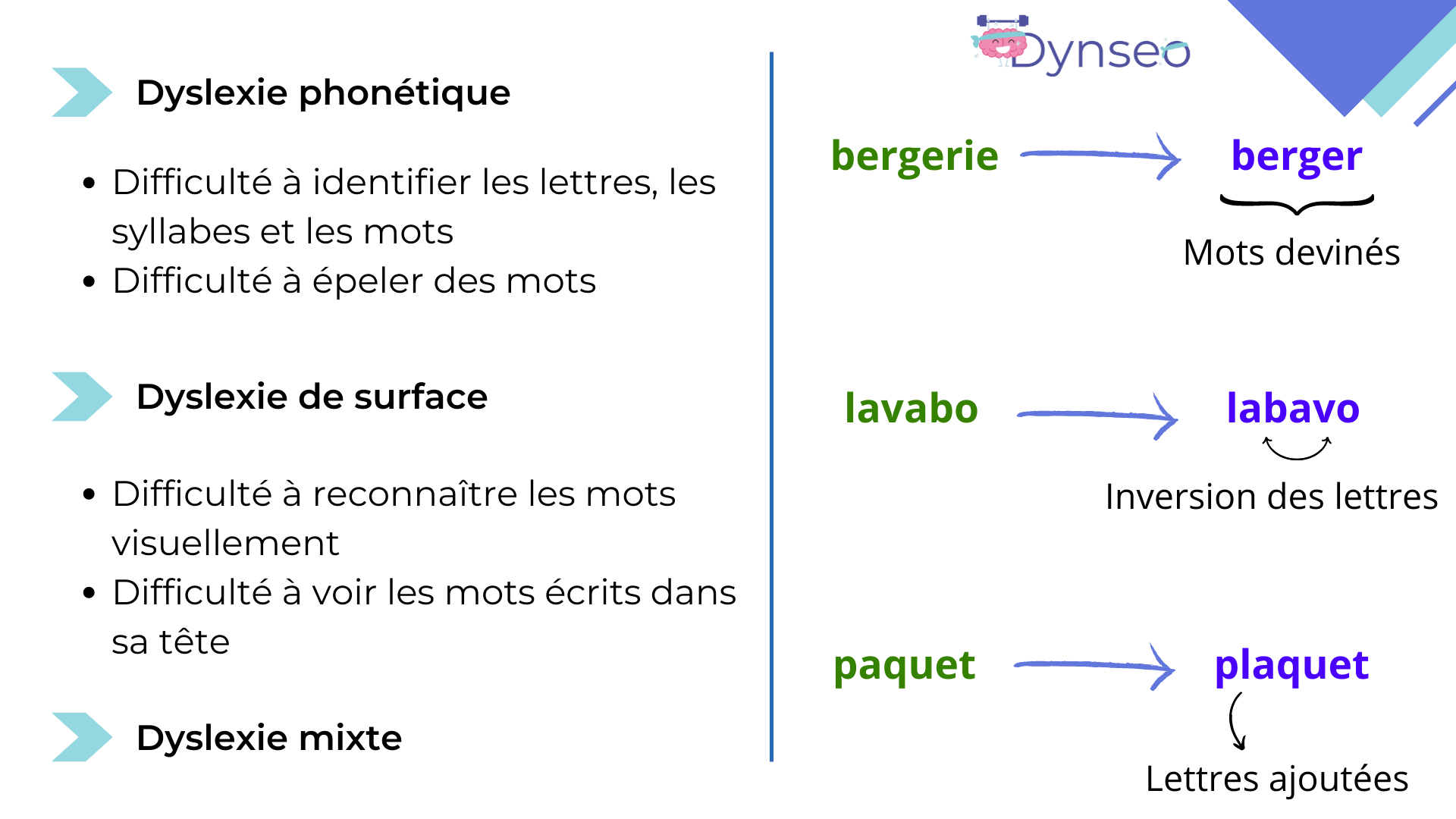
Dyslexia presents in three main forms. Phonetic dyslexia is a difficulty at the phonetic level — the child struggles to identify at the sound level letters, syllables, or words. Surface dyslexia is a difficulty at the visual level — the child has trouble recognizing words visually or seeing written words in their mind. Normally, when we read, our brain identifies the word immediately without reading each letter — for dyslexic children, this mechanism does not work. Mixed dyslexia is characterized by combined phonetic and visual difficulties.
Dysorthography
The fragilities related to dysorthography
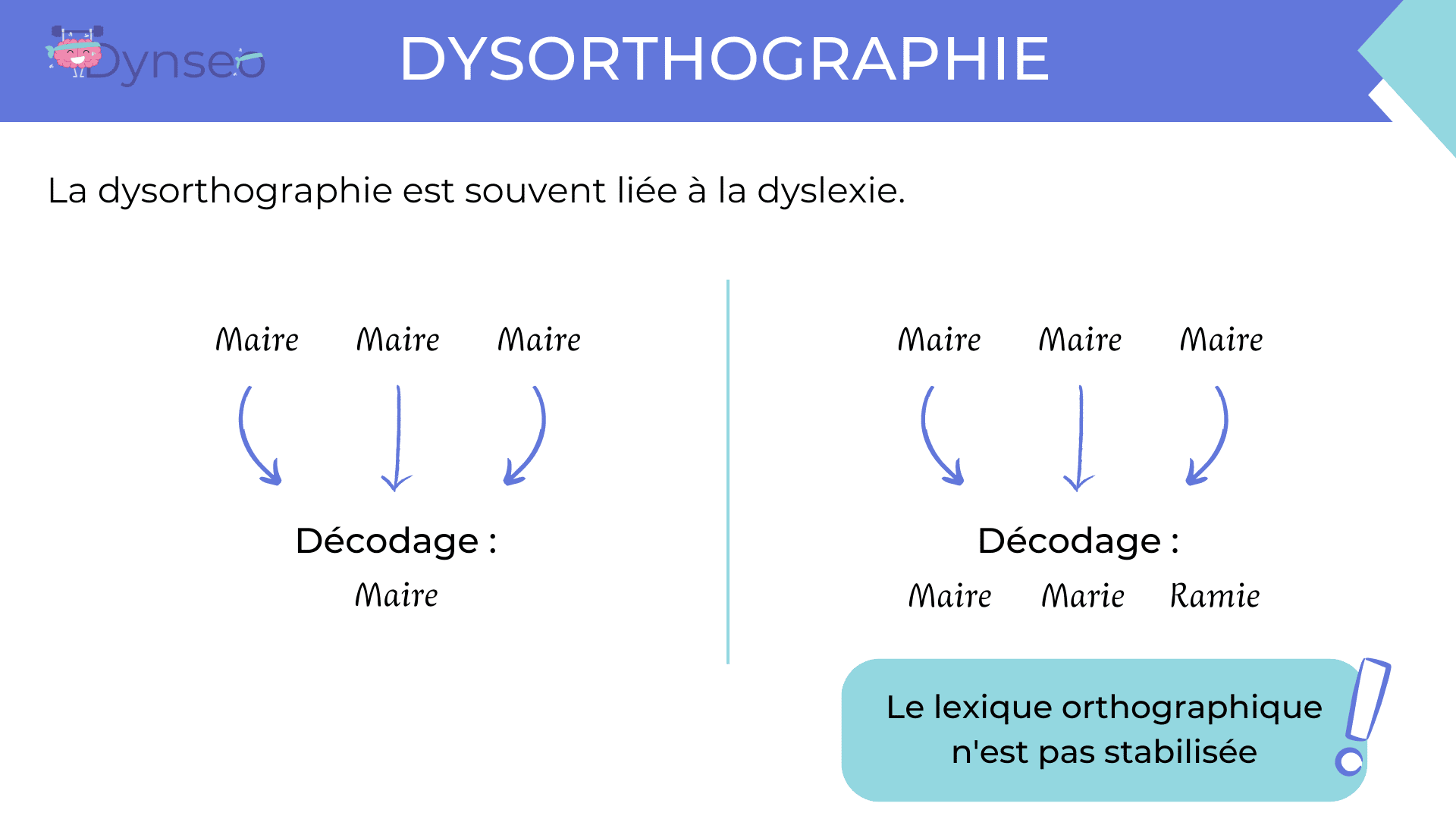
Dysorthography is related to the spelling of words. In general, a child learns to read before writing — so if there is a reading problem, there will necessarily be a difficulty in spelling. When we read a word, our brain always records the same order of letters and manages to memorize it. When there is a reading difficulty, the word “ Mayor ” is read differently each time (Mayor, Marie, Ramie…) — the brain cannot stabilize the order of the letters. Without a fixed order, the writing of words will be random. Often, dysorthographic children have phonetic writing, based on sound more than on grammar rules.
Dyscalculia
The signs of dyscalculia
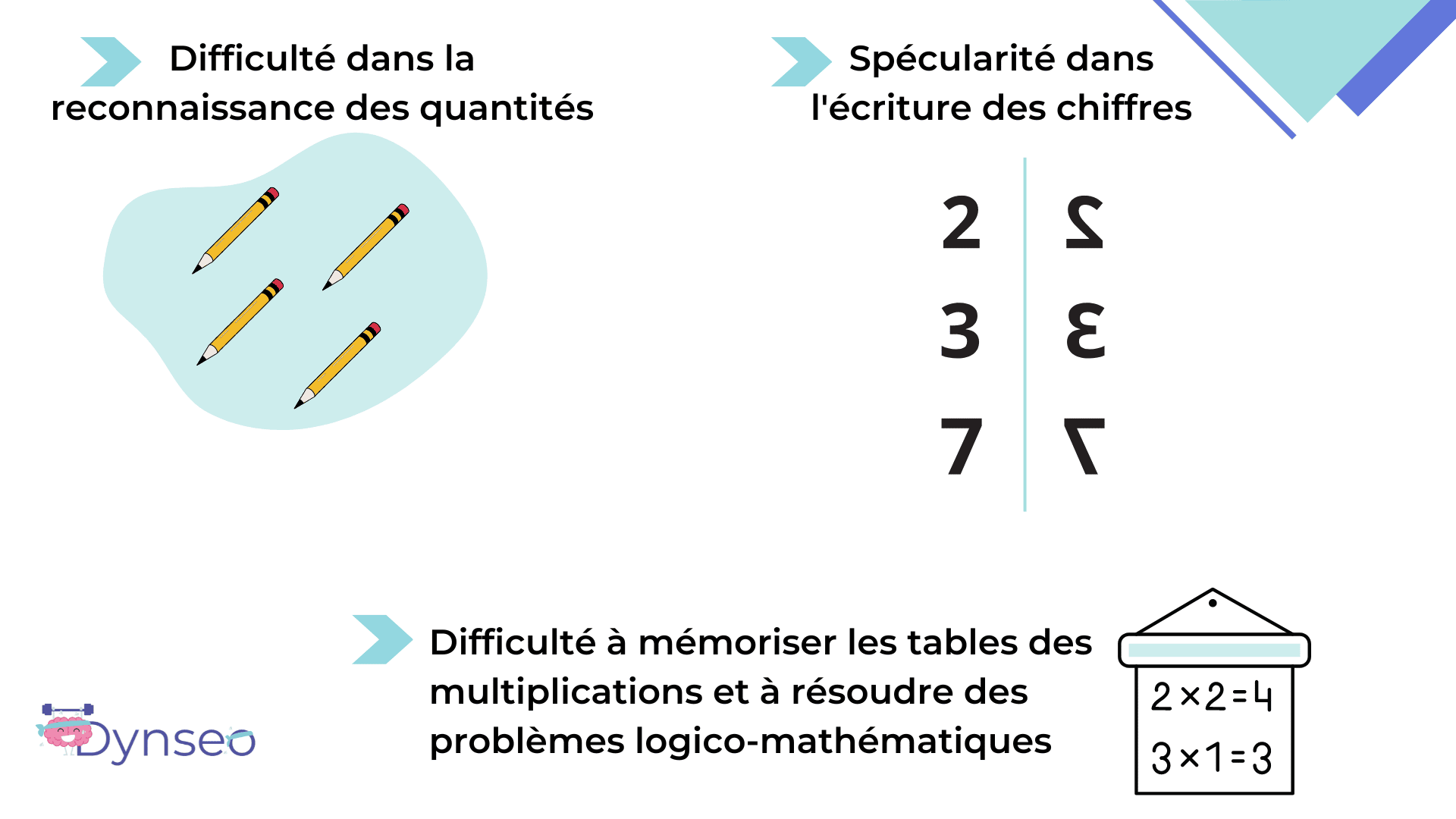
Dyscalculia is a disorder related to numbers in several aspects — difficulty in the concept of quantity, visual difficulties, difficulties in mathematical logic. Among the main signs: difficulty recognizing quantities (the child must count the presented objects each time), mirror-written numbers (the child cannot create a mental image of the numbers), and difficulties memorizing multiplication tables or solving logical-mathematical problems (they cannot memorize numerical information and manipulate it).
Dysgraphia
Dyspraxic dysgraphia
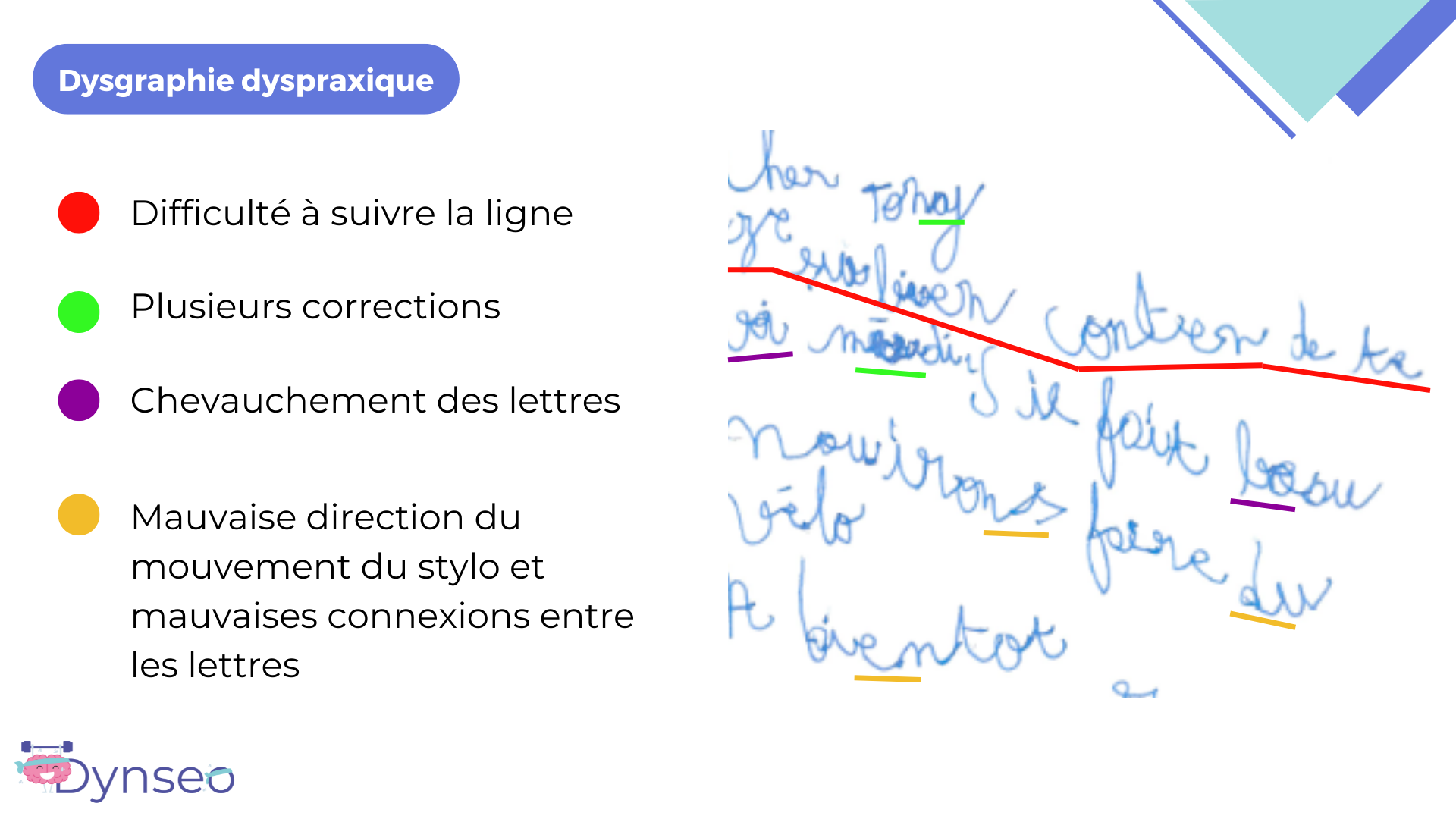
Dysgraphia is a disorder related to graphic gesture where the child's writing is almost illegible. This difficulty is related to dyspraxia — the child cannot coordinate the movements of the pen on the paper. Without reference points, they cannot follow an imaginary line, write letters poorly, and make corrections that make the text even harder to read. It can be seen that there is not enough space between the letters or that they are poorly connected. One should not confuse dysorthography (difficulty in spelling words) and dysgraphia (difficulty in graphic gesture).
Dyslexia is often the most well-known DYS disorder — but it is far from being the only one, and its understanding deserves to be deepened beyond preconceived ideas. Dyslexia is not a lack of will, a mental delay, or a consequence of a lack of reading at home. It is a neurobiological disorder with documented genetic bases (it is hereditary in 50-60% of cases) and visible neurological correlates in brain imaging — differences in activation in the temporal and parietal regions involved in phonological processing. A dyslexic child can have a high IQ and remarkable reasoning abilities — this is precisely why untrained teachers sometimes struggle to understand these “ good students who cannot read ”.
2. Adaptations to Implement in Class
Adapt the environment and reading materials
There are several adaptations that can be implemented to support children with DYS disorders. A support is not necessarily useful for all children — it is therefore necessary to try to see if the adaptation makes the exercise easier. Each child is different, so the adaptations must be different.
For dyslexia, it is important to make the text more readable. Use specific fonts like Open Dyslexic. Choose texts with color codes — two-colored lines or colored words according to syllables. Use a sufficiently large font size. Align the texts to the left to avoid words being cut off at the end of the line — the text is more spaced out and the child can more easily orient themselves in the space.
✦ Adaptations by type of DYS disorder
- Dyslexia: Open Dyslexic font, colored texts by syllables, left-aligned text, increased font size, audio reading available.
- Dysorthography: spell checker, voice dictation, extra time for assessments, separate grading (content/form).
- Dyscalculia: visual aids for quantities, calculator allowed for operations, focus assessments on mathematical logic rather than calculation.
- Dysgraphia: computer or tablet for writing, photocopied notes, oral assessment possible, increased line spacing.
- Dyspraxia: adaptation of the workspace (stable desk, well-organized materials), digital supports, segmented and visual instructions.
Adaptations should always be presented to the child and the class in a positive and normalizing way. The teacher who says “ Paul uses a special font because his eyes work differently — just like others wear glasses ” elegantly normalizes the adaptation. Conversely, adaptations that label the child as “ different ” or “ less capable ” can harm self-esteem and social relationships. The goal is for the adaptation to be a transparent, functional tool that allows the child to access the same task as their peers.
3. Technologies as Compensation Tools
New technologies serving DYS
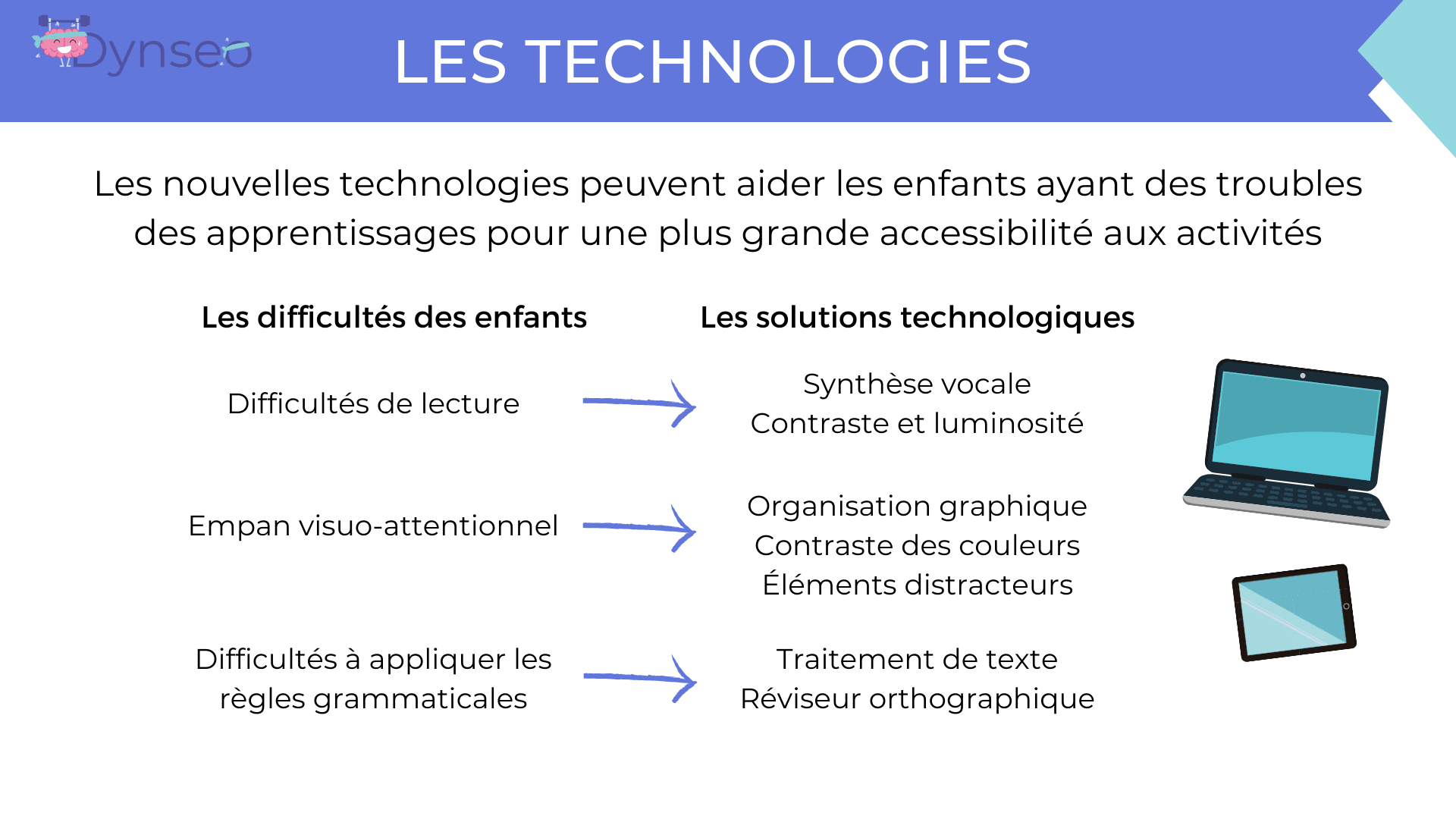
Children with DYS disorders may need compensation tools — supports that help erase or reduce difficulties. Thanks to these tools, the child can access the activity without using all their attention to manage their difficulty, and can focus on the task at hand.
For example, a computer or tablet can have text-to-speech to help dyslexic children, or a spell checker for children with dysorthography. Additionally, all elements on the screen can have increased contrast and brightness adjusted according to individual needs.
🔊 Text-to-speech
Text-to-speech reads texts aloud, allowing dyslexic children to access content without the effort of decoding. Software like Dasher, Balabolka, or built-in functions on tablets (VoiceOver on iOS, TalkBack on Android) make any written content accessible orally.
✏️ Voice dictation
Voice dictation allows children with dysorthographia and dysgraphia to produce text without relying on manual writing. The idea, understanding, and written expression are thus evaluated separately from the graphic gesture and spelling — a fundamental dissociation for a fair assessment.
🎯 Adapted cognitive applications
Applications like COCO THINKS and COCO MOVES integrate audio instructions, games with syllables, and formats accessible to DYS children. These tools allow for playful work on deficient cognitive functions without visual or graphic overload.
New technologies have profoundly transformed the possibilities for supporting DYS children. Where a previous generation had only paper resources and limited accommodations, today's DYS children can access a range of compensatory tools that significantly reduce the impact of their disorders. This transformation is particularly visible for dyslexic children — the combination of text-to-speech + voice dictation + spell checker allows them to produce and consume written content with a fluency close to that of their peers, freeing their cognitive energy for conceptual learning.
4. COCO THINKS and COCO MOVES for DYS Children
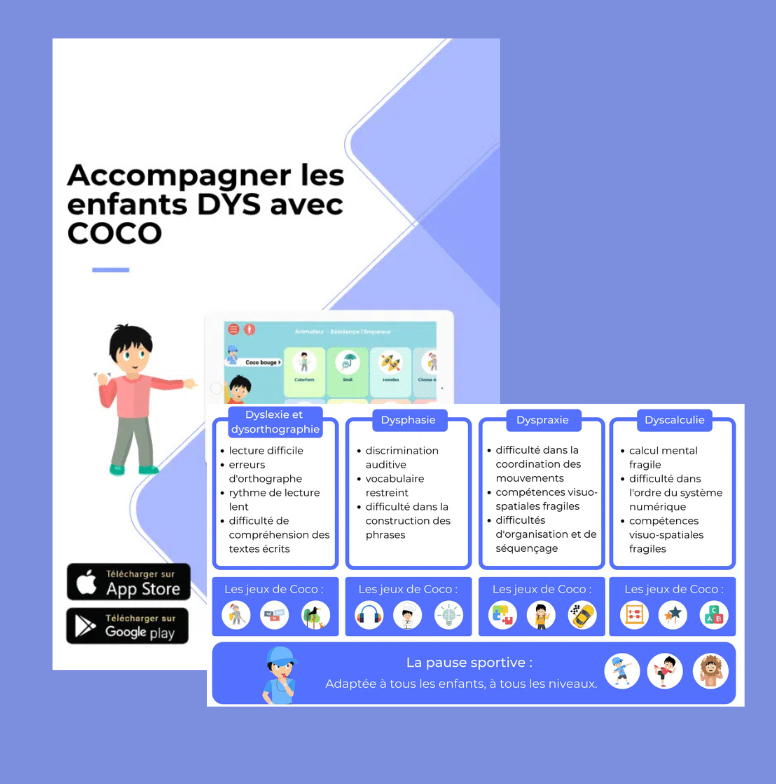
In technology, there are also applications that can be used with children with DYS disorders. The application COCO THINKS and COCO MOVES is an application with over 30 educational games. The games can be used to improve cognitive functions such as attention, memory, logic, or language. Some games can also be used as adapted exercises for DYS children — they include audio instructions, games with syllables, or fill-in-the-blank texts.
Moreover, after 15 minutes of screen time, the application stops and offers children a sports break. The games are more or less physical (there are also relaxation games). This break allows children to refresh their brains and rest to be more motivated for the following activities. The sports break also teaches them to step away from the screen and use it wisely.
COCO has been designed for children from first to fifth grade with particular attention to atypical learning profiles — DYS, ADHD, autism. The clean interface limits cognitive overload, the audio instructions bypass the decoding difficulties of dyslexic children, and the predictable structure (cognitive session → sports break) is reassuring for anxious children.
Systematic audio instructions · Minimalist interface without visual overload · Adapted font · Syllable and language games · Progressive levels · Integrated sports break · Ability to hide games according to the profile.
COCO THINKS and COCO MOVES is used by many teachers in the classroom and by parents at home as a complementary tool for children with DYS disorders. Its design includes elements particularly suited to these profiles — interface without visual overload, systematic audio instructions for children who struggle to read instructions, syllable and language construction games that specifically target skills deficient in dyslexia, and adaptive levels that allow each child to progress at their own pace without facing repeated failure.
5. Involve Families in the School Journey
Supporting children with DYS disorders cannot be limited to school. It is essential to create continuity between learning in the classroom and at home. By involving families, a coherent, reassuring environment tailored to the child's specific needs is fostered.
✦ Why Actively Involve Families
- This allows parents to better understand DYS disorders and support their child on a daily basis.
- This strengthens the child's confidence by creating a continuity link between home and school.
- This facilitates the implementation of common strategies to help the child progress more smoothly.
📅 Concrete Actions to Implement
Regularly organize exchange times between teachers and parents. Set up a tracking notebook (paper or digital) to share successes and points of vigilance. Provide resources to families — practical advice, explanatory videos, applications like COCO. Offer workshops or awareness webinars on DYS disorders.
Some schools organize monthly meetings called “ DYS Café ” allowing parents to exchange ideas with teachers and other families. Parents use the COCO app at home to reinforce learning in reading, logic, or memory. A teacher shares a short video each week summarizing the concepts covered in class, to help parents follow along and support their child.
The school-home continuity is a major factor in the success of DYS support. When parents and teachers use the same terminology to discuss the disorder, the same strategies to help the child, and maintain regular communication about progress and difficulties — the child benefits from consistent and predictable support that reduces their anxiety. This consistency is particularly important for DYS children, who often experience a lot of school-related anxiety due to their repeated difficulties.
6. Training Teachers on DYS Disorders
Raising awareness and training teachers on DYS disorders is an essential condition for effective adaptations to be implemented. A teacher who understands the mechanisms of dyslexia does not react the same way as a teacher who sees the student as “ unmotivated ” or “ lazy ”. This understanding radically transforms the perspective on the child and the teaching strategies deployed.
DYS Disorders : identify and adapt in class
Identify the signs (dyslexia, dysorthographia, dyspraxia, etc.), understand the impact in class, and adapt your methods without overload. This online training offers : warning signs by disorder, affected cognitive functions, ready-to-use key adaptations.
Continuing education for teachers on DYS disorders is an investment that benefits the entire class. A teacher trained in DYS spontaneously adapts their materials (larger fonts, less content per page, short and clear instructions) in a way that benefits all students — not just those with diagnosed disorders. The principles of universal pedagogy (Universal Design for Learning) that guide the best teaching practices for DYS students are also the principles of quality pedagogy for all. Investing in teacher training on DYS is improving the quality of education for the entire class.
7. Emotional Well-Being and Self-Esteem of DYS Children
DYS disorders have an impact that goes far beyond the academic field. Children living with undiagnosed or poorly supported DYS disorders often develop a very negative self-image — they see themselves as “ useless ”, “ not smart ”, “ different from others in a bad way ”. It is not the disorder itself that is most damaging in the long term — it is often the accumulation of years of misunderstood difficulties and negative perceptions.
Early diagnosis and compassionate support profoundly change this trajectory. When a child understands that their dyslexia is not a lack of intelligence but a different way of processing information, when they see that simple adaptations allow them to succeed in the same tasks as their peers, when their parents and teachers believe in their abilities — self-esteem gradually rebuilds.
✦ Strategies to Support the Self-Esteem of a Child with DYS
- Name the disorder clearly: explain to the child what their dyslexia (or other disorder) is in simple and positive terms — “ your brain processes letters differently, it’s not a question of intelligence .”
- Value strengths: DYS children often have remarkable strengths — creativity, visual thinking, artistic sense, empathy, ability to see problems from different angles. These strengths deserve to be explicitly named and celebrated.
- Offer regular successes: organize activities where the child can shine — sports, arts, music, games, hands-on activities — to balance out academic difficulties.
- Talk about famous people with DYS: many remarkable people have DYS disorders — Steven Spielberg (dyslexia), Richard Branson (dyslexia), Henry Winkler (dyslexia). These examples show that the disorder is not a glass ceiling.
The self-esteem of a well-supported DYS child can become a remarkable strength. These children who have learned to cope with persistent difficulties, to find creative workarounds, to persevere despite repeated failures, often develop exceptional resilience and adaptive intelligence. These skills — often invisible in standard school assessments — are valuable assets in adult and professional life. The caring support of DYS children is not just about reducing their difficulties — it’s also about helping them discover and cultivate their strengths.
8. The Diagnostic Pathway for DYS Disorders
The diagnosis of a DYS disorder is a process that involves several professionals and can take time. It is important for parents and teachers to know this pathway to effectively guide families and not delay a support that can transform the child's academic trajectory.
👩⚕️ Professionals Involved in DYS Diagnosis
The speech therapist is the key professional for the diagnosis of dyslexia, dysorthographia, and dysphasia — they conduct an assessment of oral and written language. The neuropsychologist can perform a comprehensive cognitive assessment including IQ, memory, attention, executive functions. The occupational therapist intervenes for dysgraphia and dyspraxia. The school doctor can initiate the PAP and refer to the appropriate specialists.
📋 When to alert and guide
Alert parents if you observe — in CP-CE1 class — persistent difficulties in associating letters and sounds, a systematic confusion of certain letters (b/d, p/q), very slow and laborious reading after several months of learning, or spelling that is very distant from the phonology of the word. In CE2-CM, if these difficulties persist despite regular support, a speech therapy assessment is essential. Do not wait for "the child will catch up on their own" — early diagnosis is systematically associated with better long-term outcomes.
The diagnostic process can be long — appointment delays with speech therapists and neuropsychologists are often significant. It is important for teachers and families to start implementing adaptations even before the diagnosis is confirmed — as soon as a disorder is suspected. These preventive adaptations do not "distort" the diagnosis — they allow the child not to accumulate too much delay and negative experiences during the waiting period. The diagnosis is important to formalize the PAP or PPS and access legal provisions — but pedagogical adaptation can and should begin beforehand.
Comorbidities are the rule rather than the exception in DYS disorders. Dyslexia is often associated with dysorthographia (90% of cases), but also frequently with ADHD (20-30% of cases), dyspraxia, or dysphasia. This overlap of disorders creates complex profiles that require multidisciplinary evaluations and sophisticated support plans. A child with dyslexia and ADHD cannot be supported in the same way as a child with pure dyslexia — they need adaptations that take both profiles into account simultaneously. This is why a complete neuropsychological assessment is often more informative than a simple speech therapy assessment for complex profiles.
9. The Inclusive School — Principles and Reality
The law of February 11, 2005, for equal rights and opportunities, participation, and citizenship of disabled people established the principle of common schooling for all children with special educational needs, including severe DYS disorders. This legal framework creates rights — PAP, PPS, exam accommodations — but also implementation challenges that require the commitment of all stakeholders.
Real inclusion — not just formal — requires that the DYS child can fully participate in class activities, learn the same objectives as their peers, and be assessed fairly. This involves adaptations of materials, assessments, and sometimes work modalities — without these adaptations being experienced as stigmatization by the child. The way the teacher presents the adaptations to the class and to the child themselves makes a major difference in how the child experiences them.
10. Testimonials and Inspiring Practices
Good practices for supporting DYS children often emerge from the field — teachers who have experimented, adapted, adjusted, and shared their experiences with their colleagues. Here are some examples of inspiring practices collected from DYNSEO teachers.
🍋 The reference card method
A teacher of CE2 created "reference cards" for her DYS students — one side with difficult letter-sound correspondences for dyslexia, one side with multiplication tables for dyscalculia. These cards, placed on the desk, allow the child not to use all their attention to find this information, and to focus on solving the problem or producing the text.
🎨 The digital dictation to an adult
A teacher of CM1 equipped his dysorthographic students with an iPad with voice dictation function. While their classmates write their texts, these students dictate theirs quietly. The teacher then evaluates the richness of vocabulary, narrative structure, and ideas — not the spelling. The result has been spectacular — these children, who produced two lines by hand, produce several paragraphs in voice dictation, revealing a rich and original written expression that the graphic obstacle hid.
📱 COCO as a remediation tool for autonomy
Several teachers use COCO as an independent activity during free time or differentiated workshops. While the teacher works with one group, DYS students use COCO for language, memory, or attention exercises adapted to their level, with audio instructions that allow them to work independently without constantly asking for help.
These testimonials illustrate a central principle of inclusive pedagogy for DYS children — the creativity of the teacher is often more decisive than the available resources. The most effective adaptations are often the simplest — a reference card, a reorganized workspace, permission to use text-to-speech. It is not the sophistication of the tool that matters — it is the consistency and kindness of the approach. And when the tool is well designed, like COCO THINKS and COCO MOVES, it significantly amplifies the effectiveness of these adaptations by making them systematic, accessible at any time, and engaging for the child.
Teacher training — like that offered by the DYNSEO Training Institute — plays a crucial role in spreading these good practices. It allows teachers to move from intuitive support to structured and equipped support, from reacting to difficulties to anticipating needs, and from individual management to a universal pedagogy that benefits the whole class.
Parents of DYS children have a fundamental role — not just as "homework helpers" but as ambassadors for their child. Knowing how to accurately describe their child's difficulties to teachers, understanding their rights (PAP, exam accommodations), maintaining dialogue with health professionals, and finding the right balance between support and fostering independence — this is a demanding role that is learned. Parent associations for DYS children, webinars like those offered by DYNSEO, and online resources are valuable aids for acquiring these skills. The training from the DYNSEO Institute, available online, is also accessible to parents who wish to understand the mechanisms of DYS disorders to better support their child at home.
Frequently Asked Questions
Exam accommodations — extra time, computer with spell checker, reader for dyslexic students, calculator for dyscalculics — are legal rights that must be requested and obtained early in the schooling process. Too often, families discover these rights at the time of the diploma or the baccalaureate — when they could have been activated as early as primary school. Informing families of these rights as soon as the diagnosis is made is a responsibility of the educational and medical teams.
In conclusion, DYS disorders are a reality for 5 to 10% of students in every class. They do not disappear with age — they evolve and adapt, but persist throughout life. The goal of support is not to "cure" the disorder, but to give the child the tools, adaptations, and confidence to successfully navigate a school system and a society that are not always designed for their way of functioning. Teachers, parents, speech therapists, doctors, and educational applications like COCO — all these actors can contribute to this common goal, each in their field and with their specific tools.
Resources to support DYS children have significantly increased in recent years — among parent associations (French Federation of DYS, Dyspraxia France, Avenir Dysphasie), online resources (Eduscol, Réseau Canopé, specialized sites), professional training, and adapted educational applications. The main difficulty is no longer the lack of resources — it is their knowledge and accessibility. Practical guides like this DYNSEO webinar, training like that of the DYNSEO Institute, and tools like COCO help make these resources more accessible to all teachers and all families, regardless of their geographical area or prior experience.
Dyslexia is distinguished from a classic reading delay by its persistence despite appropriate teaching and normal intelligence. A dyslexic child continues to have difficulties after several years of learning, while a child with a reading delay generally makes progress with additional support. The diagnosis of dyslexia is made by a speech therapist after a complete assessment. If you have doubts, consult a speech therapist — early diagnosis is essential to quickly implement effective adaptations.
Two main provisions exist. The PAP (Personalized Support Plan) is implemented by the school doctor and allows for educational adjustments without formal medical diagnosis — extra time, adaptations of materials, reduction of workload. The Personalized Schooling Project is granted by the disability rights assessment office and entitles access to more significant provisions, including the assignment of an AESH. Exam adjustments (extra time, computer, reader) are accessible to students with PAP or PPS upon the appropriate medical certificate.
Yes — COCO THINKS and COCO MOVES is used by many families of DYS children at home to reinforce learning in a playful way. The audio instructions bypass the reading difficulties of dyslexic children. The syllable and language games work on deficient skills in an engaging manner. The sports break every 15 minutes helps children with ADHD (often associated with DYS) maintain their attention. The predictable and non-frustrating structure is reassuring for children who have often accumulated negative experiences with school tasks.
Recognizing a DYS disorder, explaining it to the child and their family, implementing appropriate adaptations, and maintaining a trusting relationship with all stakeholders — this is a process that takes time and energy. But the impact of this investment on a child's trajectory is considerable. A well-supported DYS child in primary school has every chance of succeeding in their education and adult life — with their differences, and thanks to them.
🧩 Support your DYS students with COCO and DYNSEO resources
Adapted app for DYS, ADHD, and ASD · Audio instructions · Language games · Sports break · Teacher training available.
The success of a child with DYS disorders is not just a matter of diagnosis and tools — it is also a matter of perspective. A teacher who believes in their student's abilities, who marvels at their creativity and original thinking, who adapts their expectations without giving up on their standards — this teacher changes the course of this child's education and sometimes their life. A parent who supports, encourages, and celebrates every progress, even modest — this parent builds lasting resilience. And an application like COCO, which offers a judgment-free learning space where the child can progress at their own pace in a fun and caring environment — this application complements this support network in a way that is accessible to all families.
DYS disorders are not a barrier to success — they are a different way of learning that requires a different way of teaching. Teachers and parents who accept this challenge with curiosity and kindness often discover, with these children who resisted them, intellectual and human riches they would not have imagined.
DYS disorders illustrate a more general truth about the diversity of learning styles — there is no universally "normal" way to learn, read, write, or calculate. School systems have been designed for a certain learner profile — and many children, for various reasons, do not fit this profile. DYS disorders are a particularly well-documented example, but they are just a part of a much broader spectrum of cognitive diversity. The tools and pedagogies developed for children with DYS disorders — flexibility of materials, multimodality of teaching, assessment by skills rather than by raw performance — are valuable contributions to the education of all children.
Did this content help you? Support DYNSEO 💙
We are a small team of 14 people based in Paris. For 13 years, we have been creating free content to help families, speech therapists, care homes and healthcare professionals.
Your feedback is the only way we know if our work is useful. A Google review helps us reach other families, caregivers and therapists who need it.
One action, 30 seconds: leave us a Google review ⭐⭐⭐⭐⭐. It costs nothing, and it changes everything for us.