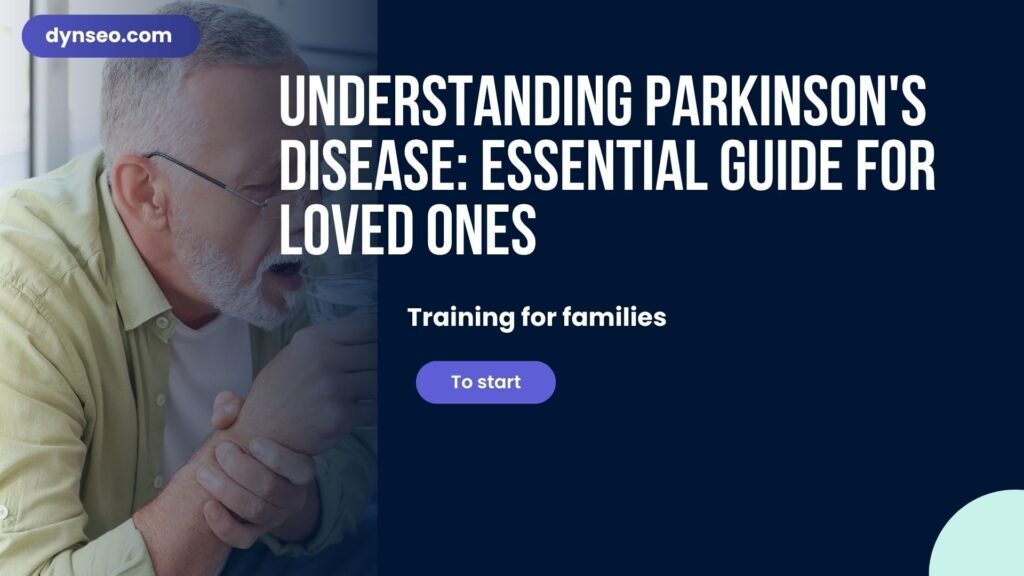
Understanding Parkinson's disease — the complete reference guide
The diagnosis often comes after months of doubt : a hand that trembles slightly at rest, handwriting that shrinks, a new slowness that one attributed to age or fatigue. Then the word is spoken, and it is frightening. For the family, understanding Parkinson's disease becomes a concrete necessity : knowing what is really happening in the brain, distinguishing what is related to the disease from what is not, and stopping interpreting what is actually a symptom as character.
In this article
The associated training
Our printable notebooks



This guide takes the time to explain. It describes the mechanisms at play in simple words, reviews the motor manifestations and those, less known, that sometimes weigh more heavily on daily life, debunks the most tenacious misconceptions, and summarizes what research has established today. It does not replace any medical advice : it gives you the tools to better understand the one you receive, and to ask the right questions at the right time.
The essentials in 30 seconds
Parkinson's disease is a neurodegenerative disease linked to the progressive loss of neurons that produce dopamine, a chemical messenger essential for controlling movements. It evolves slowly, over many years, and differs profoundly from one person to another.
- The immediate cause — the loss of dopamine neurons in a small region of the brain disrupts movement control. The disease is not yet curable, but it is treatable.
- The motor signs — slowness of movements, muscle rigidity, and resting tremor form the classic trio. The tremor is not always present.
- The non-motor signs — sleep disorders, loss of smell, constipation, anxiety, pain, fatigue : often just as disabling, and sometimes early.
- The treatment — medications compensate for the lack of dopamine and significantly improve symptoms. Rehabilitation and regular physical activity are pillars, not options.
- A key point — according to the WHO, Parkinson's is the neurological disorder whose frequency is increasing the fastest in the world. Better understanding it changes the daily life of the person as well as their relatives.
What is Parkinson's disease, exactly ?
Parkinson's disease is a chronic and progressive neurological disorder. It was first described in 1817 by an English physician, James Parkinson, who called it “ shaking paralysis ”. The term was misleading : the person is not paralyzed, and they are not necessarily agitated. Two centuries later, we know that it is a neurodegenerative disease, meaning a disease during which certain neurons deteriorate and then gradually disappear.
Specifically, the disease attacks a specific group of nerve cells located in a small deep region of the brain. These cells have a particularity : they produce dopamine, a substance that serves as a messenger between neurons and plays a central role in the fluidity and control of movements. As these cells disappear, dopamine becomes deficient, and the command of movement becomes disordered. It is this deficit that explains the characteristic slowness, stiffness, and tremor.
Some benchmarks to situate the disease
Parkinson's disease is the second most common neurodegenerative disease after Alzheimer's disease, reminds Inserm. It is one of the leading causes of motor disability of neurological origin in elderly people. According to the World Health Organization, more than 8.5 million people were living with this disease worldwide in 2019, and it is the neurological disorder with the fastest-growing prevalence globally — particularly due to the aging of populations.
In France, Inserm estimates that around 200 000 people are affected, with several thousand new diagnoses each year. The average age at the time of diagnosis is around sixty. But the disease does not wait for old age : the France Parkinson association reminds us that some of those affected develop the disease before the age of 50, which is called an early form. These younger forms raise particular questions — professional activity, family life, children still dependent — that this guide only touches on superficially, but that must be kept in mind.
A movement disorder… and not just that
It is often summarized by tremors. In reality, it also affects sleep, mood, digestion, and smell. These non-motor aspects are sometimes the most burdensome in daily life.
A slow progression
Parkinson's progresses over years, often decades. It is not a disease that deteriorates abruptly overnight, contrary to what many fear at the time of diagnosis.
Causes still poorly understood
In the vast majority of cases, no single cause is found. It is described as a combination of factors : age, individual predispositions, and environmental factors. Purely hereditary forms remain minority.
What we know about causes and risk factors
The question keeps coming back : “ why him, why her ? ”. The honest answer is that we do not completely know. In the vast majority of cases, no single cause is found. Researchers rather describe an interaction between several elements : aging, which remains the main risk factor, individual predispositions, and environmental factors. Among these, prolonged exposure to certain products — particularly pesticides — is now recognized as a risk factor, to the point that Parkinson's disease is listed as an occupational disease for some farmers in France. This does not mean that each case can be explained by exposure : most have no identifiable cause.
It is also necessary to lift a weight that many families carry in silence: stress, an emotional shock, a bereavement, or a disappointment do not cause Parkinson's disease. They may, at most, make certain symptoms more visible at a given moment, but they do not create the disease. Looking back for the "trigger" event is a natural reaction, but it often leads to unfounded guilt. No one in the family caused the disease; no one could have prevented it with different attention.
Because Parkinson's does not evolve in quite the same way. In one person, tremors dominate and autonomy remains preserved for a long time; in another, slowness and postural instability take over earlier. The affected area, the rate of progression, the age of onset, and the response to treatment vary from person to person. That is why comparing two patients — or projecting the journey of one loved one onto that of another — makes little sense and often generates unnecessary worry.
What happens in the brain, explained simply
To understand Parkinson's disease, one helpful image is to imagine an orchestra. The movements of the body, even the simplest ones — walking, picking up a glass, turning in bed — are not just simple orders "lift the arm." They are the result of very fine coordination among many muscles, which must contract and relax at the right moment, with the right force. In the brain, a small region acts as the conductor of movement. Dopamine is the baton that sets the tempo.
In Parkinson's disease, the musicians who produce this baton gradually disappear. The orchestra is still there, the instruments work, but the conductor lacks the means to keep the rhythm. The result: movements become slow to start, jerky, less ample, and sometimes the body starts to "play" by itself when it should be at rest — this is the tremor.
The dopamine deficit, the heart of the problem
The affected region has a name, the substantia nigra, so named because of its dark color. Its neurons produce dopamine and send it to other deep structures in the brain that regulate movement. When these neurons die, the amount of available dopamine drops. An important point, often surprising for families: the first motor symptoms appear only after a significant portion of these neurons has disappeared. In other words, the disease has begun, silently, long before any sign is visible. This explains why it is currently impossible to diagnose it very early, and why the diagnosis often comes after a phase of doubt.
Not just dopamine
For a long time, Parkinson's was reduced to a story of dopamine. Research has shown that it is more complex. Other chemical messengers in the brain are affected, and other regions than the substantia nigra are involved. This explains the symptoms that have nothing to do with movement — sleep disorders, loss of smell, constipation, anxiety. Some of these signs even appear several years before motor disorders. This broader understanding has changed the perspective of caregivers: we no longer just treat stiffness, we support a disease that affects the entire functioning.
| What is often believed | What the disease actually is |
|---|---|
| « It's a muscle disease » | It's a brain disease : the muscles are healthy, it's their command that is disturbed |
| « It's the tremor » | The tremor is just one sign among others, and it is absent in some patients |
| « It's immediately visible » | The disease evolves silently for years before the first visible sign |
| « It's purely motor » | Sleep, mood, digestion, and smell are often affected as well |
The manifestations to know, motor and non-motor
The manifestations of the disease are divided into two main families : motor signs, which concern movement, and non-motor signs, more discreet but often just as disabling. Knowing them allows those around to better understand what is happening, and to stop attributing to will or mood what is related to the disease.
The three classic motor signs
Slowness (akinesia, bradykinesia)
Movement takes time to trigger, then occurs slowly and with less amplitude. Writing shrinks, the face expresses less, daily gestures take longer. This is often the most disabling sign.
Rigidity
The muscles remain contracted, resist movement, giving a sensation of stiffness. It can cause pain, especially in the shoulder or neck, sometimes mistakenly taken for a joint problem.
Resting tremor
It appears when the limb is still and decreases during voluntary movement. It often first affects one hand, on one side. It is not always present : its absence does not rule out the disease.
To these three signs is later added postural instability : difficulty maintaining balance, increased risk of falling, a modified gait — not smaller steps, sudden blockages (the feet seem "stuck" to the ground), difficulty turning or starting. These walking and balance disorders deserve particular attention from those around, as falls are one of the main causes of loss of autonomy.
A point often misunderstood by relatives : motor symptoms frequently begin on one side of the body, and they remain asymmetrical for a long time. A hand trembling on the right, an arm swinging less on one side while walking : this asymmetry is even one of the elements that guide the diagnosis. Another puzzling feature : symptoms can vary greatly throughout the day and from one day to the next. A person perfectly fluid in the morning may be blocked by late afternoon. This is neither acting nor bad will : it reflects the effect of treatment and fatigue, and it deserves to be noted to discuss with the doctor.
The often underestimated non-motor signs
These are the ones that families know the least, yet they weigh heavily in daily life. They can even precede movement disorders by several years. Many people report, in hindsight, having lost their sense of smell or suffered from constipation and restless sleep long before any slowness — without ever making the connection. This observation has actually opened an important research avenue : spotting these early signs could, one day, allow for an earlier diagnosis. For those around, the lesson is immediate : do not reduce the disease to tremors, and take seriously fatigue, anxiety, or pain, which are neither imaginary nor secondary.
- Sleep disorders — restless sleep, movements or screams during the night, drowsiness during the day.
- Loss or decrease of smell — one of the most common early signs, long overlooked.
- Constipation — very common, sometimes present long before the diagnosis.
- Anxiety and depression — they are part of the disease and are not just a psychological reaction to the diagnosis.
- Fatigue — a deep fatigue that is not always repaired by rest.
- Pain — related to stiffness, cramps, postures.
- Attention disorders and slowness of thought — thought may become slower, without intelligence being affected.
- Weaker, less articulated voice — speech may become monotone, low, difficult to follow.
| What the family observes | What it may mean |
|---|---|
| « He no longer smiles, he seems closed off » | Reduction of facial expression (amimia), a motor symptom — not indifference |
| « She speaks so softly that we can no longer hear her » | Decrease in voice volume related to the disease, not a voluntary withdrawal |
| « He takes forever to get dressed » | Slowness of movement (bradykinesia), not unwillingness |
| « She is sad, anxious, she is no longer herself » | Anxiety and depression are part of the disease itself |
| « He suddenly freezes in the hallway » | Freezing: a neurological blockage, not hesitation |
| « She sleeps all day » | Fatigue and drowsiness related to the disease or treatment |
Keep this principle in mind, which applies to the entire disease : what resembles a change in attitude or character is often a symptom. Understanding this transforms the way to react — and thus the way the sick person feels seen and treated. This is precisely the decoding work that DYNSEO training aims to equip loved ones with.
What Parkinson's is not
A good understanding also involves what needs to be ruled out. Many manifestations are wrongly attributed to the disease, and conversely, the disease is sometimes confused with other situations. Only a doctor, usually a neurologist, can make the diagnosis : there is no single test that guarantees it, and the diagnosis mainly relies on clinical examination and progression.
A tremor is not necessarily Parkinson's
This is a very common confusion. There are other causes of tremor, much more frequent, such as essential tremor. A useful difference to know : in Parkinson's disease, the tremor occurs mainly at rest and decreases during movement ; in essential tremor, it is often the opposite — it appears during action, for example when holding a cup or writing. A tremor, in itself, does not mean Parkinson's. Only a doctor can distinguish between them.
Parkinson's is not Alzheimer's disease
Both are neurodegenerative diseases, but they do not affect the same functions or regions at the outset. Alzheimer's primarily affects memory and intellectual functions ; Parkinson's primarily affects movement. A person with Parkinson's can maintain clear thinking for a long time. Cognitive disorders may appear at a more advanced stage in some patients, but equating Parkinson's with a “ loss of mind ” is false and hurtful.
This is not a contagious disease nor a "fault"
It must be said clearly, as the question crosses many families: Parkinson's disease is not contagious, and in the vast majority of cases, it is not hereditary in the strict sense. No one is "responsible" for it. The search for a cause — stress, shock, exposure — is human, but it mainly feeds guilt, which helps no one.
Parkinson's disease itself is not an emergency: it evolves slowly. But certain situations require quick medical advice: a fall with trauma, sudden confusion, a brutal difficulty swallowing, rapid and unusual worsening, or marked effects after a change in treatment. In case of severe discomfort, loss of consciousness, or signs suggesting another acute problem, contact the emergency services in your country. Never modify a Parkinson's treatment on your own initiative: some abrupt stops are dangerous.
Understanding the disease is already helping your loved one
The DYNSEO training "Understanding Parkinson's Disease" covers all this in 16 short lessons, 100% online, at your own pace: mechanisms, signs, communication, daily life, caregiver balance. Designed for loved ones, without jargon.
Discover the training — €20The main stages of the journey and what to expect
No journey is the same, and one must resist the temptation to impose a unique pattern on a given person. That said, we can describe major phases that help to navigate, provided we keep in mind that their duration and intensity vary greatly from one patient to another.
- The phase of doubt and diagnosis. Discreet signs — a slower hand, a slight tremor, fatigue, a changing handwriting — lead to a consultation. The diagnosis is made by the neurologist based on the clinical examination; there is no single test that confirms it, and a period of observation is sometimes necessary.
- The therapeutic "honeymoon." Once the treatment is established, symptoms often improve significantly and sustainably. This period, where the person feels almost like before, can last several years. It is the right time to establish good habits: physical activity, rehabilitation, organization.
- The fluctuations. Over time, the effect of the treatment may become less regular: alternating phases where everything is fine and phases where symptoms return, possible involuntary movements. Medical follow-up then adjusts the management. This is a phase that requires careful observation, which those around can greatly help to document.
- The advanced phase. Motor difficulties, balance, sometimes speech, swallowing, or cognition, require more sustained support and a multidisciplinary team. The goal remains quality of life and maintaining autonomy as much as possible.
What medical follow-up looks like
Parkinson's disease is monitored over time, with a team that expands as needed. The neurologist remains the pilot of the management: he is the one who makes the diagnosis, chooses and adjusts treatments, and evaluates progress during regular consultations. Depending on the situations, the treating physician, physiotherapist, speech therapist, occupational therapist, sometimes the neuropsychologist, nurse, dietitian, or social worker may be involved. This multidisciplinary approach is not a luxury: it corresponds to a disease that affects multiple aspects of life.
For the family, understanding that this journey is built progressively avoids two common pitfalls. The first consists of expecting everything from medication, neglecting rehabilitation and physical activity, which are crucial. The second, conversely, consists of multiplying the interveners without coordination. The right reflex is to circulate information — from one professional to another, and to the referring neurologist — using simple tools like a notebook or a tracking sheet. The question “ who to contact and how to maintain over time ” is the subject of a dedicated article in this series.
The neurologist sees the person a few times a year, often at a good time of day. The family, on the other hand, observes daily : at what moment do the symptoms return, how is sleep, when do blockages occur. Noting these observations — in a notebook, a chart, a simple tracking tool — and then passing them on greatly helps the care team adjust the management. You are the eyes of the doctor between two consultations.
What treatments and research say
We must be honest : to date, we do not know how to cure Parkinson's disease or stop its progression. But — and this is essential — we treat it, and often very effectively for a long time. Treatments do not repair lost neurons : they compensate for the lack of dopamine and significantly improve symptoms and quality of life. Any therapeutic decision is the responsibility of the doctor ; this guide does not provide any indication of medication or dosage.
Main areas of management
Medications
They aim to restore the action of the missing dopamine. They improve slowness, stiffness, and tremors. Their choice, dosage, and adjustments are the responsibility of the neurologist, depending on each situation.
Physical activity
It is not a supplement : it is a pillar of treatment. Regular and appropriate activity helps maintain mobility, balance, and morale. Regularity takes precedence over intensity.
Rehabilitation
Physiotherapy for movement and balance, speech therapy for voice and swallowing, occupational therapy for daily gestures. Conducted over time, it makes a real difference.
Advanced techniques
In some selected patients, at a specific stage, approaches like deep brain stimulation may be proposed. The decision is highly regulated and falls under specialized centers.
Three useful lessons for a family
1. Regularity takes precedence over intensity. Whether it is physical activity, rehabilitation exercises, or cognitive stimulation, a little every day is better than a big one-time effort. The body and brain consolidate what is repeated at close intervals. Fifteen minutes of walking or exercises daily produces more than a long isolated session.
2. What is used is maintained better. A function that is no longer solicited — walking, speaking, a gesture — tends to degrade faster. Doing for the person, out of kindness or to go faster, accelerates the loss of autonomy. The right posture, though more uncomfortable, is to let them do it, more slowly, with just the necessary level of help.
3. Cognitive stimulation has its place. Because the disease can slow down attention and processing speed, regularly maintaining cognitive functions through suitable activities is useful, in addition to other measures. Applications like SCARLETT, designed for seniors and adapted for people affected by Parkinson's or Alzheimer's disease, offer games whose level adjusts progressively — neither too easy nor discouraging. The free cognitive tests DYNSEO also allow for an initial assessment.
An important clarification to avoid misunderstandings: these activities are not intended to "cure" anything, and no application replaces medical care or rehabilitation. Their interest lies elsewhere: maintaining a pleasant routine, preserving a moment of exchange, sustaining attention and memory, and combating withdrawal. The right balance is found in regularity and enjoyment, not in performance. A session that is too long or experienced as a constraint does more harm than good. A short daily moment, chosen and anticipated, is better than an imposed exercise that becomes a source of tension between the person and their loved one.
Current work focuses particularly on the mechanisms of the disease, on markers that would allow for earlier diagnosis, and on avenues aimed at slowing progression. This field is evolving rapidly: beware of spectacular announcements of "cure" circulating online, and report any information found to the care team before drawing conclusions. The most reliable source remains the neurologist who follows your loved one.
7 misconceptions to correct
“Parkinson's is just tremors”
False, or at least very incomplete. Tremors are one sign among others, and they are not present in all patients. Some affected individuals never tremble: for them, slowness and rigidity dominate. Reducing the disease to tremors leads to underestimating everything else — fatigue, anxiety, sleep disorders — which often weighs more heavily in daily life.
“It's a disease of very old people”
Age is the main risk factor, and the disease is more common after 60. But it is not reserved for the elderly: the France Parkinson association reminds us that some affected individuals develop the disease before the age of 50. These earlier forms do exist and are sometimes diagnosed late, precisely because they are not considered in someone still active.
“People die from it”
Parkinson's disease is a chronic illness with which one can live for a long time. It is not, in itself, a disease that abruptly shortens life. The complications to watch for — falls, swallowing disorders — can be prevented and managed. The diagnosis is not a short-term condemnation, contrary to what many imagine at first.
“He is doing it on purpose to be slow”
No. The slowness of movement is a neurological symptom, not a lack of willingness. The person often wants to go faster but cannot. Pressuring, sighing, or doing it for them only adds stress, which often worsens the symptoms. The time given is a form of care.
« Parkinson inevitably leads to dementia »
False. Parkinson is primarily a movement disorder. Many people retain preserved intellectual abilities for many years. Cognitive disorders may occur at an advanced stage in some patients, but the systematic association of Parkinson with dementia is inaccurate and deeply hurtful to those affected.
« Rest above all »
Rest is necessary, but inactivity is harmful. Prolonged immobility worsens stiffness, muscle wasting, and the risk of falling. Regular and appropriate physical activity, on the contrary, is part of the treatment in its own right. Balance is found in alternating between appropriate effort and recovery, never in one to the exclusion of the other.
« There’s nothing we can do, we just have to wait »
This may be the most discouraging idea, and the most false. We do not yet cure the disease, but we can act on it : treatments provide relief, rehabilitation maintains abilities, physical activity and stimulation help, and daily adjustments reduce difficulties. Inaction, on the other hand, gives ground to the disease. Understanding Parkinson's disease is precisely about finding levers for action.
What really helps, what is useless
| ✅ What helps | ❌ What does not help |
|---|---|
| Allow time, slow down the pace of exchanges | Rush the person, finish their gestures or sentences for them |
| A regular and appropriate physical activity, a little each day | Permanent rest “ to avoid getting tired ” |
| Let the person do it, with just the right level of help | Do everything for them to go faster |
| Treat mood and expression changes as symptoms | Take them personally or see them as indifference |
| Note daily observations for the caregiving team | Wait for the consultation hoping to remember everything |
| Scrupulously respect the prescribed treatment schedules | Modify or stop a treatment on one’s own initiative |
| The approaches validated by the caregiving team | The “ miracle cures ” and treatments sold online |
| Ask for help and take a breath before exhaustion | Manage alone “ because no one will do it as well ” |
A word about the caregiver, as they are too often forgotten : accompanying a person with Parkinson's is a long-distance race. The exhaustion of those around does not help anyone — neither the caregiver nor the sick person. Accepting support, preserving time for oneself, relying on associations and professionals is not abandonment : it is a condition for lasting endurance. A rested, informed, and supported caregiver accompanies better, longer, and with more serenity — which is precisely what the sick person needs.
Three simple gestures that change daily life
Beyond the main principles, a few concrete reflexes make a real difference, without ever replacing the instructions of professionals. First gesture : adapt the way you communicate. Position yourself facing the person, one idea at a time, allowing them time to respond. If the voice becomes weak, do not say “ speak louder ” in an annoyed tone ; instead, say calmly : “ I’m listening, take your time. ” Pressure increases symptoms, patience calms them.
Deuxième geste : décomposer les mouvements bloqués. Lorsque les pieds semblent collés au sol, inutile de tirer sur le bras — cela aggrave le blocage et le risque de chute. On peut proposer un repère : compter « un, deux, trois » avant de repartir, viser un point au sol à enjamber, ou marquer un rythme. Ces astuces, à valider avec le kinésithérapeute, aident souvent à « débloquer » la marche. Troisième geste : sécuriser sans infantiliser. Un logement dégagé, un bon éclairage, des chaussures adaptées réduisent le risque de chute ; mais on veille à laisser la personne faire ce qu'elle peut encore faire seule. L'objectif n'est pas de tout faire à sa place, c'est de rendre possible ce qu'elle fait elle-même.
❌ À éviter : presser la personne, faire les gestes à sa place « pour gagner du temps », hausser le ton devant une lenteur, ou décider seul de suspendre un traitement parce que « ça a l'air d'aller mieux ». Ces réflexes, souvent bien intentionnés, se retournent contre la personne accompagnée. Les situations concrètes du quotidien et la boîte à outils des aménagements sont détaillées dans les articles dédiés de cette série.
Pour aller plus loin
Ce guide explique la maladie. Quatre autres articles de cette série approfondissent chacun un aspect concret du quotidien :
Situations du quotidien10 situations difficiles au quotidien avec Parkinson et comment y répondre, pas à pas
Boîte à outilsActivités, supports et aménagements concrets à mettre en place à la maison
Aides & interlocuteursÀ qui s'adresser, quelles aides et comment tenir dans la durée
Côté ressources gratuites : le catalogue d'outils DYNSEO propose notamment un tableau de suivi des progrès et une fiche de suivi de séance à imprimer, utiles pour objectiver ce qui évolue et le transmettre aux professionnels. Les tests cognitifs permettent de faire un premier point, et les applications EDITH et JOE servent de support de stimulation cognitive selon le profil.
Questions fréquentes
La maladie de Parkinson est-elle héréditaire ?
Dans l'immense majorité des cas, non : la maladie n'est pas transmise directement d'un parent à un enfant. On parle plutôt d'une combinaison de facteurs — âge, prédispositions, environnement — sans cause unique identifiable. Des formes réellement héréditaires existent, mais elles restent minoritaires et concernent surtout certaines formes précoces. Avoir un proche atteint n'implique donc pas que l'on développera soi-même la maladie. Si une inquiétude particulière existe, notamment en cas de plusieurs cas dans une même famille, c'est au neurologue ou à un généticien qu'il faut en parler pour un avis personnalisé et fiable.
Peut-on guérir de la maladie de Parkinson ?
À ce jour, on ne sait pas guérir la maladie ni stopper sa progression. C'est important de le dire avec honnêteté. En revanche, on la traite, et souvent très efficacement pendant de nombreuses années : les médicaments compensent le manque de dopamine et améliorent nettement les symptômes, tandis que la rééducation et l'activité physique aident à maintenir les capacités. Beaucoup de personnes vivent longtemps avec une bonne qualité de vie. La recherche progresse activement. Méfiez-vous des annonces de guérison miracle qui circulent : la source fiable reste toujours le neurologue qui suit votre proche.
Le tremblement signifie-t-il forcément la maladie de Parkinson ?
Non. Un tremblement peut avoir de nombreuses causes, et la plus fréquente n'est pas Parkinson mais le tremblement essentiel. Une différence utile : dans Parkinson, le tremblement survient surtout au repos et diminue lors du mouvement ; dans le tremblement essentiel, il apparaît plutôt pendant l'action, par exemple en tenant un objet. Mais ces repères ne suffisent pas à conclure. Seul un médecin, généralement un neurologue, peut faire la part des choses après un examen. Un tremblement isolé ne doit donc pas faire conclure trop vite à la maladie de Parkinson.
Une personne atteinte de Parkinson perd-elle la tête ?
Non, pas nécessairement, et surtout pas d'emblée. Parkinson est avant tout une maladie du mouvement : beaucoup de personnes conservent une pensée claire et des capacités intellectuelles préservées pendant de longues années. La pensée peut devenir plus lente, ce qui n'a rien à voir avec une atteinte de l'intelligence. Des troubles cognitifs peuvent apparaître à un stade avancé chez une partie des malades, mais assimiler systématiquement Parkinson à une démence est faux et blessant. Continuer à s'adresser à la personne normalement, comme à l'adulte qu'elle est, reste essentiel à tous les stades.
Comment aider un proche au quotidien sans le brusquer ?
Le principe de base tient en un mot : le temps. Ralentissez le rythme, laissez la personne faire elle-même avec juste le niveau d'aide nécessaire, évitez de finir ses gestes ou ses phrases. Comprenez que la lenteur, le visage moins expressif ou la voix basse sont des symptômes, pas de l'indifférence. Respectez scrupuleusement les horaires de traitement. Notez vos observations pour l'équipe soignante. Enfin, préservez-vous : demander du relais et souffler n'est pas un abandon, c'est ce qui permet d'accompagner dans la durée sans s'épuiser.
Cet article a une visée d'information générale. Il ne remplace ni un diagnostic, ni un avis médical, ni un traitement. Aucun médicament ni aucune dose n'y sont indiqués : toute décision thérapeutique relève du médecin. Pour toute question concernant une situation personnelle, adressez-vous au médecin traitant ou au neurologue qui suit votre proche. En cas de situation grave ou soudaine, contactez les services d'urgence de votre pays.
Passer de la compréhension à l'accompagnement
Vous savez désormais l'essentiel pour comprendre la maladie de Parkinson, ses mécanismes, ses signes et ses leviers d'action. Pour traduire ces repères en gestes concrets, jour après jour, à la maison, la formation DYNSEO « Comprendre la maladie de Parkinson : guide essentiel pour les proches » propose 16 leçons courtes, 100 % en ligne, à votre rythme et en accès illimité. Organisme certifié Qualiopi (N° 11757351875), attestation de fin de formation.
Découvrir la formation — 20 €Did this content help you? Support DYNSEO 💙
We are a small team of 14 people based in Paris. For 13 years, we have been creating free content to help families, speech therapists, care homes and healthcare professionals.
Your feedback is the only way we know if our work is useful. A Google review helps us reach other families, caregivers and therapists who need it.
One action, 30 seconds: leave us a Google review ⭐⭐⭐⭐⭐. It costs nothing, and it changes everything for us.