--dyn-bleu:#5e5ed7;
--dyn-bleu-fonce:#5268c9;
--dyn-vert:#a9e2e4;
--dyn-jaune:#ffeca7;
--dyn-rose:#e73469;
--dyn-encre:#1d1d2e;
--dyn-gris:#5c5c72;
--dyn-fond:#f6f6fd;
--dyn-ombre:0 6px 24px rgba(29,29,46,.08);
--dyn-ombre-forte:0 12px 34px rgba(94,94,215,.22);
--dyn-radius:18px;
font-family:"Inter","Segoe UI",system-ui,-apple-system,"Helvetica Neue",Arial,sans-serif;
color:var(--dyn-encre);
line-height:1.68;
font-size:clamp(16px,1.05vw + 13px,18px);
max-width:860px;
margin:0 auto;
padding:0 4px;
-webkit-font-smoothing:antialiased;
}
.dbi-art-44a2a7 .dyn-article * {box-sizing:border-box;}
.dbi-art-44a2a7 .dyn-article h1, .dbi-art-44a2a7 .dyn-article h2, .dbi-art-44a2a7 .dyn-article h3, .dbi-art-44a2a7 .dyn-article h4 {
color:var(--dyn-encre);line-height:1.22;margin:0 0 .5em;font-weight:800;letter-spacing:-.015em;
}
.dbi-art-44a2a7 .dyn-article h1 {font-size:clamp(1.65rem,3.4vw,2.35rem);margin-top:.4em;}
.dbi-art-44a2a7 .dyn-article h2 {font-size:clamp(1.35rem,2.4vw,1.75rem);margin-top:2.1em;padding-top:.2em;}
.dbi-art-44a2a7 .dyn-article h3 {font-size:clamp(1.1rem,1.7vw,1.28rem);margin-top:1.5em;font-weight:700;}
.dbi-art-44a2a7 .dyn-article p {margin:0 0 1.05em;}
.dbi-art-44a2a7 .dyn-article a {color:var(--dyn-bleu-fonce);text-decoration:underline;text-underline-offset:3px;}
.dbi-art-44a2a7 .dyn-article a:hover {color:var(--dyn-rose);}
.dbi-art-44a2a7 .dyn-article a:focus-visible {outline:3px solid var(--dyn-bleu);outline-offset:2px;border-radius:4px;}
.dbi-art-44a2a7 .dyn-article ul, .dbi-art-44a2a7 .dyn-article ol {margin:0 0 1.05em;padding-left:1.25em;}
.dbi-art-44a2a7 .dyn-article li {margin-bottom:.45em;}
.dbi-art-44a2a7 .dyn-article strong {font-weight:700;}
.dbi-art-44a2a7 .dyn-article img {max-width:100%;height:auto;display:block;}
.dbi-art-44a2a7 .dyn-pagehead {
position:relative;overflow:hidden;border-radius:var(--dyn-radius);
padding:30px 24px 28px;margin:0 0 1.5em;box-shadow:var(--dyn-ombre);
}
@media(min-width:720px) {
.dbi-art-44a2a7 .dyn-pagehead {padding:44px 44px 40px;}
}
.dbi-art-44a2a7 .dyn-pagehead::after {
content:"";position:absolute;right:-80px;top:-80px;width:250px;height:250px;border-radius:50%;
background:rgba(255,255,255,.14);pointer-events:none;
}
.dbi-art-44a2a7 .dyn-pagehead > * {position:relative;z-index:1;}
.dbi-art-44a2a7 .dyn-pagehead--bleu {background:linear-gradient(135deg,var(--dyn-bleu) 0%,var(--dyn-bleu-fonce) 100%);color:#fff;}
.dbi-art-44a2a7 .dyn-pagehead--bleu h1 {color:#fff;}
.dbi-art-44a2a7 .dyn-pagehead--bleu .dyn-pagehead__cat {color:var(--dyn-jaune);}
.dbi-art-44a2a7 .dyn-pagehead--bleu .dyn-pagehead__lead {color:rgba(255,255,255,.93);}
.dbi-art-44a2a7 .dyn-pagehead--bleu .dyn-pagehead__meta {color:#fff;}
.dbi-art-44a2a7 .dyn-pagehead--bleu .dyn-pagehead__meta li {background:rgba(255,255,255,.18);}
.dbi-art-44a2a7 .dyn-pagehead--eau {background:linear-gradient(135deg,var(--dyn-vert) 0%,#cfeff1 100%);color:var(--dyn-encre);}
.dbi-art-44a2a7 .dyn-pagehead--eau .dyn-pagehead__cat {color:var(--dyn-rose);}
.dbi-art-44a2a7 .dyn-pagehead--eau .dyn-pagehead__lead {color:#3b4a5c;}
.dbi-art-44a2a7 .dyn-pagehead--eau .dyn-pagehead__meta li {background:rgba(255,255,255,.62);}
.dbi-art-44a2a7 .dyn-pagehead--jaune {background:linear-gradient(135deg,var(--dyn-jaune) 0%,#fff7d6 100%);color:var(--dyn-encre);}
.dbi-art-44a2a7 .dyn-pagehead--jaune .dyn-pagehead__cat {color:var(--dyn-rose);}
.dbi-art-44a2a7 .dyn-pagehead--jaune .dyn-pagehead__lead {color:#5a5240;}
.dbi-art-44a2a7 .dyn-pagehead--jaune .dyn-pagehead__meta li {background:rgba(255,255,255,.68);}
.dbi-art-44a2a7 .dyn-pagehead__cat {
display:inline-block;font-size:.76rem;font-weight:800;letter-spacing:.12em;
text-transform:uppercase;margin-bottom:.9em;
}
.dbi-art-44a2a7 .dyn-pagehead h1 {margin:0 0 .5em;}
.dbi-art-44a2a7 .dyn-pagehead__lead {font-size:clamp(1.02rem,1.4vw,1.16rem);margin:0 0 1.3em;}
.dbi-art-44a2a7 .dyn-pagehead__meta {
display:flex;flex-wrap:wrap;gap:8px;list-style:none;padding:0;margin:0;
font-size:.83rem;font-weight:600;
}
.dbi-art-44a2a7 .dyn-pagehead__meta li {border-radius:999px;padding:5px 13px;}
.dbi-art-44a2a7 .dyn-hero {
background:linear-gradient(135deg,#ffffff 0%,var(--dyn-fond) 100%);
border-radius:var(--dyn-radius);
box-shadow:var(--dyn-ombre);
overflow:hidden;
margin:0 0 2.2em;
}
.dbi-art-44a2a7 .dyn-hero__grid {display:grid;grid-template-columns:minmax(0,1fr);}
@media(min-width:720px) {
.dbi-art-44a2a7 .dyn-hero__grid {grid-template-columns:42% minmax(0,1fr);}
}
.dbi-art-44a2a7 .dyn-hero__media {position:relative;background:var(--dyn-vert);}
.dbi-art-44a2a7 .dyn-hero__media img {width:100%;height:100%;object-fit:cover;aspect-ratio:16/9;}
@media(min-width:720px) {
.dbi-art-44a2a7 .dyn-hero__media img {aspect-ratio:auto;min-height:100%;}
}
.dbi-art-44a2a7 .dyn-hero__eyebrow {
display:inline-block;background:var(--dyn-rose);color:#fff;font-size:.72rem;font-weight:800;
letter-spacing:.09em;text-transform:uppercase;padding:6px 13px;border-radius:999px;margin-bottom:.7em;
}
.dbi-art-44a2a7 .dyn-hero__body {padding:22px 22px 24px;}
@media(min-width:720px) {
.dbi-art-44a2a7 .dyn-hero__body {padding:28px 30px;}
}
.dbi-art-44a2a7 .dyn-hero__title {font-size:clamp(1.12rem,2vw,1.42rem);font-weight:800;margin:0 0 .55em;line-height:1.25;}
.dbi-art-44a2a7 .dyn-hero__title a {color:var(--dyn-encre);text-decoration:none;}
.dbi-art-44a2a7 .dyn-hero__title a:hover {color:var(--dyn-bleu);}
.dbi-art-44a2a7 .dyn-hero__pitch {font-size:.97rem;color:var(--dyn-gris);margin:0 0 1em;}
.dbi-art-44a2a7 .dyn-badges {display:flex;flex-wrap:wrap;gap:7px;margin:0 0 1.1em;padding:0;list-style:none;}
.dbi-art-44a2a7 .dyn-badges li {
background:#fff;border-radius:999px;padding:5px 12px;font-size:.79rem;font-weight:600;
color:var(--dyn-bleu-fonce);box-shadow:0 2px 8px rgba(29,29,46,.07);
}
.dbi-art-44a2a7 .dyn-hero__actions {display:flex;flex-wrap:wrap;gap:10px;align-items:center;}
.dbi-art-44a2a7 .dyn-btn {
display:inline-block;background:var(--dyn-bleu);color:#fff !important;text-decoration:none !important;
font-weight:700;padding:13px 26px;border-radius:999px;box-shadow:var(--dyn-ombre-forte);
transition:transform .15s ease,background .15s ease;text-align:center;
}
.dbi-art-44a2a7 .dyn-btn:hover {background:var(--dyn-bleu-fonce);transform:translateY(-2px);color:#fff !important;}
.dbi-art-44a2a7 .dyn-btn--ghost {
background:#fff;color:var(--dyn-bleu-fonce) !important;box-shadow:0 2px 10px rgba(29,29,46,.09);
}
.dbi-art-44a2a7 .dyn-btn--ghost:hover {background:var(--dyn-jaune);color:var(--dyn-encre) !important;}
.dbi-art-44a2a7 .dyn-hero__price {font-weight:800;color:var(--dyn-rose);font-size:1.02rem;margin-left:2px;}
.dbi-art-44a2a7 .dyn-hero--pastel {background:var(--dom-fond);}
.dbi-art-44a2a7 .dyn-pastel {display:grid;grid-template-columns:auto minmax(0,1fr);gap:18px;align-items:start;padding:22px;}
@media(min-width:720px) {
.dbi-art-44a2a7 .dyn-pastel {gap:24px;padding:30px 32px;}
}
.dbi-art-44a2a7 .dyn-pastel__icone {
flex:0 0 auto;width:74px;height:74px;border-radius:22px;background:#fff;
display:flex;align-items:center;justify-content:center;font-size:34px;line-height:1;
box-shadow:0 4px 14px rgba(29,29,46,.10);
}
@media(min-width:720px) {
.dbi-art-44a2a7 .dyn-pastel__icone {width:88px;height:88px;font-size:40px;}
}
.dbi-art-44a2a7 .dyn-pastel__domaine {
display:inline-block;background:#fff;border-radius:999px;padding:4px 12px;
font-size:.74rem;font-weight:800;letter-spacing:.08em;text-transform:uppercase;
color:var(--dom-texte);margin-bottom:.6em;
}
.dbi-art-44a2a7 .dyn-hero--pastel .dyn-hero__eyebrow {background:var(--dom-texte);}
.dbi-art-44a2a7 .dyn-hero--pastel .dyn-btn {background:var(--dom-texte);}
.dbi-art-44a2a7 .dyn-hero--pastel .dyn-btn:hover {filter:brightness(.92);}
.dbi-art-44a2a7 .dyn-hero--pastel .dyn-btn--ghost {background:#fff;color:var(--dom-texte) !important;}
.dbi-art-44a2a7 .dyn-hero--pastel .dyn-badges li {color:var(--dom-texte);}
.dbi-art-44a2a7 .dyn-hero--pastel .dyn-hero__price {color:var(--dom-texte);}
.dbi-art-44a2a7 .dyn-dom--memoire {--dom-fond:#e9e9fb;--dom-texte:#5268c9;}
.dbi-art-44a2a7 .dyn-dom--attention {--dom-fond:#dcf2f4;--dom-texte:#1b7f86;}
.dbi-art-44a2a7 .dyn-dom--logique {--dom-fond:#ece9fb;--dom-texte:#5e5ed7;}
.dbi-art-44a2a7 .dyn-dom--langage {--dom-fond:#ffe8d9;--dom-texte:#b35a2a;}
.dbi-art-44a2a7 .dyn-dom--emotions {--dom-fond:#fdeaf1;--dom-texte:#c0295a;}
.dbi-art-44a2a7 .dyn-dom--apprentissage {--dom-fond:#fff3cd;--dom-texte:#8a6a13;}
.dbi-art-44a2a7 .dyn-dom--autonomie {--dom-fond:#e4f2ea;--dom-texte:#25795c;}
.dbi-art-44a2a7 .dyn-tldr {
background:var(--dyn-vert);border-radius:var(--dyn-radius);padding:22px 24px;margin:0 0 2em;
}
.dbi-art-44a2a7 .dyn-tldr h2 {margin:0 0 .5em;font-size:1.1rem;text-transform:uppercase;letter-spacing:.06em;}
.dbi-art-44a2a7 .dyn-tldr p {margin-bottom:.8em;}
.dbi-art-44a2a7 .dyn-tldr ul {margin-bottom:0;padding-left:1.1em;}
.dbi-art-44a2a7 .dyn-toc {background:var(--dyn-fond);border-radius:var(--dyn-radius);padding:20px 24px;margin:0 0 2.2em;}
.dbi-art-44a2a7 .dyn-toc p {font-weight:800;margin:0 0 .6em;font-size:.9rem;text-transform:uppercase;letter-spacing:.07em;color:var(--dyn-bleu-fonce);}
.dbi-art-44a2a7 .dyn-toc ol {margin:0;padding-left:1.2em;}
.dbi-art-44a2a7 .dyn-toc li {margin-bottom:.3em;}
.dbi-art-44a2a7 .dyn-cards {display:grid;gap:14px;grid-template-columns:repeat(auto-fit,minmax(230px,1fr));margin:1.4em 0 1.8em;}
.dbi-art-44a2a7 .dyn-card {
background:#fff;border-radius:var(--dyn-radius);padding:20px 20px 18px;box-shadow:var(--dyn-ombre);
}
.dbi-art-44a2a7 .dyn-card h3 {margin:0 0 .45em;font-size:1.03rem;}
.dbi-art-44a2a7 .dyn-card p {margin:0;font-size:.94rem;color:var(--dyn-gris);}
.dbi-art-44a2a7 .dyn-card__icon {font-size:1.5rem;display:block;margin-bottom:.35em;line-height:1;}
.dbi-art-44a2a7 .dyn-module {
background:#fff;border-radius:var(--dyn-radius);box-shadow:var(--dyn-ombre);
padding:20px 22px;margin:0 0 14px;
}
.dbi-art-44a2a7 .dyn-module__head {display:flex;align-items:center;gap:12px;margin-bottom:.7em;}
.dbi-art-44a2a7 .dyn-module__num {
flex:0 0 auto;width:38px;height:38px;border-radius:12px;background:var(--dyn-bleu);color:#fff;
display:flex;align-items:center;justify-content:center;font-weight:800;font-size:1rem;
}
.dbi-art-44a2a7 .dyn-module__title {margin:0;font-size:1.05rem;font-weight:800;}
.dbi-art-44a2a7 .dyn-module ul {margin:0;padding-left:1.15em;font-size:.95rem;}
.dbi-art-44a2a7 .dyn-module li::marker {color:var(--dyn-rose);}
.dbi-art-44a2a7 .dyn-tablewrap {overflow-x:auto;-webkit-overflow-scrolling:touch;margin:1.3em 0 1.9em;border-radius:var(--dyn-radius);box-shadow:var(--dyn-ombre);background:#fff;}
.dbi-art-44a2a7 .dyn-article table {width:100%;border-collapse:collapse;min-width:460px;font-size:.94rem;}
.dbi-art-44a2a7 .dyn-article thead th {
background:var(--dyn-bleu);color:#fff;text-align:left;padding:13px 16px;font-weight:700;font-size:.9rem;
}
.dbi-art-44a2a7 .dyn-article tbody td {padding:12px 16px;vertical-align:top;border-top:1px solid #ececf7;}
.dbi-art-44a2a7 .dyn-article tbody tr:nth-child(even) td {background:#fbfbff;}
.dbi-art-44a2a7 .dyn-article th:first-child {border-top-left-radius:var(--dyn-radius);}
.dbi-art-44a2a7 .dyn-article th:last-child {border-top-right-radius:var(--dyn-radius);}
.dbi-art-44a2a7 .dyn-oui {color:#1a8f6b;font-weight:700;}
.dbi-art-44a2a7 .dyn-non {color:var(--dyn-rose);font-weight:700;}
.dbi-art-44a2a7 .dyn-note, .dbi-art-44a2a7 .dyn-alerte {border-radius:var(--dyn-radius);padding:18px 22px;margin:1.5em 0;}
.dbi-art-44a2a7 .dyn-note {background:var(--dyn-jaune);}
.dbi-art-44a2a7 .dyn-alerte {background:#fdeef3;}
.dbi-art-44a2a7 .dyn-note p:last-child, .dbi-art-44a2a7 .dyn-alerte p:last-child {margin-bottom:0;}
.dbi-art-44a2a7 .dyn-note strong, .dbi-art-44a2a7 .dyn-alerte strong {display:block;margin-bottom:.3em;font-size:1rem;}
.dbi-art-44a2a7 .dyn-cta {
background:var(--dyn-bleu);border-radius:var(--dyn-radius);padding:26px 24px;margin:2.2em 0;
color:#fff;text-align:center;box-shadow:var(--dyn-ombre-forte);
}
.dbi-art-44a2a7 .dyn-cta h3 {color:#fff;margin:0 0 .4em;font-size:clamp(1.1rem,2vw,1.35rem);}
.dbi-art-44a2a7 .dyn-cta p {color:rgba(255,255,255,.92);margin:0 0 1.1em;font-size:.97rem;}
.dbi-art-44a2a7 .dyn-cta .dyn-btn {background:#fff;color:var(--dyn-bleu) !important;box-shadow:none;}
.dbi-art-44a2a7 .dyn-cta .dyn-btn:hover {background:var(--dyn-jaune);color:var(--dyn-encre) !important;}
.dbi-art-44a2a7 .dyn-steps {list-style:none;counter-reset:dyn;padding:0;margin:1.4em 0 1.8em;display:grid;gap:12px;}
.dbi-art-44a2a7 .dyn-steps li {
counter-increment:dyn;background:#fff;border-radius:var(--dyn-radius);box-shadow:var(--dyn-ombre);
padding:16px 20px 16px 62px;position:relative;font-size:.96rem;
}
.dbi-art-44a2a7 .dyn-steps li::before {
content:counter(dyn);position:absolute;left:18px;top:15px;width:30px;height:30px;border-radius:10px;
background:var(--dyn-jaune);color:var(--dyn-encre);display:flex;align-items:center;justify-content:center;
font-weight:800;font-size:.9rem;
}
.dbi-art-44a2a7 .dyn-faq {background:var(--dyn-fond);border-radius:var(--dyn-radius);padding:6px 24px 20px;margin:1.4em 0 0;}
.dbi-art-44a2a7 .dyn-faq h3 {font-size:1.05rem;margin-top:1.4em;}
.dbi-art-44a2a7 .dyn-faq p {font-size:.96rem;}
.dbi-art-44a2a7 .dyn-serie {display:grid;gap:12px;margin:1.4em 0 1.8em;}
.dbi-art-44a2a7 .dyn-serie a {
display:block;background:#fff;border-radius:var(--dyn-radius);box-shadow:var(--dyn-ombre);
padding:15px 20px;text-decoration:none;color:var(--dyn-encre);font-weight:600;font-size:.96rem;
transition:transform .15s ease;
}
.dbi-art-44a2a7 .dyn-serie a:hover {transform:translateX(4px);color:var(--dyn-bleu);}
.dbi-art-44a2a7 .dyn-serie span {display:block;font-size:.82rem;font-weight:600;color:var(--dyn-rose);text-transform:uppercase;letter-spacing:.06em;margin-bottom:2px;}
@media(prefers-reduced-motion:reduce) {
.dbi-art-44a2a7 .dyn-article * {transition:none !important;}
}{
"@context": "https://schema.org",
"@graph": [
{
"@type": "Article",
"headline": "Prévenir les chutes : posture professionnelle, travail en équipe et montée en compétences",
"inLanguage": "fr",
"author": {
"@type": "Organization",
"name": "DYNSEO",
"url": "https://www.dynseo.com/"
},
"publisher": {
"@type": "Organization",
"name": "DYNSEO",
"url": "https://www.dynseo.com/"
},
"image": "https://www.dynseo.com/wp-content/uploads/2026/03/Autisme-en-etablissement-Accompagnement-Global-13.jpg"
},
{
"@type": "FAQPage",
"mainEntity": [
{
"@type": "Question",
"name": "Que répondre à une famille qui demande de « l'attacher pour qu'il ne tombe pas » ?",
"acceptedAnswer": {
"@type": "Answer",
"text": "On accueille l'inquiétude avant de répondre sur le fond : « je comprends votre peur. » Puis on rappelle le cadre : la contention ne se décide pas au cas par cas par un soignant, elle relève d'une évaluation médicale, elle est encadrée et peut même aggraver le risque et l'anxiété. On termine par du concret : « voici ce que nous mettons en place — passage dégagé, veilleuse, surveillance de nuit — et je transmets votre demande au cadre et au médecin. » On ne promet jamais l'absence totale de chute, qu'aucune organisation ne peut garantir."
}
},
{
"@type": "Question",
"name": "Puis-je décider seul d'empêcher une personne de se lever ?",
"acceptedAnswer": {
"@type": "Answer",
"text": "Non. Restreindre la liberté de mouvement d'une personne relève d'une décision encadrée, prise en équipe et le plus souvent sur avis médical, jamais de l'initiative individuelle. Votre rôle est de sécuriser l'environnement, de proposer de l'aide, d'accompagner et de tracer : noter par exemple qu'une personne se lève sans attendre l'aide qu'elle a pourtant sonnée. Si vous estimez qu'une mesure de protection est nécessaire, vous le portez en réunion avec des faits observés. Agir seul crée un risque juridique et éthique, et souvent aggrave la situation."
}
},
{
"@type": "Question",
"name": "Comment tracer une chute correctement ?",
"acceptedAnswer": {
"@type": "Answer",
"text": "On décrit un fait daté et situé : heure, lieu, ce qui précédait, l'état de la personne, les éléments d'environnement (sol, éclairage, chaussage, présence des aides techniques). On note ce qui a été fait — protéger, ne pas mobiliser en cas de doute, alerter l'infirmier ou les services d'urgence de votre pays — et l'on signale explicitement tout élément nouveau. On évite les jugements comme « imprudent ». Cette rigueur permet à l'équipe de repérer les causes récurrentes et sert la démarche qualité comme le suivi médical."
}
},
{
"@type": "Question",
"name": "La formation continue sur la prévention des chutes est-elle obligatoire ?",
"acceptedAnswer": {
"@type": "Answer",
"text": "Les obligations varient selon les pays, les statuts et les métiers, mais la formation continue relève presque partout à la fois d'une obligation d'employeur et des exigences des référentiels qualité applicables aux établissements médico-sociaux. La prévention des chutes est un thème régulièrement attendu lors des évaluations. Ce qui est demandé en pratique : un programme écrit, un organisme identifiable et certifié Qualiopi, et une preuve individuelle de réalisation. Renseignez-vous auprès de votre service RH pour les règles précises applicables dans votre structure."
}
},
{
"@type": "Question",
"name": "Comment financer cette formation pour mon équipe ?",
"acceptedAnswer": {
"@type": "Answer",
"text": "La certification Qualiopi (N° 11757351875) est la condition qui permet à un employeur d'envisager une prise en charge via le plan de développement des compétences ou l'opérateur de compétences (OPCO). Les règles, plafonds et procédures dépendent de votre branche et de votre financeur, et aucune aide n'est automatique. La bonne démarche : faire valider le programme et le devis (tarif de 150 € par accès) par votre service RH ou votre OPCO avant l'achat. Ne présentez jamais un montant d'aide comme acquis tant qu'il n'est pas confirmé par écrit."
}
}
]
}
]
}
Preventing falls: professional posture, teamwork, and skill development
Supporting an elderly person at risk of falling tests three skills rarely taught as such : knowing the extent of one's role in the face of danger, knowing how to describe what one observes so that the team can act, and knowing how to discuss the risk with a family without alarming or blaming them. This is precisely what preventing falls : professional training aims for, focusing on posture, the collective, and traceability, rather than just technical gestures.
Dans cet article
La formation associée
These skills do not fall under a vague know-how. They are formulated, transmitted, and evaluated. This article details them, with the exact words that work on the ground, and then addresses a topic that is always postponed: the professional weariness of those who carry, on a daily basis, the constant vigilance required for fall prevention.
The essentials in 30 seconds
The professional posture in the face of fall risk can be summed up in one sentence: observing and describing the environment and behaviors is up to you, interpreting is up to the team, diagnosing a medical cause is up to the doctor.
- A useful transmission describes a dated, located, and reproducible fact — the time, the place, what preceded the fall or imbalance — never a label like “reckless”.
- In multidisciplinary meetings, three minutes prepared around a fact, a hypothesis, and a testable proposal are worth more than ten minutes of impressions.
- With families, we describe what we observe and what the team is putting in place; we do not promise “no more falls” or a prognosis.
- Professional weariness sets in silently when vigilance never stops: it can be identified by specific signals.
- Training reduces a large part of the mental load: much fatigue comes from uncertainty about what to do, report, or tolerate.
The posture: how far does your role go in the face of risk
The difficulty is not knowing that a fall is serious: it is maintaining a correct position between two symmetrical drifts. On one side, doing too much — immobilizing a person “for their safety”, deciding alone to install a bed barrier, restricting walking because it causes concern. On the other, hiding behind the perimeter to avoid acting: seeing a slippery rug and telling oneself that it is not one's place to report it.
The World Health Organization reminds us that falls are a major cause of accidental injuries among elderly people, and Public Health France makes it a priority prevention issue. But the role of the field professional is not to rule on medical risk: it is to observe, to secure within their perimeter, and to report what needs to be reported. The line is clear as soon as it is named.
| Situation | ✅ What you can say or do | ❌ What is outside your role |
|---|---|---|
| A family asks if their loved one is at risk of falling again | « I see that he is getting up more cautiously since we cleared the passage. For the evolution, the doctor is the best placed » | Give a prognosis, even reassuring |
| A person is walking more unsteadily than before | Describe the change, the time, the context, and report it | Conclude a neurological problem or a treatment effect |
| A rug is slipping, a light bulb is burnt out in the hallway | Secure immediately within your perimeter and report | Wait for “ someone else ” to take care of it |
| A person wants to get up alone despite the risk | Accompany, offer assistance, document the possible refusal | Physically constrain on your own initiative |
| You think that a restraint would be “ safer ” | Raise the question with the team, with observed facts | Install a barrier or a strap without prescription or collective decision |
| A fall has just occurred | Do not lift alone if there is any doubt, alert, protect, describe | Minimize, “ tidy ” the scene before reporting |
The specific trap of falling: overprotection that increases the risk
The fear of falling almost mechanically triggers reflexes that, when combined, turn against the person: we sit them down “ so they don’t move ”, we do for them, we discourage walking. However, the High Authority of Health reminds us that maintaining activity and mobility is part of prevention: a person who no longer walks loses strength and balance, which increases the risk of falling in the medium term. Securing is not immobilizing.
Does what I do reduce the risk or just my anxiety ? Clearing a passage, turning on the light before entering, offering an arm reduces the actual risk. Preventing someone from getting up when they are capable mainly reduces my anxiety — and deteriorates their autonomy. Adapting the environment is professional ; restricting the person without a framework is not.
Traceability and transmissions : what to note
A transmission has three recipients : the colleague on duty, the multidisciplinary team, and sometimes the doctor. It must allow someone who was not there to understand what happened and to act. Most transmissions fail because they deliver a judgment — “ he is reckless ” — instead of an observation that opens up to a decision.
In fall prevention, traceability has a particular value : it is by accumulating dated observations that one identifies a decline in balance, a side effect, a recurring environmental factor. An isolated fall is an accident ; three near-falls noted in the same place at the same time are an actionable signal.
- A fact, not a label. What was seen or heard — “ lost balance when getting up from the chair ” — not what we deduce from it.
- Timed and located. The time and place change everything : instability at the end of the day does not mean the same as in the morning.
- The immediate context. What preceded : wet floor, open slippers, hurried rise to the toilet, low lighting, absence of the cane.
- What worked. The most valuable and often forgotten information : “ stable as soon as we give him time to sit on the edge of the bed before leaving ”.
- What is new. Explicitly report that an instability did not exist the previous week : this triggers a search for a medical cause.
| ❌ Unusable transmission | ✅ Useful transmission |
|---|---|
| Almost fell this morning | Instability at 6:40 AM when getting up alone for the toilet, without light ; caught at the edge of the bed |
| Reckless, not paying attention | Gets up without waiting for the help he is calling for ; leaves before we arrive |
| Poor walking | Dragging the left foot for two days, which was not the case last week — new |
| Fell, nothing serious | Fall observed at 3 PM in the hallway near the dining room ; clean floor but slippers without a heel ; was able to get up with help, nurse notified |
| Refuses his cane | Leaves his cane in the room in the afternoon ; takes it back when it is placed visibly to the right of the chair |
| Drowsy | More drowsy in the afternoon for three days ; dozed off sitting on the edge of the bed — new, to be reported |
Any fall, even without apparent injury, and any new element — instability, discomfort, unusual drowsiness, confusion, pain after a shock — must be explicitly reported as new and not drowned in the day's report. In case of a head injury, taking anticoagulants, intense pain, or inability to get up, do not move the person: protect, reassure, and immediately alert the emergency services in your country as well as the nurse or on-call doctor.
To structure these observations over time, simple tools help: a shared monitoring sheet makes visible what is recurring. The entire DYNSEO free tools catalog is designed in this logic of traceability for the team, not for paperwork.
Posture, transmissions, families, environment: everything is connected
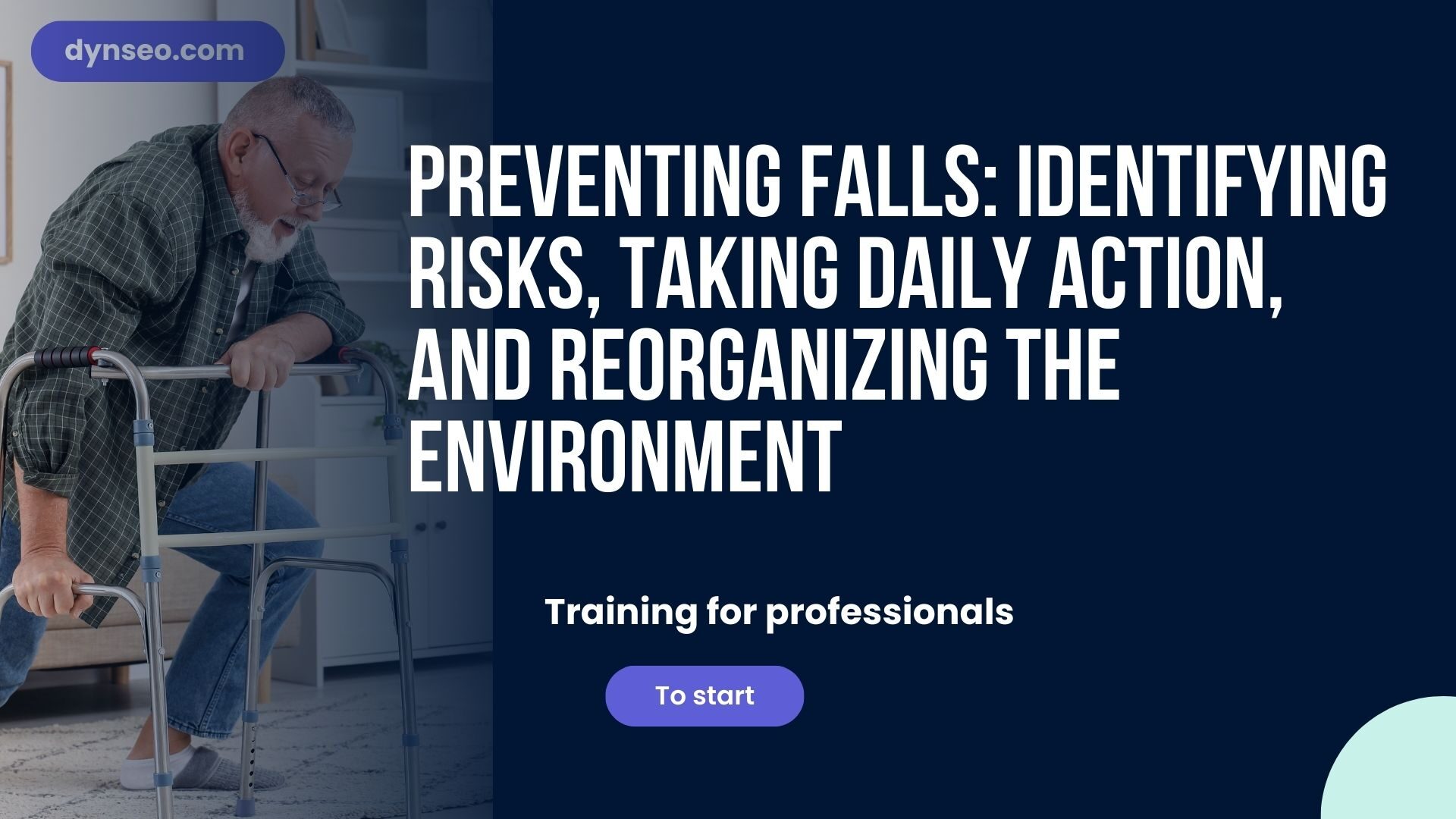
The training “Preventing falls: identifying risks, acting daily, and reorganizing the environment” addresses exactly these topics — 18 lessons, 100% online, unlimited access, at your own pace, with a certificate of completion. Certified organization Qualiopi No. 11757351875.
Discover the training — 150 €Multidisciplinary work: who does what
Around a person at risk of falling often revolve six to eight professionals who almost never cross paths. Effective prevention is not the sum of their goodwill: it is their coordination. The same person may receive contradictory instructions — “let her walk” on one side, “do not let her get up” on the other — simply because the information has not circulated. The meeting is the only moment when it truly circulates.
| Professional | What they specifically contribute to fall prevention |
|---|---|
| Caregiver, life assistant | What the person actually does daily, at what time, under what conditions ; the near-falls that no one else sees |
| Nurse | Clinical monitoring, effects of treatments, link with the doctor, follow-up after a fall |
| Doctor | Investigating causes, reviewing treatments that may promote falls, care-related decisions |
| Physiotherapist | Balance and strength work, what is being acquired, what is contraindicated |
| Occupational therapist | Environmental adjustments, technical aids, adaptation of transfers and housing |
| Psychologist, neuropsychologist | Fear of falling, post-fall syndrome, reading behaviors and anxiety |
| Facilitator | Activities that maintain mobility and balance with pleasure and without putting at risk |
| Manager | Arbitration, resources, consistency of instructions, protocols of the establishment |
Prepare three useful minutes in the meeting
The voices of field professionals are often the best informed and the least heard. A simple format changes this : it transforms a complaint into a decision.
- An observation, stated as a dated fact : « for the past two weeks, she gets up three times a night and loses her balance each time ».
- A hypothesis, presented as such : « it could be related to darkness or a need to go to the bathroom ».
- A specific question : « can we install a night light with a sensor and move the wardrobe chair closer? ».
- A proposal that you are ready to test : « I will try for two weeks and note the number of imbalances at night ».
A prevention instruction is only valuable if it is applied by the entire team, day and night, week and weekend, regulars and substitutes. One person who “does it their way” is enough to create an accident. That’s why a meeting decision must be documented in the same place that everyone consults, never communicated only verbally.
Communicate with families about the risk of falling
The relatives of a person at risk of falling often arrive with a mix of guilt and fear. A fall, especially the first one, awakens the anxiety of a serious accident and loss of autonomy. What they express in the form of reproach is very rarely directed at you : it is the expression of a concern that seeks a place to settle.
The three most frequent situations
Announcing a fall
We describe the facts, without dramatizing or minimizing : « your mother fell this afternoon in the hallway, she has no visible injuries, the nurse examined her and the doctor has been informed ». Then we direct them to the caregiver for medical follow-up.
Reframing a request to restrain
« I understand your concern. Restraint is not decided like that : it requires a medical evaluation and can increase the risk. I will pass your request to the manager and the doctor who will get back to you. »
The family that wants to prevent everything
Frequent and well-intentioned. We explain the concrete benefit: “when he continues to walk accompanied, he maintains his strength and balance. Preventing him from moving would paradoxically make him more fragile.”
“I understand that this is distressing, and I will tell you precisely what we are putting in place.” Acknowledging the emotion before responding to the substance helps to de-escalate most hallway situations. Then, we describe the concrete measures — clear passage, appropriate footwear, night light, night supervision — because a family reassured by concrete actions stops demanding the impossible. Never promise “no more falls”: no organization can guarantee this, and this promise backfires at the first relapse.
❌ To avoid: “Don't worry, everything is fine” — this phrase denies the emotion and shuts down dialogue. “We can't be behind every resident” — true but perceived as disengagement. “It's normal at his age” — trivializes a signal that may deserve evaluation. Always describe what we are doing, never what we cannot do.
Preventing professional burnout in this context
Care professions accumulate physical load, emotional load, and time constraints. Fall prevention adds a particular burden: vigilance never stops. We keep an eye on the unstable resident while helping another; we anticipate nighttime getting up; we carry, sometimes alone, the fear of being held responsible if “it happens during my shift.” This constant tension exhausts as much as physical effort.
The signals
Fatigue that does not yield to rest, apprehension before starting a shift, unusual irritability, sleep disturbances, persistent pain, feeling like one is doing their job poorly.
Emotional distancing
Finding oneself talking about residents as tasks, avoiding exchanges, rushing systematically. It’s a protective mechanism, and a signal not to be ignored.
What protects
Being able to talk about difficult situations as a team, having clear guidelines about one's role and responsibility, debriefing after a fall rather than experiencing it alone and in silence.
When to consult
If the signals last for several weeks, talk to occupational health or your doctor. It’s a professional act, not a confession of weakness.
One point deserves to be stated explicitly: a significant part of the fatigue in this profession does not come from the actions, but from uncertainty. Not knowing if an instability is serious, if one can let them walk, if one should have reported earlier, if one will be “covered” in case of a fall. Understanding the mechanisms of risk and knowing precisely one’s role alleviates this mental burden very concretely: we act with guidelines instead of improvising in anxiety.
A serious fall affects the team as much as the person. Taking ten minutes to discuss it collectively, without seeking a culprit but rather the causes, protects both the quality of care and the health of professionals. Keeping guilt to oneself is a major factor of burnout; shared analysis transforms the event into learning.
Preventing falls: professional training, framework, and funding
In most configurations, the ongoing training of professionals in the medico-social sector is both an employer's obligation and part of the quality approach of establishments. Regarding falls, regulatory authorities and evaluation frameworks increasingly expect a structured prevention approach: risk identification, protocols, traceability, and team competencies. Therefore, training is not an optional extra; it is an expected link.
In practical terms, three elements are required in almost all situations: a written program with explicit educational objectives, an identifiable and certified organization, and an individual proof of completion for each trained professional.
| Requested element | What DYNSEO training provides |
|---|---|
| Detailed program | Structured program in 18 lessons, with explicit educational objectives |
| Certified organization | Training organization certified Qualiopi — No. 11757351875 |
| Proof of completion | Certificate of completion, by learner |
| Traceability of follow-up | Tracking progress in the online training space |
| Organizational flexibility | 100 % online, unlimited access, at your own pace — without immobilizing the team |
Regarding funding, Qualiopi certification is the condition that allows an employer to consider coverage under the skills development plan or through their skills operator (OPCO). The rules, ceilings, and procedures vary according to statuses, branches, and funders, and nothing is automatic: have the program and quote validated by your HR department or funding organization before the purchase, never after. No amount of aid can be presented as certain until your funder has confirmed it in writing.
The training "Preventing falls: identifying risks, acting daily, and reorganizing the environment" is offered at 150 €, with unlimited access and 100% online. This fixed rate facilitates the establishment of a quote and dialogue with the HR service or the OPCO, without additional travel or session organization costs.
Beyond the training, DYNSEO offers cognitive tests and stimulation applications that extend the approach: the application CLINT, for example, maintains the cognitive functions of adults and integrates into activities that indirectly support vigilance and mobility. These tools do not replace on-the-ground prevention: they complement it.
Deploying training within the team and reinforcing the learning
The real risk of online training is not that it is poorly followed: it is that it is followed, appreciated, and then has no effect three weeks later. Therefore, deploying training within a team requires two things: a realistic logistical organization and anchoring mechanisms.
Organizing deployment without disrupting the service
- Identify the concerned individuals and a referent responsible for monitoring access and certificates.
- Distribute the 18 lessons over several weeks, taking advantage of the flexibility of the 100% online format at one's own pace rather than blocking an entire day.
- Track attendance and progress via the training space, to have traceability for quality evaluations.
- Collect training completion certificates and archive them in each professional's file.
- Plan a time for exchange to share what each person retains and adapt it to the establishment.
Anchoring learning in daily life
- A five-minute point in the meeting after each group of lessons: what do we keep, applied to whom, starting when.
- A concrete decision, written in the personalized project: the passage to clear, the night light to install, the footwear to review, the wake-up time to secure.
- A "fall prevention" referent to consult in case of doubt, rather than a diffuse knowledge that no one embodies.
- An adjustment sheet for each concerned person, so that the measures survive weekends and replacements.
- A point at three months with a single question: what has changed, how many near-falls avoided, what adjustments to make? This distinguishes a useful training from a training that is simply consumed.
To support this follow-up, the free resources from the DYNSEO tools catalog — tracking sheets and shared tables — make the decided measures visible and allow for measuring what evolves. This also feeds the debriefing in case of a fall and supports the quality approach of the establishment.
To go further
Background guidePreventing falls: the complete guide to understand what is at stake
Everyday situations10 difficult situations around falls and how to respond to them
ToolboxActivities, materials and concrete arrangements to implement
These in-depth studies complement the professional angle developed here. The catalog of free tools and the cognitive tests DYNSEO also offer resources that can be directly mobilized in teams, at no cost.
Frequently asked questions
What to say to a family who asks to "tie him up so he doesn't fall"?
We acknowledge the concern before addressing the issue: "I understand your fear." Then we reiterate the framework: restraint is not decided on a case-by-case basis by a caregiver, it is based on a medical evaluation, it is regulated and can even increase the risk and anxiety. We conclude with concrete actions: "Here is what we are putting in place — clear passage, night light, night monitoring — and I will pass your request to the supervisor and the doctor." We never promise total absence of falls, which no organization can guarantee.
Can I decide alone to prevent a person from getting up?
No. Restricting a person's freedom of movement is a decision that is regulated, made as a team and most often based on medical advice, never on individual initiative. Your role is to secure the environment, offer help, accompany and document: for example, noting that a person gets up without waiting for the help they have called for. If you believe that a protective measure is necessary, you bring it up in a meeting with observed facts. Acting alone creates legal and ethical risks, and often worsens the situation.
How to properly document a fall?
We describe a dated and located fact: time, place, what preceded it, the person's condition, environmental elements (floor, lighting, footwear, presence of technical aids). We note what has been done — protect, do not mobilize in case of doubt, alert the nurse or emergency services in your country — and explicitly report any new elements. We avoid judgments such as "reckless." This rigor allows the team to identify recurring causes and serves the quality approach as well as medical follow-up.
Is continuing education on fall prevention mandatory?
Obligations vary by country, status, and profession, but continuing education is almost everywhere both an employer obligation and the requirements of quality standards applicable to social and medical establishments. Fall prevention is a topic regularly expected during evaluations. What is practically required: a written program, an identifiable and Qualiopi certified organization, and individual proof of completion. Check with your HR department for the specific rules applicable in your organization.
How to finance this training for my team?
The Qualiopi certification (No. 11757351875) is the condition that allows an employer to consider coverage through the skills development plan or the skills operator (OPCO). The rules, ceilings, and procedures depend on your sector and your funder, and no aid is automatic. The right approach: have the program and quote (price of €150 per access) validated by your HR department or your OPCO before the purchase. Never present an amount of aid as guaranteed until it is confirmed in writing.
This article provides general professional guidelines. Training obligations, funding rules, and areas of responsibility vary by country, status, and employers: refer to your management, your HR service, and the protocols of your establishment. Any questions regarding diagnosis, prognosis, or treatment fall under the responsibility of the healthcare professional. This content does not constitute medical or legal advice.
Preventing falls: the professional training that equips the entire team
18 lessons, 100% online, unlimited access, to be distributed over available times without immobilizing the service. Certified organization Qualiopi No. 11757351875, training completion certificate for each professional. A clear framework, concrete guidelines, less uncertainty on a daily basis.
Discover the training — 150 €Did this content help you? Support DYNSEO 💙
We are a small team of 14 people based in Paris. For 13 years, we have been creating free content to help families, speech therapists, care homes and healthcare professionals.
Your feedback is the only way we know if our work is useful. A Google review helps us reach other families, caregivers and therapists who need it.
One action, 30 seconds: leave us a Google review ⭐⭐⭐⭐⭐. It costs nothing, and it changes everything for us.