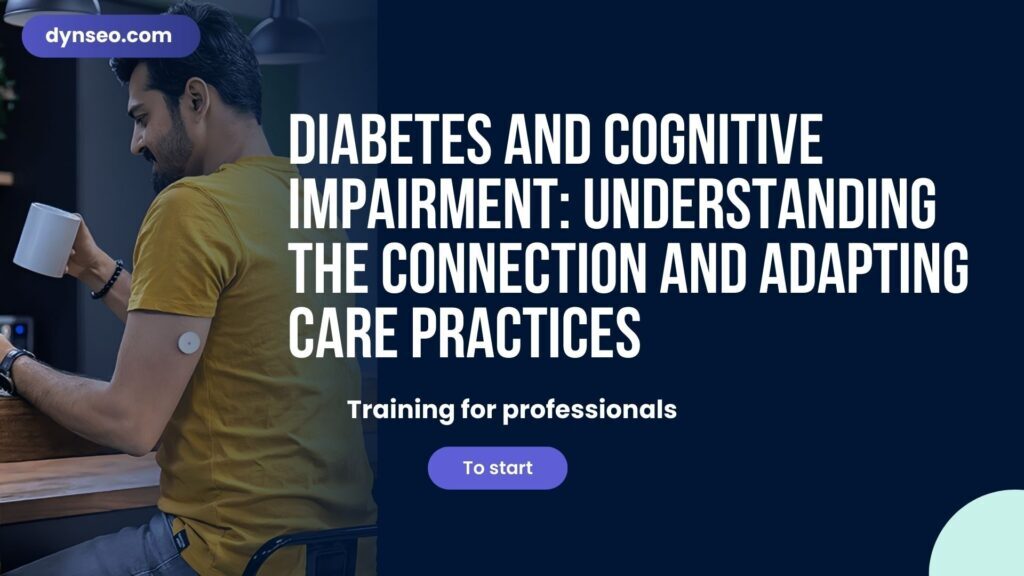
Training “Diabetes and cognitive disorders: understanding the link and adapting your professional practice”: program, content, and who it is for
This page describes in detail the diabetes and cognitive disorders training offered by DYNSEO: “Diabetes and cognitive disorders: understanding the link and adapting your professional practice”. You will find what it contains module by module, who it is really useful for, how much time it requires, what it costs, and — just as importantly — what it does not do. The idea is simple: to allow you to decide, before registering, if it fits your practice or your situation as a caregiver.
In this article
The associated training
The cited resources
 Communication notebook
Printable notebooks — EDITH Collection





The topic is more common than one might think. When diabetes and cognitive disorders occur together in the same elderly person, each exacerbates the other: failing memory complicates blood sugar monitoring, and sugar fluctuations muddle attention and mood. This training has been designed to untangle this cycle, with a common vocabulary and concrete actions, aimed at both caregivers in institutions and relatives who provide support at home.
The essentials in 30 seconds
The training “Diabetes and cognitive disorders: understanding the link and adapting your professional practice” is an online training of 8 modules and 32 lessons, designed by DYNSEO for support professionals and family caregivers. It costs 20 €, is taken at your own pace, and ends with a final assessment.
- For whom — nursing assistant, AES, ASG, nurse, activity leader, staff in a nursing home or at home, and family caregiver of a diabetic person with cognitive disorders. No prerequisites.
- What you will learn — understand the diabetes-brain link, monitor blood sugar in a disoriented person, adapt diet and hydration, prevent complications, manage complex situations, support families.
- Duration — a few hours in total, in short sequences to be divided.
- Access — immediate after purchase, unlimited over time, on computer, tablet, or phone.
- Organization — DYNSEO, Qualiopi certified training organization (No. 11757351875), certificate of completion issued.
Pourquoi se former au lien entre diabète et cognition ?
Le diabète de type 2 est l'une des maladies chroniques les plus répandues chez la personne âgée, et son suivi devient particulièrement délicat lorsque s'y ajoutent des troubles de la mémoire ou de l'orientation. Les grandes institutions de santé — l'Organisation mondiale de la santé, la Fédération internationale du diabète, Santé publique France — décrivent toutes une progression du diabète avec l'âge et une prévalence importante en établissement. Sans donner de chiffre précis ici, retenez l'essentiel : dans un EHPAD ou à domicile, accompagner une personne à la fois diabétique et cognitivement fragile n'est pas l'exception, c'est le quotidien.
Or les deux problèmes s'entretiennent. Une hypoglycémie peut se manifester par de la confusion, de l'agitation ou une somnolence — des signes qu'on attribue trop vite au trouble cognitif, alors qu'il s'agit d'une urgence métabolique. À l'inverse, une personne qui oublie qu'elle a mangé, qui refuse un repas ou qui ne sait plus dire qu'elle a soif expose sa glycémie à des variations brutales. C'est ce que la formation appelle le cercle vicieux diabète-cognition, et c'est précisément là que se joue la qualité de l'accompagnement.
Un besoin de repères fiables, pas de discours théorique
Sur le terrain, la difficulté n'est jamais de savoir ce qu'est le diabète dans l'absolu. Elle est de savoir quoi faire quand madame D. repousse son assiette pour la troisième fois, quand monsieur L. transpire et devient incohérent en fin de matinée, ou quand une famille reproche à l'équipe de « laisser manger du sucre ». Ces situations demandent des réflexes, une capacité d'observation et un langage partagé avec l'infirmière, le médecin coordonnateur et la famille. C'est cet espace que la formation vient combler : elle ne remplace aucun professionnel de santé, mais elle donne à chacun les repères pour observer juste, signaler au bon moment et appliquer les consignes sans se tromper.
Devant des signes évoquant une hypoglycémie sévère — sueurs, tremblements, confusion brutale, perte de connaissance, convulsions — on ne temporise pas : on applique le protocole de l'établissement, on alerte l'infirmier ou le médecin, et en l'absence de réponse rapide on contacte les services d'urgence de votre pays. Une confusion nouvelle chez une personne diabétique doit toujours faire penser à la glycémie avant d'être mise sur le compte des troubles cognitifs. Le diagnostic et la conduite à tenir relèvent du professionnel de santé.
À qui s'adresse cette formation ?
Le titre le dit : il s'agit d'adapter sa pratique professionnelle. La formation vise donc en priorité les personnes qui accompagnent, au quotidien, des personnes âgées diabétiques présentant des troubles cognitifs. Mais son vocabulaire reste accessible, et plusieurs modules — notamment celui consacré aux familles — parlent aussi directement aux proches aidants. Trois profils s'y retrouvent particulièrement.
Le professionnel de l'accompagnement
Aide-soignant, AES, assistant de soins en gérontologie, agent de service, animateur en EHPAD ou en résidence. Il applique des consignes, observe, transmet, et a besoin de comprendre ce qu'il surveille.
L'intervenant à domicile
Auxiliaire de vie, aide à domicile, infirmier libéral qui passe plusieurs fois par jour. Il est souvent seul face à un refus alimentaire ou à un malaise, et cherche des repères clairs pour réagir.
Le proche aidant
Conjoint, enfant, frère ou sœur qui gère les repas, les rendez-vous et l'inquiétude. Il veut comprendre pourquoi la surveillance se complique et comment aider sans se substituer aux soignants.
Faite pour vous / pas faite pour vous
| Votre situation | Cette formation… |
|---|---|
| Vous accompagnez en établissement des résidents diabétiques et désorientés | ✔ Convient parfaitement |
| Vous intervenez à domicile et gérez seul les repas et la surveillance | ✔ Convient — les modules 2, 3 et 4 sont au cœur du sujet |
| Vous êtes un proche et voulez comprendre ce que fait l'équipe soignante | ✔ Convient — le module 7 vous est en partie consacré |
| Vous cherchez à poser vous-même un diagnostic ou à adapter un traitement | ✘ Non — cela relève exclusivement du médecin |
| Vous voulez un protocole de dosage d'insuline personnalisé | ✘ Non — la prescription appartient au professionnel de santé |
| Vous voulez un diplôme d'État reconnu | ✘ Non — il s'agit d'une attestation de fin de formation, pas d'un diplôme |
Le programme détaillé de la formation diabète et troubles cognitifs, module par module
La formation diabète et troubles cognitifs compte 8 modules et 32 leçons, chacune volontairement courte : on avance leçon par leçon, avec le temps d'assimiler entre deux. Voici le contenu réel, tel qu'il est structuré dans la plateforme, décrit bloc par bloc.
Comprendre le diabète et ses effets sur le cerveau
- Le diabète de type 2 — mécanismes et épidémiologie — les bases indispensables : ce qu'est l'insulinorésistance, comment évolue la maladie, et pourquoi elle est si fréquente chez la personne âgée.
- Le lien diabète-cerveau — mécanismes scientifiques — comment le déséquilibre glycémique retentit sur le cerveau et la mémoire, expliqué simplement.
- Les troubles cognitifs spécifiques liés au diabète — attention, mémoire, vitesse de traitement : ce qui peut être touché.
- Le cercle vicieux diabète-cognition — comment chaque trouble aggrave l'autre, et pourquoi il faut agir sur les deux fronts à la fois.
Surveillance glycémique et soins adaptés
- Comprendre la surveillance glycémique en établissement — à quoi sert la mesure, comment la lire, ce que le professionnel observe et transmet.
- Reconnaître et gérer l'hypoglycémie — les signes, y compris ceux qu'on confond avec la confusion, et la conduite à tenir selon les consignes de l'établissement.
- Reconnaître et gérer l'hyperglycémie — les manifestations à repérer et les situations qui doivent alerter.
- Les traitements du diabète — ce que le professionnel doit savoir — un panorama des grands types de traitements pour mieux comprendre ce qui est prescrit, sans jamais s'y substituer.
Alimentation, hydratation et diabète en établissement
- Les principes de l'alimentation diabétique chez la personne âgée — équilibre, plaisir et sécurité, sans tomber dans la restriction excessive.
- Les troubles cognitifs et l'alimentation — les défis pratiques — refus, oubli des repas, grignotage : comment observer et adapter.
- L'hydratation — un enjeu majeur souvent négligé — pourquoi la déshydratation est un risque particulier ici, et comment y veiller.
- Soins de pieds et prévention des complications — l'importance de l'observation quotidienne des pieds et de l'alerte précoce.
Adapter l'accompagnement aux troubles cognitifs
- Adapter la gestion du diabète aux troubles cognitifs — comment ajuster les gestes de surveillance quand la personne ne comprend plus ou n'anticipe plus.
- Stimulation cognitive et diabète — comment entretenir les fonctions cognitives sans épuiser, en lien avec le quotidien.
- Gérer les comportements liés aux variations glycémiques — décrypter agitation, apathie ou irritabilité à la lumière de la glycémie.
- Les hypoglycémies nocturnes — vigilance spécifique — un risque discret, ce qu'il faut surveiller et signaler.
Prevention of complications and coordination
- Prevent cardiovascular complications — the points of vigilance and everyone's role in prevention.
- Prevent and monitor diabetic neuropathy — identify signs of nerve damage and alert in time.
- Prevention of infections in establishments — hygiene and observation as the first barriers.
- Transmit and coordinate effectively — written and oral transmission, key to safe team support.
Complex situations and special cases
- Diabetes and end of life — adapting palliative care — how prioritizing comfort modifies support, within the framework defined by the medical team.
- Diabetes, fasting, and special situations — the vigilance during fasts, examinations, or events that disrupt the rhythm.
- Diabetes and depression in establishments — a frequent link, to be identified and reported.
- Complex clinical cases — analysis and decision — learning to reason in the face of cumulative situations.
Supporting families
- What families experience facing diabetes AND cognitive disorders — the double concern, guilt, the need to be heard.
- Training and informing families — how to explain without worrying and involve relatives.
- Managing conflicts around food — one of the most sensitive topics, defused methodically.
- Supporting family caregivers at home — guiding, reassuring, and providing the right resources.
Practical cases and consolidation
- Emergency glycemic protocols — understanding the logic of protocols to act quickly and effectively, within your professional framework.
- Role-playing and situational exercises — practicing realistic scenarios to anchor reflexes.
- Building an individualized diabetes-cognition care plan — linking everything above into a coherent management approach.
- Final evaluation and resources — validating knowledge and leaving with reusable materials.
Do not watch everything at once. Follow one module per week, and test one thing in between: a finer observation of hypoglycemia signs, a better-formulated transmission, a different way of approaching a meal refusal. It is the repetition in practice that changes support, not the quantity of information consumed.
Do you want to see the details of the 32 lessons ?
The complete program is available online, and the training is accessible immediately after registration — enough to transform situations that challenge you into reliable reflexes.
Access the trainingThe format and organization
Everything is designed for a person who does not have a guaranteed time slot in their week. No imposed schedule, no virtual class, no deadline: you can open the training between shifts, in the evening, or during a quiet time. The short lessons are perfectly suited for this snacking of availability, without ever having to start over from the beginning.
| Criterion | Detail |
|---|---|
| Format | 100% online, short lessons |
| Content | 8 modules · 32 lessons · final evaluation |
| Estimated duration | Several hours, to be divided freely |
| Rhythm | Free, with no imposed end date |
| Support | Computer, tablet, smartphone |
| Access | Immediate after registration, unlimited |
| Required level | All levels, no prerequisites |
| Validation | Final evaluation + certificate of completion |
The important point for a professional as well as for a caregiver: access remains open. You can return to the lesson dedicated to nighttime hypoglycemia on the day a resident presents unusual drowsiness upon waking, months after completing the course. It is often at this moment that the content makes perfect sense and becomes reflexive.
What you will be able to do by the end
Not just theoretical knowledge: actions and reflexes. Here is what you should be able to do concretely once the course is completed. Each time, the logic remains the same: observe, report, apply the instructions, and refer to the healthcare professional for anything related to diagnosis or prescription.
Identify hypoglycemia
Recognize the signs, including those confused with confusion, and trigger the appropriate response according to your facility's protocol.
Decode behaviors
Differentiate between what relates to cognitive disorder and what comes from a variation in blood sugar — and stop interpreting every reaction as a whim.
Adapt meals
Support a food refusal, ensure hydration, and balance blood sugar levels with the pleasure of eating.
Prevent complications
Observe the feet, skin, and signs of infection daily, and alert the nurse or doctor early.
Communicate accurately
Formulate a clear and useful transmission, oral or written, so that information flows and care remains safe.
Support families
Listen, explain without causing worry, defuse conflicts around food, and guide to the right resources.
❌ To avoid: immediately attributing new confusion or agitation to cognitive disorder without considering blood sugar, modifying a treatment or dietary instruction on your own initiative, or minimizing a sign "because it will pass." When in doubt, observe, note, and report to the healthcare professional.
Qualiopi and certification: what it changes for you
DYNSEO is a Qualiopi certified training organization, registered under the activity declaration number 11757351875. This certification focuses on the quality of the training process: clarity of objectives, adaptation to audiences, qualification of trainers, collection of feedback, and continuous improvement. It does not judge the content lesson by lesson, but the seriousness of the pedagogical approach as a whole.
In practical terms: this means that the content is not improvised, it is revised, and the educational objectives are written before being produced. At the end of the course, you receive a certificate of completion in your name. It certifies your participation — it is neither a state diploma nor a regulated professional qualification, and it is important to state this clearly to avoid any misunderstanding.
The Qualiopi certification allows an employer to consider coverage under the skills development plan. The conditions depend on your skills operator and your internal organization: they should be verified on a case-by-case basis with your human resources department before purchase.
Pricing and registration
The training is offered at 20 €. This is a deliberately accessible price: the goal is for a professional or a relative to be able to train without budgetary constraints, at a time when concrete answers are being sought. Payment is made once, and access remains open afterwards, without a subscription.
- Open the training page and add it to your cart.
- Create your learner account (or log in if you already have one) and confirm the payment.
- You are registered: the training appears in your space and the first lesson starts immediately.
No entry date, no session to wait for. If you register after a night shift because it's the only available time, you start right away. You will then find the course in your learner space, picking up exactly where you left off.
What this training is not
Let's be frank, this avoids disappointments and misunderstandings.
- This is not medical advice. No lesson replaces the attending physician, the coordinating physician, the diabetologist, or the nurse. Diagnosis, prognosis, and prescriptions belong to them.
- This is not a dosing protocol. The training explains the logic of treatments and emergency protocols for better understanding; it does not provide doses to apply yourself.
- This is not individual support. There is no personalized follow-up included: this is a course you follow alone, at your own pace.
- This is not a diploma. The certificate confirms participation, not a regulated professional qualification.
- This is not exhaustive from a medical standpoint. The short format prioritizes what is actionable on a daily basis, not scientific exhaustiveness.
The tools and applications that complement it
The training relies on several DYNSEO resources that can be used immediately, without additional purchase. The following tools are free, printable, and downloadable from the tools catalog:
- Session tracking sheet — to note what has been observed and what has fatigued the person.
- Skills tracking table — to visualize what is progressing, week after week.
- Progress tracking table (visual) — to objectify advances that may be invisible day to day.
- Communication notebook — to share your observations between the team and family without forgetting anything.
On the digital side, the cognitive stimulation mentioned in module 4 relies on DYNSEO applications. For an elderly person, especially in the case of Alzheimer's disease or related conditions, SCARLETT offers an interface designed for seniors, with memory, attention, and logic games that are suitable. For a more autonomous adult audience, the CLINT application offers a wide range of games and a tracking of results. You can also check in with the online cognitive tests, and discover all the courses on the our training page.
To go further on diabetes and cognitive disorders
This article presents the training. Four other articles delve into different angles:
Everyday situationsDiabetes and cognitive disorders: 10 difficult situations and how to respond
ToolboxActivities, materials, and concrete adjustments to implement
Support & contactsWho to contact, what support is available, and how to sustain it over time
The complete catalogue of DYNSEO training also offers courses related to old age, neurodegenerative diseases, and support for caregivers.
Frequently Asked Questions
How long does the diabetes and cognitive disorders training last ?
Count a few hours in total for the 8 modules, the 32 lessons, and the final assessment. The lessons being short, most learners spread the course over one to three weeks, tackling one module at a time. There is no obligation to a specific pace : access remains open after the course ends, and you can revisit any lesson when a concrete situation requires it. In fact, it is often by going back to a specific point, when it becomes useful, that the content truly anchors in practice.
Do I need medical knowledge to follow it ?
No, none. The training is classified as “all levels” and is aimed at both support professionals and family caregivers. Medical vocabulary is explained as you go : you do not need to know what insulin resistance or neuropathy is before starting, that is precisely one of the objectives of the first lessons. The spirit of the course is not to make you an expert caregiver, but to give you reliable benchmarks to observe, understand, and communicate with the right person.
Will I receive a certificate at the end ?
Yes. After the final assessment, a certificate of completion in your name is issued by DYNSEO, a Qualiopi certified organization (N° 11757351875). This certificate attests to your participation in the course and can be attached to your professional file or your continuing education portfolio. However, it does not constitute a state diploma or a regulated professional qualification : it is a training certificate, not a title. It remains accessible in your learner space once obtained.
Can this training be financially covered ?
For an individual supporting a relative, the training is purchased directly for €20. For an employee of an establishment, DYNSEO's Qualiopi certification allows the employer to consider financial coverage as part of the skills development plan. The conditions depend on the skills operator and the training policy of the organization ; they must be verified with the human resources department before purchase. No amount of coverage can be guaranteed in advance : inquire internally.
Does this training replace the advice of a doctor or nurse ?
No, in no case, and that is not its purpose. The training helps you to better observe, better understand what you see, and better communicate information. Diagnosis, treatment adaptation, and care decisions are exclusively the responsibility of health professionals : attending physician, coordinating physician, diabetologist, nurse. In case of doubt or concerning signs, the correct course of action is always the same : follow your organization's guidelines, alert the competent caregiver, and contact your country's emergency services if the situation warrants it.
This training is a tool for skill enhancement and awareness. It never substitutes for individualized medical advice. The information it contains aims to improve observation, vigilance, and coordination around the diabetic person with cognitive disorders ; any decision regarding diagnosis, treatment, or emergency conduct belongs to health professionals. In case of emergency, contact your country's emergency services.
Transform the link between diabetes and cognition into safe reflexes
With DYNSEO's diabetes and cognitive disorders training — 8 modules, 32 short lessons, unlimited access — you move from “ I don’t know how to react ” to a clear way of observing, adapting, and transmitting, starting this week.
Discover the training — 20 €Did this content help you? Support DYNSEO 💙
We are a small team of 14 people based in Paris. For 13 years, we have been creating free content to help families, speech therapists, care homes and healthcare professionals.
Your feedback is the only way we know if our work is useful. A Google review helps us reach other families, caregivers and therapists who need it.
One action, 30 seconds: leave us a Google review ⭐⭐⭐⭐⭐. It costs nothing, and it changes everything for us.