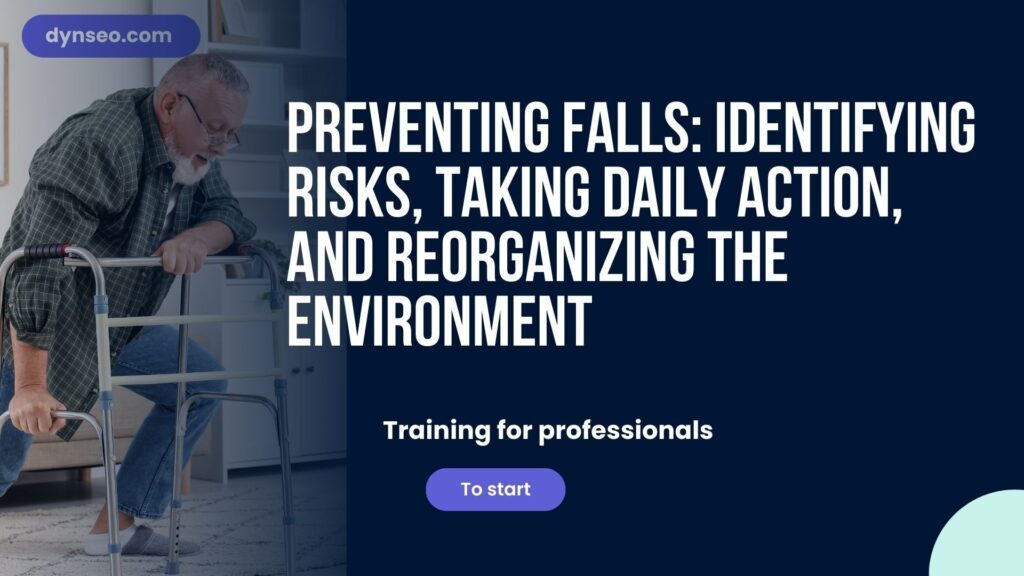
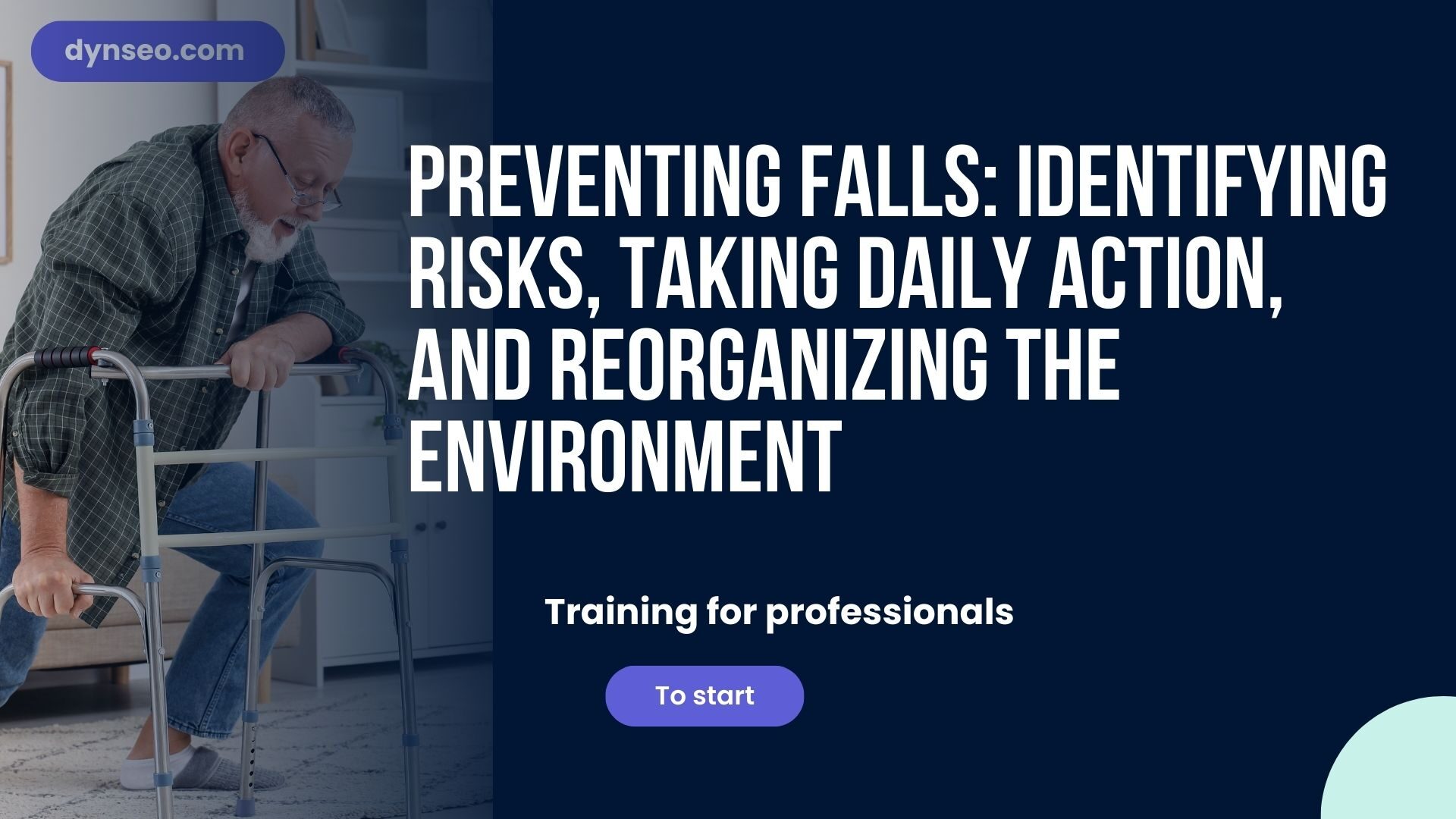
Understanding Falls in the Elderly: Causes, Consequences and Initial Guidelines

Dans cet article
La formation associée
📋 Summary
- The Fall: A Common Event? No — A Serious Signal
- The Numbers That Make You Think
- Why the Body Ages and Falls More Easily
- Internal Risk Factors
- External Risk Factors
- What a Fall Really Changes
- Post-Fall Syndrome: The Fear That Immobilizes
- Falls and Dementia: An Amplified Risk
- What Families See — and What They Can Do
- Prevention is Possible: The Levers of Action
An elderly person who falls. The scene seems almost ordinary — so much so that we hear about it often, and statistics normalize it. And yet, behind this apparent banality lies a serious medical reality, a cascade of physical and psychological consequences, and above all — this is what matters most — an event that is largely predictable and often preventable.
This first article in our series on fall prevention lays the groundwork. Not to scare, but to understand. Because we can only prevent what we understand well. And because caregivers and families, together, have more levers than they often think.
1. The Fall: A Common Event? No — A Serious Signal
“He fell again” — this phrase, spoken with a resignation that sometimes borders on fatalism, reveals a deep misunderstanding of what falls are in the elderly. A fall is not an unpredictable accident that “happens.” It is a sentinel event — the visible sign of a fragile balance, of a risk that existed before the fall and will exist after if nothing is done.
Treating a fall as an isolated incident — treating the injury, getting the person back on their feet, moving on — amounts to ignoring what it says. It says that something, in the person or in their environment, created the conditions for this fall. And that if these conditions do not change, another fall will occur.
Fall prevention begins with this change of perspective — moving from “he fell, that’s unfortunate” to “he fell, what does that tell us, and what do we do now?”
2. The Numbers That Make You Think
In nursing homes, the fall rate is even higher — averaging 1.5 to 2 falls per resident per year, with significant disparities depending on the facilities and the profiles of the residents. Hip fractures, directly related to falls, are one of the main causes of hospitalization and sudden loss of autonomy in elderly people.
These numbers are not there to alarm — they are there to remind us of the real stakes of prevention. Every fall avoided is potentially a hospitalization avoided, a fracture avoided, a loss of autonomy avoided, and an installed fear — that fear that prevents walking, going out, living — avoided.
3. Why the Body Ages and Falls More Easily
Understanding why elderly people fall more frequently than younger ones requires understanding what aging does to the body — not as a catastrophe, but as a normal process that gradually alters the mechanics of balance and walking.
Human balance is a complex performance that relies on three systems that constantly work together: the vestibular system (the inner ear, which detects movements and orientation), the proprioceptive system (muscle and joint sensors that inform the brain about the body's position in space), and the visual system (which complements the information from the other two). With age, each of these three systems gradually deteriorates — and their coordination, ensured by the brain, can also be affected by normal or pathological brain aging.
In addition, there is the loss of muscle mass (sarcopenia), reduced joint flexibility, slowed reaction times, and changes in the center of gravity related to postural changes. The result is a person who walks with a more unstable support, who reacts less quickly to balance disturbances, and who has fewer muscle resources to recover from a loss of balance before falling.
4. Internal Risk Factors
💊 Medications
Some medications significantly increase the risk of falling — benzodiazepines, antihypertensives, diuretics, antidepressants, antipsychotics. Polypharmacy (4 medications or more) is itself an independent risk factor.
🦵 Muscle Weakness
Age-related sarcopenia, exacerbated by sedentary behavior, prolonged immobilization, or malnutrition, reduces the body's ability to maintain balance and react quickly to imbalances.
👁️ Sensory Disorders
Decreased visual acuity, cataracts, glaucoma, vestibular disorders — all impair the perception of the environment and the ability to anticipate obstacles or irregularities in the ground.
🧠 Cognitive Disorders
Dementia impairs distance judgment, risk awareness, the ability to anticipate obstacles, and movement coordination. Residents with dementia fall 2 to 3 times more frequently than others.
🩸 Cardiovascular Pathologies
Orthostatic hypotension (drop in blood pressure upon standing), heart rhythm disorders, fainting — these cardiovascular events account for a significant number of falls, often confused with mechanical falls.
🦴 Pain and Osteo-Articular Pathologies
Osteoarthritis, joint pain, and sequelae from previous fractures alter walking and balance. A person compensating for pain by limping adopts a posture that increases their risk of falling.
5. External Risk Factors
If internal factors explain the increased vulnerability of the elderly, external factors create the opportunities to fall. And these factors are often the easiest to modify.
✦ Main Environmental Fall Factors
- The Floor: slippery or uneven surfaces, poorly secured rugs, high door thresholds, cluttered pathways
- Lighting: insufficient light, absence of night lights, glare — particularly dangerous during nighttime rising
- Inappropriate Furniture: chairs without armrests, beds at inappropriate heights, absence of grab bars in bathrooms
- Footwear: shoes with smooth soles, overly large slippers, socks without grip on smooth floors
- Inadequate Technical Aids: cane that is too short or too long, poorly adjusted walker, wheelchair without tight brakes
- Haste: getting up too quickly, answering a phone call while moving quickly, not taking the time to use available aids
6. What a Fall Really Changes
The consequences of a fall in an elderly person go far beyond the immediate physical injury — even when it is severe. They unfold on several levels, often in a cascade, and can profoundly transform a person's life trajectory.
On the physical level, a fall can lead to a fracture (hip, wrist, vertebra), a wound, a bruise, or — in cases where the person has been on the ground for a long time — serious complications such as rhabdomyolysis, hypothermia, or dehydration. The hip fracture is particularly feared: it requires surgery, hospitalization, long rehabilitation, and is associated with significant mortality in the 12 months following in very elderly and fragile individuals.
On the functional level, a fall — even without a fracture — can lead to significant loss of autonomy. Immobilization due to pain or fear, loss of confidence in mobility abilities, and rapid physical deconditioning in the elderly can turn a “benign” fall into a tipping point towards increased dependence.
7. Post-Fall Syndrome: The Fear That Immobilizes
Post-fall syndrome is one of the least visible and most serious consequences of falls in the elderly. It refers to the set of manifestations — physical, psychological, and behavioral — that follow a fall and can persist long after the physical injury has healed.
At the heart of this syndrome: the fear of falling again. A fear that can become so overwhelming that it leads the person to drastically reduce their movements, to avoid getting up alone, to refuse activities they once enjoyed, to gradually retreat into an increasingly confined space. This voluntary confinement has paradoxical consequences: by moving less, the person loses muscle strength and balance — which actually increases their risk of falling again.
This very common observation perfectly describes post-fall syndrome. The person has not “become lazy” or “too dependent” — they are afraid, and their fear is legitimate given what they have experienced.
Recognize and name post-fall syndrome. Reassure without minimizing the fear. Offer gradual rehabilitation with the physiotherapist. Work on confidence alongside physical abilities. Involve the family in the gradual resumption of activities.
8. Falls and Dementia: An Amplified Risk
Residents with dementia have a fall risk 2 to 3 times higher than residents without cognitive disorders. Several mechanisms accumulate: impaired judgment and risk awareness, gait disorders related to brain injuries, use of psychotropic medications, agitation and nighttime wandering, and inability to use or remember how to use technical aids.
Fall prevention in individuals with dementia requires a specific approach — which cannot rely on verbal instructions that the person will not integrate, but on securing the environment, appropriate monitoring, and a caregiving presence that anticipates risky situations.
9. What Families See — and What They Can Do
Families are valuable observers — they know their loved one, their habits, their new difficulties, the changes that have occurred since the last visit. What they observe has real clinical value, and their communication to the care team is often the first link in effective prevention.
Signals Families Can Report to the Team: a changed gait (slower, more hesitant, shorter steps), difficulties getting up or transitioning from sitting to standing, complaints of dizziness or lightheadedness, a reported decrease in vision from the loved one, a tendency to lean more on walls or furniture, an increase in sedentary behavior compared to previous visits, inappropriate shoes or slippers.
10. Prevention is Possible: The Levers of Action
Fall prevention is not a marginal discipline or reserved for specialists. It is accessible to the entire care team and families — provided they have the right guidelines. The following articles in this series detail each of these levers: risk assessment, environmental adjustments, balance and strengthening exercises, medication review, adaptation of technical aids, and team training.
What unites all these levers is a simple conviction: a fall is not an inevitability of aging. It is a risk, like others, that can be identified, assessed, and reduced. And every fall avoided is a person who remains standing, mobile, autonomous — and free to continue living as they wish.
🎓 Train Your Team in Fall Prevention
The DYNSEO training “Preventing Falls” equips the entire team with the tools to identify risks, act daily, and restructure the environment. Qualiopi certified, possible OPCO funding.
Did this content help you? Support DYNSEO 💙
We are a small team of 14 people based in Paris. For 13 years, we have been creating free content to help families, speech therapists, care homes and healthcare professionals.
Your feedback is the only way we know if our work is useful. A Google review helps us reach other families, caregivers and therapists who need it.
One action, 30 seconds: leave us a Google review ⭐⭐⭐⭐⭐. It costs nothing, and it changes everything for us.