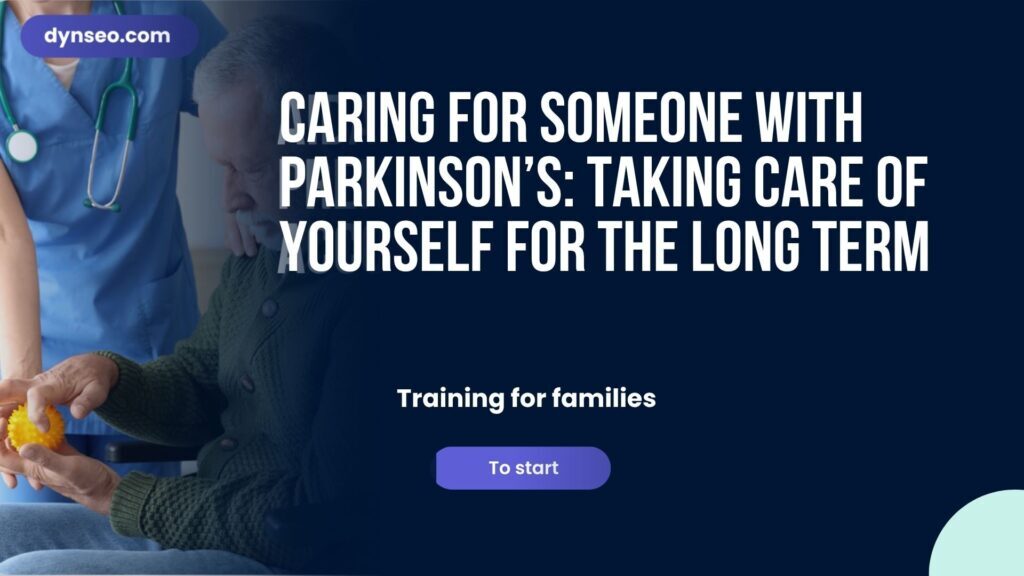
Caregiver and Parkinson's:
everything to understand to support over time
Understanding Parkinson's disease, adapting daily life, preserving your own health as a caregiver — the complete guide for relatives and professionals who support a person with Parkinson's
Dans cet article
La formation associée
Les ressources citées
 Thermomètre des émotions
 Décodeur d'Expressions Faciales
Parkinson's disease is a trial that affects not only the diagnosed person — it profoundly transforms the lives of all their relatives. The caregiver of a person with Parkinson's experiences a unique support role: a progressive disease over the years, symptoms that change and intensify gradually, an emotional relationship that reinvents itself over time. To endure over time — months, years, sometimes decades — it is not enough to love: one must also understand, adapt, and take care of oneself as much as of the other. This guide is made for you.
1. Understanding Parkinson's disease: what every caregiver should know
Before knowing how to support, one must understand. Parkinson's disease is often reduced to its most visible symptoms — tremors — while it is actually a complex neurological disease, with multiple facets, that evolves differently from one person to another. This understanding is the basis of informed support.
1.1 What is Parkinson's disease?
Parkinson's disease is a chronic and progressive neurodegenerative disease, caused by the progressive destruction of dopamine-producing neurons in a brain region called the substantia nigra. Dopamine is a neurotransmitter essential for controlling movements — its scarcity leads to the characteristic motor disorders of the disease.
🧬 An important point to remember
Parkinson's disease affects not only motor functions. It also impacts the autonomic nervous system (digestion, blood pressure, sleep), cognitive functions, mood, and behavior. Understanding this multidimensional reality is essential to anticipate the needs of your loved one and not be caught off guard by unexpected symptoms.
1.2 Motor symptoms: recognize and anticipate
Resting tremors
Tremors that occur at rest and decrease during voluntary movement. Often the first symptom identified, but not systematically present in all Parkinson's patients.
Akinetic and bradykinetic
Difficulty initiating movements (akinesia) and slowness of movements (bradykinesia). Results in shuffling gait, difficulty getting up, and increasingly smaller handwriting (micrography).
Muscle rigidity
Stiffness of muscles that resist passive movements. Responsible for pain, hunched posture, and contributes to difficulties in movement and turning in bed.
Balance and posture disorders
Postural instability, increased risk of falls. "Freezing" (sudden gait blockages) is particularly dangerous and can occur in specific situations (doorway passage, turning around).
1.3 Non-motor symptoms: the hidden side of Parkinson's
Non-motor symptoms are often underestimated even though they have a major impact on the patient's quality of life and the caregiver's burden. They can precede motor symptoms by several years.
| Category | Frequent Symptoms | Impact on the Caregiver |
|---|---|---|
| Cognitive | Slowed thinking, attention difficulties, memory disorders, risk of Parkinsonian dementia | High mental load |
| Psychiatric | Depression (very common), anxiety, apathy, hallucinations (especially under treatment) | Emotionally challenging |
| Sleep | Insomnia, daytime drowsiness, behavioral disorders of REM sleep (nocturnal agitation) | Caregiver fatigue |
| Autonomous | Orthostatic hypotension, constipation, urinary disorders, hypersalivation, excessive sweating | Complex intimate care |
| Communication | Weak voice (hypophonia), rapid or monotone speech, difficulties swallowing (dysphagia) | Relational adaptations |
| Pain | Muscle pain, cramps, burning sensations — often underdiagnosed | Vigilance and reporting |
1.4 The progression of the disease: understanding the stages
Parkinson's disease progresses at a variable rate from person to person. The Hoehn and Yahr scale distinguishes five stages, from stage 1 (mild unilateral symptoms, preserved autonomy) to stage 5 (total dependence). However, this progression is not linear — it is marked by fluctuations related to treatments, "good periods," and periods of freezing. Your support must constantly adapt to this changing reality.
2. Daily life with a person with Parkinson's: adapting every gesture
Daily support for a person with Parkinson's requires constant adaptation of practices, environment, and attitudes. It is not just a matter of good will — it is a skill that is learned and refined over time.
2.1 Motor fluctuations: understanding the "on" and "off"
One of the most confusing phenomena for caregivers is motor fluctuation: periods when your loved one functions relatively well (the "on" period) alternate with periods when symptoms are significantly worsened (the "off" period). These fluctuations are related to variations in the effectiveness of dopaminergic treatment throughout the day.
Practical advice: Learn to identify the "peak" hours of effectiveness of your loved one's treatment and plan the most demanding activities (personal care, meals, outings, medical appointments) during these times. A fluctuation diary, shared with the medical team, helps optimize treatment.
2.2 Supporting mobility and preventing falls
Securing the home environment
Remove rugs and obstacles, install grab bars in strategic locations (bathroom, toilet, hallway), ensure sufficient lighting at night, choose shoes with non-slip soles and easy closures. A visit from an occupational therapist can be valuable for a complete home audit.
Managing freezing episodes
During a freezing episode, stay calm — rushing worsens the situation. Simple techniques can help: ask your loved one to walk to the rhythm of music, to step over an imaginary visual obstacle, to lift their knee high. Never pull on the arm of a person who is freezing.
Accompany without overprotecting
The caregiver's reflex is often to intervene at the slightest risk. But helping too much deprives your loved one of natural exercises that maintain their motor skills. The goal is to ensure safety without taking over what your loved one can still do alone — even slowly.
Protocol in case of a fall
If your loved one falls, do not rush to lift them up. First, ensure they are not injured. Then help them to get up methodically — first rolling to the side, then on all fours, and then by leaning on a sturdy piece of furniture. Report any fall to the medical team, even without apparent injury.
2.3 Meals and swallowing
Swallowing disorders (dysphagia) and food handling issues are common in advanced Parkinson's. They pose a real risk of aspiration and aspiration pneumonia — one of the main causes of serious complications. Adapting meals is an essential aspect of support.
- Adapt the texture of foods according to the speech therapist's recommendations — pureed, chopped, ground as needed
- Position your loved one correctly during meals: sitting upright, head slightly tilted forward (never backward)
- Take your time — calm meals, without rushing, with small bites
- Watch for signs of aspiration: coughing during or after meals, "wet" voice, repeated swallowing
- Adapt drinks if necessary — thickeners recommended by the speech therapist to facilitate liquid swallowing
- Consult a dietitian if your loved one shows weight loss — common in Parkinson's
DYNSEO session tracking sheet
Tracking daily observations — motor fluctuations, freezing episodes, meal quality, incidents — is valuable for the medical team and for yourself. The DYNSEO session tracking sheet helps you structure these observations and share them effectively during consultations.
Download the tracking sheet3. The cognitive and emotional dimension of Parkinson's
Parkinson's disease is not a "merely physical" illness. Its effects on cognition, mood, and behavior are often at the heart of the difficulties experienced by caregivers — sometimes more than the motor symptoms themselves.
3.1 Cognitive disorders in Parkinson's
Between 25 and 40% of people with Parkinson's develop moderate cognitive disorders, and about 80% present parkinsonian dementia after 20 years of disease progression. These disorders differ from those of Alzheimer's disease — they more affect executive functions, processing speed, and attention than episodic memory initially.
Executive functions and planning
Difficulties in planning, organizing, transitioning from one task to another. Your loved one may seem "stuck" or unable to start a familiar activity — this is neither unwillingness nor laziness.
Cognitive slowdown
The processing of information gradually slows down. Your loved one needs more time to respond, process a question, or make a decision. Giving this time, without rushing or finishing sentences, is fundamental.
Visual hallucinations
Common in Parkinson's patients under treatment, especially in advanced stages. They can be very disturbing for the caregiver. Knowing how to recognize them, staying calm, and informing the neurologist is essential — an adjustment of the treatment can often alleviate them.
Apathy and depression
Depression affects up to 50% of people with Parkinson's — partly neurological (related to decreased dopamine), partly reactive. Apathy (lack of initiative and drive) is often confused with depression but requires different management. In both cases, report it to the medical team.
3.2 Cognitive stimulation: a valuable tool
Maintaining regular and appropriate cognitive stimulation helps preserve cognitive functions and improve quality of life in Parkinson's. It is not a promise of healing — it is a way to nourish cognitive reserves and maintain a sense of competence and pleasure.
The SCARLETT app from DYNSEO is specially designed for seniors, including those affected by Parkinson's or Alzheimer's. It offers memory, attention, and logic games tailored to the person's abilities, with a simplified and intuitive interface, usable even with reduced manual dexterity. Short sessions — 10 to 15 minutes — can be integrated into the "on" moments of the day.
SCARLETT App — Cognitive stimulation for seniors
Memory, attention, and reasoning games specially designed for seniors, adapted for people with Parkinson's or Alzheimer's. Simplified interface, short sessions, gentle progression. A stimulation tool that is both enjoyable and beneficial for your loved one.
Discover the SCARLETT app4. DYNSEO training for caregivers of Parkinson's patients
Supporting a person with Parkinson's in the long term requires knowledge that is not acquired naturally. Understanding the mechanisms of the disease, anticipating its progression, learning the right support gestures, and — above all — knowing how to take care of oneself: all of this can be learned.
Training: Caregiver and Parkinson's — taking care of oneself to provide long-term support
This DYNSEO online training, certified Qualiopi, is specifically designed for the family caregivers of people with Parkinson's and professionals in the medico-social field. It covers understanding the disease and its symptoms, appropriate support techniques for each stage, managing difficult situations (falls, fluctuations, hallucinations), and — at the heart of the training — strategies to preserve one's own health as a caregiver in the long term. Available online, at your own pace, without time constraints.
Discover the training →5. Taking care of oneself: the key to providing long-term support
This is the title of the DYNSEO training — and it is the core of what every Parkinson's caregiver must understand. Supporting a progressive disease over the years is a marathon, not a sprint. Caregivers who last over time are not those who sacrifice everything for themselves — they are those who have learned to recharge, to accept support, and to set healthy boundaries.
5.1 Caregiver burnout syndrome: recognizing it before it happens
Caregiver burnout (or "caregiver burnout syndrome") is a medically recognized reality that affects a large proportion of the relatives of people with Parkinson's, particularly after several years of intensive support. It often develops insidiously, masked by the feeling of "holding on" and the habit of prioritizing the needs of others above one's own.
⚠️ Early warning signs
- Increasing irritability, unusual impatience
- Permanent feeling of guilt
- Loss of pleasure in loved activities
- Persistent sleep disturbances
- Progressive social isolation
- Feeling trapped or having no choices
- Negative intrusive thoughts about your loved one
✅ What protects against burnout
- A regular psychological follow-up
- Planned respite solutions
- At least one personal activity per week
- An active support network (family, friends, associations)
- Solid knowledge about the disease
- The ability to ask for help without guilt
- Clear boundaries accepted by those around
5.2 Respite: a necessity, not a luxury
Respite refers to the periods during which the caregiver is temporarily relieved of their caregiving role. It can take many forms — from a short daily break to the temporary accommodation of your loved one in a specialized facility. Organizing respite solutions is not abandoning your loved one — it is taking care of the relationship over time.
- Specialized Parkinson's day care — your loved one spends one or more days a week in an adapted center, with activities, stimulation, and professional care
- Temporary accommodation in a facility — a few days to a few weeks in a Nursing home or a specialized structure, to allow you to rest or manage other aspects of your life
- Home relief by a professional — caregiver, home helper who takes over for a few hours
- Volunteer support — associations like France Parkinson that offer trained volunteers to visit and support your loved one
- Respite stays for caregivers — stays organized specifically for caregivers (with parallel accommodation for your loved one)
“The first time I accepted that my husband would go to day care twice a week, I cried with guilt. Three months later, I realized that I was much more patient and caring with him on the other days. Respite brought me back to him.”
— Testimony from a caregiving wife, supporting her husband with Parkinson's for 7 yearsDYNSEO Emotion Thermometer
A simple visual tool to help your loved one express what they feel even when verbal communication becomes difficult. Also useful for you — identifying and naming your own emotions as a caregiver is the first step to managing them healthily. Available for free download.
Access the free tool6. Available aids and devices for Parkinson's caregivers
Many devices exist to support caregivers of people with Parkinson's. Many are underutilized due to lack of awareness. Here is an overview of the resources you are entitled to.
6.1 Financial aids
- personal independence / care allowance — for people over 60 who are losing autonomy, it finances part of the aid plan (home help, day care, temporary accommodation)
- Personal Independence Payment — for people under 60, it can finance human, technical, and housing adaptation aids
- AEEH (Allowance for Disabled Child Education) — if your loved one is a child or young adult with early Parkinson's
- Caregiver leave — allows an employee to temporarily suspend their professional activity to care for a dependent loved one, with possible compensation (AJPA)
- Home help tax credit — 50% of home help expenses deductible from taxes
- Pension fund aids — Pension Service can finance home help as part of their social action
6.2 Human and associative resources
France Parkinson
The national reference association for patients and their caregivers. Offers support groups, volunteer assistance, practical information, and documentary resources.
Parkinson Expert Centers
Specialized hospital centers offer multidisciplinary follow-up (neurologist, physiotherapist, speech therapist, neuropsychologist, social worker). Ask your primary care physician for a referral to the expert center in your area.
Support groups for caregivers
Local groups regularly bring together caregivers of people with Parkinson's to share, inform, and support each other. France Parkinson can guide you to groups in your area.
care coordination service
The Support Coordination Devices and care coordination service help coordinate the professionals around your loved one and assist you in building a coherent support plan.
7. Communicating with your loved one with Parkinson's: adapting the relationship
Parkinson's disease gradually transforms communication — quieter voice, altered speech rate, reduced facial expressions (hypomimia), difficulties in finding words. For the caregiver, this can be challenging: the usual interlocutor changes, and one must learn to read differently.
Facing weak voice (hypophonia)
Reduce background noise, always position yourself facing your loved one, ask them to look at you when they speak. If vocal communication becomes very difficult, a speech therapist can suggest voice amplification techniques and alternative communication supports.
Facing hypomimia (frozen face)
The unexpressive face of the Parkinson's patient does not mean they are not moved or concerned. Learn to read emotions differently — in the eyes, posture, tone of voice. Do not presume indifference where there is muscle rigidity.
Facing cognitive slowdown
Ask one question at a time, wait for the answer patiently, do not finish sentences. A longer processing time does not indicate a loss of understanding — your loved one is following the conversation, but at their own pace.
Maintaining the relationship beyond care
The caregiver role can gradually absorb the entire relationship. Preserve spaces where you are a partner, child, friend — not just a caregiver. Moments of sharing unrelated to care (watching a movie together, music, reminiscing) maintain the human texture of the relationship.
DYNSEO Facial Expression Decoder
Facing Parkinsonian hypomimia, this tool can help identify and name emotions from subtle non-verbal cues. Also useful for your loved one who may struggle to recognize others' facial expressions — a common deficit in Parkinson's.
Discover the tool8. Working with the medical and paramedical team
The management of Parkinson's is necessarily multidisciplinary. As a caregiver, you are a full member of this team — and your daily perspective is invaluable for optimizing the treatment and support of your loved one.
👥 The multidisciplinary Parkinson's team
- Neurologist — leader of the medication treatment
- General practitioner — overall coordination
- Physiotherapist — mobility, balance, fall prevention
- Speech therapist — voice, swallowing, communication
- Occupational therapist — home and activity adaptation
- Neuropsychologist — cognitive monitoring and rehabilitation
- Psychologist — emotional support for patient and caregiver
- Social worker — rights, assistance, coordination
📋 Your role in the team
- Observe and note motor fluctuations
- Report any new symptoms or changes
- Ensure proper medication intake at prescribed times
- Relay information between different stakeholders
- Ask your own questions during consultations
- Report your own state of exhaustion if necessary
- Prepare for consultations with a notebook
Training to better understand and better cope
The DYNSEO training "Caregiver and Parkinson's: taking care of oneself to support in the long term" gives you the medical, practical, and emotional keys to be an informed and preserved caregiver. Online, certified Qualiopi, at your own pace. For families and professionals in the medico-social field.
Access the training →Supporting in the long term: a marathon that can be learned
Being a caregiver for a person with Parkinson's is committing to a long, demanding, and profoundly human support. Taking care of yourself is not secondary — it is the condition for your sustainability and the quality of your presence. The DYNSEO training is here to help you with that.
Discover the DYNSEO training →FAQ — Caregiver and Parkinson's: your frequently asked questions
Q1 How to manage difficult nights with a person with Parkinson's?
Sleep disorders are very common in Parkinson's — insomnia, nighttime agitation, intense nightmares related to REM sleep behavior disorders (RBD). For the caregiver, these disturbed nights are often a major source of exhaustion. Several approaches can help: report the disorders to the neurologist who can adjust the treatment, secure the bed (side rails if necessary), consider occasional separate nights without guilt, and use nighttime respite solutions (night caregiver, temporary accommodation) when the situation becomes too heavy.
Q2 My loved one refuses to see a psychiatrist or psychologist for their depression. What to do?
Refusal is common — due to denial, fear of stigma, or lack of understanding. Several approaches can help: talk to the primary care physician or neurologist to introduce the topic during a consultation (their medical legitimacy is often more easily accepted), present the psychologist as part of the Parkinson's care team (which is true), or start with a less "psychiatrically labeled" support group. Parkinsonian depression is a medical emergency that deserves attention — insist gently and consistently.
Q3 How to make distant family understand the reality of my daily life as a caregiver?
The misunderstanding of distant family is a very common source of suffering among Parkinson's caregivers. Relatives who only see your loved one occasionally do not see the fluctuations, the difficult nights, the accumulated exhaustion. Practical solutions: invite a relative to spend an entire day with you to experience the reality of your daily life; share documentary resources on the disease; talk with the social worker who can sometimes serve as a mediator with the family. Don't wait until you are exhausted to ask for help — ask for it beforehand.
Q4 When to consider placement in a facility for my loved one with Parkinson's?
This painful question often arises too late, in an emergency. The decision for placement depends on several factors: the level of dependence of your loved one, safety at home (repeated falls, nighttime wandering), caregiver exhaustion, availability and quality of home care. It is not abandonment — it is sometimes the most loving decision, allowing your loved one to have professional care 24/7 while preserving you to continue visiting with energy and presence. A social worker can assist you in this reflection and in the steps.
Q5 How can DYNSEO applications help a person with Parkinson's?
The SCARLETT application from DYNSEO is particularly suitable for people with Parkinson's. It offers cognitive stimulation games (memory, attention, logic) with a simplified and intuitive interface, short sessions adapted to fatigue, and progressive difficulty. It can be used during the "on" periods of treatment, when motor and cognitive abilities are better. For the caregivers themselves, the free DYNSEO tools (Emotion Thermometer, Choice Wheel, Tracking Sheet) can structure daily life and facilitate communication with the medical team.
Did this content help you? Support DYNSEO 💙
We are a small team of 14 people based in Paris. For 13 years, we have been creating free content to help families, speech therapists, care homes and healthcare professionals.
Your feedback is the only way we know if our work is useful. A Google review helps us reach other families, caregivers and therapists who need it.
One action, 30 seconds: leave us a Google review ⭐⭐⭐⭐⭐. It costs nothing, and it changes everything for us.