
Disability & Medical-Social Establishments
Train your multidisciplinary teams with our 100% online courses, designed by experts in cognitive sciences. Accessible 24/7, our training adapts to the pace of each specialized educator, workshop supervisor, psychologist, and professional in IME, SESSAD, FAM, and ESAT.
- ✓ 13 years of expertise in cognitive support for disability
- ✓ Unlimited access to the e-learning platform
- ✓ Fundable by OPCO — possible coverage

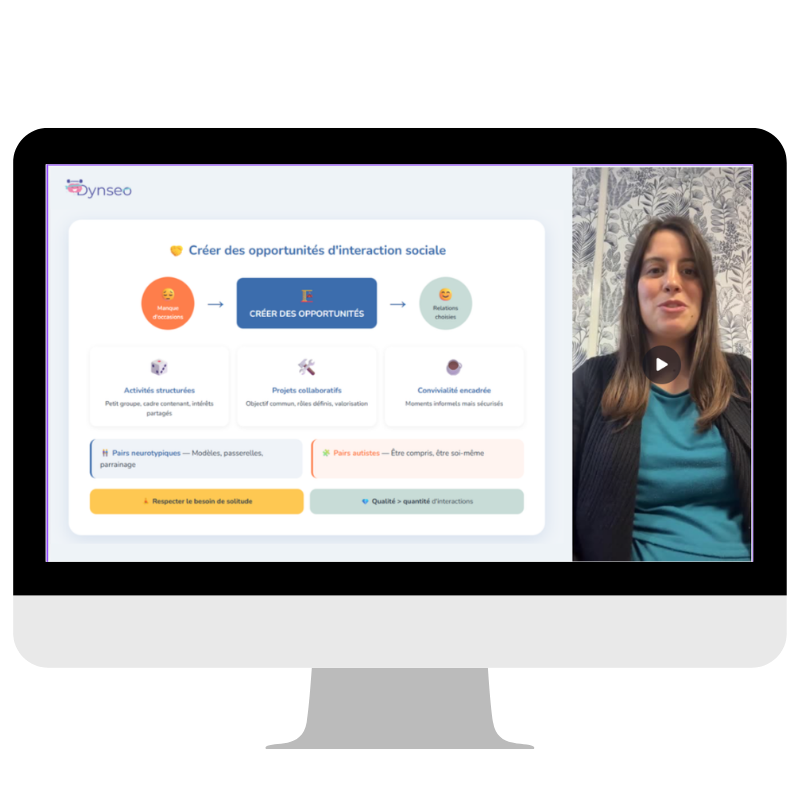
Why choose e-learning?
Concrete training, accessible remotely, to strengthen team skills without disrupting support.
Flexible
At your own pace, in short sessions, without immobilizing the team.
Accessible everywhere
Computer, tablet or mobile, at the office as well as at home.
Concrete
Practical cases, role-playing, scripts and ready-to-use tools.
Traceable
Completion tracking, certificates and Qualiopi certifications.
✅ Professional training available
In-depth training for teams in establishments (ESAT, group home, IME, SESSAD, MAS, FAM). OPCO funding possible.
Autism in establishment: comprehensive support
Complete 5-day training: from understanding ASD to concrete daily support strategies.
Down syndrome in establishment: comprehensive support
Understand the motor, cognitive and emotional specifics, adapt practices and promote autonomy in daily life.
ADHD in establishment: advanced strategies to manage impulsivity and opposition
Structured support for ADHD in the establishment: neurocognitive understanding, accommodations, impulsivity management, and team coordination.
Support students with learning disorders: strategies and tools for the classroom
Identify the signs of DYS disorders in the establishment, adapt educational materials, and coordinate interventions in a multidisciplinary team.
👨👩👧 And for families?
Short, accessible, and concrete training to support your loved one on a daily basis.
Supporting a child with autism
Understanding autism and implementing concrete strategies: visual supports, routines, communication, and autonomy.
👉 DiscoverManaging the emotions of an autistic teenager
Preventing autistic burnout, understanding masking, and mastering regulation strategies in adolescence.
👉 DiscoverManaging the emotions of an autistic adult
Understanding adult burnout, the spoon theory, and sensory and cognitive regulation techniques.
👉 DiscoverManaging the emotions of an autistic child
Visual and sensory tools to help your child regulate their emotions: visual schedule, calm corner, crisis script.
👉 DiscoverAutism: managing difficult situations
Understanding challenging behaviors, identifying warning signs, and preventing crises in daily life.
👉 DiscoverAutism in adulthood: promoting autonomy
Supporting autonomy, promoting social inclusion, and maintaining the quality of life of the autistic adult.
👉 DiscoverAsperger Autism: the invisible peculiarities
Specific cognitive functioning, sensory sensitivities, social fatigue, and unknown relational strengths.
👉 DiscoverSupporting a child with Down syndrome
Supporting the child in their learning, motor skills, and daily autonomy.
👉 DiscoverHelping your child with Down syndrome manage their emotions
Concrete tools to develop emotional regulation: emotion cards, thermometer, calm-down techniques.
👉 DiscoverManaging difficult behaviors – Down syndrome
Crisis prevention strategies, de-escalation, visual routines, and positive reinforcement.
👉 DiscoverStimulate motor development – Down syndrome
Fun activities for gross and fine motor skills: dance, obstacle courses, children's yoga, crafts, playdough.
👉 DiscoverDevelop communication – Down syndrome
Help the child express themselves, reduce frustrations, and strengthen the bond with practical strategies.
👉 DiscoverEncourage socialization – Down syndrome
Friendships, social codes, inclusion: help your child connect and avoid isolation.
👉 DiscoverFacilitate autonomy for children with Down syndrome
Structured routines, visual and sequential tools to develop confidence and independence.
👉 DiscoverSupport a teenager with Down syndrome towards autonomy
Puberty, independent travel, money management, social life, and preparing for a professional future.
👉 DiscoverHelp an adult with Down syndrome manage their emotions
Support anger, frustration, and anxiety while respecting adult dignity and emotional autonomy.
👉 DiscoverFacilitate autonomy for adults with Down syndrome
Essential routines, visual tools, positive reinforcement, and adaptation to early aging.
👉 DiscoverSupport an adult with Down syndrome: social life, employment, autonomy
Professional integration, social and emotional life, housing, and preparation for aging.
👉 DiscoverSupport a child with ADHD
Strategies to improve attention, channel energy, and establish calming routines.
👉 DiscoverADHD child: advanced strategies for impulsivity & opposition
Neurocognitive mechanisms, risky situations, concrete intervention techniques for daily life.
👉 DiscoverADHD in teenagers: impulsivity and opposition
ADHD + adolescence: triggering situations, differentiate agitation/crisis/opposition, coherent home-school framework.
👉 DiscoverADHD in adults: organization and impulsivity
Personalized organization system, managing impulsivity and emotional overflow on a daily basis.
👉 DiscoverSupporting a child with DYS disorders
Understanding the needs of the DYS child, adapting the environment and homework at home.
👉 DiscoverDYS disorders in adulthood
Impacts at work, compensation tools (voice dictation, mind maps) and autonomy strategies.
👉 DiscoverManaging the emotions of a hypersensitive child
3 forms of hypersensitivity, triggers, square breathing, thermometer and anchoring techniques.
👉 DiscoverSupporting an anxious child
Safety rituals, abdominal breathing, anchoring 5-4-3-2-1 and managing anxious thoughts.
👉 DiscoverPreventing school dropout
Identifying early signs, establishing reassuring routines, and rekindling the desire to learn.
👉 DiscoverRaising awareness about screens: understanding and acting
Age guidelines, regular breaks, parental control, and effective routines for a calming environment.
👉 Discover🚀 Upcoming trainings: vote!
Click to vote. Your choice helps us prioritize the development of the most requested trainings.
DYS disorders in institutions: identifying and adapting
Identifying DYS signs in structures, adapting educational materials, and coordinating interventions in multidisciplinary teams.
Multiple disabilities: communication and sensory stimulation
Alternative communication, sensory approaches, adapted stimulation, and maintaining connections for people with multiple disabilities.
Affective life and sexuality in institutions
Supporting the affective and sexual life of adults with disabilities while respecting self-determination and legal frameworks.
Aging and disability: adapting support
Early aging, loss of autonomy, adaptation of practices, and transition to senior devices.
Behavior-challenges: functional analysis and prevention
Understand the function of behavior, conduct a functional analysis, prevent crises, and secure support.
Self-determination and user rights
Promote self-determination, legal framework, practical tools, and a professional posture that respects choices.
Professional inclusion and supported employment
Support the transition from ESAT to the ordinary environment, supported employment, job adaptation, and sustainable follow-up.
Tablets and DYNSEO applications in institutions
Master COCO, CLINT, SCARLETT, and MY DICTIONARY to create personalized programs and run digital workshops.
💡 Use cases & concrete benefits
Discover how our training transforms the daily lives of teams in ESAT, IME, group homes, SESSAD, and at home
ESAT Educator facing the crises of an autistic worker
Karim, workshop supervisor in ESAT, supervises Julien, 28 years old, autistic. Every task change triggers crises: screams, throwing objects, refusal to resume. The team hesitates to redirect Julien to a less demanding workshop, which would demotivate him.
Karim understands that the crises are related to unprepared transitions. He sets up a visual TEACCH schedule with a timer, announces each change 10 minutes in advance, and creates a sensory retreat area in the workshop. He uses Julien's specific interests (trains) as reinforcement.
- Crises reduced from 5/week to 1 in 3 weeks
- Julien maintained in his main workshop
- Julien's productivity increased by 40%
- Transition protocol adopted for 8 other ASD workers
IME Educator and autonomy of a teenage girl with Down syndrome
Sophie, specialized educator in IME, supports Léa, 15 years old, with Down syndrome. Léa refuses to dress alone, gives up at the slightest button, and throws a tantrum when pressed. The parents do everything for her at home.
Sophie applies backward chaining: Léa finishes the last step alone (closing the zipper), then the last two, etc. Visual sequences photographed with Léa herself are displayed in her room. Each success is valued by an adapted positive reinforcement system. Sophie shares the protocol with the parents.
- Léa dresses alone in 4 weeks (except shoelaces)
- Tantrums during dressing: from daily to zero
- Parents apply the same method on weekends
- Generalization: Léa starts preparing her breakfast
Mother exhausted by her son's impulsivity with ADHD
Sandrine is on sick leave. Her son Lucas, 9 years old, diagnosed with ADHD, interrupts constantly, gets up 15 times during homework, and has tantrums when told no. The father "gives up," the couple is under tension.
Sandrine identifies the 5 triggering situations (homework, screen time end, meals, bedtime, refusals). She sets up micro-steps with a visual timer, a sensory calm box, and photographed routines. She shares the techniques with the father to create educational consistency. The school receives the same framework.
- Homework reduced from 1h30 of conflict to 25 minutes
- Daily tantrums reduced to 2-3 per week
- Father involved with the same tools
- Sandrine returns to work after 6 weeks
Worried parents for their autistic son who has become an adult
Marc and Isabelle, 62 years old, live with Théo, 26 years old, autistic. Théo no longer goes out, refuses activities, spends his days on his computer. His parents compensate for everything: shopping, cleaning, meals. They worry about the future: “What will happen to him when we are no longer here?”
The parents understand Théo's autistic burnout and the accumulated cost of masking. They apply the spoon theory to gauge demands, set up gradual routines with visual support, and use CLINT brain coach for short cognitive stimulation sessions. Théo chooses 2 household tasks per day himself.
- Théo does his shopping at the supermarket (with visual list)
- 2 daily household tasks completed independently
- Supported employment registration initiated
- Parents relieved and reassured about the life project
Teacher facing a DYS student in increasing difficulty
Mrs. Leroux, a CE2 teacher, notices that Emma, 8 years old, is falling behind. She confuses letters, copies slowly, cries at every dictation. The parents deny the problem: “She is just a bit slow.” The AESH has not yet been assigned.
Mrs. Leroux implements adjustments without waiting for the AESH: adapted font, fill-in-the-blank dictations, extended time, audio reading. She documents the difficulties to support the MDPH file. The parents, trained in parallel, adapt homework at home with visual tools and voice dictation. COCO is used in class for letter recognition exercises.
- Emma no longer cries in class in 2 weeks
- Dictation results: from 2/20 to 11/20 with adaptations
- MDPH file submitted with documented observations
- Parents become active participants in home support
Complete ESAT: annual disability training plan
The ESAT Les Ateliers du Parc (45 workers, including 18 with ASD and 12 with Down syndrome) experiences high turnover of monitors (25%). Challenging behaviors are multiplying, protocols are nonexistent, and the external ESSMS evaluation is approaching. Management is looking for a training solution without disrupting production.
22 professionals trained in 4 months through e-learning, without stopping production. Visual transition protocols harmonized across all workshops, behavior-challenge sheets shared, JOE and COCO workshops integrated into breaks. Families receive free access to short training to ensure continuity between home and establishment.
- Monitor turnover reduced to 10% (–15 points)
- Challenging behaviors: –55% of reported incidents in 6 months
- Successful external ESSMS evaluation with positive recommendations
- Training budget optimized thanks to OPCO funding (minimal out-of-pocket costs)
📋 Receive the catalog & a quote
Tell us your needs: we will get back to you quickly.
📚 Selected training (0)
💬 What they say
Testimonials from professionals and families trained with DYNSEO
❓ Frequently asked questions
Everything you need to know about our disability training for professionals and families
Who are these trainings for?
Specialized educators, workshop instructors, AMP/AES, psychologists, service managers, families, and caregivers. No technical prerequisites.
What types of establishments?
ESAT, living center, accommodation center, IME, SESSAD, MAS, FAM, adapted company. The trainings adapt to each support context.
How does e-learning work?
100% online, at your own pace. Short videos, quizzes, situational exercises, downloadable PDF tool sheets. Access 24/7, for 6 months.
Possible OPCO funding?
All our trainings are Qualiopi certified. Eligible for OPCO, skills development plan, and FIFPL. We assist in preparing the file.
What is the duration of the trainings?
Family trainings: 2h, at €29. Professional trainings: 14h (Down syndrome) or 35h (Autism), divided into short modules to avoid blocking the service.
Certificate at the end?
Qualiopi certificate issued after passing the final test (70%). Valid for your professional file and the external evaluation of the establishment.
Training for an entire team?
Recommended establishment formula: each at their own pace, then collective time to harmonize protocols. Discounted rate from 5 registrants (–15%).
Professional and family trainings: what's the difference?
Professional trainings (14h-35h) are in-depth, with functional analysis and team protocols. Family trainings (2h) are practical, focused on daily life at home.
DYNSEO applications included?
The trainings explain how to use COCO, CLINT, SCARLETT, and MY DICTIONARY in workshops or at home. Separate application licenses. Free demos.
Useful for external ESSMS evaluation?
Yes. Our trainings directly feed into quality criteria: training plan, written protocols, Qualiopi traceability, personalized support.
Immediate access?
Credentials sent within 5 minutes after payment. Accessible 24/7 on computer, tablet, or smartphone, at the office or at home.
Follow-up and assistance?
Email assistance within 48h for any technical or educational questions. Personalized support for establishments upon request.