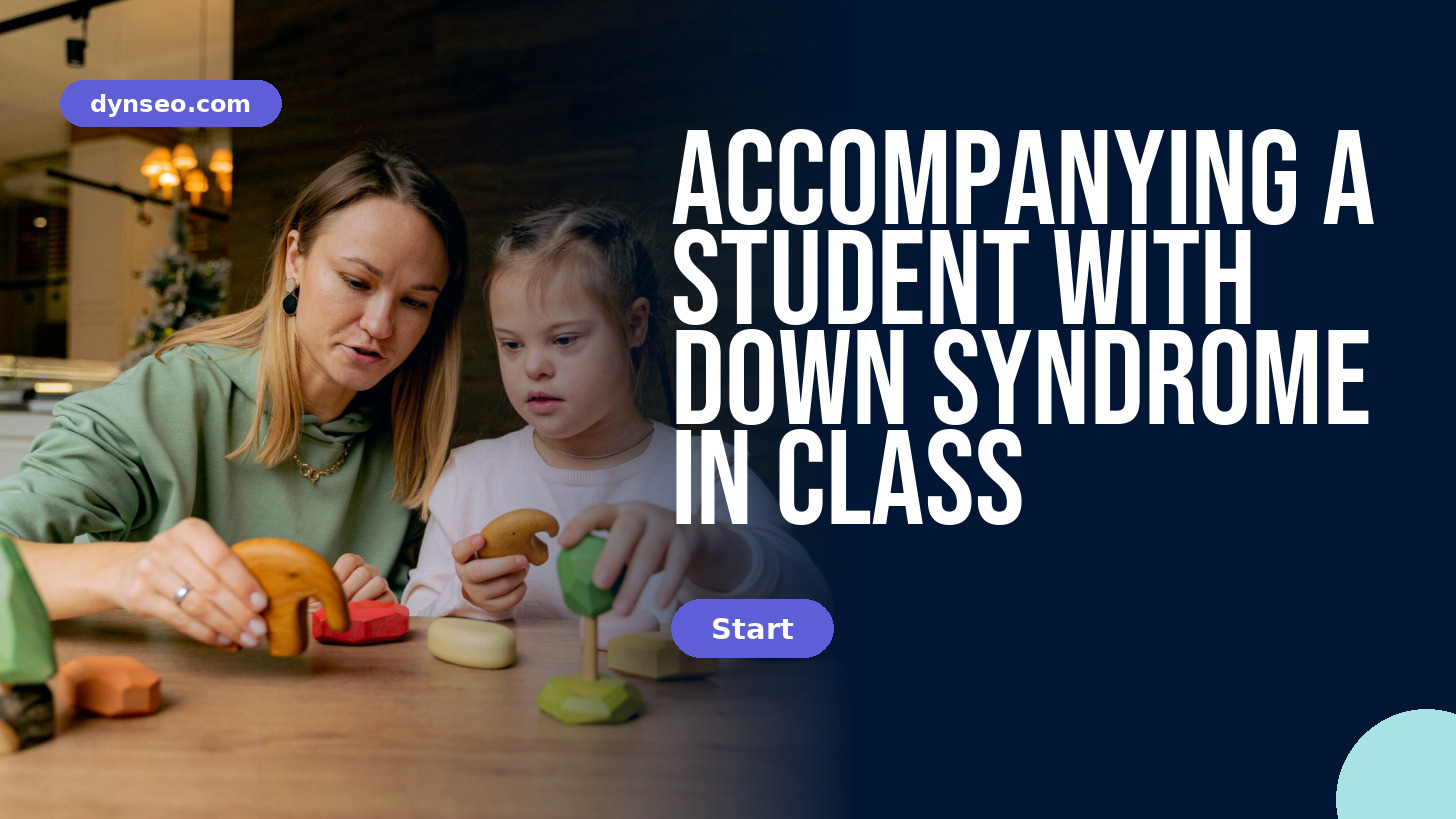
Teaching a student with Down syndrome to read: where to start in class
A student with Down syndrome arrives in the class, and the question always comes back to the same place : where to start ? We know we have to go for it, we feel that the child is ready, and yet the usual methods — those that start with sounds and syllables — seem to slide off him without sticking. This is not a coincidence, and it is certainly not a sign that he will not be able to read. Teaching a student with Down syndrome to read simply requires changing the entry point : we start with the global recognition of whole words, we rely on visual memory which is often a strong point, and we install the very first words before touching on decoding.
In this article
The associated training
Our printable notebooks


Cet article décrit une progression concrète : le matériel à préparer, les 50 premiers mots à travailler et dans quel ordre, le déroulé d'une séance, les fameux plateaux d'apprentissage qui déstabilisent tant d'équipes, et le moment où le décodage des syllabes peut s'ajouter à la reconnaissance globale. L'objectif n'est pas de transformer une classe en cabinet spécialisé, mais de donner des repères utilisables dès la semaine prochaine à un enseignant, un AESH — accompagnant d'élève en situation de handicap —, un orthophoniste ou un parent. Une idée traverse tout le texte : apprendre plus lentement n'est pas ne pas apprendre.
L'essentiel en 30 secondes
Pour un élève porteur de trisomie 21, on commence l'entrée dans la lecture par la reconnaissance globale de mots entiers, en s'appuyant sur la mémoire visuelle, avant d'aborder le décodage des sons et des syllabes.
- On part de mots porteurs de sens — le prénom, les mots du quotidien de l'enfant — présentés sur des cartes-mots, associés à des cartes-images.
- On avance par petits groupes : quelques mots à la fois, très souvent revus, jusqu'à une base d'une cinquantaine de mots reconnus au premier coup d'œil.
- Les plateaux sont normaux : des périodes sans progrès visible ne signifient pas l'échec ; on ne retire pas un objectif trop tôt.
- Le décodage vient ensuite, en complément et non à la place, quand une base de mots reconnus est solide.
- Chacun garde son rôle : l'enseignant et l'AESH font vivre l'apprentissage en classe, l'orthophoniste évalue et guide, le médecin traite tout signe de souffrance ou de difficulté sensorielle.
Apprendre à lire à un élève porteur de trisomie 21 : pourquoi commencer par les mots entiers
La plupart des méthodes de lecture du commerce reposent sur le décodage : on apprend le son de chaque lettre, on assemble les sons pour former des syllabes, puis des mots. Cette voie fonctionne remarquablement bien pour beaucoup d'enfants, mais elle sollicite fortement la mémoire de travail auditive et la conscience phonologique — la capacité à percevoir et manipuler les sons de la langue. Or ces deux compétences font souvent partie des points d'appui les plus fragiles chez un élève porteur de trisomie 21, alors que la mémoire visuelle, elle, est fréquemment plus solide.
C'est cette dissymétrie qui fonde le choix de commencer par la reconnaissance globale. Reconnaître un mot entier, c'est le traiter comme une image : la forme du mot « papa », sa longueur, sa silhouette, ses lettres caractéristiques deviennent un repère mémorisé, exactement comme on reconnaît un logo ou un panneau sans en épeler les lettres. L'enfant lit alors des mots vrais, chargés de sens, dès les premières séances — et cette réussite précoce nourrit la motivation, qui est un moteur d'apprentissage au moins aussi important que la technique.
Reconnaissance globale et décodage : deux voies complémentaires
Il ne s'agit pas d'opposer les deux approches, mais de choisir par laquelle entrer. La reconnaissance globale ouvre la porte ; le décodage viendra ensuite consolider et généraliser. Le tableau ci-dessous résume ce qui les distingue.
| Global recognition | Syllabic decoding | |
|---|---|---|
| Principle | Recognize the whole word as a memorized image | Assemble the sounds of letters and syllables |
| Required skill | Visual memory, image-word matching | Phonological awareness, auditory memory |
| Early success | Quick: the child reads real words very early | More gradual: meaning comes after assembly |
| Limit | Does not allow reading an unknown word by itself | Demanding if phonology is fragile |
| Place in progression | Entry point | Next step, as a complement |
Reading is not decoding: it is understanding. A child who globally recognizes the word "cake" and knows what it refers to is already reading, even if they cannot spell it yet. Understanding precedes mechanics here, and that is good news: it places meaning at the center from day one.
The learning profile: on which strengths to rely
No student with Down syndrome is like another, and there is no "typical profile" that would exempt us from observing the real child in front of us. However, many share trends that guide pedagogy. Knowing them helps to build a realistic progression, without turning them into labels.
A often strong visual memory
What is seen and associated with an image is generally remembered better than what passes solely through the ear. This is the central support point of global recognition.
A more fragile phonology
Perceiving and breaking down the sounds of language often takes more time. Decoding is not out of reach, but it is not the best starting point.
Extended processing time
Information is well processed, but more slowly. A fast-paced instruction or a too tight sequence can create the illusion of a difficulty that is not really there.
A great sensitivity to meaning
Words that matter to the child — their name, those of their loved ones, their favorite objects — anchor much faster than abstract words or those foreign to their world.
From these trends arise a few simple principles: use the visual channel as much as possible, allow a longer response time without filling it in for the child, and choose words that make sense to them rather than a standard list. The slowness of processing deserves special attention: many apparent failures disappear when we accept to count mentally to five or ten before intervening, giving the student the time their brain requires.
Avant d'attribuer une difficulté à l'apprentissage lui-même, il faut s'assurer que la vision et l'audition ont été récemment évaluées par un professionnel de santé. Les troubles sensoriels sont plus fréquents dans ce contexte, et une difficulté à distinguer les lettres ou à entendre les sons peut n'avoir rien à voir avec la lecture. En cas de doute, on oriente vers le médecin, l'ophtalmologiste ou l'orthophoniste avant d'aller plus loin.
Le matériel de base : cartes-mots et cartes-images
La force de cette méthode tient à sa simplicité matérielle : quelques cartes bien conçues suffisent pour démarrer. On n'a besoin ni d'application, ni de manuel spécialisé, seulement d'un matériel lisible, stable et personnalisé pour l'enfant.
Les cartes-mots
Une carte-mot est un carton sur lequel figure un seul mot, écrit en gros, dans une police simple et régulière. On privilégie une écriture nette, sans empattements superflus, avec un contraste fort entre le texte et le fond. On garde une taille de carte et une taille de lettres constantes d'un mot à l'autre : c'est la régularité du support qui permet à l'enfant de comparer les silhouettes des mots. Un mot par carte, toujours : on ne surcharge pas.
Les cartes-images
À chaque carte-mot correspond une carte-image représentant clairement le mot : une photo ou un dessin épuré, sans détail parasite, du même objet ou de la même personne. Pour « papa », c'est idéalement la photo du père de l'enfant, pas un dessin générique. Cette personnalisation n'est pas un détail : elle transforme un exercice abstrait en quelque chose qui parle à l'enfant.
| Élément | Ce qui aide | ❌ À éviter |
|---|---|---|
| Police | Simple, régulière, sans fioritures | Écritures fantaisistes, majuscules décoratives |
| Taille | Grande et constante d'une carte à l'autre | Tailles variables qui parasitent la comparaison |
| Contraste | Texte foncé sur fond clair uni | Fonds colorés, images derrière le texte |
| Image associée | Photo ou dessin clair, personnalisé quand c'est possible | Illustrations chargées, plusieurs objets sur une image |
| Nombre de mots par carte | Un seul | Deux mots ou une courte phrase dès le départ |
On complète utilement ce jeu par des étiquettes autocollantes pour nommer les objets réels de la classe — la porte, la table, la fenêtre — afin que les mots vivent aussi hors des cartes. L'idée générale est de multiplier les rencontres avec les mêmes mots dans des contextes différents, sans jamais changer leur graphie.
Les 50 premiers mots : par quels groupes commencer
La première liste ne se choisit pas au hasard : elle part de l'enfant. Le tout premier mot est presque toujours son prénom, parce qu'il le voit partout, qu'il le charge d'affect et qu'il le reconnaît souvent déjà en partie. On construit ensuite la progression par petits groupes thématiques, en n'introduisant que quelques mots à la fois et en les consolidant longuement avant d'en ajouter.
Une progression possible par groupes
| Groupe | Type de mots | Exemples |
|---|---|---|
| 1 | Identité et proches | Le prénom de l'enfant, papa, maman, les prénoms de la fratrie |
| 2 | Le corps | main, pied, tête, yeux, bouche |
| 3 | Le quotidien immédiat | école, maison, lit, table, porte |
| 4 | Aliments familiers | eau, pain, lait, pomme, gâteau |
| 5 | Actions du jour | manger, boire, dormir, jouer, venir |
| 6 | Petits mots outils | oui, non, le, la, un |
Cet ordre n'a rien d'obligatoire : c'est un exemple à adapter au monde réel de l'enfant. Un élève passionné de dinosaures apprendra « dinosaure » plus vite que « table », même si le mot est plus long — parce que le sens porte la mémorisation. Le principe qui compte est le rythme : on n'introduit un nouveau groupe que lorsque le précédent est reconnu de façon fiable, dans le désordre et sans l'aide de l'image.
Un mot vaut d'être appris s'il sert à l'enfant dans sa vie : pour se nommer, demander, refuser, désigner ce qui l'entoure. Les petits mots outils comme « oui » et « non » ouvrent la porte à la construction de courtes phrases, étape motivante qui donne du sens à tout ce qui précède.
Combien de mots à la fois ?
Il n'existe pas de nombre magique, et surtout pas de chiffre à imposer comme un objectif chiffré : le bon rythme est celui qui permet de garder la réussite au premier plan. En pratique, on travaille souvent deux à quatre mots nouveaux à la fois, en continuant de revoir tous les mots déjà acquis. Mieux vaut peu de mots solidement installés que beaucoup de mots hésitants. La cinquantaine de mots reconnus n'est pas une fin en soi : c'est le seuil à partir duquel l'enfant lit de courtes phrases et où le décodage devient envisageable.
Comment se déroule une séance de reconnaissance globale
Une séance efficace est courte, ritualisée et joyeuse. On vise quelques minutes de qualité plutôt qu'une longue séance qui épuise l'attention. La régularité prime largement sur la durée : mieux vaut cinq minutes chaque jour qu'une demi-heure une fois par semaine.
- L'appariement mot-image. On pose la carte-image, puis on présente la carte-mot en la nommant clairement : « Regarde, ça c'est écrit "papa". » L'enfant associe les deux. On répète cette association plusieurs fois, sans le mettre en difficulté.
- La désignation. On place deux ou trois cartes-mots devant l'enfant et on demande : « Montre-moi "papa". » Reconnaître parmi plusieurs mots est plus facile que produire, et permet une réussite immédiate.
- Le retrait progressif de l'image. Une fois l'appariement solide, on présente la carte-mot seule : « C'est quel mot ? » On vérifie que le mot est reconnu sans le soutien de l'image.
- Le brassage. On revoit les mots dans un ordre différent à chaque fois, pour éviter que l'enfant ne mémorise une position plutôt qu'un mot. C'est l'étape qui distingue une vraie reconnaissance d'un simple par cœur.
- La mise en situation. On termine par un usage vrai : retrouver le mot « porte » collé sur la porte, composer « papa vient » avec deux cartes. Le mot sert à quelque chose, et cela referme la séance sur une réussite.
Quelques gestes concrets font la différence. On dit toujours le mot exact, jamais « le petit mot là » ; on félicite le juste sans dramatiser l'erreur ; et surtout, on ne corrige pas en disant « non, c'est faux », on reformule : « Presque ! Regarde bien, ce mot-là commence par la même lettre que ton prénom. » L'erreur fait partie de l'apprentissage ; elle ne doit jamais devenir un moment d'échec vécu.
❌ À éviter : allonger la séance « tant que ça marche » jusqu'à la fatigue — on arrête sur une réussite, pas sur une lassitude. ❌ À éviter : répondre à la place de l'enfant dès qu'il hésite — on laisse le temps du traitement. ❌ À éviter : changer la graphie d'un mot d'une carte à l'autre — la stabilité visuelle est le cœur de la méthode.
Moving from benchmarks to a structured practice in class
The training "Supporting a student with Down syndrome in class" breaks down this progression into concrete modules: materials, sessions, adaptations, with downloadable sheets and resources ready to use. 100% online, at your own pace, with no prerequisites.
Discover the trainingLearning plateaus: do not abandon a goal too soon
This is probably the point that destabilizes teams the most, and the one that leads to giving up too quickly. The learning of a student with Down syndrome rarely progresses in a straight line: it alternates between phases of acquisition and plateaus, sometimes long periods where nothing seems to advance, or even where there is a feeling of regression. These plateaus are not failures: they are times of consolidation, during which the brain stabilizes and integrates what has been learned.
The risk, when faced with a plateau, is twofold: either one concludes that "it's not working" and removes the goal, or one increases the pressure, which damages motivation. Neither of these reactions helps. What helps is to hold on: continue the sessions, vary the supports and contexts without changing the words themselves, revisit what has been learned to restore the feeling of success, and allow time to do its work.
| Observed situation | Cautious interpretation | Appropriate reaction |
|---|---|---|
| No new words recognized for weeks | Consolidation plateau, frequent and normal | Maintain, lighten, revisit what has been learned |
| One acquired word seems "lost" | Temporary forgetfulness, often reversible | Reintroduce it without dramatizing |
| Success in the morning, failure in the afternoon | Effect of attentional fatigue | Schedule sessions at times of availability |
| Sudden and lasting refusal of the activity | To explore: fatigue, but also pain, sensory concern, other cause | Observe, communicate, guide if needed |
| Progress resumes after a long apparent pause | End of plateau: integration has occurred | Resume the introduction of new words |
« He does not learn less ; he learns differently, and he consolidates for longer. » Naming the board, explaining it to parents and colleagues, avoids the collective discouragement that leads to withdrawing a goal too early that the child would eventually have achieved. Learning more slowly is not not learning.
When and how to introduce syllable decoding
Global recognition has a limit that must be known : it does not allow, on its own, to read a word never encountered. This is where decoding comes in — learning the sounds of letters and assembling them into syllables — not to replace what came before, but to expand it. The right moment is not a date : it is a state. Decoding is considered when the child has a solid base of recognized words, shows interest in letters, and begins to notice that some words “ start the same ”.
We then rely on what the child already knows. Their name becomes a valuable starting point : the first letter, its sound, then other words that start with the same sound. We move from the known to the unknown, from the whole to the analysis, and not the other way around. Decoding often progresses more slowly than global recognition, which is normal given the phonological demand : we maintain the same principle of small steps and accepted boards.
Starting from known words
We isolate a letter in a word already recognized — the “ p ” of “ dad ” — and we work on its sound from this familiar word, never in a vacuum.
Assembling very gradually
We combine two sounds to form a simple syllable, then we find this syllable in several words. We progress sound by sound, without rushing the assembly.
Keeping both pathways active
We continue global recognition while establishing decoding : the two reinforce each other rather than replace each other.
At this stage, collaboration with the speech therapist becomes particularly valuable. The work on phonological awareness largely falls within their domain ; the teacher and the AESH extend it in class, in continuity with what the professional has assessed and proposed. This coordination avoids contradictory approaches and gives the child a coherent framework between school, the office, and home.
Who is this approach for and what are its limits
A method has value only if we also know what it does not do. This progression through global recognition, and the training that equips it, is aimed at specific professionals and caregivers, and encounters limits that must be clearly stated.
Who is this training for
| Public | Ce que la démarche lui apporte |
|---|---|
| Enseignants de classe ordinaire ou spécialisée | Un point d'entrée concret dans la lecture, adaptable à un élève parmi d'autres |
| AESH (accompagnants d'élèves en situation de handicap) | Des gestes précis pour animer les séances au quotidien, en lien avec l'enseignant |
| Orthophonistes | Un cadre partagé avec l'école pour prolonger le travail en classe |
| Professionnels du médico-social | Des repères communs pour accompagner l'entrée dans l'écrit |
| Parents et aidants | Une compréhension de la logique de l'apprentissage, sans se substituer aux professionnels |
À qui elle ne s'adresse pas, et ses limites
Cette démarche n'est pas un protocole de rééducation, ni un outil de diagnostic. Elle ne se substitue en rien au bilan et au suivi d'un orthophoniste, ni à l'évaluation d'un médecin. Elle ne prétend pas garantir un résultat : chaque enfant avance à son propre rythme, et aucune méthode ne peut promettre une échéance ou un niveau. Elle ne convient pas non plus comme réponse unique lorsqu'un trouble sensoriel non pris en charge, une douleur ou une souffrance de l'enfant sont en jeu : ces situations relèvent d'abord d'un professionnel de santé.
Tout diagnostic, tout bilan de vision, d'audition ou de langage, et tout signe de souffrance chez l'enfant — retrait durable, pleurs, refus global, régression inexpliquée — se réfèrent au médecin, au psychologue ou à l'orthophoniste. La pédagogie décrite ici accompagne l'apprentissage ; elle ne remplace pas le soin.
Une formation en ligne, concrète et certifiante
La formation « Accompagner un élève porteur de trisomie 21 en classe » se suit intégralement en ligne, à son rythme, accessible à tout moment. Chaque module se termine par un quiz de validation, complété par une évaluation finale, et met à disposition des exemples détaillés, des études de cas et des supports téléchargeables prêts à l'emploi. Elle ne demande aucun prérequis. Elle est proposée par un organisme certifié Qualiopi (N° 11757351875) et donne lieu à une attestation de fin de formation. Un financement est possible via un organisme financeur, et la formation peut s'intégrer au plan de développement des compétences d'une structure. Pour explorer l'ensemble des thématiques disponibles, le catalogue complet des formations réunit les parcours dédiés à la neurodiversité, à l'éducation et à la santé. Pour une question précise ou un besoin d'équipe, il est possible d'échanger directement avec l'organisme.
Pour aller plus loin
Le catalogueToutes les formations DYNSEO en neurodiversité, éducation et santé
ÉchangerPoser une question ou construire un parcours pour une équipe
Questions fréquentes
At what age should we start teaching a child with Down syndrome to read?
There is no single age: we rely on the child's signs of interest rather than a date. Many children with Down syndrome show curiosity for words and images relatively early, and global recognition can begin as soon as the child matches an image to an object and pays attention to the written words around them. It is better to start with very short play sessions around the name rather than waiting for a theoretical "good moment." In case of doubt about the child's availability, the speech therapist and the teacher can help evaluate together the appropriate starting point.
Why start with whole words rather than letters?
Because visual memory is often a strength for the student with Down syndrome, while awareness of the sounds of the language takes more time to develop. Recognizing a whole word as an image allows the child to read real words from the very first sessions, which establishes success and motivation. The decoding of letters and syllables is not excluded: it comes later, as a complement, once a solid base of recognized words is established. Starting with the global approach is opening the door from the side where it gives way most easily, without giving up on the rest.
How many words does a child need to be considered "reading"?
There is no official threshold, and it is better to be wary of numbers presented as goals. It is often considered that a base of about fifty words recognized at first glance allows the child to read short sentences and begin to tackle decoding. But the essential thing is not the number: it is that the learned words are useful and truly anchored, recognized in disorder and without the support of the image. A child who recognizes twenty solid words and uses them to communicate progresses better than a child who hesitates over fifty. Quality takes precedence over quantity.
What to do when the child stagnates and no longer learns new words?
These periods, called plateaus, are frequent and normal: the brain consolidates what has been learned before moving on. The right reaction is neither to remove the goal nor to increase the pressure, but to hold on: maintain short sessions, revisit already acquired words to restore success, vary contexts without changing the spelling of the words. We also check that no external cause — fatigue, pain, sensory concern — explains the blockage, and we pass it on if necessary. Most often, progress resumes on its own after this phase of apparent pause. Learning more slowly is not the same as not learning.
Should we use purchased word cards or can we make them ourselves?
We can absolutely make them ourselves, and it is often preferable, as personalization enhances effectiveness. The important thing is the consistency of the support: one word per card, a simple and consistent font, large letters, a strong contrast between the text and the background, and a clear image associated with each word. Using a photo of the real "dad" or the family cat anchors the word much better than a generic drawing. Commercial cards can serve as a base, but they benefit from being supplemented with words from the child's real world, those that make sense to them.
How to help in class without stigmatizing the student in front of others?
Global recognition lends itself well to discreet and rewarding practice. Many activities — recognizing their name, finding the label of an object, composing a small message — can be done within shared workshops where other students also work on words. We avoid isolating vocabulary, we praise successes as we would for any child, and we present the cards as a game rather than as a treatment. The AESH can accompany these moments without turning them into separate sessions. The goal is for the student to experience reading as a class activity, not as a constant reminder of a difference.
What is the role of the speech therapist in relation to the teacher and the AESH?
The roles complement each other without overlapping. The speech therapist evaluates language, speech, and phonological awareness, sets rehabilitation goals, and proposes approaches: this is their domain. The teacher designs the place of reading in the classroom and brings the learning to life on a daily basis. The AESH supports the sessions as closely as possible to the student, in continuity with what has been decided. The key is coordination: sharing the words worked on, successes, and difficulties, to provide the child with a coherent framework between school, the office, and home. Everything related to diagnosis or treatment remains with health professionals.
Does this method guarantee that the child will be able to read?
No method can guarantee a result, and one should be wary of any promise of this kind. Each child progresses at their own pace, with their strengths and obstacles, and reading can take various forms: recognizing useful everyday words is already a valuable form of reading, even if it does not extend to complete decoding. What we can aim for is to create the best conditions: rely on the child's strengths, respect their pace, maintain motivation, and coordinate the stakeholders. The progression described here is a proven framework, not a guarantee; it is valuable for the regularity and patience we put into it.
This article is intended for general educational information. It does not replace the assessment of a speech therapist, the opinion of a doctor, or a personalized schooling project. For any diagnosis, sensory or language assessment, and any signs of distress in the child, refer to a healthcare professional and the team that follows the student.
Learning to read with a student with Down syndrome, with method and serenity
Start with global recognition, prepare the right materials, face the boards, introduce decoding at the right time: the training "Supporting a student with Down syndrome in class" equips each of these steps. 100% online, at your own pace, with quizzes, downloadable resources, and a certificate of completion. Certified Qualiopi organization, funding possible.
Discover the trainingDid this content help you? Support DYNSEO 💙
We are a small team of 14 people based in Paris. For 13 years, we have been creating free content to help families, speech therapists, care homes and healthcare professionals.
Your feedback is the only way we know if our work is useful. A Google review helps us reach other families, caregivers and therapists who need it.
One action, 30 seconds: leave us a Google review ⭐⭐⭐⭐⭐. It costs nothing, and it changes everything for us.