--dyn-bleu:#5e5ed7;
--dyn-bleu-fonce:#5268c9;
--dyn-vert:#a9e2e4;
--dyn-jaune:#ffeca7;
--dyn-rose:#e73469;
--dyn-encre:#1d1d2e;
--dyn-gris:#5c5c72;
--dyn-fond:#f6f6fd;
--dyn-ombre:0 6px 24px rgba(29,29,46,.08);
--dyn-ombre-forte:0 12px 34px rgba(94,94,215,.22);
--dyn-radius:18px;
font-family:"Inter","Segoe UI",system-ui,-apple-system,"Helvetica Neue",Arial,sans-serif;
color:var(--dyn-encre);
line-height:1.68;
font-size:clamp(16px,1.05vw + 13px,18px);
max-width:860px;
margin:0 auto;
padding:0 4px;
-webkit-font-smoothing:antialiased;
}
.dbi-art-199d86 .dyn-article * {box-sizing:border-box;}
.dbi-art-199d86 .dyn-article h1, .dbi-art-199d86 .dyn-article h2, .dbi-art-199d86 .dyn-article h3, .dbi-art-199d86 .dyn-article h4 {
color:var(--dyn-encre);line-height:1.22;margin:0 0 .5em;font-weight:800;letter-spacing:-.015em;
}
.dbi-art-199d86 .dyn-article h1 {font-size:clamp(1.65rem,3.4vw,2.35rem);margin-top:.4em;}
.dbi-art-199d86 .dyn-article h2 {font-size:clamp(1.35rem,2.4vw,1.75rem);margin-top:2.1em;padding-top:.2em;}
.dbi-art-199d86 .dyn-article h3 {font-size:clamp(1.1rem,1.7vw,1.28rem);margin-top:1.5em;font-weight:700;}
.dbi-art-199d86 .dyn-article p {margin:0 0 1.05em;}
.dbi-art-199d86 .dyn-article a {color:var(--dyn-bleu-fonce);text-decoration:underline;text-underline-offset:3px;}
.dbi-art-199d86 .dyn-article a:hover {color:var(--dyn-rose);}
.dbi-art-199d86 .dyn-article a:focus-visible {outline:3px solid var(--dyn-bleu);outline-offset:2px;border-radius:4px;}
.dbi-art-199d86 .dyn-article ul, .dbi-art-199d86 .dyn-article ol {margin:0 0 1.05em;padding-left:1.25em;}
.dbi-art-199d86 .dyn-article li {margin-bottom:.45em;}
.dbi-art-199d86 .dyn-article strong {font-weight:700;}
.dbi-art-199d86 .dyn-article img {max-width:100%;height:auto;display:block;}
.dbi-art-199d86 .dyn-pagehead {
position:relative;overflow:hidden;border-radius:var(--dyn-radius);
padding:30px 24px 28px;margin:0 0 1.5em;box-shadow:var(--dyn-ombre);
}
@media(min-width:720px) {
.dbi-art-199d86 .dyn-pagehead {padding:44px 44px 40px;}
}
.dbi-art-199d86 .dyn-pagehead::after {
content:"";position:absolute;right:-80px;top:-80px;width:250px;height:250px;border-radius:50%;
background:rgba(255,255,255,.14);pointer-events:none;
}
.dbi-art-199d86 .dyn-pagehead > * {position:relative;z-index:1;}
.dbi-art-199d86 .dyn-pagehead--bleu {background:linear-gradient(135deg,var(--dyn-bleu) 0%,var(--dyn-bleu-fonce) 100%);color:#fff;}
.dbi-art-199d86 .dyn-pagehead--bleu h1 {color:#fff;}
.dbi-art-199d86 .dyn-pagehead--bleu .dyn-pagehead__cat {color:var(--dyn-jaune);}
.dbi-art-199d86 .dyn-pagehead--bleu .dyn-pagehead__lead {color:rgba(255,255,255,.93);}
.dbi-art-199d86 .dyn-pagehead--bleu .dyn-pagehead__meta {color:#fff;}
.dbi-art-199d86 .dyn-pagehead--bleu .dyn-pagehead__meta li {background:rgba(255,255,255,.18);}
.dbi-art-199d86 .dyn-pagehead--eau {background:linear-gradient(135deg,var(--dyn-vert) 0%,#cfeff1 100%);color:var(--dyn-encre);}
.dbi-art-199d86 .dyn-pagehead--eau .dyn-pagehead__cat {color:var(--dyn-rose);}
.dbi-art-199d86 .dyn-pagehead--eau .dyn-pagehead__lead {color:#3b4a5c;}
.dbi-art-199d86 .dyn-pagehead--eau .dyn-pagehead__meta li {background:rgba(255,255,255,.62);}
.dbi-art-199d86 .dyn-pagehead--jaune {background:linear-gradient(135deg,var(--dyn-jaune) 0%,#fff7d6 100%);color:var(--dyn-encre);}
.dbi-art-199d86 .dyn-pagehead--jaune .dyn-pagehead__cat {color:var(--dyn-rose);}
.dbi-art-199d86 .dyn-pagehead--jaune .dyn-pagehead__lead {color:#5a5240;}
.dbi-art-199d86 .dyn-pagehead--jaune .dyn-pagehead__meta li {background:rgba(255,255,255,.68);}
.dbi-art-199d86 .dyn-pagehead__cat {
display:inline-block;font-size:.76rem;font-weight:800;letter-spacing:.12em;
text-transform:uppercase;margin-bottom:.9em;
}
.dbi-art-199d86 .dyn-pagehead h1 {margin:0 0 .5em;}
.dbi-art-199d86 .dyn-pagehead__lead {font-size:clamp(1.02rem,1.4vw,1.16rem);margin:0 0 1.3em;}
.dbi-art-199d86 .dyn-pagehead__meta {
display:flex;flex-wrap:wrap;gap:8px;list-style:none;padding:0;margin:0;
font-size:.83rem;font-weight:600;
}
.dbi-art-199d86 .dyn-pagehead__meta li {border-radius:999px;padding:5px 13px;}
.dbi-art-199d86 .dyn-hero {
background:linear-gradient(135deg,#ffffff 0%,var(--dyn-fond) 100%);
border-radius:var(--dyn-radius);
box-shadow:var(--dyn-ombre);
overflow:hidden;
margin:0 0 2.2em;
}
.dbi-art-199d86 .dyn-hero__grid {display:grid;grid-template-columns:minmax(0,1fr);}
@media(min-width:720px) {
.dbi-art-199d86 .dyn-hero__grid {grid-template-columns:42% minmax(0,1fr);}
}
.dbi-art-199d86 .dyn-hero__media {position:relative;background:var(--dyn-vert);}
.dbi-art-199d86 .dyn-hero__media img {width:100%;height:100%;object-fit:cover;aspect-ratio:16/9;}
@media(min-width:720px) {
.dbi-art-199d86 .dyn-hero__media img {aspect-ratio:auto;min-height:100%;}
}
.dbi-art-199d86 .dyn-hero__eyebrow {
display:inline-block;background:var(--dyn-rose);color:#fff;font-size:.72rem;font-weight:800;
letter-spacing:.09em;text-transform:uppercase;padding:6px 13px;border-radius:999px;margin-bottom:.7em;
}
.dbi-art-199d86 .dyn-hero__body {padding:22px 22px 24px;}
@media(min-width:720px) {
.dbi-art-199d86 .dyn-hero__body {padding:28px 30px;}
}
.dbi-art-199d86 .dyn-hero__title {font-size:clamp(1.12rem,2vw,1.42rem);font-weight:800;margin:0 0 .55em;line-height:1.25;}
.dbi-art-199d86 .dyn-hero__title a {color:var(--dyn-encre);text-decoration:none;}
.dbi-art-199d86 .dyn-hero__title a:hover {color:var(--dyn-bleu);}
.dbi-art-199d86 .dyn-hero__pitch {font-size:.97rem;color:var(--dyn-gris);margin:0 0 1em;}
.dbi-art-199d86 .dyn-badges {display:flex;flex-wrap:wrap;gap:7px;margin:0 0 1.1em;padding:0;list-style:none;}
.dbi-art-199d86 .dyn-badges li {
background:#fff;border-radius:999px;padding:5px 12px;font-size:.79rem;font-weight:600;
color:var(--dyn-bleu-fonce);box-shadow:0 2px 8px rgba(29,29,46,.07);
}
.dbi-art-199d86 .dyn-hero__actions {display:flex;flex-wrap:wrap;gap:10px;align-items:center;}
.dbi-art-199d86 .dyn-btn {
display:inline-block;background:var(--dyn-bleu);color:#fff !important;text-decoration:none !important;
font-weight:700;padding:13px 26px;border-radius:999px;box-shadow:var(--dyn-ombre-forte);
transition:transform .15s ease,background .15s ease;text-align:center;
}
.dbi-art-199d86 .dyn-btn:hover {background:var(--dyn-bleu-fonce);transform:translateY(-2px);color:#fff !important;}
.dbi-art-199d86 .dyn-btn--ghost {
background:#fff;color:var(--dyn-bleu-fonce) !important;box-shadow:0 2px 10px rgba(29,29,46,.09);
}
.dbi-art-199d86 .dyn-btn--ghost:hover {background:var(--dyn-jaune);color:var(--dyn-encre) !important;}
.dbi-art-199d86 .dyn-hero__price {font-weight:800;color:var(--dyn-rose);font-size:1.02rem;margin-left:2px;}
.dbi-art-199d86 .dyn-hero--pastel {background:var(--dom-fond);}
.dbi-art-199d86 .dyn-pastel {display:grid;grid-template-columns:auto minmax(0,1fr);gap:18px;align-items:start;padding:22px;}
@media(min-width:720px) {
.dbi-art-199d86 .dyn-pastel {gap:24px;padding:30px 32px;}
}
.dbi-art-199d86 .dyn-pastel__icone {
flex:0 0 auto;width:74px;height:74px;border-radius:22px;background:#fff;
display:flex;align-items:center;justify-content:center;font-size:34px;line-height:1;
box-shadow:0 4px 14px rgba(29,29,46,.10);
}
@media(min-width:720px) {
.dbi-art-199d86 .dyn-pastel__icone {width:88px;height:88px;font-size:40px;}
}
.dbi-art-199d86 .dyn-pastel__domaine {
display:inline-block;background:#fff;border-radius:999px;padding:4px 12px;
font-size:.74rem;font-weight:800;letter-spacing:.08em;text-transform:uppercase;
color:var(--dom-texte);margin-bottom:.6em;
}
.dbi-art-199d86 .dyn-hero--pastel .dyn-hero__eyebrow {background:var(--dom-texte);}
.dbi-art-199d86 .dyn-hero--pastel .dyn-btn {background:var(--dom-texte);}
.dbi-art-199d86 .dyn-hero--pastel .dyn-btn:hover {filter:brightness(.92);}
.dbi-art-199d86 .dyn-hero--pastel .dyn-btn--ghost {background:#fff;color:var(--dom-texte) !important;}
.dbi-art-199d86 .dyn-hero--pastel .dyn-badges li {color:var(--dom-texte);}
.dbi-art-199d86 .dyn-hero--pastel .dyn-hero__price {color:var(--dom-texte);}
.dbi-art-199d86 .dyn-dom--memoire {--dom-fond:#e9e9fb;--dom-texte:#5268c9;}
.dbi-art-199d86 .dyn-dom--attention {--dom-fond:#dcf2f4;--dom-texte:#1b7f86;}
.dbi-art-199d86 .dyn-dom--logique {--dom-fond:#ece9fb;--dom-texte:#5e5ed7;}
.dbi-art-199d86 .dyn-dom--langage {--dom-fond:#ffe8d9;--dom-texte:#b35a2a;}
.dbi-art-199d86 .dyn-dom--emotions {--dom-fond:#fdeaf1;--dom-texte:#c0295a;}
.dbi-art-199d86 .dyn-dom--apprentissage {--dom-fond:#fff3cd;--dom-texte:#8a6a13;}
.dbi-art-199d86 .dyn-dom--autonomie {--dom-fond:#e4f2ea;--dom-texte:#25795c;}
.dbi-art-199d86 .dyn-tldr {
background:var(--dyn-vert);border-radius:var(--dyn-radius);padding:22px 24px;margin:0 0 2em;
}
.dbi-art-199d86 .dyn-tldr h2 {margin:0 0 .5em;font-size:1.1rem;text-transform:uppercase;letter-spacing:.06em;}
.dbi-art-199d86 .dyn-tldr p {margin-bottom:.8em;}
.dbi-art-199d86 .dyn-tldr ul {margin-bottom:0;padding-left:1.1em;}
.dbi-art-199d86 .dyn-toc {background:var(--dyn-fond);border-radius:var(--dyn-radius);padding:20px 24px;margin:0 0 2.2em;}
.dbi-art-199d86 .dyn-toc p {font-weight:800;margin:0 0 .6em;font-size:.9rem;text-transform:uppercase;letter-spacing:.07em;color:var(--dyn-bleu-fonce);}
.dbi-art-199d86 .dyn-toc ol {margin:0;padding-left:1.2em;}
.dbi-art-199d86 .dyn-toc li {margin-bottom:.3em;}
.dbi-art-199d86 .dyn-cards {display:grid;gap:14px;grid-template-columns:repeat(auto-fit,minmax(230px,1fr));margin:1.4em 0 1.8em;}
.dbi-art-199d86 .dyn-card {
background:#fff;border-radius:var(--dyn-radius);padding:20px 20px 18px;box-shadow:var(--dyn-ombre);
}
.dbi-art-199d86 .dyn-card h3 {margin:0 0 .45em;font-size:1.03rem;}
.dbi-art-199d86 .dyn-card p {margin:0;font-size:.94rem;color:var(--dyn-gris);}
.dbi-art-199d86 .dyn-card__icon {font-size:1.5rem;display:block;margin-bottom:.35em;line-height:1;}
.dbi-art-199d86 .dyn-module {
background:#fff;border-radius:var(--dyn-radius);box-shadow:var(--dyn-ombre);
padding:20px 22px;margin:0 0 14px;
}
.dbi-art-199d86 .dyn-module__head {display:flex;align-items:center;gap:12px;margin-bottom:.7em;}
.dbi-art-199d86 .dyn-module__num {
flex:0 0 auto;width:38px;height:38px;border-radius:12px;background:var(--dyn-bleu);color:#fff;
display:flex;align-items:center;justify-content:center;font-weight:800;font-size:1rem;
}
.dbi-art-199d86 .dyn-module__title {margin:0;font-size:1.05rem;font-weight:800;}
.dbi-art-199d86 .dyn-module ul {margin:0;padding-left:1.15em;font-size:.95rem;}
.dbi-art-199d86 .dyn-module li::marker {color:var(--dyn-rose);}
.dbi-art-199d86 .dyn-tablewrap {overflow-x:auto;-webkit-overflow-scrolling:touch;margin:1.3em 0 1.9em;border-radius:var(--dyn-radius);box-shadow:var(--dyn-ombre);background:#fff;}
.dbi-art-199d86 .dyn-article table {width:100%;border-collapse:collapse;min-width:460px;font-size:.94rem;}
.dbi-art-199d86 .dyn-article thead th {
background:var(--dyn-bleu);color:#fff;text-align:left;padding:13px 16px;font-weight:700;font-size:.9rem;
}
.dbi-art-199d86 .dyn-article tbody td {padding:12px 16px;vertical-align:top;border-top:1px solid #ececf7;}
.dbi-art-199d86 .dyn-article tbody tr:nth-child(even) td {background:#fbfbff;}
.dbi-art-199d86 .dyn-article th:first-child {border-top-left-radius:var(--dyn-radius);}
.dbi-art-199d86 .dyn-article th:last-child {border-top-right-radius:var(--dyn-radius);}
.dbi-art-199d86 .dyn-oui {color:#1a8f6b;font-weight:700;}
.dbi-art-199d86 .dyn-non {color:var(--dyn-rose);font-weight:700;}
.dbi-art-199d86 .dyn-note, .dbi-art-199d86 .dyn-alerte {border-radius:var(--dyn-radius);padding:18px 22px;margin:1.5em 0;}
.dbi-art-199d86 .dyn-note {background:var(--dyn-jaune);}
.dbi-art-199d86 .dyn-alerte {background:#fdeef3;}
.dbi-art-199d86 .dyn-note p:last-child, .dbi-art-199d86 .dyn-alerte p:last-child {margin-bottom:0;}
.dbi-art-199d86 .dyn-note strong, .dbi-art-199d86 .dyn-alerte strong {display:block;margin-bottom:.3em;font-size:1rem;}
.dbi-art-199d86 .dyn-cta {
background:var(--dyn-bleu);border-radius:var(--dyn-radius);padding:26px 24px;margin:2.2em 0;
color:#fff;text-align:center;box-shadow:var(--dyn-ombre-forte);
}
.dbi-art-199d86 .dyn-cta h3 {color:#fff;margin:0 0 .4em;font-size:clamp(1.1rem,2vw,1.35rem);}
.dbi-art-199d86 .dyn-cta p {color:rgba(255,255,255,.92);margin:0 0 1.1em;font-size:.97rem;}
.dbi-art-199d86 .dyn-cta .dyn-btn {background:#fff;color:var(--dyn-bleu) !important;box-shadow:none;}
.dbi-art-199d86 .dyn-cta .dyn-btn:hover {background:var(--dyn-jaune);color:var(--dyn-encre) !important;}
.dbi-art-199d86 .dyn-steps {list-style:none;counter-reset:dyn;padding:0;margin:1.4em 0 1.8em;display:grid;gap:12px;}
.dbi-art-199d86 .dyn-steps li {
counter-increment:dyn;background:#fff;border-radius:var(--dyn-radius);box-shadow:var(--dyn-ombre);
padding:16px 20px 16px 62px;position:relative;font-size:.96rem;
}
.dbi-art-199d86 .dyn-steps li::before {
content:counter(dyn);position:absolute;left:18px;top:15px;width:30px;height:30px;border-radius:10px;
background:var(--dyn-jaune);color:var(--dyn-encre);display:flex;align-items:center;justify-content:center;
font-weight:800;font-size:.9rem;
}
.dbi-art-199d86 .dyn-faq {background:var(--dyn-fond);border-radius:var(--dyn-radius);padding:6px 24px 20px;margin:1.4em 0 0;}
.dbi-art-199d86 .dyn-faq h3 {font-size:1.05rem;margin-top:1.4em;}
.dbi-art-199d86 .dyn-faq p {font-size:.96rem;}
.dbi-art-199d86 .dyn-serie {display:grid;gap:12px;margin:1.4em 0 1.8em;}
.dbi-art-199d86 .dyn-serie a {
display:block;background:#fff;border-radius:var(--dyn-radius);box-shadow:var(--dyn-ombre);
padding:15px 20px;text-decoration:none;color:var(--dyn-encre);font-weight:600;font-size:.96rem;
transition:transform .15s ease;
}
.dbi-art-199d86 .dyn-serie a:hover {transform:translateX(4px);color:var(--dyn-bleu);}
.dbi-art-199d86 .dyn-serie span {display:block;font-size:.82rem;font-weight:600;color:var(--dyn-rose);text-transform:uppercase;letter-spacing:.06em;margin-bottom:2px;}
@media(prefers-reduced-motion:reduce) {
.dbi-art-199d86 .dyn-article * {transition:none !important;}
}{
"@context": "https://schema.org",
"@graph": [
{
"@type": "Article",
"headline": "Parkinson en établissement : 10 situations difficiles du quotidien et comment y répondre",
"inLanguage": "fr",
"author": {
"@type": "Organization",
"name": "DYNSEO",
"url": "https://www.dynseo.com/"
},
"publisher": {
"@type": "Organization",
"name": "DYNSEO",
"url": "https://www.dynseo.com/"
},
"image": "https://www.dynseo.com/wp-content/uploads/2026/03/Autisme-en-etablissement-Accompagnement-Global-9-4.jpg"
},
{
"@type": "FAQPage",
"mainEntity": [
{
"@type": "Question",
"name": "Comment savoir si un comportement est un symptôme ou de la mauvaise volonté ?",
"acceptedAnswer": {
"@type": "Answer",
"text": "Un bon repère : le comportement varie-t-il selon les moments de la journée et le traitement, et la personne semble-t-elle en subir les effets ? Blocage soudain à la marche, lenteur, visage sans expression, retrait : ce sont des manifestations neurologiques classiques de la maladie de Parkinson, pas des choix. En cas de doute, décrivez précisément la scène — l'heure, le lieu, ce qui s'est passé avant — à l'équipe soignante et au médecin, plutôt que de la résumer par « il ne fait pas d'efforts ». C'est le détail concret qui permet de distinguer le symptôme du reste."
}
},
{
"@type": "Question",
"name": "Que faire quand une personne se fige en pleine marche ?",
"acceptedAnswer": {
"@type": "Answer",
"text": "On arrête de pousser et de tirer, on se place à côté d'elle et on la rassure calmement : le mouvement est bloqué, pas la volonté. On propose ensuite un repère qui aide le redémarrage : enjamber une ligne au sol ou votre pied, un décompte rythmé « un, deux, trois, on part », ou une consigne de grand pas. On laisse quelques secondes : le mouvement revient souvent de lui-même si l'on ne panique pas. Tirer sur le bras déséquilibre et augmente le risque de chute. Signalez les lieux de blocage répétés à l'ergothérapeute et au kinésithérapeute."
}
},
{
"@type": "Question",
"name": "Faut-il respecter les horaires de traitement à la minute ?",
"acceptedAnswer": {
"@type": "Answer",
"text": "Dans la maladie de Parkinson, la régularité des prises est déterminante : elle conditionne directement la capacité à bouger et le confort de la personne. Un retard peut suffire à faire basculer en phase de blocage et à déclencher de l'anxiété. Les horaires prescrits doivent donc primer sur les contraintes d'organisation du service, dans le respect de l'ordonnance. On n'avance, ne retarde, ni ne modifie jamais un traitement de sa propre initiative. Si le circuit du médicament génère des décalages répétés, on le fait remonter pour le corriger avec le médecin et le pharmacien."
}
},
{
"@type": "Question",
"name": "Comment réagir face à des hallucinations sans aggraver la situation ?",
"acceptedAnswer": {
"@type": "Answer",
"text": "On ne contredit pas frontalement : pour la personne, sur le moment, c'est réel, et la nier l'angoisse davantage. On rassure sans mentir : « Je ne le vois pas, mais je suis là, vous ne risquez rien. » On agit sur l'environnement — allumer, réduire ombres et reflets — puis on détourne doucement l'attention. Surtout, toute hallucination nouvelle ou toute confusion récente se signale à l'équipe et au médecin : elle peut être liée à la maladie, au traitement, ou à un facteur ajouté comme une infection ou une déshydratation, qui se recherche et se traite."
}
},
{
"@type": "Question",
"name": "La formation DYNSEO s'adresse-t-elle aux familles ou aux professionnels ?",
"acceptedAnswer": {
"@type": "Answer",
"text": "Aux deux. La formation « Parkinson en établissement : comprendre la maladie et adapter sa pratique professionnelle » est conçue pour les soignants et accompagnants en établissement, mais elle éclaire tout autant les proches qui veulent comprendre ce qui se joue. Elle compte 32 leçons, se suit 100 % en ligne, à son rythme, avec un accès illimité. Elle est proposée par un organisme certifié Qualiopi (N° 11757351875) et donne lieu à une attestation de fin de formation. Elle reprend les situations concrètes du quotidien pour transformer la compréhension de la maladie en gestes justes."
}
}
]
}
]
}
Parkinson en établissement : 10 situations difficiles du quotidien et comment y répondre
Dans un établissement, la maladie de Parkinson ne se manifeste presque jamais par les grands symptômes des manuels. Elle se glisse dans les micro-scènes du quotidien : un résident qui reste figé sur le seuil de sa chambre, un repas qui s'éternise, une voix devenue si faible qu'on finit par répondre à sa place. Face à ces moments, la question qui revient sans cesse chez les équipes comme chez les familles est simple : Parkinson en établissement, que faire concrètement, à l'instant où la scène se produit ?
Dans cet article
La formation associée
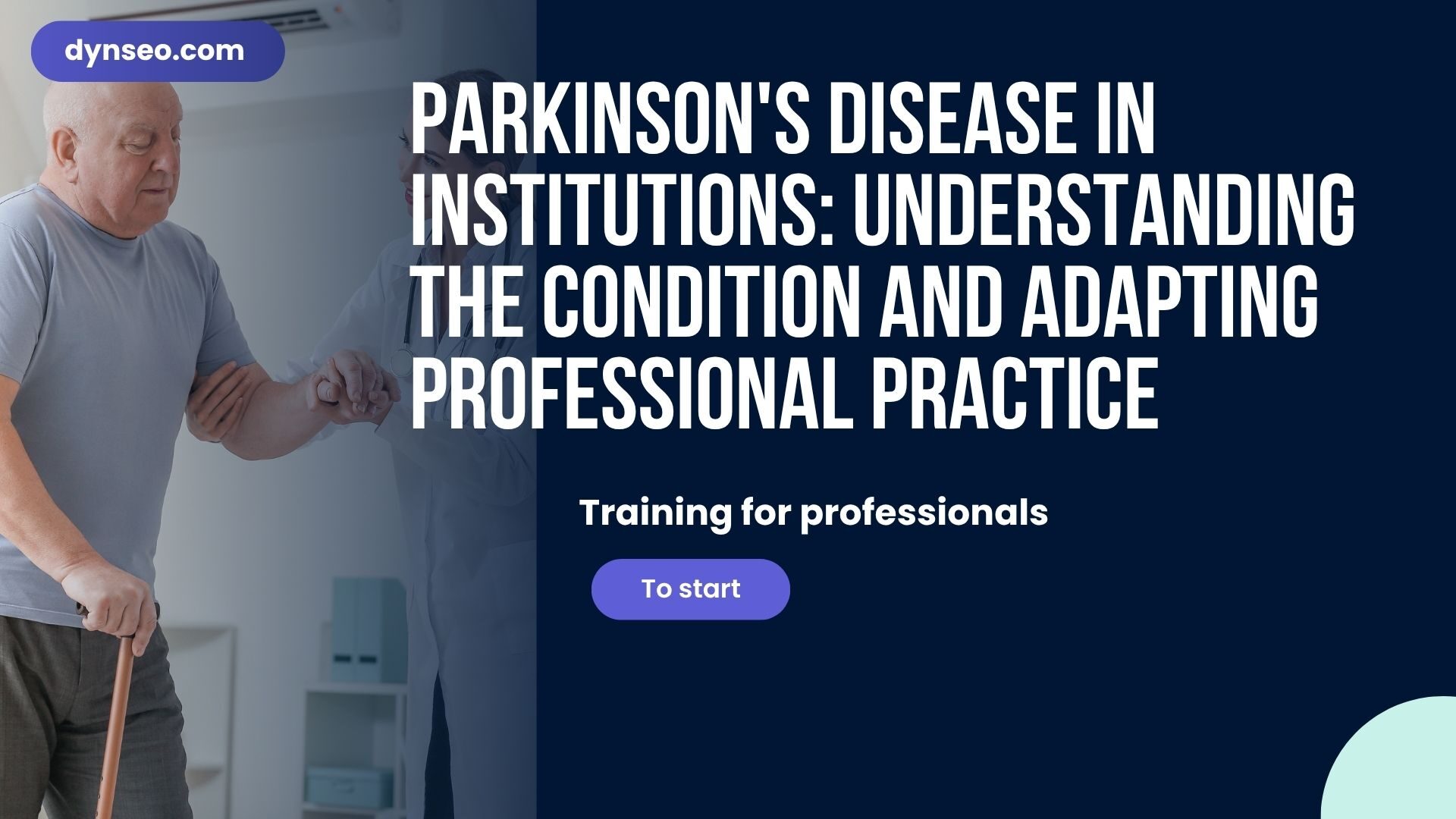
Voici dix de ces scènes, décrites telles qu'elles se déroulent réellement dans un couloir, une salle à manger ou une chambre. Pour chacune : ce qui se joue vraiment côté maladie, le réflexe spontané qui aggrave la situation — celui que nous avons tous — et la réponse pas à pas qui fonctionne, avec les mots exacts à dire et la posture à adopter. Sans jargon, sans protocole médical, et sans jamais confondre un symptôme neurologique avec un trait de caractère.
L'essentiel en 30 secondes
La plupart des situations difficiles liées à Parkinson en établissement ne sont ni de la mauvaise volonté, ni un caprice, ni de la paresse : ce sont des manifestations neurologiques. Les reconnaître comme telles change complètement la réponse à apporter.
- Trois réflexes valables presque partout — ralentir son propre rythme, donner un repère (visuel, sonore, verbal), et laisser le temps du mouvement s'installer.
- Ce qui aggrave presque toujours — presser, tirer sur le bras, faire à la place, hausser la voix, multiplier les consignes en même temps.
- Le blocage moteur (freezing) n'est pas un refus : le mouvement est bloqué, pas la volonté.
- Les fluctuations dans la journée (effet « on-off ») sont normales dans la maladie : la personne n'exagère pas le matin et ne fait pas semblant l'après-midi.
- Tout changement soudain (chute, fausse route répétée, confusion nouvelle) s'observe, se note et se signale à l'équipe soignante et au médecin.
1. Il se fige dans le couloir et ne peut plus avancer
10 h, dans le couloir qui mène à la salle d'animation. M. R. marchait normalement. Arrivé devant l'encadrement de la porte, ses pieds semblent collés au sol. Vous lui dites « allez, avancez », vous le prenez par le bras pour l'entraîner. Il se penche en avant, manque de tomber, et se braque.
Ce qui se joue : c'est ce qu'on appelle le blocage moteur, ou freezing. Le cerveau n'arrive plus à envoyer la commande de démarrage. C'est souvent déclenché par un passage étroit, un seuil, un changement de sol, ou par la précipitation. La personne veut avancer, elle en est incapable sur le moment. Tirer sur son bras déséquilibre son centre de gravité déjà instable et augmente le risque de chute.
- Arrêtez de pousser, arrêtez de tirer. Placez-vous à côté, jamais devant à reculons. Dites calmement : « On ne bouge pas, on respire, ça va repartir. »
- Donnez un repère pour enjamber. Une consigne rythmée aide souvent le démarrage : « grand pas par-dessus ma chaussure », ou compter « un, deux, trois, on part ».
- Proposez un point de mire au sol. Une ligne, un carrelage, votre pied posé devant le sien : enjamber un repère visuel débloque fréquemment la marche.
- Laissez le temps du redémarrage. Le mouvement revient généralement de lui-même en quelques secondes si on ne panique pas.
❌ À éviter : tirer sur le bras, dire « dépêchez-vous », s'agacer, ou entourer la personne de plusieurs soignants qui parlent en même temps — la surcharge aggrave le blocage. Signalez à l'ergothérapeute et au kinésithérapeute les endroits où les blocages reviennent : l'aménagement des lieux fait partie de la réponse.
Un point qui déroute souvent les équipes : la même personne qui reste figée devant une porte peut monter un escalier sans difficulté, ou repartir dès qu'une musique rythmée se met en route. Ce n'est pas contradictoire. Le blocage touche l'automatisme du démarrage, pas la mécanique du mouvement lui-même. C'est pourquoi un stimulus extérieur — un repère visuel, un rythme, une consigne concrète — sert de « béquille » au cerveau pour relancer la séquence. Retenir cette logique évite bien des interprétations erronées et des réponses inadaptées d'un accompagnant à l'autre.
2. Le repas s'éternise et il fait des fausses routes
12 h 30, salle à manger. Mme L. mange très lentement, sa cuillère tremble, elle tousse à plusieurs reprises pendant le repas. Le service presse : il faut débarrasser. Quelqu'un propose de lui donner à manger plus vite « pour gagner du temps ».
Ce qui se joue : la lenteur des gestes (bradykinésie) et les troubles de la déglutition sont fréquents dans la maladie de Parkinson. La toux pendant le repas peut être le signe d'une fausse route, c'est-à-dire d'aliments qui passent du mauvais côté. Accélérer le repas ou détourner l'attention de la personne au moment où elle avale augmente précisément ce risque. Ce n'est pas un problème d'appétit ni de bonne volonté.
- Installez la personne bien droite, sans la presser. Une posture assise stable, le repas dans un environnement calme, sans télévision ni conversation croisée au-dessus de sa tête.
- Un temps pour avaler, une bouchée à la fois. On ne relance pas, on ne fait pas la conversation pendant qu'elle déglutit. Le silence attentif est ici une aide, pas de l'indifférence.
- Observez et notez. Toux, voix « mouillée » après avoir bu, aliments qui restent en bouche : ce sont des observations à transmettre, pas à interpréter seul.
- Renvoyez au professionnel. L'adaptation des textures et des consignes de posture relève de l'orthophoniste et du médecin : appliquez leurs préconisations, ne les improvisez pas.
❌ À éviter : faire manger vite, donner à boire pendant une quinte de toux, modifier de sa propre initiative la texture des aliments, ou considérer que « elle fait des manières ». En cas d'étouffement avec impossibilité de respirer, on applique les gestes de premiers secours et on alerte immédiatement les services d'urgence de votre pays.
3. Il n'arrive plus à se lever du fauteuil
16 h, salon commun. M. B. veut rejoindre sa chambre. Il pose les mains sur les accoudoirs, se balance une fois, deux fois, retombe assis. Un soignant, pressé, le saisit sous les aisselles et le hisse d'un coup. M. B. crie de douleur et se crispe.
Ce qui se joue : l'initiation du mouvement est justement ce qui coince dans Parkinson. Le transfert assis-debout demande une séquence (avancer les fesses, pencher le buste, pousser sur les jambes) que la maladie désorganise. Soulever la personne en force, sans qu'elle participe, la met en danger et abîme le lien de confiance. Le geste doit rester le sien, avec vous en soutien.
- Décomposez la séquence à voix haute. « On avance les fesses au bord… on met les pieds sous les genoux… on penche le nez vers l'avant… et on pousse. »
- Donnez le rythme, laissez l'élan. Un décompte « un, deux, trois » synchronise l'effort mieux qu'un ordre sec.
- Sécurisez sans faire à la place. Vous accompagnez le mouvement, vous ne le remplacez pas. La personne garde le contrôle de son corps.
- Appliquez les consignes de transfert de l'établissement. Techniques de manutention, aides techniques, hauteur d'assise : ce sont des points à voir avec le kinésithérapeute et l'ergothérapeute.
❌ À éviter : tirer sous les bras, presser, ou au contraire tout faire à la place « parce que c'est plus rapide ». Chaque transfert autonome entretenu aujourd'hui est un transfert de moins à assurer demain.
Il vaut la peine d'observer aussi quand le transfert échoue. Souvent, il coince en début de matinée ou juste avant la prise suivante du traitement, quand l'effet est au plus bas — et devient beaucoup plus fluide une heure plus tard. Programmer les levers importants sur les bons créneaux, plutôt que de lutter contre une phase de blocage, épargne de la fatigue à la personne comme à l'équipe. C'est le même principe que pour les fluctuations décrites plus loin : on adapte le moment à la personne, on ne demande pas à la personne de s'adapter à un moment qui ne lui convient pas.
4. Le matin il est bloqué, l'après-midi il va bien
Le matin, Mme D. est raide, lente, presque incapable de tenir sa fourchette. En début d'après-midi, la même personne marche dans le couloir et plaisante. Un remplaçant, surpris, lâche : « Ce matin vous exagériez, non ? »
Ce qui se joue : ce sont les fluctuations motrices, l'effet dit « on-off ». Selon le moment de la journée et l'efficacité du traitement, la personne passe de phases où elle bouge correctement à des phases de blocage. Ces variations sont une caractéristique connue de la maladie de Parkinson évoluée. La personne n'en exagère aucune : elle subit les deux.
- Calez les activités exigeantes sur les phases « on ». Toilette, marche, sorties, animation : dans les créneaux où la personne bouge le mieux.
- Respectez les horaires de traitement. Dans Parkinson, la régularité des prises est déterminante. Un retard peut suffire à faire basculer en phase « off ».
- Repérez le rythme propre à chacun. Notez sur la journée les moments de blocage et de mieux-être : cette carte du quotidien est précieuse pour toute l'équipe.
- Transmettez au médecin. Des fluctuations qui s'aggravent ou changent de forme sont une information d'ajustement du suivi, pas une fatalité à subir.
❌ À éviter : juger la personne sur un seul moment de la journée, la soupçonner de « faire semblant », ou décaler les prises de traitement pour des raisons d'organisation du service.
Ces fluctuations sont l'une des sources de malentendu les plus fréquentes entre équipes, entre équipe de jour et équipe de nuit, ou entre soignants et famille. Une personne vue seulement le matin peut être perçue comme « très dépendante », tandis que la même, observée l'après-midi, semblera « autonome ». Les deux photographies sont vraies, aucune ne l'est à elle seule. C'est pourquoi une transmission qui note les horaires des phases « on » et « off » vaut mieux qu'un jugement global : elle donne à chacun la même carte du quotidien et évite que la personne ne soit accompagnée différemment selon qui la croise.
These situations, decrypted and worked through step by step
The DYNSEO training “ Parkinson in care facilities ” covers these everyday scenes : understanding the symptoms, adapting posture, securing transfers and meals, preserving autonomy. 32 lessons, 100 % online, at your own pace, unlimited access — certified organization Qualiopi (N° 11757351875), certificate of completion.
Discover the training — 20 €5. His voice has become inaudible
Mr. T. is trying to tell you something. His voice comes out in a thin, monotone stream, without breath. You make him repeat twice, then you turn to his daughter : “ What is he saying ? ” He lowers his eyes and falls silent.
What is happening : Parkinson's disease often weakens the voice (hypophonia) and makes the speech monotonous. The person does not always realize that they are speaking too softly : to them, they are speaking normally. Turning to a third party and speaking “ over ” them, as if they are not there, is one of the most frequently cited wounds by those affected.
- Reduce noise above all. Turn off the television and radio, get closer : this is what most changes understanding.
- Position yourself facing them, at eye level. The face and context help to understand what the voice alone no longer conveys.
- Gently invite to “ speak louder ”. A simple “ please speak louder, I want to hear you ” helps, without reproach.
- Continue to address them. Even if you check later with the family, the speech remains directed at the person, not above them.
❌ To avoid : speaking about them in the third person in front of them, finishing their sentences out of weariness, or raising your own voice — it’s not a hearing issue. Voice rehabilitation falls under the speech therapist : report any worsening to guide the care.
The weakened voice has a cascading effect that is underestimated : because it is hard to hear, it is used less ; because it is used less, it weakens further. The person, for their part, sometimes ends up giving up speaking to avoid the effort and discomfort of having to repeat. This is how a motor symptom insidiously becomes a factor of isolation. Keeping the habit of soliciting speech, being patient, and valuing every exchange — even brief — is not a detail of comfort : it is a true lever for maintaining connection and quality of life.
6. Her face shows nothing, we think she is sulking
You propose an activity to Mrs. P., you joke, you smile at her. Her face remains completely still, expressionless, with a fixed gaze. You conclude that she is angry, or that she is bored, and you move on to someone else.
What is happening : this is what is called amimia, or “ frozen face ”, characteristic of the disease. The facial muscles move little : the person may be delighted or touched without anything showing. Interpreting this neutral face as hostility or disinterest leads to reducing solicitations… and thus further isolating the person.
- Do not rely on the face alone. Look for other signals : a gaze that follows, a word, a hand gesture, a posture that turns towards you.
- Ask the question directly. “ Would you like it ? ” is better than guessing from a face that no longer provides information.
- Give time for the response. Slowness also affects expression : a smile may come delayed, several seconds later.
- Explain it to the family and colleagues. “ The face doesn’t move, but she is fine with us ” : this phrase changes the perspective of the whole team.
❌ To avoid : concluding “ she is sulking ”, reducing proposals because “ anyway it doesn’t matter to her ”, or speaking about her as if she does not understand.
7. He sees things that do not exist, especially in the evening
7 PM, night falls. Mr. V. claims to see a child in the corner of his room. He is not terrified, but he insists. A caregiver responds : “ But no, there is no one, you are making things up. ” Mr. V. becomes agitated and refuses to stay alone.
What is happening : hallucinations or confusion can occur in advanced Parkinson's disease, sometimes related to the disease itself, sometimes to treatments, sometimes to an added factor (fever, dehydration, infection, change of environment). They are often more frequent at the end of the day. Contradicting the person directly increases their anxiety : for them, at that moment, it is real.
- Reassure without lying or denying brutally. “ I don’t see it, but I am here, you are not at risk. ” Secure before correcting.
- Act on the environment. Turning on lights, reducing shadows and reflections, tidying up objects that may cause confusion often calms the episode.
- Gently redirect attention. Changing rooms, proposing a calm activity or a drink frequently interrupts the scene.
- Always report. Any new hallucination, or any recent confusion, should be communicated to the team and the doctor : it is a follow-up information, never something to manage alone.
A sudden installation confusion, a new disorientation, unusual drowsiness, or agitation that is out of the ordinary may indicate an acute medical problem (infection, dehydration, medication effect). It is not "just Parkinson's evolving." We observe, we note the time and circumstances, we alert the care team and the doctor without delay; in case of rapid deterioration of the general condition, we contact the emergency services in your country.
8. He no longer wants to participate in anything
Every activity proposal meets a "no," or worse, an absence of reaction. Mrs. F. stays in her room. The team eventually leaves her alone: "She doesn't want anything, we're not going to force her."
What is at stake: apathy — a loss of momentum and initiative — is common in Parkinson's disease, and it should not be confused with laziness or reduced to a choice. It can also accompany depression, which is also common and treatable. The person often has "no desire for anything": they can no longer initiate action, even when the activity would please them.
- Offer something concrete, not a desire. "I need you to fold these napkins" works better than "Would you like to do something?"
- Reduce the distance to be covered. Five minutes, one single step, a tiny and achievable goal: we start small, we extend if the momentum comes.
- Make the result visible. A session follow-up or a progress marker shows the person what they have accomplished, which rekindles engagement.
- Distinguish apathy from depression. Lasting sadness, crying, negative remarks about oneself: this should be reported to the doctor. Apathy can be worked on; depression can be treated.
❌ To avoid: interpreting withdrawal as a definitive choice, blaming the person ("make an effort"), or giving up all solicitation — this accelerates withdrawal. Adapted supports like the CLINT application allow for adjusting the level to avoid failure that discourages.
9. Restless nights and the risk of falling
3 a.m. Mr. G. got up alone to go to the bathroom. His room is dark, he is stiff, disoriented upon waking. He is found on the floor near the bed, without knowing how long he has been there.
What is at stake: sleep disorders are common in Parkinson's disease, and the night accumulates risk factors for falls: stiffness upon waking, the treatment effect at its lowest, darkness, low blood pressure when getting up, disorientation. A fall is not clumsiness: it is the convergence of several vulnerabilities at the worst moment.
- Secure the night path. Night light, automatic lighting, clear floor, appropriate footwear: the route from bed to toilet must be visible and obstacle-free.
- Never rush the nighttime rising. Sitting on the edge of the bed, waiting a few moments before standing limits discomfort when verticalizing.
- Anticipate the call. Bell within reach, clear markers: it's better to be called than to find someone on the floor.
- Analyze each fall as a team. Time, circumstances, environment: fall prevention is built with the occupational therapist, physiotherapist, and doctor.
❌ To avoid: lifting a fallen person alone and forcefully without checking that they are not injured, trivializing a fall as "without visible consequences," or resorting to restraint measures that are a medical decision, never a service initiative.
A fall always deserves a time for cold analysis, beyond immediate care. What was the person doing? At what time? Were they wearing appropriate shoes? Was the floor slippery, was the light sufficient? Was there dizziness upon getting up? These questions, asked as a team, transform a suffered event into useful information. The fear of falling also needs to be taken into account: a person who has fallen once may restrict their movements out of apprehension, which accelerates the loss of mobility. Reassuring, securing the environment, and maintaining appropriate physical activity, on the advice of the physiotherapist, are part of prevention just like the night light.
10. He becomes anxious when the treatment is delayed
The distribution cart is delayed. Mrs. S., usually calm, becomes anxious, demands, tenses up, says she "can't take it anymore." A caregiver, overwhelmed, responds: "It's okay, it's not a matter of minutes."
What is at stake: in Parkinson's disease, the timing of doses is not indicative: it directly conditions the ability to move. When the treatment is delayed, the person feels the return of the blockage and the accompanying anxiety. It is neither a demand nor a performance: it is the very concrete fear of freezing. Minimizing the delay worsens anxiety.
- Take the worry seriously. "I understand, your treatment matters, I'm taking care of it" calms faster than "it's not a big deal."
- Protect the regularity of doses. The timing of Parkinson's treatment takes precedence over the organizational constraints of the service, within the framework of prescriptions.
- Accompany the wait. Staying present, speaking calmly, offering a support point: reducing anxiety also reduces motor blockage.
- Report recurring delays. A poorly timed medication circuit can be corrected at the organizational level and, if necessary, with the doctor and pharmacist.
❌ To avoid: minimizing the delay, rescheduling doses to accommodate the schedule, or modifying a treatment on one's own initiative — even when "everything has been fine for weeks."
Parkinson's in an institution, what to do: the summary table
To be displayed in the transmission room or slipped into the care binder: it is in the urgency of daily life that we forget what we had understood in calm. A response addressed to the symptom rather than to the person almost always defuses the situation before it escalates.
| Situation | ✅ The reflex to have | ❌ To avoid |
|---|---|---|
| Blockage in the corridor (freezing) | Stand next to them, give a ground reference, let them go | Pull on the arm, press, get annoyed |
| Long meals, false routes | Sit up straight, calm, one bite at a time, signal | Rush the eating, change the texture yourself |
| Unable to get up | Break down and rhythm the movement, assist | Lift forcefully under the arms |
| Fluctuations "on-off" | Activities during "on" phases, respect schedules | Judge based on a single moment, shift the intake |
| Inaudible voice | Reduce noise, get closer, address the person | Talk about them in the 3rd person, raise your voice |
| Frozen face (amimia) | Look for other signals, ask the question directly | Conclude "she's sulking", reduce solicitations |
| Hallucinations, confusion in the evening | Reassure, illuminate, divert attention, signal | Contradict harshly, trivialize a new confusion |
| No longer participating (apathy) | Offer something concrete, reduce walking, make it visible | Interpret as a choice, guilt-trip |
| Restless nights, falls | Secure the path, lift without rushing, analyze | Lift forcefully, trivialize a fall |
| Anxiety if treatment is delayed | Take seriously, protect the regularity of intakes | Minimize, shift for organization |
Before reacting, ask yourself one question: could this behavior be a symptom? In the vast majority of cases, the answer is yes. Recognizing the symptom behind the scene, slowing your own pace, and referring to the right professional when necessary: this is where the support for Parkinson's disease in institutions is concretely played out.
To go further
ToolboxActivities, resources, and concrete arrangements to implement
Support & contactsWho to contact, what support is available, and how to sustain it over time
TrainingProgram, content, and who the DYNSEO Parkinson training is for
Several free resources help to put the above into practice: the skills tracking table and the session tracking sheet help objectify what daily life makes us forget, while the complete tools catalog offers other support resources. For cognitive stimulation tailored to seniors and people with Parkinson's, the application SCARLETT adjusts the difficulty level to avoid repeated failure, and the cognitive tests provide an initial reference to share with the care team.
Frequently Asked Questions
How to know if a behavior is a symptom or a lack of will ?
A good indicator : does the behavior vary according to the times of the day and the treatment, and does the person seem to be affected by it ? Sudden blockage in walking, slowness, expressionless face, withdrawal : these are classic neurological manifestations of Parkinson's disease, not choices. In case of doubt, describe the scene precisely — the time, the place, what happened before — to the care team and the doctor, rather than summarizing it as “ he is not making an effort ”. It is the concrete detail that allows distinguishing the symptom from the rest.
What to do when a person freezes while walking ?
Stop pushing and pulling, stand next to them and calmly reassure them : the movement is blocked, not the will. Then suggest a cue that helps restart : stepping over a line on the ground or your foot, a rhythmic countdown “ one, two, three, let’s go ”, or a command for big steps. Wait a few seconds : movement often returns on its own if one does not panic. Pulling on the arm destabilizes and increases the risk of falling. Report repeated blockage locations to the occupational therapist and physiotherapist.
Should treatment times be respected to the minute ?
In Parkinson's disease, the regularity of doses is crucial : it directly affects the ability to move and the comfort of the person. A delay can be enough to trigger a blockage phase and cause anxiety. Prescribed times must therefore take precedence over organizational constraints of the service, in accordance with the prescription. One should never advance, delay, or modify a treatment on their own initiative. If the medication circuit generates repeated delays, it should be reported to correct it with the doctor and the pharmacist.
How to react to hallucinations without worsening the situation ?
Do not contradict directly : for the person, at that moment, it is real, and denying it increases their anxiety. Reassure without lying : “ I don’t see it, but I am here, you are not at risk. ” Act on the environment — turn on lights, reduce shadows and reflections — then gently divert attention. Above all, any new hallucination or recent confusion should be reported to the team and the doctor : it may be related to the disease, the treatment, or an added factor such as an infection or dehydration, which should be investigated and treated.
Is DYNSEO training aimed at families or professionals ?
Both. The training “ Parkinson in care facilities : understanding the disease and adapting professional practice ” is designed for caregivers and companions in facilities, but it also enlightens relatives who want to understand what is happening. It includes 32 lessons, is 100 % online, at one’s own pace, with unlimited access. It is offered by a certified Qualiopi organization (N° 11757351875) and results in a certificate of completion. It addresses concrete daily situations to transform the understanding of the disease into appropriate actions.
This article provides general guidelines for daily life in a facility. It does not replace a diagnosis, medical advice, or rehabilitation. Each person living with Parkinson's disease is different: for any decisions regarding treatments, food textures, transfers, or fall prevention, refer to the caregiving team and the doctor who follows the person.
Know what to do in every situation
You now know what to do, Parkinson's in a facility, in response to the ten most common daily scenarios. To go further and embed these reflexes into your practice, the DYNSEO training covers them one by one: 32 lessons, 100% online, unlimited access, at your own pace. Qualiopi certified (N° 11757351875), certificate of completion.
Discover the training — 20 €Did this content help you? Support DYNSEO 💙
We are a small team of 14 people based in Paris. For 13 years, we have been creating free content to help families, speech therapists, care homes and healthcare professionals.
Your feedback is the only way we know if our work is useful. A Google review helps us reach other families, caregivers and therapists who need it.
One action, 30 seconds: leave us a Google review ⭐⭐⭐⭐⭐. It costs nothing, and it changes everything for us.