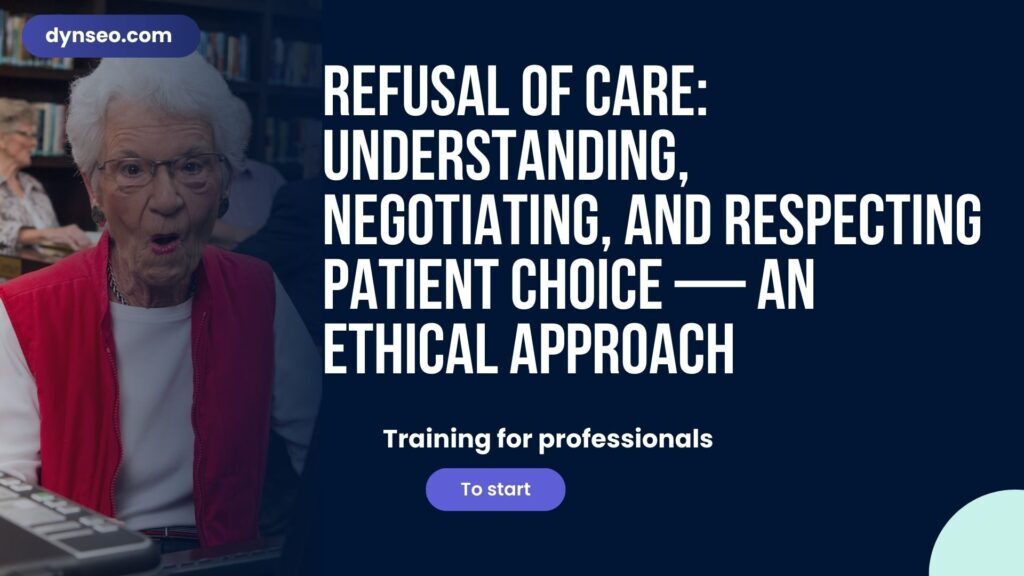
Refusal of Care: The Complete Guide to Understanding What is at Stake
One morning, a caregiver enters the room, prepares the washcloth, extends the glove: “No. Not today.” The same gesture, the same person, was accepted the day before without a word. Elsewhere, a teenager grits their teeth in front of the dentist's chair. Further away, a man pushes away his IV and asks to go home. Three scenes that seemingly have nothing in common — yet, each time, the same word appears in the reports: “refusal.”
In this article
Related training
Cited resources
 Emotion Thermometer
 Choice Wheel - DYNSEO Training Tools
 Conversation Cards
 Voice Scale
The refusal of care is one of the most misunderstood situations in social and medical work. It is recorded as a blockage, a whim, an opposition, while it almost always conveys a message: something in the situation does not suit the person. This guide does not offer miracle solutions. It details what is really happening behind a refusal, how to interpret it, how to distinguish it from similar behaviors, and what the law and recommendations say. The goal: to transform an apparent wall into actionable information.
The Essentials in 30 Seconds
A refusal of care is neither a whim nor a simple opposition: it is a behavior that has meaning, function, and context. Understanding it first requires not taking it for what it is not.
- Refusing care is a right for the adult and conscious person: consent is the rule, not the exception.
- Refusal is a language. Behind the “no,” there is often pain, fear, misunderstanding, loss of bearings, or a need for control.
- Many “refusals” reported as character traits are actually symptoms — cognitive disorders, unrecognized pain, side effects of treatment, poorly chosen context.
- What helps: seeking the cause, adjusting the timing and manner, offering a real choice, coming back later. What does not help: forcing, arguing, threatening, moralizing.
- The central principle: support without constraint. Coercion resolves the moment and destroys the relationship; negotiation takes time and preserves it.
What are we really talking about
The term “refusal of care” actually covers very different situations, and this is the first source of misunderstandings. Refusing a shower does not carry the same meaning as refusing a vital treatment; saying “no” at a specific moment does not equate to a lasting opposition to all care; and the refusal of a fully lucid person is not interpreted the same way as that of a disoriented person. Before taking action, it is essential to understand what we are discussing.
A refusal, several realities
We can distinguish, without claiming to be exhaustive, several forms of refusal that do not call for the same response. The occasional refusal concerns a specific care at a given moment: the person often accepts the same action later or in a different way. The persistent refusal establishes itself over time and questions the meaning of the proposed care. The verbal refusal is expressed through words: “I do not want to,” “leave me alone.” The non-verbal refusal is conveyed through the body: turning away, pursing lips, pushing away a hand, curling up, leaving. For a person who can no longer express themselves verbally, this bodily refusal is sometimes the only available language — and it deserves exactly the same respect.
What the word “refusal” masks
| What is written in the reports | What should be sought behind it |
|---|---|
| “Refused the bath” | At what time? After what? Total refusal or refusal of the washcloth, cold water, this person, this moment? |
| “Opposing” | A lasting character trait, or a reaction to a specific and reproducible situation? |
| “Did not want to eat” | Pain in the mouth, nausea, fatigue, disliked food, poorly chosen moment, sadness? |
| “Aggressive during care” | Pain triggered by the action? Fear? Feeling of intrusion? Startled by an unannounced action? |
| “Refuses his treatment” | Does he understand what it is for? An undesirable effect? A considered decision he has the right to make? |
The whole difference lies here: the word “refusal” closes the reflection, while a well-described refusal opens it. A useful report does not state what the person is; it states what happened, when, under what conditions, and what worked or did not work. This is the raw material for everything that follows.
A refusal is not necessarily a problem to solve. Sometimes, it expresses a legitimate choice that must be heard and respected. The question is therefore not only “how to obtain the care?” but also “is this care, at this moment, in this manner, really what the person needs?”
Two meanings not to be confused
A precise vocabulary avoids many confusions. The expression “refusal of care” refers, in the common language of the medico-social field, to the refusal expressed by the person receiving support — this is the subject of this guide. However, the same expression has a second legal meaning: the refusal of a professional or an establishment to take charge of a patient, which is regulated and penalized when it is discriminatory. The two realities are unrelated. When this guide speaks of refusal of care, it always refers to the first meaning: a person who, through a word or gesture, says “no” to what is being offered.
A phenomenon present in all sectors
Refusal is not exclusive to a specific audience or location. It is encountered in nursing homes, where it often relates to personal hygiene, meals, or treatments; in hospitals, where it may involve examinations or technical care; in the field of disability, where it can crystallize a need for predictability; at home, where the intimacy of the living space makes intrusion even more sensitive; and even in schools or pediatrics, where a child may refuse care out of fear or misunderstanding. The underlying causes are similar across sectors; it is the forms and stakes that vary.
What is really at stake: the mechanisms
To understand a refusal, an image helps: that of care experienced from the inside. The professional sees help, attention, a necessary gesture. The person, however, may experience an intrusion into their intimacy, a loss of control over their body, a constraint imposed at a moment they did not choose. Between these two perspectives, the same gesture does not have the same meaning. Refusal often arises from this gap.
The need for control
Imagine that someone enters your home without knocking, opens your cupboards, and decides the order of your belongings, with the best intentions in the world. Even well-intentioned, this gesture provokes a protective reflex. For a dependent person, whose daily life is largely decided by others — the time to get up, the menu, the time for personal hygiene — saying “no” is sometimes the last space of decision that remains. The refusal then becomes less a rejection of care than an affirmation: “I still exist, I still have a say.”
The fear and anticipation of pain
A treatment that was painful once may be refused long after. The body remembers. A painful mobilization, a bandage ripped off too quickly, a poorly experienced needle: the memory of discomfort is reactivated at the mere approach of the caregiver or the equipment. The refusal here is not directed against the person providing care; it is directed against anticipated pain. This is why unrecognized pain is one of the most frequent, and most silent, causes of refusal.
Misunderstanding and loss of reference points
When a person does not understand what is about to happen to them — because it is not explained, because a cognitive disorder affects comprehension, because the action comes too quickly — refusal is a logical protective reaction. One does not allow themselves to be subjected to what they do not understand. For a disoriented person, an unannounced action can be perceived as aggression: a hand approaching the face, water on the skin, clothing being removed can become threatening due to lack of context.
Protecting oneself
Refusal distances what is experienced as intrusive or dangerous. It is a safeguard function, not an attack.
Communicating
When words are lacking, the body speaks. A refusal can signal pain, discomfort, or an emotion that finds no other outlet.
Maintaining control
Regaining some power over one's life when everything else is decided by others. Saying no is sometimes a way of asserting one's existence.
Expressing a need
Hunger, fatigue, a desire to be alone, an ill-timed moment: refusal often points to an unmet need that must be decoded.
The weight of modesty and life history
Personal hygiene is the care most often refused, and this is no coincidence. Allowing oneself to be undressed and washed by another person directly challenges the modesty built over a lifetime. A person who has always been autonomous, discreet, and concerned about their privacy does not suddenly become indifferent to having their body exposed. Refusal is then a way to protect dignity, not a whim. Similarly, life history weighs heavily: a past traumatic experience, a cultural or religious practice, a painful experience with care can reactivate a refusal that nothing in the present moment explains. Knowing a bit about the person's history — often through relatives — sheds light on refusals that would otherwise be incomprehensible.
When refusal is the only possible language
For a person who has lost their speech or whose reference points are profoundly altered, bodily refusal becomes the main channel of expression. Clenching teeth at the approach of a spoon may mean "I have pain when swallowing," "I am not hungry," "I am tired," or "I do not understand what you are doing." The gesture is the same; the messages are multiple. That is why one should never interpret a non-verbal refusal as a unique and definitive response, but as an entry point to a question: what is it about this specific situation that is not acceptable?
Remembering this changes the approach: one stops asking "how can I make them give in?" and starts asking "what are they telling me?". The first question leads to a power struggle; the second leads to a solution. This shift in perspective is exactly what the training details situation by situation.
Recognizing a refusal, and what is not a refusal
Not everything that resembles a refusal is one. Confusing the scenarios leads to inappropriate, sometimes counterproductive responses. Here are the main confusions to avoid.
Refusal or incapacity?
A person who "does not do" what is asked of them is not always refusing: sometimes, they cannot. An initiation disorder prevents them from triggering an action they actually want to take. A command that is too quick or too complex is not processed in time. A comprehension aphasia means they simply did not grasp what was being asked. The visible result is the same — nothing happens — but the cause has nothing to do with refusal, and forcing or insisting is futile.
Refusal or expression of pain?
For a person who can no longer say they are in pain, the refusal of a movement or care may be the only signal of discomfort. Pushing away a hand during a transfer, screaming when an arm is lifted, stiffening at approach: these are behaviors that should first be interpreted as possible pain and reported as such, rather than noted as opposition.
Refusal or effect of a cognitive disorder?
| What you observe | Refusal indicator | Other possibility to consider |
|---|---|---|
| The person pushes away the meal | They are not hungry or do not like the dish | Pain in the mouth, nausea, difficulty swallowing, fatigue |
| They do not respond to the request | They do not want to cooperate | They did not understand, or cannot hear, or cannot initiate |
| They become agitated during washing | They oppose the care | Unannounced action perceived as an intrusion, water too cold, fear |
| They want to leave the room | They are avoiding care | Need to move, disorientation, seeking a familiar reference |
| They say "no" and then accept later | They changed their mind | The first moment was poorly chosen; the need has not changed |
The practical rule: before concluding refusal, rule out incapacity, pain, and misunderstanding. These three checks are enough to redirect a large part of situations reported as oppositions.
A new refusal from a usually cooperative person should prompt a search for a cause: pain, infection, constipation, adverse effect of a medication, acute episode. Report it without delay. In the presence of signs suggesting a medical emergency — discomfort, sudden confusion, difficulty breathing, intense pain — immediately apply the emergency procedure of the facility and contact emergency services in your country.
Common misconceptions, debunked one by one
The refusal of care carries with it a series of persistent beliefs that often misguide the way to respond. Naming them is already a step towards liberation.
No. Refusing care is primarily the exercise of a right and, very often, the expression of a need. Treating refusal as a misconduct establishes a power struggle that worsens the situation. Refusal is information, not an infraction.
Respecting a momentary refusal is not "giving in": it is recognizing that the timing or manner was not right. Coming back later, differently, often leads to care much more effectively than forcing the issue. Flexibility is not a weakness; it is a strategy.
Attributing a refusal to a character trait shuts down any search for underlying causes. However, most refusals have an identifiable origin: pain, fear, misunderstanding, context. The “doing it on purpose” explanation does not clarify anything and helps no one.
The “for their own good” does not suspend consent or dignity. Forcing comfort care damages the relationship, increases future refusals, and can amount to abuse. There are emergency situations where the law regulates action; these are exceptions, not the daily rule.
A cognitive disorder does not erase the ability to feel, prefer, or express discomfort. Even when medical decisions are made by a third party, the manner of doing things, the pace, and the small daily choices can and should remain those of the person, as much as possible.
Behind these misconceptions lies the same error: taking refusal as a problem of the person, when it is almost always a problem of the interaction between a need, an action, and a context. Shifting the blame to the relationship, rather than the individual, immediately opens up avenues for action.
Moving from theory to daily actions
16 lessons, 100% online, to transform these guidelines into practice: understanding refusal, negotiating without forcing, and respecting the person's choice — a gentle and ethical approach.
Discover the trainingWhat the law and recommendations say
The refusal of care is not just a matter of practice: it is also a matter of law. In France, free and informed consent is a fundamental principle. Understanding this helps to move beyond the false dilemma of “force or abandon.”
Consent is the rule
The law of March 4, 2002, relating to the rights of patients, known as the Kouchner law, clearly established the principle: no medical act or treatment can be performed without the free and informed consent of the person, and this consent can be withdrawn at any time (Article L.1111-4 of the Public Health Code). In other words, an adult who is capable of making decisions has the right to refuse care, even when this refusal seems unreasonable to the professional. The role of the team is to inform about the consequences, seek to understand, propose alternatives — not to coerce.
When the person can no longer consent
When a person is no longer able to express their will, the law provides for alternatives: the trusted person, advance directives, consulting relatives, and a collegial procedure for significant decisions. These provisions, reinforced by the Claeys-Leonetti law of February 2, 2016, aim to respect, as much as possible, what the person would have wished. They remind us of one thing: even when the decision escapes the person themselves, it does not fall to an isolated professional.
Respecting a refusal never means stopping support. The person retains their right to comfort, presence, pain relief, and regular reassessment of their situation. We respect the "no" to this care today; we do not give up on the person.
What the guidelines for best practices recommend
The French recommendations for best practices — put forth by the High Authority of Health, which has taken over the missions of the former agency dedicated to social and medico-social establishments — converge on several points regarding behavioral disorders and refusals. They prioritize non-drug approaches as the first line of action, emphasize the systematic search for a somatic cause (with pain being a primary concern), adaptation of the environment and communication, and strict limitation of any form of constraint. Restraint and restrictive measures are presented as exceptional measures, regulated, reassessed, and never as tools for daily management.
These guidelines also agree on one point that teams observe daily: the quality of the relationship and communication is the primary lever. Care that is announced, explained, offered at the right time, and in respect of the person's pace is much better accepted than imposed care. Technique never replaces the relationship; it complements it.
Constraint: a strictly regulated exception
There are times when refusal clashes with a vital or major safety issue. The law then provides frameworks: restraint and restrictive measures on freedom can only be decided upon medical prescription, for a limited duration, after exploring alternatives, with regular monitoring and reassessment. They are never a comfort response or an organizational tool. The principle remains that restriction is the exception: we do not restrain someone because they refuse a shower; we protect from a specific danger, proportionately, and seek to return to ordinary support as quickly as possible. Any measure of this type falls under a collegial and medical decision, never an individual initiative taken in the moment.
The specific case of the child
When a child refuses care — in pediatrics, at school, with a healthcare professional — the principle remains the same: refusal has meaning, most often fear or misunderstanding. The approach aims to be protective and reassuring, never anxiety-inducing: we explain with age-appropriate words, we do not lie about what will happen, we allow the child an active role when possible, and we involve the holder of parental authority in decisions. Any sign of persistent suffering — intense fear, withdrawal, regression — justifies referring to a doctor or psychologist. Here more than anywhere else, forcing leaves marks: the trust built or damaged at this age weighs on all future relationships with care.
The main steps in response to a refusal of care
In the face of a refusal, there is no magic formula, but there is a process. Here it is in steps, not as a rigid protocol, but as a way to organize reasoning in the moment.
- Welcome the refusal without fighting it. Stop, do not continue the action. Simply say: “Alright, we won’t do it now.” This pause diffuses the power struggle and shows that the “no” has been heard.
- Look for the likely cause. Pain? Fear? Misunderstanding? Bad timing? Unmet need? Observe the context: the time, what happened before, who is present, the noise level.
- Adjust what can be adjusted. Change the moment, the person, the approach, explain differently, offer a real choice (“Shall we start with the hands or the face?”), reduce noise, warm the water, slow down.
- Propose again, differently. Often, the same care can be offered a few minutes or hours later, presented differently. The need hasn’t disappeared; it’s the approach that changes.
- Communicate an actionable fact. Note precisely: time, context, what was refused, what was attempted, what worked. “Toilet refused at 8 AM, accepted at 10 AM after announcing and choosing to start with the hands” is far better than “resistant.”
- Collaborate as a team and alert if necessary. A persistent refusal, new or associated with other signs, should be discussed as a team and reported to the healthcare professional. Diagnosis and prognosis are the physician's responsibility; careful observation is everyone's role.
Offering a choice, even a small one, restores the person's sense of control. “Now or in ten minutes?”, “the blue glove or the pink one?”, “sitting or standing?”. This is not a trick: it’s a concrete way to restore the control that was missing, and often, the refusal calms down with it.
What to expect? That this approach will not always succeed, but it will succeed much more often than forceful methods. That some refusals will persist and must then be respected and reassessed. And that, over time and with a consistent team, a person's “chronic” refusals will decrease when they have been correctly interpreted the first time.
What really helps vs what is useless
In the effort to do well, we sometimes use strategies that worsen the refusal. Distinguishing what helps from what is useless—or even harmful—saves precious time and avoids much tension.
| What helps | What is useless, or worsens |
|---|---|
| Announce each action before doing it | Act quickly and by surprise to “get it done” |
| Offer a real choice, even a small one | Ask a false question when the answer is imposed |
| Be willing to postpone and return differently | Insist, repeat the request louder and louder |
| Look for pain or the cause first | Argue, explain that “it’s for their own good” |
| Get down to their level, slow down, soften your voice | Stand over them, pressure, raise your voice |
| Pass the baton to a colleague | Stubbornly hold your position out of principle |
| Describe facts in communication | Label the person (“resistant,” “difficult”) |
Words that soothe, words that shut down
The wording is just as important as the intention. Here are some concrete examples to adapt to each individual :
“ I see that this is not the right moment, we will continue later. ” — “ What would you prefer to start with ? ” — “ I will wash your right arm, let me know if it bothers you. ” — “ We will go slowly, at your pace. ” Phrases that announce, that leave choices, that offer a hand.
“ You still need to wash yourself. ” — “ Be reasonable. ” — “ You cannot stay like this. ” — “ Come on, it will be quick. ” — Speaking about the person in the third person in front of them. These phrases moralize, pressure, or infantilize, and turn a disagreement into a confrontation.
Simple tools to support the relationship
For individuals with fragile communication, some concrete supports facilitate expression and reduce misunderstandings that lead to refusal. The emotion thermometer helps identify an internal state before it translates into a blockage. The choice wheel materializes the idea of a real choice mentioned earlier. The conversation cards and the voice scale support clearer and calmer communication. These resources are free, just like the entire tool catalog.
On the cognitive stimulation side, maintaining reference points, shared enjoyment, and positive interactions outside of care moments nourishes the trust relationship, which in turn reduces refusals. The SCARLETT app, designed for seniors, offers suitable activities ; the CLINT app is aimed more at adults. Finally, cognitive tests can help better identify preserved abilities to rely on — clinical evaluation remains the responsibility of health professionals.
Forcing to “ provide care ” resolves the moment but damages the relationship in the long term : the next refusal will be stronger, the fear greater. Outside of an emergency situation governed by law and validated collectively, coercion is neither a tool nor a solution. In case of immediate danger, follow the institution's procedure and contact your country's emergency services.
What falls under you, the team, and the medical
In the face of a refusal, everyone has a role, and clarifying these roles avoids both excessive zeal and giving up. No one should bear a complex situation alone.
| Your daily role | What falls under the team | What is strictly medical |
|---|---|---|
| Observe and describe dated and situated facts | Cross observations in meetings | Make a diagnosis |
| Adapt your communication, timing, and pace | Build a coherent and shared approach | Assess and treat pain or a somatic cause |
| Offer choices, respect a temporary refusal | Ensure continuity between teams and substitutes | Decide on a treatment or its cessation |
| Report any new or persistent refusals | Involve the trusted person and relatives | Determine the capacity to consent |
| Apply current guidelines and protocols | Regularly reassess the situation | Supervise any exceptional restrictive measures |
The dividing line is easy to remember: you observe, adapt, propose, and report; the team coordinates and decides collectively; the doctor diagnoses, prescribes, and determines what falls under medical care. A refusal is never managed in the solitude of a hallway: it is contemplated, communicated, and reassessed together.
To go further
Everyday situationsRefusal of care: 10 difficult situations and how to respond
ToolboxRefusal of care: activities, resources, and concrete arrangements to implement
Professional postureRefusal of care: posture, teamwork, and skills development
These four in-depth explorations extend this guide: the first details the educational content of the training, the second analyzes concrete everyday scenarios, the third gathers resources and arrangements, and the fourth focuses on posture and teamwork. Together, they form a coherent pathway around the refusal of care.
Frequently Asked Questions
Does a person really have the right to refuse care?
Yes. In France, free and informed consent is a fundamental principle: the law of March 4, 2002, states that no procedure can be performed without the person's agreement, which can be withdrawn at any time (Article L.1111-4 of the Public Health Code). An adult who is capable of making decisions can therefore refuse care, even if this choice seems unreasonable. The role of the team is to inform about the consequences, to seek to understand, and to propose alternatives, without coercion. Respecting this right never means abandoning the person: comfort, presence, and pain relief are still owed.
How to distinguish a true refusal from an inability to act?
The visible result is sometimes the same — the person "does not act" — but the origin differs. A refusal is often accompanied by a clear intention to say no: turning away, pushing back, expressing disagreement. An inability, on the other hand, relates to a disorder of initiation, an instruction not understood, aphasia, or slow processing: the person would like to act but cannot trigger the action. Insisting is then futile. The right reflex is to first rule out inability, pain, and misunderstanding before concluding a refusal, and then to describe precisely what is observed for the team.
Should one sometimes override the refusal "for their own good"?
The "for their own good" does not suspend consent. For daily comfort care, forcing the issue damages the relationship, increases future refusals, and may constitute abuse. There are situations of vital emergency and specific legal frameworks where action is regulated, but these are exceptions, never the daily rule, and they are decided collectively, not alone in a hallway. The right approach remains to stop, seek the cause, adjust the timing and manner, offer alternatives, and report. Coercion is neither a technique nor a solution.
What to do when a person consistently refuses at the same time?
A refusal that occurs at the same time is valuable information: it almost always indicates a reproducible cause. A bath consistently refused in the morning may be due to fatigue, morning pain, a too abrupt awakening, or a poorly chosen moment. The approach consists of finely describing the context — time, what precedes it, environment — and then testing an adjustment: changing the schedule, altering the approach, providing more information, offering a choice. We communicate what has been tried and what has worked, and we discuss it as a team to build a shared and stable course of action over time.
How to explain a persistent refusal to the family?
By staying within its scope and describing facts rather than interpretations. We explain what we observe and what the team implements: “he refuses to take a shower in the morning, we have moved it to late morning and it goes better.” We remind that respecting a refusal does not mean giving up on support, and that comfort and safety remain ensured. We avoid making statements about the diagnosis or prognosis, which are the doctor's responsibility. Involving the trusted person and relatives in the reflection often helps to better understand the person's past preferences and to ease concerns.
This guide is intended for general professional information. It does not replace a clinical assessment, the protocols of your establishment, or individual prescriptions. For any concrete situation of refusal of care, particularly when it involves safety, pain, or the ability to consent, refer to your management, the multidisciplinary team, and the healthcare professional.
From knowledge to practice: better managing the refusal of care
16 lessons, 100% online, unlimited access at your own pace to understand, negotiate, and respect refusal — a gentle and ethical approach. Certified organization Qualiopi (N° 11757351875), certificate of completion.
Discover the training — €90Did this content help you? Support DYNSEO 💙
We are a small team of 14 people based in Paris. For 13 years, we have been creating free content to help families, speech therapists, care homes and healthcare professionals.
Your feedback is the only way we know if our work is useful. A Google review helps us reach other families, caregivers and therapists who need it.
One action, 30 seconds: leave us a Google review ⭐⭐⭐⭐⭐. It costs nothing, and it changes everything for us.