Training for the Therapeutic Use of Digital Games in Medical Settings
How serious games and cognitive stimulation applications are revolutionizing the care of autistic individuals in healthcare facilities.
Dans cet article
Therapeutic digital games represent a revolution in supporting autistic individuals in medical settings. By combining gamification principles with specific therapeutic goals, these tools provide healthcare professionals with innovative ways to stimulate cognitive functions, work on social skills, and maintain patient motivation. This article explores the scientific foundations, practical applications, and necessary training to integrate these tools into daily practice.
🎯 Scientific Foundations of Digital Therapeutic Games
The use of digital games for therapeutic purposes is based on solid scientific foundations from neuroscience, cognitive psychology, and learning science. The concept of "serious game" refers to a game designed with a primary objective other than pure entertainment, while leveraging game mechanics to engage the user and promote learning or rehabilitation.
Brain neuroplasticity is the fundamental principle underlying the effectiveness of therapeutic games. The human brain, especially the developing brain of a child, is capable of reorganizing itself in response to stimulation and training. Digital games, by offering repeated and progressive exercises targeting specific cognitive functions, activate the corresponding neural circuits and promote their strengthening. This stimulation is even more effective when it is regular, tailored to the individual's level, and associated with a positive experience.
Gamification in Service of Therapy
Gamification applies game mechanics to non-gaming contexts to increase engagement and motivation. In a therapeutic context, these mechanics transform potentially repetitive rehabilitation exercises into attractive and motivating activities. The immediate feedback provided by the digital game is particularly beneficial for autistic individuals who need clear and immediate responses regarding their performance.
Neuroplasticity
Targeted stimulation of neural circuits to promote the strengthening of connections and the acquisition of skills
Gamification
Rewards, progression, and tailored challenges to maintain motivation and transform rehabilitation into a positive experience
Accessibility
Available on tablet and smartphone, usable in sessions and at home for continuous and regular training
Research in neuroscience also shows that learning is optimized when the individual is in a positive emotional state. The game, by eliciting pleasure and curiosity, creates neurochemical conditions favorable to learning: dopamine release, activation of reward circuits, and reduction of cortisol related to stress. For autistic individuals, often faced with experiences of failure in traditional learning, this dimension is particularly valuable.
✨ Specific Benefits for Autistic Individuals
Therapeutic digital games present particular advantages for autistic individuals, due to the match between the characteristics of the digital interface and certain specificities of the autistic profile. Understanding these advantages is essential for professionals who wish to use these tools in a relevant and effective manner.
The digital environment offers predictability and consistency that reassure autistic individuals. The rules are fixed, the system's responses are always the same for the same action, and there is no implicit social dimension to decode. This predictability reduces anxiety and allows the individual to focus on the cognitive task rather than managing social interaction.
- Predictability: stable rules and constant responses that reduce anxiety related to the unpredictability of human interactions
- Absence of social judgment: no gaze of others, no social pressure, freedom to make mistakes and try again without emotional consequence
- Sensory control: ability to adjust volume, brightness, and pace according to the individual's sensory preferences
- Immediate feedback: clear visual and auditory responses regarding performance, without ambiguity or need for social interpretation
- Repetition without fatigue: ability to repeat the same exercise as many times as necessary with playful variations
- Individualization: adaptable difficulty levels allowing for challenges that match each individual's abilities
🎮 Types of therapeutic games and their applications
The landscape of therapeutic digital games is varied and constantly evolving. Professionals need to be aware of the different categories of tools available to choose those that best meet the therapeutic goals of each patient.
Cognitive stimulation games
Cognitive stimulation games target executive functions, memory, attention, reasoning, and visuospatial skills. They offer structured exercises with progressively difficult levels that allow the professional to specifically work on the functions identified as priorities during the assessment. For autistic individuals, these games are particularly useful for training mental flexibility, working memory, and planning, three functions often impacted in ADHD.
Social skills games
Some digital games are specifically designed to work on the social skills of autistic individuals. They offer interactive social scenarios in which the person must identify emotions, understand social situations, and choose appropriate responses. The advantage of digital media is that it allows training in a safe environment, without the consequences of mistakes in a real social situation, before transferring the acquired skills to daily life.
Communication games
Alternative and augmentative communication (AAC) applications use playful mechanics to encourage the use of communication supports. They offer interactive activities that motivate the person to use pictograms, photos, or words to express their needs and participate in exchanges. These tools effectively complement speech therapy sessions and promote the generalization of communicative skills.
💡 Choosing the right tool: selection criteria
The choice of a digital therapeutic game should be based on rigorous criteria: scientific validation of the approach, alignment with therapeutic goals, adaptability to individual profiles, quality of the user interface, ability to track performance, and compliance with data protection standards. The trained professional knows how to evaluate these criteria and select the most relevant tools for each patient.
🏥 Integrating digital games into clinical practice
Integrating digital games into therapeutic practice is not just about putting a tablet in the patient's hands. It requires deep reflection on the intended goals, the choice of activities, the framework for use, and the coordination with other intervention modalities. The trained professional knows how to create a coherent therapeutic program in which digital play occupies a defined and complementary place.
In rehabilitation sessions
In sessions, digital play can serve as the main support for working on a targeted cognitive function, or be used alternately with traditional exercises to vary modalities and maintain engagement. The therapist selects the games and levels of difficulty based on the current objectives, observes the patient's strategies, provides additional guidance, and analyzes performance to adjust their intervention.
As a complement at home
One of the major advantages of digital games is that they allow for regular training between sessions. The professional can prescribe activities to be carried out at home, supervised by parents, and monitor performance remotely. This continuity between sessions and home is essential to consolidate learning and accelerate progress. Parents become active partners in the therapeutic process, which enhances their involvement and understanding of the goals.
⚠️ The tool does not replace the therapist
The digital game is a tool at the service of the therapist, not a substitute. Its effectiveness depends on the competence of the professional who prescribes it, sets it up, analyzes the results, and adjusts its use. Without this clinical expertise, the game remains a simple entertainment. Training is therefore essential for the digital tool to fully fulfill its therapeutic function.
🌟 COCO THINKS and COCO MOVES: an exemplary program
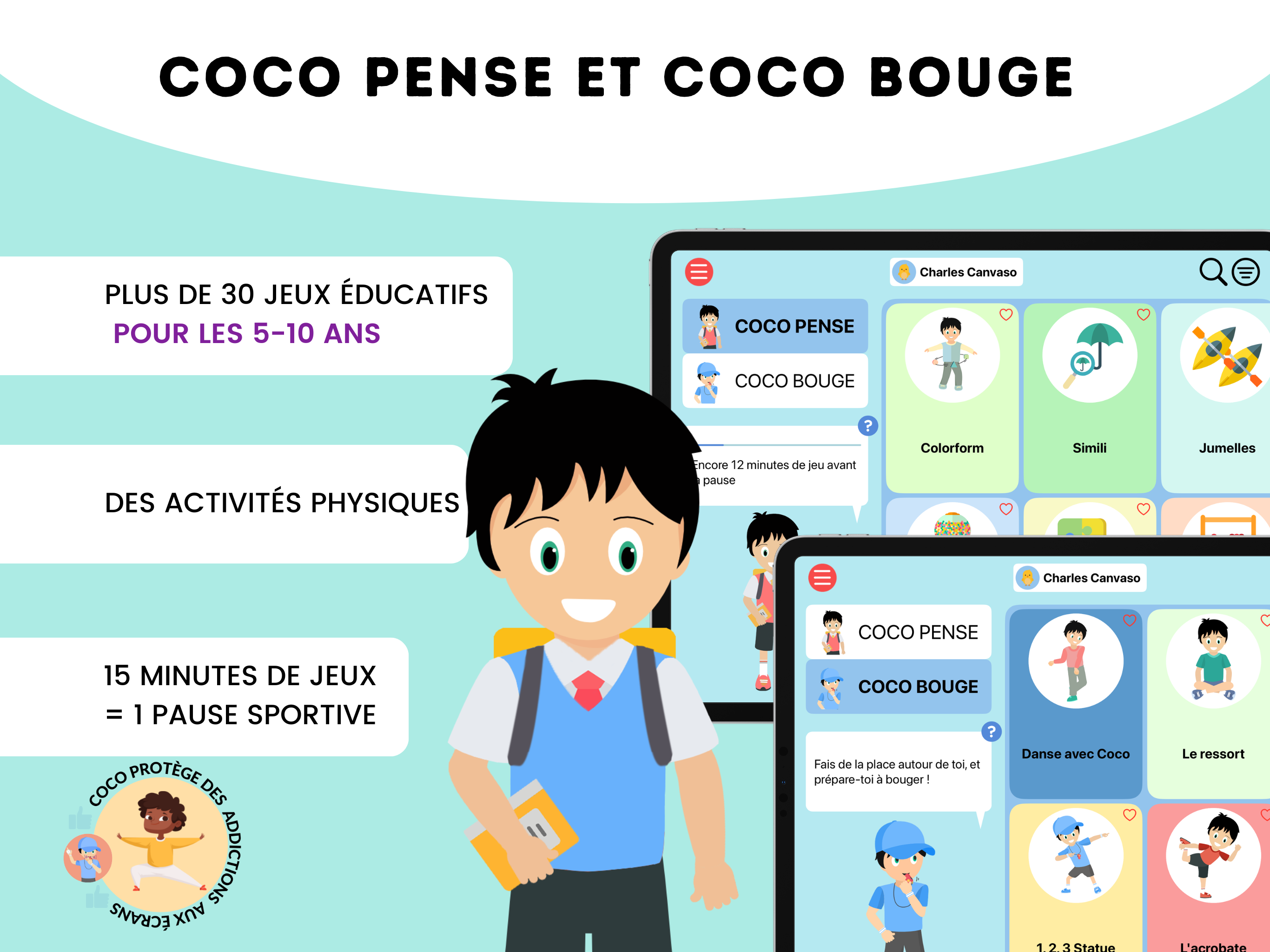
The program COCO THINKS and COCO MOVES from DYNSEO perfectly illustrates what a well-designed therapeutic digital game can bring. Intended for children aged 5 to 10, it combines targeted cognitive activities and physical activities, with a remarkable innovation: mandatory alternation every 15 minutes between the two types of activities.
Targeted cognitive functions
COCO THINKS offers games targeting the main cognitive functions: sustained and selective attention, working memory and visual memory, logical reasoning, visuospatial functions, and mental flexibility. The very well-adapted difficulty levels allow for challenges that match each child's abilities, ensuring a successful experience that boosts motivation and self-esteem.
The innovation of cognitive-motor alternation
The mandatory alternation between cognitive activities and physical activities is an innovation based on research data that shows that movement enhances cognitive performance. For children with autism, this alternation offers a double benefit: motor breaks allow for sensory regulation that then optimizes cognitive performance, and physical activities work on complementary skills such as coordination, imitation, and emotional recognition (notably the game "Mime an Emotion").
🎯 Discover COCO THINKS and COCO MOVES
An innovative cognitive and motor stimulation program, with very well-adapted levels and mandatory alternation between cognitive and physical activities.
Discover the COCO program →📊 Monitoring and evaluating progress
One of the major advantages of therapeutic digital games is their ability to collect objective data on patient performance. Response times, success rates, error patterns, progress curves: these data, analyzed by the trained professional, provide a valuable complement to clinical observations and allow for fine and objective monitoring of progress.
The trained professional knows how to interpret this data in the overall context of care. An improvement in response times in an attention game, for example, can be related to the progress observed in sessions and in daily life. Conversely, a plateau or regression in digital performance may alert to a difficulty requiring investigation (fatigue, changes in the environment, unidentified comorbidity).
Communicating results
The data from digital games facilitate communication with families and care partners. Graphs showing performance evolution are more telling than subjective observations and reinforce the credibility of the intervention. They allow parents to objectively see their child's progress and funders of the intervention to assess its effectiveness.
⚖️ Limitations and best practices
While therapeutic digital games offer remarkable possibilities, their use must be framed by rigorous best practices. The trained professional knows the limitations of these tools and knows how to use them ethically and effectively.
The first limitation concerns the risk of screen dependency. Individuals with autism, due to their attraction to predictable digital environments, may develop excessive use if not monitored. The professional must define appropriate usage durations, vary intervention supports, and ensure that the digital game does not replace human interactions and activities in the real world.
The second limitation is that of generalization. Skills acquired in the digital environment do not automatically transfer to daily life. The trained professional knows how to implement generalization strategies: working on the same skill in different contexts, involving parents in transferring skills, and proposing real-life situations after digital training.
The DYNSEO guides for supporting children with autism and supporting adults with autism offer complementary strategies for comprehensive support that articulates digital tools and interventions in daily life.
🎓 Training with DYNSEO
DYNSEO offers a certified Qualiopi training "Supporting a child with autism: keys and solutions for daily life" which includes modules on the use of digital tools in supporting individuals with ASD. This training is accessible to all health professionals wishing to enrich their practice with innovative tools.

The training covers the principles of therapeutic use of digital tools, criteria for choosing tools, strategies for integration into practice, and analysis of monitoring data. It enables professionals to make the most of digital tools while maintaining a person-centered approach that addresses individual needs.
🎓 Train in therapeutic digital tools
Qualiopi certified training accessible online, to integrate digital games meaningfully into your clinical practice.
Discover the training →🎯 Conclusion
Therapeutic digital games open exciting perspectives for supporting individuals with autism in medical settings. Based on neuroscience and gamification, programs like COCO THINKS and COCO MOVES offer effective, motivating, and adaptable cognitive stimulation tools tailored to the individual needs of each patient.
However, the effectiveness of these tools directly depends on the competence of the professional using them. Training is essential to know how to select relevant games, integrate them into a coherent therapeutic program, analyze monitoring data, and ensure the generalization of learning. The digital game is a powerful ally for the therapist, provided it is used with discernment and expertise.
Innovate to better support:
Digital technology in the service of therapy.
Did this content help you? Support DYNSEO 💙
We are a small team of 14 people based in Paris. For 13 years, we have been creating free content to help families, speech therapists, care homes and healthcare professionals.
Your feedback is the only way we know if our work is useful. A Google review helps us reach other families, caregivers and therapists who need it.
One action, 30 seconds: leave us a Google review ⭐⭐⭐⭐⭐. It costs nothing, and it changes everything for us.