
SCARLETT is set up on the tablet. Your loved one has played once or twice, with pleasure… then the tablet was put back in a drawer. This is the most common story, and it has nothing to do with the quality of the games: what is almost always missing is a routine.
With Alzheimer's disease, improvisation is tiring and worrying, while repetition is reassuring. A short session, at the same time, in the same chair, with the same words to start it gradually becomes a landmark of the day, and not just another chore.
This guide provides you with the complete method: why aim for 15 minutes, at what time, how to establish the habit over 4 weeks, how to structure a session, how to adapt it to the stage of the disease, what to say (and not say), how to get through difficult moments, and how to track progress.
Why 15 minutes a day
Cognitive stimulation is one of the most studied non-drug approaches in Alzheimer's disease and related diseases. Available research summaries, including Cochrane reviews dedicated to cognitive stimulation, report modest but real benefits on cognitive functioning and quality of life in people at a mild to moderate stage, provided that the activity is offered regularly.
The exact "ideal" duration is not set by a universal rule. The 15 to 20 minutes we recommend is a practical benchmark, derived from the field experience of families and facilities that use our games: long enough to offer several varied activities, short enough to stop before fatigue sets in.
Why not longer?
Alzheimer's disease is accompanied by significant attentional fatigue. Beyond 20 to 25 minutes, the same spiral is often observed:
- attention wanes and errors multiply;
- errors generate frustration, sometimes annoyance or sadness;
- the person retains an unpleasant impression of the session, even if they forget the details. The next day, they refuse.
This is a crucial point: the memory of events fades, but emotional memory remains. A session that ends well makes one want to start again; a session that ends in failure leaves a lasting negative mark.
Why not less?
A session of 3 or 4 minutes remains useful on difficult days. But on a daily basis, it only allows for one game, thus only one function being engaged, and leaves little time to "get into" the activity. Fifteen minutes allow for a real mini-course: a warm-up, two or three games that engage different abilities, then a return to calm.
Short and daily is better than long and occasional. An hour on Sunday does not equate to seven sessions of fifteen minutes. What makes it effective is the regular appointment, which becomes a reference point and a habit.
The right time of day
The best slot: the morning, after breakfast
For most people, the window 9:30 AM – 11 AM is the most favorable:
Rested mind
After the night, attention is at its best level. The fatigue of the day has not yet accumulated.
A natural anchor
Get up, wash, have breakfast… then SCARLETT. Tying the session to an existing habit is the best way to not forget it.
Away from "twilight"
At the end of the day, many people become more agitated or confused (twilight syndrome). The morning avoids this moment.
The alternative: early afternoon
If your loved one gets up late, if the morning is occupied with care, or if you are only available in the afternoon, aim for 2:30 PM – 4 PM, after a short nap or quiet time, and in any case before 4:30 PM.
The time to avoid: the evening
After 5 PM, accumulated fatigue, decreasing light, and twilight syndrome make games more difficult. A stimulating activity can also disrupt falling asleep. In the evening, prioritize calming activities: soft music, photo album, conversation, short walk.
For a few days, note when your loved one is most alert, most smiling, most talkative. This personal "good time" takes precedence over all general recommendations. Once chosen, do not change it: it is the consistency of the schedule that creates the reference point.
Prepare the ground before the first session
A large part of failures occurs even before starting the first game. A few minutes of preparation can avoid many frustrations.
Physical comfort
- Clean glasses and hearing aids in place: a poorly seen or poorly heard instruction is often mistakenly taken for a cognitive disorder.
- Bathroom break and glass of water before starting, to avoid interruptions.
- A stable seat with armrests and the tablet placed on an inclined support or cushion, rather than held at arm's length.
- Good lighting, without glare on the screen: avoid having the window behind your loved one.
The environment
- Television and radio off: background noise captures already fragile attention.
- Always the same place: "the tablet chair" becomes a signal in itself.
- Tablet charged and ready, brightness at maximum, volume adjusted, notifications turned off.
The settings in SCARLETT
SCARLETT was designed for seniors: large buttons, simple instructions, no pressure from the timer. Before the first session, take a few minutes to discover the app yourself, identify the games that match your loved one's interests (cooking, music, geography, sports, nature…) and choose an easy difficulty level to start. It's always better to start too easy than too hard.
Avoid saying “We are going to do exercises because your memory is declining.” Prefer a positive and neutral phrasing: “I found a game app, I would like your opinion,” or “Shall we do our little morning quiz?” The word “game” can put some people off, as they find it infantilizing; others prefer “exercises” or “training.” Adapt to your loved one.
The 4-week installation program
You don't go from zero to fifteen minutes of autonomy overnight. The idea is to gradually increase in duration and autonomy, ending each session on a success.
Week 1: Discovery
5 to 10 min · you are nearbyObjective: associate the tablet with a pleasant moment.
- Days 1 and 2: one game, 5 minutes. Choose the most intuitive or the one closest to your loved one's interests. Play a round in front of them while commenting, then hand them the tablet. Stop after a success: “Well done, we’ll do this again tomorrow.”
- Days 3 and 4: two games, 8 minutes. The game from yesterday, now familiar, followed by a new one that engages a different ability (attention after memory, for example).
- Days 5 and 6: two or three games, 10 minutes. Start offering a choice: “Do you prefer this one or that one?”
- Day 7: rest, or a free session if your loved one requests it.
Note during the week: the games that are enjoyed, those that are avoided, those that pose difficulties.
Week 2: The cruising rhythm
12 to 15 min · you stay closeObjective: reach 15 minutes and establish the structure “warm-up – stimulation – cool down” (see below).
- Same time, same place, same opening phrase every day.
- Three to four games per session, always starting with a favored game.
- You stay nearby, but you intervene less and less: give them time to think before helping.
Week 3: First steps in autonomy
15 min · you start, then you step backObjective: for your loved one to play alone for part of the session, if their stage allows it.
- You launch SCARLETT, play the first game together, then announce: “I’m preparing lunch nearby, I’ll be back in ten minutes.”
- Stay within earshot and check in once or twice: “So, how’s it going?”
- Always come back at the end to congratulate and discuss the session.
Week 4: The habit is established
15 to 20 min · accompanied autonomyObjective: for the session to be part of the day, like coffee or the newspaper.
- A visual reminder (a small poster “After coffee: my tablet”) or a gentle alarm on the tablet serves as a trigger.
- Many people start to request their session themselves: this is a sign that the habit is formed.
- Your role is to check the launch, remain available, and value the end of the session.
Some people establish the routine in ten days, others in two months. If a step gets stuck, stay there longer. Going back is not a failure: it's an adaptation. And at an advanced stage, autonomy is not a goal; playing together remains the right formula.
The ideal course of a session
A successful session always has the same form, in three parts. This fixed structure reassures your loved one and allows you to vary the games without disorienting them.
1. The warm-up
A well-liked and well-mastered game. Almost guaranteed success: it builds confidence and gently "turns on" attention.
2. The stimulation
Two or three games that engage different abilities: memory, attention, language, logic, spatial awareness…
3. The return to calm
An easy, enjoyable game or one focused on memories, to end on a positive and soothing note.
Rotating the engaged abilities
It is tempting to only offer memory games. However, the disease also affects attention, language, orientation, reasoning, and organization. Varying the functions from one session to another allows for more complete stimulation and limits fatigue.
Memory
Retaining elements, finding pairs, completing proverbs, songs, or known expressions.
Attention
Spotting an intruder, finding differences, reacting to a specific signal.
Language
Finding words, completing missing letters, guessing from clues.
Logic
Classifying, sorting, completing a sequence, solving small problems.
Orientation
Locating places, reconstructing an image, orienting on a map.
Memories and culture
Songs, trades of the past, cuisine, regions of France: themes that awaken old memories.
Vocal games: another way to stimulate
SCARLETT also offers games that are played by voice, highly appreciated by people who have difficulty manipulating the screen or who enjoy talking. In CYRANO, one memorizes a poem before reciting it aloud; if a line is missed, the coach whispers it. In WHO AM I?, one guesses a character or an object from clues that come one by one, and responds orally; a few letters appear to help if needed.
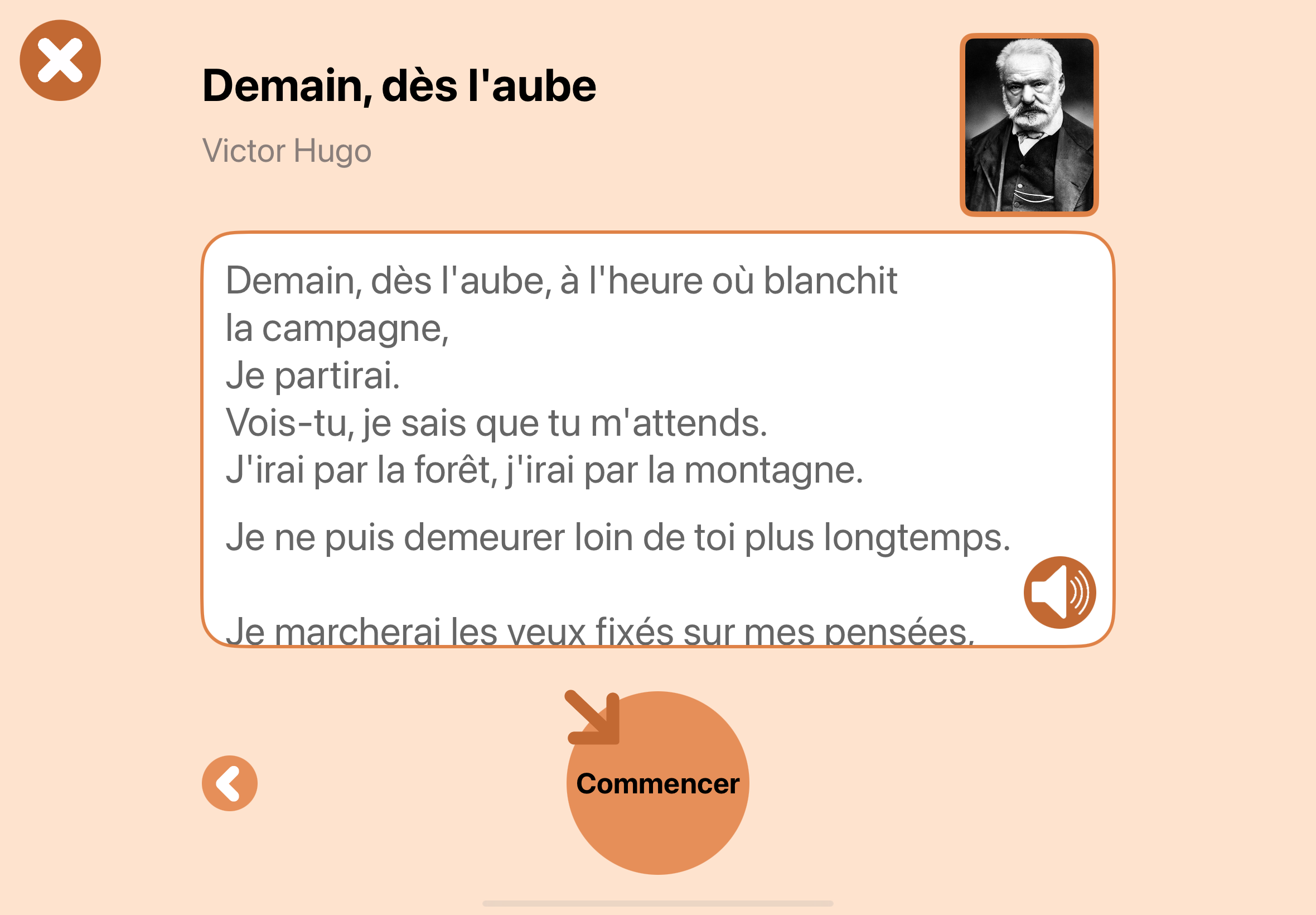
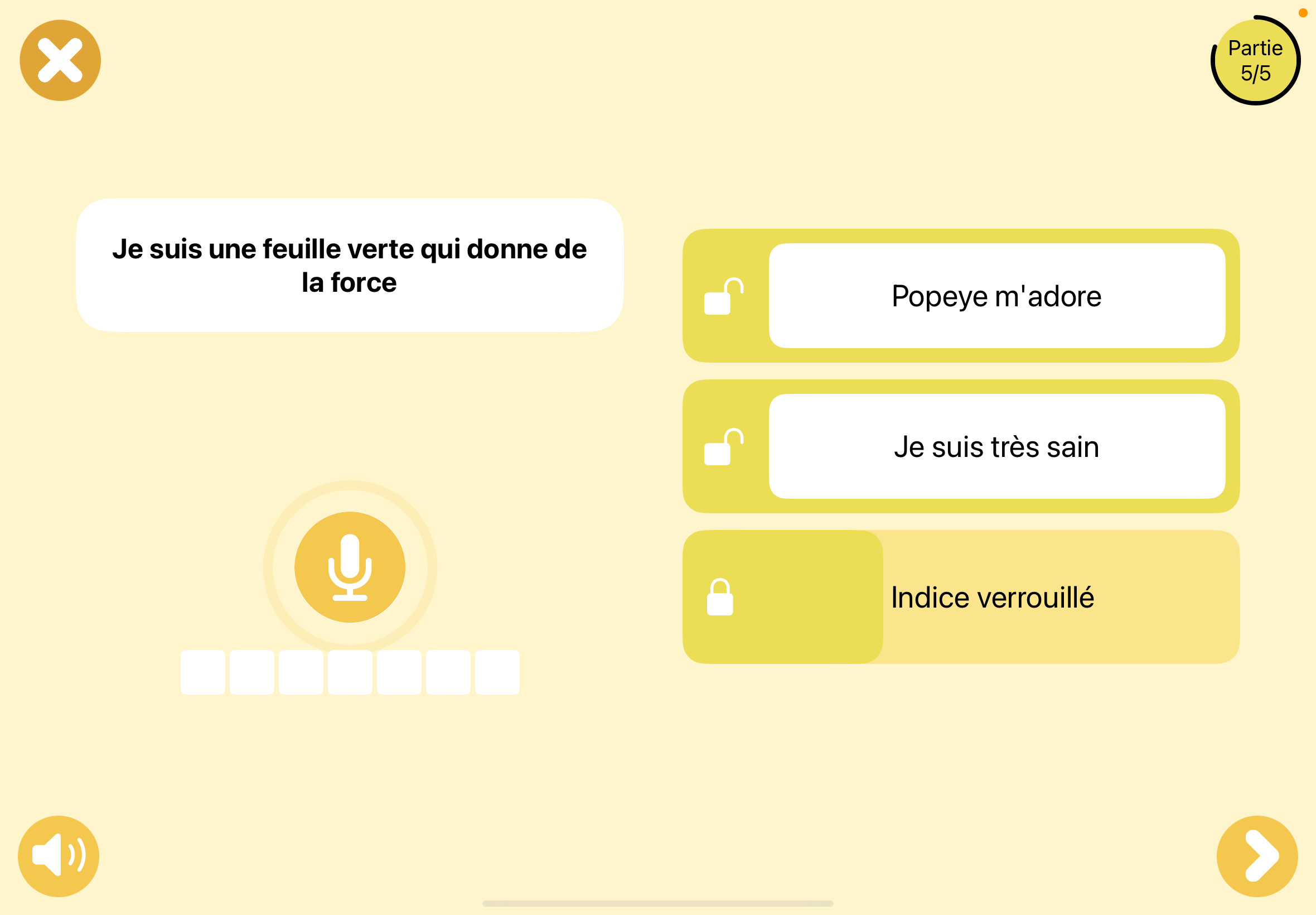
These games naturally find their place in phase 2 (language, memory) or at the end of the session, when the pleasure of reciting or guessing takes precedence over performance.
Always stop on a success, even if the 15 minutes are not reached. If a game goes poorly, return to an easy game, succeed together, then conclude: “It was a great session today.”
Example of a typical week
Here is a sample schedule to adapt to your loved one's tastes. The important thing is to maintain the three-part structure and rotate the engaged abilities.
| Day | Warm-up | Stimulation | Cool down |
|---|---|---|---|
| Monday | Favorite game | Memory + attention | Memory game |
| Tuesday | Favorite game | Language + logic | Easy and enjoyable game |
| Wednesday | General knowledge game | Spotting + memory | Vocal game (riddle) |
| Thursday | Favorite game | Attention + language | Memory game |
| Friday | General knowledge game | Logic + vocal game (poem) | Easy and enjoyable game |
| Saturday | Favorite game | A new game to discover together | Favorite game |
| Sunday | Rest, or free session if your loved one requests it | ||
One new game per week is enough. Introduce it in the middle of the session, never first or last, and do it together the first time. Too much novelty can be disorienting; no novelty at all can be boring.
Adapt the routine to the stage of the disease
The same routine does not suit all stages of the disease. Here are some guidelines; it is always your observation of your loved one that matters.
Early stage
15 to 20 min, with possible autonomy from the 3rd week. Vary the games widely and gradually increase difficulty. The person can choose their games and track their own results, which is empowering.
Moderate stage
10 to 15 min, with close presence. Keep a small number of well-known games and a very stable routine. Rephrase instructions and focus on memory themes and vocal games.
Advanced stage
5 to 10 min, playing together. The goal is no longer performance but shared pleasure and contact. Guide the hand if needed and comment on the images. The time spent together is the real success.
If the routine that has become habitual suddenly becomes impossible (sudden refusal, new confusion, great fatigue), this change should be reported to the treating physician or neurologist. It may have a medical cause (infection, side effect of a treatment, pain, sleep disorder) that is useful to identify.
The role of the caregiver: what to say, what to avoid
Your attitude matters as much as the choice of games. Your loved one perceives your impatience, your worry, or your pleasure, sometimes better than the instructions themselves.
Your three hats
- The guide (weeks 1 and 2): you show, you explain, you reassure. You demonstrate, but you do not play in their place.
- The starter (weeks 3 and 4): you open the session, you remain available nearby, and you come back to conclude.
- The supportive witness (afterwards): you encourage, you discuss the games of the day, you discreetly check the statistics.
Helpful phrases… and those that hurt
✅ To say
- “Take your time, we’re not in a hurry.”
- “That one is really difficult, even for me.”
- “Do you remember this song? Tell me about it.”
- “You had a good eye, well done!”
- “Let’s do the last one, then we’ll go have a coffee.”
❌ To avoid
- “But yes, you know, we did it yesterday!”
- “No, that’s not it.”
- “Focus a little.”
- “Come on, just one more, you can make an effort.”
- Taking the tablet from their hands to “show how it’s done.”
Facing a mistake
Do not correct directly. Wait a few seconds, then offer a hint (“It’s something you find in the kitchen…”). If the mistake persists, provide the answer together (“Let’s look at it together”) and move on. The goal is not the score, but engagement and pleasure.
The 8 most common obstacles (and how to overcome them)
1. “This is not for me, it's for children”
- Talk about “training,” “quizzes,” or “exercises to stay fit.”
- Start with a general knowledge or word game, clearly aimed at adults.
- Play yourself first, out loud: curiosity often does the rest.
- A professional's advice (doctor, speech therapist, psychomotor therapist) often carries more weight than that of a relative.
2. “I don’t know how to use these gadgets”
- Show only one gesture at a time: touch, then later swipe.
- Use a stylus if the finger is imprecise or shaky.
- Voice games bypass the difficulty of manipulation.
3. He forgets the session, even when the habit seems established
- A well-placed visual reminder (“After coffee: my tablet”) on the table or fridge.
- A gentle alarm or notification on the tablet at the usual time.
- The tablet always placed in the same spot, visible, charged.
4. She stops after 5 minutes
- The level may be too high: lower it a notch.
- The game may not appeal to her: go back to the favorites.
- It may be the wrong time of day: test another slot for a week.
- Your presence may be enough to rekindle motivation: play together.
5. He wants to play for an hour
This is a good sign! But a session that is too long can tire and make the person irritable later in the day. Announce the duration at the beginning of the session (“We play until the bell rings”), use a timer, then follow up with another enjoyable activity. You can also suggest a second short session in the early afternoon.
6. Frustration, tears, or anger during a game
- Stop the current game without commenting on the failure.
- Acknowledge the emotion: “That was annoying, let’s set it aside.”
- End on a very easy game, or on a moment of memories.
- Temporarily remove this game from the rotation.
7. Motivation drops after a few weeks
- Introduce a game never tried before, or a new theme.
- Show progress in the statistics: “Look, you’re doing better than at the beginning of the month.”
- Associate the session with a pleasure: favorite coffee, a piece of chocolate, a call to the grandchildren.
- Involve someone else: a grandchild playing with their grandparent often triggers interest.
8. You don’t have time
- Aim for partial autonomy: you start, your relative continues alone.
- Delegate the start to another caregiver: home help, neighbor, family member.
- If the week is really impossible, two or three sessions are better than nothing. Don’t feel guilty: an imperfect routine is still a routine.
Track progress and adjust
SCARLETT records your relative's activity: playtime, games played, results. Once a week, take five minutes to review this data with a caregiver's perspective, not an examiner's.
Playtime
Close to 15 minutes a day? Very good. Significantly less? Look for the brake (moment, level, games). Much more? Consider limiting.
Success rate
Many failures on a game: lower the level. Systematic success and visible boredom: you can increase the level.
Preferences
Always the same games? Keep them for warm-up and introduce variety in the middle of the session.
Trend over a month
Look at the curve over several weeks, not from one day to the next. A bad day means nothing; a lasting decline should be reported to the doctor.
The results observed in SCARLETT do not constitute a diagnosis, but they provide concrete elements on the engagement and regularity of your loved one. Discuss it during consultations with the neurologist, speech therapist, psychomotor therapist, or occupational therapist: they can help you adjust the activities.
Beyond the tablet
The SCARLETT session is not an end in itself: it is a starting point to nourish conversation and connection for the rest of the day.
- Extend memories: a question about past jobs can open a conversation about your loved one's first job, the family farm, or a tour of France followed on the radio.
- Vary the media: on screen-free days, or for those who prefer paper, the SCARLETT Notebooks offer exercises and memory pages to print, on various themes.
- Move too: a walk, even short, just after the session, usefully complements cognitive stimulation.
- Maintain a social life: nothing replaces exchanges with family, friends, or a day care. A grandchild playing with their grandparent is both cognitive stimulation and connection.
In institutions: the same logic on a group scale
In Nursing homes, day care, or senior residences, the routine works the same way: a fixed time slot every morning, an identified place, an animator or caregiver who opens and closes the session, and small groups. The tablet can also be projected for collective sessions, where the discussion around the questions becomes as important as the answers.
And you, the caregiver?
Establishing a routine takes energy, and you may already be lacking it. A few important reminders:
- The session should also be enjoyable for you. If it becomes a source of tension, lighten it: shorter, less frequent, more playful.
- You are not a therapist. Your role is to provide a quality moment, not to achieve results.
- Your loved one's autonomy is also yours. Fifteen minutes of play in semi-autonomy means fifteen minutes of respite.
- Get help. Support and respite platforms, family associations, support groups, day care: don’t wait until you are exhausted to seek help.
At first, I wanted him to "do his exercises." It always ended badly. The day I decided it was just our moment together, with coffee, everything changed. Now he is the one who reminds me of the time.
A situation often described by caregivers who write to us- I have identified the best time of day for my loved one.
- I have chosen a fixed, quiet, and well-lit location.
- The tablet is charged, bright, sound adjusted, notifications turned off.
- I have discovered SCARLETT myself before the first session.
- I have identified 3 or 4 games related to their interests.
- I have found a positive opening phrase.
- I start with 5 minutes and one game.
- I always finish on a success.
- I have planned a visual reminder or an alarm.
- I will check the statistics once a week.
Frequently Asked Questions
Do I really need to play every day?
The ideal is 5 to 6 days a week, with one day of rest. But a routine of 3 or 4 sessions per week, maintained over time, is much more useful than a daily routine abandoned after two weeks.
My loved one always plays the same game. Is that a problem?
No, as long as it makes them happy. Keep this game for warm-up or at the end of the session, and slip in one or two different games in between. Enjoyment remains the main driver.
Can we play together, in groups?
Yes, and it is even recommended at a moderate or advanced stage. Playing with a partner, child, or grandchild adds a very valuable social and emotional dimension.
What if there are no visible "progress"?
In a progressive disease, maintaining engagement, enjoyment, and participation is already an important goal. Do not judge the usefulness of the routine by scores, but by mood, interest, and the quality of the shared moment.
Does SCARLETT replace speech therapy or medical follow-up?
No. SCARLETT is a daily stimulation tool that complements care by health professionals, never replaces it. Do not hesitate to talk to them about the routine you have set up.
What if my loved one does not like screens at all?
Do not insist to the point of creating a conflict. Paper supports like SCARLETT's Notebooks allow you to maintain the same routine (same time, same duration, same three-part structure) without a tablet.
In summary: an appointment, not a performance
Fifteen minutes is almost nothing in a day. Repeated day after day, they become a reference point, a moment of pride, and often a moment of complicity. It is this regularity, much more than the difficulty of the games, that makes SCARLETT a true support tool rather than just another app.
- Same time, same place, same ritual.
- About 15 minutes, starting shorter.
- Three parts: warm-up, varied stimulation, calming down.
- Always finish on a success.
- Enjoyment before score.

Start the routine tomorrow morning
SCARLETT offers memory games designed for seniors, with large buttons, simple instructions, themes that resonate with their generation, and voice-activated games.
Discover SCARLETT Printable SCARLETT NotebooksTo go further
15 minutes a day. A ritual. A shared moment.
Did this content help you? Support DYNSEO 💙
We are a small team of 14 people based in Paris. For 13 years, we have been creating free content to help families, speech therapists, care homes and healthcare professionals.
Your feedback is the only way we know if our work is useful. A Google review helps us reach other families, caregivers and therapists who need it.
One action, 30 seconds: leave us a Google review ⭐⭐⭐⭐⭐. It costs nothing, and it changes everything for us.