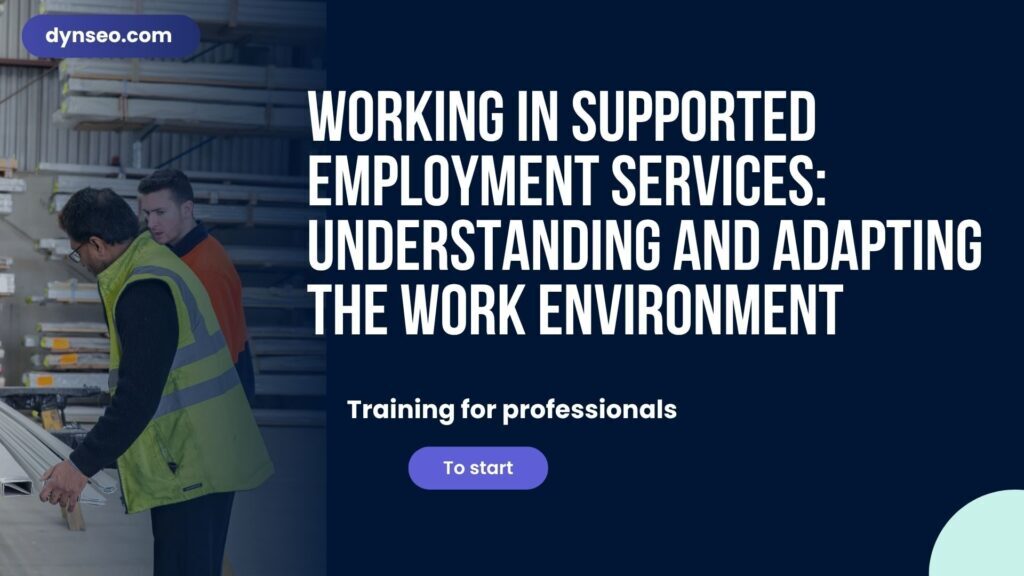
Guide: Working in ESAT
Understanding and Adapting the Work Environment
Everything that professionals, families, and disabled workers need to know about ESAT: operation, rights, adaptations, and tools for successful inclusion through work
Dans cet article
La formation associée
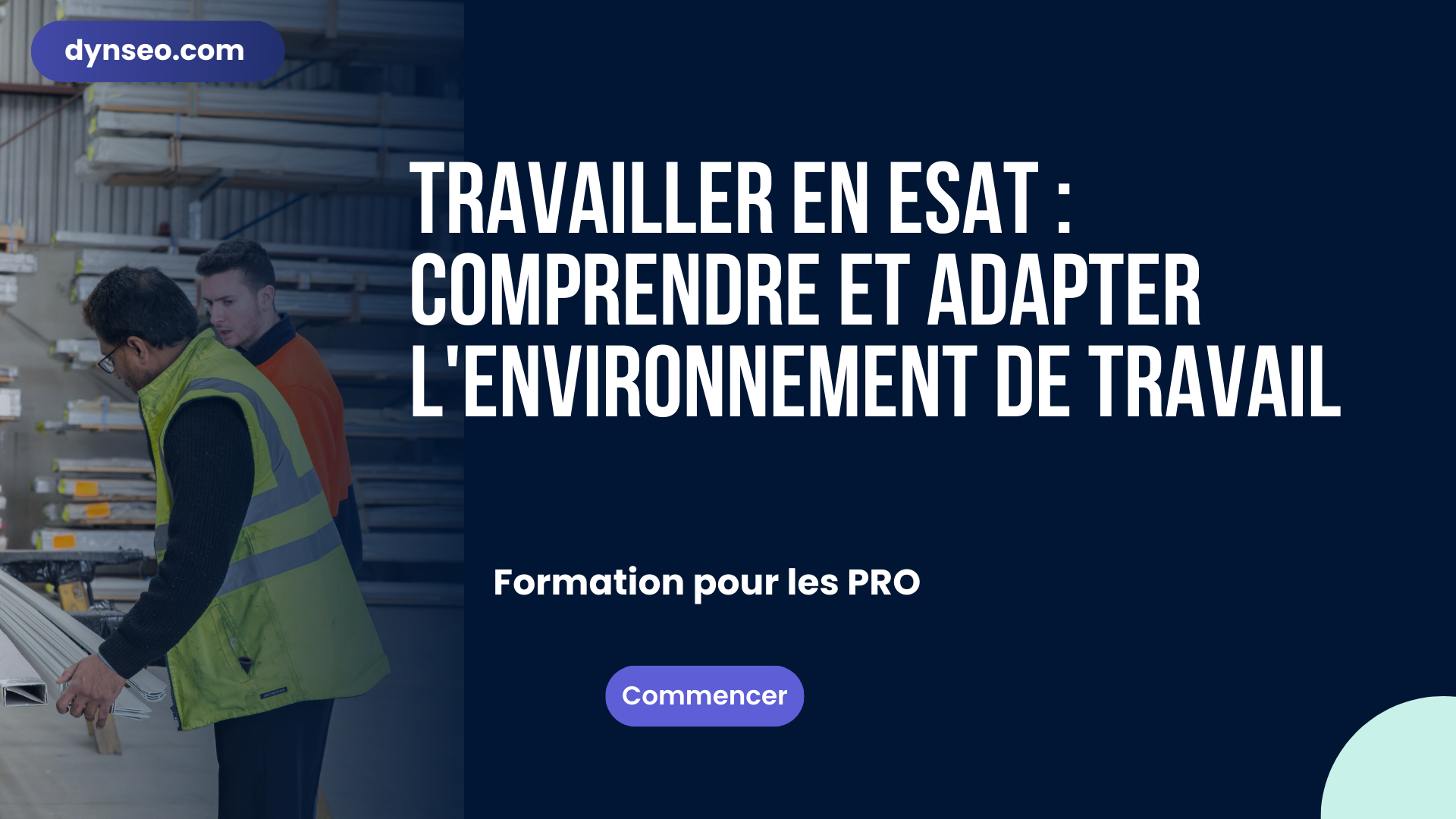
Les ressources citées
 Thermomètre des émotions
 Timer Visuel
 Tableau de motivation - Outil Formation DYNSEO
 Tableau 3 colonnes
The Establishments and Services for Work Assistance (ESAT) are an essential pillar of the French system for the professional integration of people with disabilities. They welcome more than 120,000 workers each year — adults with mental, psychological, motor, or sensory disabilities — in a work environment adapted to their capabilities. But what exactly is an ESAT? How does one enter it? What rights do workers have? And above all, how can professionals adapt the work environment so that each worker reveals their full potential? This comprehensive guide answers all these questions, with the tools and resources necessary to support ESAT workers with kindness and efficiency.

Working in ESAT: understanding and adapting the work environment
The reference training for all professionals who support disabled workers in ESAT. Understand the specificities of each disability, master the techniques for adapting the environment, develop effective communication and monitoring tools — online, at your own pace, certified.
💻 100% online
⏱️ At your own pace
💰 Fundable by OPCO
1. What is an ESAT? Definition and Legal Framework
An Establishment and Service for Work Assistance (ESAT) is a medico-social structure that offers disabled individuals professional activities and medico-social and educational support, in a protected and adapted work environment. Created by the law of June 30, 1975, ESAT have evolved significantly since then — particularly with the law of February 11, 2005 for equality of rights and opportunities, and the major reform of 2024 that strengthened workers' rights.
An ESAT is neither an ordinary company nor a medical establishment: it is a hybrid system, at the crossroads of the world of work and the medico-social world. The individuals welcomed do not have the status of employees in the sense of the Labor Code — they have the status of disabled worker in ESAT, with specific rights, guaranteed remuneration, and integrated medico-social support.
📌 ESAT vs Adapted Company (EA): what is the difference?
The ESAT and the Adapted Company (EA) are two different structures for the employment of people with disabilities. The ESAT welcomes individuals whose work capacities do not reach one-third of normal capacity — in a medico-social framework with enhanced support. The EA, on the other hand, is a fully-fledged traditional company that hires disabled workers on permanent or fixed-term contracts with full employee status. The most autonomous individuals can be directed to an EA; those who require sustained medico-social support are directed to the ESAT.
2. ESAT workers: profiles and specific needs
ESATs welcome individuals with very diverse disability situations. Understanding the diversity of these profiles is the first condition for adapting the work environment appropriately.
Mental disability / intellectual deficiency
The most represented profile. Includes Down syndrome, mild to moderate deficiencies. Needs: stable routines, simple instructions, repetition, and positive reinforcement.
Autism Spectrum Disorder (ASD)
30% of ESAT workers. Very heterogeneous profiles. Needs: predictable environment, adapted communication, sensory sensitivities taken into account, clear work rituals.
Psychic disability
Schizophrenia, bipolar disorders, stabilized severe depression. Needs: containing but flexible framework, management of fluctuations, relapse prevention, connection with care teams.
Motor and sensory disability
Cerebral palsy, sequelae of Stroke, visual or auditory deficiencies. Needs: physical accessibility, adapted technical aids, alternative communication if necessary.
Complex and multiple disabilities
Combination of several types of disabilities. Needs: highly reinforced individualized support, personalized project co-constructed with the family and the multidisciplinary team.
"Dys" profiles and ADHD adults
Dyspraxia, severe dyslexia, ADHD with significant functional impact. Needs: visual supports, explicit organization of space, assistance with planning and time management.
The golden rule of support in ESAT: There is no typical profile of an ESAT worker but as many profiles as there are individuals. Two people with the same pathology can have radically different adaptation needs. The personalized support project (PPA), co-constructed with the worker, their family, and the multidisciplinary team, is the fundamental tool for individualizing support.
3. The ESAT reform 2024: the new rights of workers
The law of December 18, 2023 (gradually coming into effect in 2024-2026) has profoundly transformed the rights of ESAT workers, bringing them closer to common labor law. These changes are significant and must be known by all stakeholders.
| Right | Before 2024 | Since 2024 |
|---|---|---|
| Paid leave | Limited rights, variable according to the ESAT | 25 working days/year — alignment with common law |
| Complementary health insurance | Not mandatory | Mandatory for the ESAT — partial coverage |
| Restaurant vouchers | Not provided | Accessible to ESAT workers |
| Professional training | Limited access to CPF | CPF open, mandatory ESAT training plan |
| Collective representation | Social Life Council (CVS) | Strengthened CVS + worker delegates |
| Guaranteed remuneration | 5 to 20 % of the minimum wage + AAH | Maintained + gradual revaluation |
⚠️ Point of vigilance for ESAT management: Compliance with the 2024 reform requires significant organizational and budgetary adjustments. Management teams must ensure that training plans, insurance contracts, and leave rights are updated. Workers and their families can now claim these rights — ignorance is no longer a legal excuse.
4. The adapted work environment: fundamental principles
Adapting the work environment in ESAT is not just a legal obligation — it is the sine qua non condition for professional success and the well-being of workers. This adaptation is based on several fundamental principles.
🔧 The 7 pillars of the adapted work environment in ESAT
Clear task structuring
Instructions broken down into simple steps, visually represented, accessible to all
Visible time markers
Schedule displayed, visual timers, stable start and end of day rituals
Sensory management
Reduction of noise, harsh light, odors — decompression space available
Adapted communication
Pictograms, Easy to Read and Understand (FALC), visual supports, AAC if necessary
Recognition of achievements
Frequent positive feedback, recognition of progress, celebration of milestones
Multidisciplinary teamwork
Workshop monitors, educators, psychologists, coordinating physician — constant coordination
Continuous individualized follow-up
Updated personalized project, regular assessments, adjustments according to each worker's evolution
5. Adaptations according to the type of disability
5.1 Adapting the environment for people with ASD
People with autism spectrum disorder represent a growing proportion of ESAT workers. Their adaptation needs are specific and often poorly understood by professionals who have not received dedicated training.
Predictable spatial organization
Each tool has a fixed and visibly marked place. The workspace is defined and stable. Job changes are anticipated and prepared in advance.
Work routines and rituals
The sequences for starting and finishing tasks are ritualized and identical each day. Any change in schedule is announced in advance and accompanied by a visual explanation.
Management of hypersensitivities
Access to hearing protection if necessary, dim lighting in rest areas, possibility of sensory breaks in a dedicated quiet space.
Augmented Alternative Communication
PECS or Boardmaker pictograms, tablets with AAC for non-verbal or minimally communicative individuals. The MON DICO application from DYNSEO is particularly suitable.
The MON DICO application from DYNSEO is a tool for Augmented Alternative Communication (AAC) specially designed for non-verbal or minimally communicative individuals — including many ESAT workers with ASD. It allows expressing needs, preferences, emotions, and requests related to daily work, significantly reducing frustration and challenging behaviors related to communication difficulties.
5.2 Adapting the environment for individuals with mental disabilities
Workers with mental disabilities (schizophrenia, bipolar disorders, stabilized severe depression) require specific adaptations, often overlooked as they are less visible than those related to intellectual or physical disabilities.
A structured yet flexible framework
Workers with mental disabilities need a clear and predictable framework — but also flexibility for days when their condition fluctuates. Plan tailored adjustments (adapted hours, temporarily reduced workload) without stigmatizing these adaptations.
Awareness of precursor signals of crisis
Train workshop monitors to recognize signs of decompensation — unusual isolation, increasing agitation, disorganized speech, behavioral changes — to intervene before the crisis and quickly coordinate with the care team.
Constant link with the external care team
Most workers with mental disabilities have external psychiatric follow-up. The ESAT must maintain an active link with this team — sharing information while respecting confidentiality, coordinating during hospitalizations or treatment changes.
DYNSEO Emotion Thermometer
The emotion thermometer allows ESAT workers to express their emotional state of the day in a simple and visual way — a valuable prevention tool to detect distress early before it evolves into a behavioral crisis or decompensation.
Access the tool5.3 Adapting the environment for people with intellectual disabilities
People with intellectual disabilities represent the majority of ESAT workers. Their adaptation needs mainly focus on simplifying instructions, organized repetition of learning, and the sensory environment.
- Instructions broken down into simple unit steps, illustrated by pictograms or photos
- Gesture demonstrations rather than lengthy verbal explanations
- Regular and rewarding repetition of professional gestures to anchor automatic responses
- Permanent visual display of task steps within reach of the workstation
- Personalized tracking notebook to record learning and progress
- Immediate and systematic positive reinforcement of appropriate behaviors
- Anticipation of transitions (break, task change, end of day)
6. Practical tools for workshop supervisors
The workshop supervisor is the frontline professional in supporting ESAT workers. Their role combines technical expertise (mastery of the workshop profession), pedagogical skills (transmission of know-how), and medico-social support skills (observation, adaptation, coordination). Several DYNSEO tools are directly usable in this context.
DYNSEO Visual Timer
The visual timer is essential in the ESAT workshop. It makes time concrete and visible for workers who have difficulty perceiving the passage of time. It structures work sequences, breaks, and transitions, reducing anxiety related to temporal uncertainty and facilitating autonomous work organization.
Access the visual timerDYNSEO Skills Tracking Chart
The skills tracking chart allows the workshop supervisor to visualize for each worker the skills acquired, skills in the process of being acquired, and upcoming objectives. A tool for managing the personalized support project, directly usable during assessments with the family and the multidisciplinary team.
Access the chartDYNSEO Session Tracking Sheet
The session tracking sheet allows for daily recording of activities performed, the general state of the worker, notable behavioral observations, and adaptations made. Essential traceability for multidisciplinary coordination and for the continuous adjustment of the personalized project.
Download the sheetDYNSEO Motivation Chart
Identify the activities that generate the most engagement for each worker, the sources of job satisfaction, and the individual motivation levers — the motivation chart helps monitors build a work program tailored to the actual preferences of each worker, sustainably enhancing engagement and well-being in the workshop.
Access the chartDYNSEO 3 Column Chart
The 3 column chart is a highly adaptable visual structuring tool in ESAT: it can be used to organize the steps of a professional task, to break down a manufacturing process, or to structure the preparation of an activity. Its visual simplicity makes it accessible to a wide range of understanding levels.
Access the chart7. Cognitive Stimulation in ESAT: Maintaining and Developing Abilities
Cognitive stimulation is not reserved for facilities for elderly people. In ESAT, it plays an essential role in maintaining and developing the cognitive abilities of workers, preventing regression related to routine, and strengthening the functions directly involved in work: working memory, attention, planning, problem-solving.
The application CLINT from DYNSEO is specifically designed for adults and offers cognitive stimulation activities tailored to different levels of difficulty. It can be integrated into the ESAT activity program as a stimulation tool between two production tasks, during quiet times, or as part of support activities. The DYNSEO cognitive tests allow for the assessment of each worker's cognitive profile and the adaptation of the stimulation activity levels to their actual abilities.
“In ESAT, we often talk about work as therapeutic — and that's true. But it's not just work that is therapeutic: it's adapted, valued, supported work. A worker who succeeds in their tasks, who is recognized for their skills and who progresses — that is what truly changes life trajectories.”
— Perspective of an ESAT director with 15 years of experience in the field8. The Personalized Support Project (PPA): Central Tool
The Personalized Support Project (PPA) is the foundational document of the relationship between the ESAT and the worker. It formalizes professional and medico-social objectives, support modalities, adaptations put in place, and progress indicators. Since the 2024 reform, it must be co-constructed with the worker themselves — and not solely with their family or guardian.
The Multidisciplinary Initial Assessment
Before entering ESAT, a multidisciplinary assessment (educator, psychologist, doctor, reference monitor) identifies preserved abilities, specific difficulties, and necessary adaptations. This assessment is the basis of the initial PPA.
The co-construction with the worker
The PPA must be constructed with the worker — in a language and format that are accessible (Easy to Read and Understand, pictograms if necessary). Their wishes, activity preferences, and professional aspirations must be at the center of the approach, not just their limitations.
The annual review and interim assessments
The PPA is reviewed at least once a year during a multidisciplinary meeting with the worker and their family or legal representative. More frequent interim assessments are recommended for evolving or complex situations.
The articulation with other systems
The PPA must be articulated with the MDPH file, the disability compensation plan (PCH if applicable), medical prescriptions, and external therapeutic orientations. Consistency between all these documents is essential for the continuity of support.
9. Training of professionals in ESAT: a major challenge
The quality of support in ESAT directly depends on the training of professionals. Workshop instructors, educators, psychologists, directors — all must master the specifics of the different types of disabilities accommodated and the techniques for adapting the work environment.
📚 What the workshop instructor must know
- Understand the characteristics of each type of disability
- Adapt instructions to each cognitive profile
- Use alternative communication (pictograms, AAC)
- Manage challenging behaviors without restraint or punishment
- Provide information on traceability and monitoring tools
- Collaborate with the multidisciplinary team
- Support transitions (new position, absence, return)
🎓 Recommended training
- Initial training: Professional Certificate in Youth, Popular Education, and Sport (BPJEPS) with a focus on social animation
- Certificate of Workshop Instructor (CMA) — specific ESAT training
- Continuing education: behavioral disorders, autism, mental disability
- DYNSEO training: Working in ESAT — understanding and adapting the environment
- Easy to Read and Understand (FALC) for adapted communication
DYNSEO Training — Working in ESAT: understanding and adapting the work environment
The complete training for all ESAT professionals — workshop instructors, educators, directors, psychologists. Understand the specifics of each disability, master adaptation techniques, develop effective monitoring tools. 100% online, at your own pace, certified Qualiopi and fundable by your OPCO.
Access the training →10. Families of ESAT workers: essential partners
The family of the ESAT worker — parents, siblings, legal guardian — is an indispensable partner in the support process. Their knowledge of the person (life history, habits, triggers for well-being or discomfort) is irreplaceable for adapting support in ESAT. Conversely, what the worker experiences in ESAT must be shared with the family to ensure the coherence of overall support.
Co-construction of the PPA
The family participates in personalized project meetings and brings its intimate knowledge of the person. Its observations of behavior at home complement those of the team in the workshop.
Regular communication
Regular exchanges (communication book, phone meetings, encounters) allow the family to be informed of progress and to quickly report any changes at home that could explain unusual behavior in the workshop.
Home-ESAT consistency
The adaptation strategies implemented in the workshop should ideally be known and applied at home — and vice versa. This consistency enhances the effectiveness of support and prevents confusion related to contradictory approaches.
Family training
Families who understand the functioning of their loved one and the appropriate support techniques become true co-therapists. DYNSEO training available through e-learning is particularly suited to their reality of a busy schedule.
11. Pathways to the ordinary environment: the role of the ESAT in the journey
The ESAT is not always a final destination. For some workers, it constitutes a step in a gradual integration journey into the ordinary work environment. Since the 2005 law, ESATs can enter into agreements with ordinary businesses — allowing the most autonomous workers to temporarily work in a standard company while retaining their ESAT status.
These placements are powerful inclusion levers — but they require careful preparation: assessment of the worker's ability to manage an ordinary environment, training of the host company on the specific needs of the worker, enhanced support during the transition period, and continuous evaluation to adjust or interrupt if the situation is not suitable.
🌱 The "zero without solution": a legal obligation
The law of January 26, 2016 established the principle of "zero without solution": any disabled person who needs it must be able to access an appropriate support solution without excessive delay. In this context, the ESATs play a crucial role in guaranteeing a place for people who cannot be accommodated in other structures. Waiting lists, sometimes very long, represent a difficult reality that ESATs and MDPHs are working to reduce.
12. Resources and perspectives: the ESAT of tomorrow
The ESAT sector is undergoing a major transformation. The 2024 reform, the challenges of inclusion, digital technology as a lever for adaptation, and the strengthening of workers' rights are shaping a new face for these structures. The ESAT of tomorrow will be more open to the ordinary environment, more attentive to workers' rights, and better equipped with digital support tools.
All DYNSEO resources — from online cognitive tests to assess abilities, to the applications CLINT and MY DICTIONARY for stimulation and communication, including all the free tracking and organization tools — constitute a valuable digital ecosystem to support this transformation.
Working in ESAT: a human mission that is professionalizing
Working in an ESAT — whether as a worker, instructor, director, or family member — is to engage in a demanding and deeply rewarding human adventure. Adapting the work environment is not a constraint: it is the condition that allows each worker to reveal their skills and contribute with pride to a real professional activity. Training for this mission is choosing excellence in support.
Access the DYNSEO ESAT training →FAQ — Working in ESAT: Frequently Asked Questions
Q1 How to integrate into an ESAT? What are the admission conditions?
Admission to an ESAT requires a referral issued by the Commission for the Rights and Autonomy of Disabled Persons (CDAPH), within the MDPH (Departmental House for Disabled Persons). This referral is granted to individuals whose work capacities do not reach one third of the normal capacity and who require medical-social support. The MDPH file includes a medical assessment, a psychological and social evaluation, and the person's project. Once the referral is granted, the person can contact the ESATs in their department to apply — waiting lists often exist.
Q2 What is the remuneration of a worker in an ESAT?
The remuneration of ESAT workers consists of two elements: a guaranteed salary paid by the ESAT (between 5% and 20% of the minimum wage depending on the activities and results of the establishment), and the Disabled Adult Allowance (AAH) paid by the CAF, which complements this remuneration. In total, an ESAT worker receives on average between €800 and €1,200 per month depending on their situation. Since the 2024 reform, additional improvements (mutual insurance, meal vouchers) have been added to this system.
Q3 Can an ESAT worker leave the ESAT to work in a regular environment?
Yes — this is even one of the objectives of certain pathways in ESAT. Secondment agreements allow an ESAT worker to temporarily work in a regular company while maintaining their status and ESAT support. If the person proves capable of working independently in a regular environment, they can request a review of their MDPH referral to join an Adapted Company (EA) or a regular company. The CDAPH then evaluates the situation and can modify the referral.
Q4 How to manage a difficult behavior of an ESAT worker in the workshop?
Challenging behaviors in the workshop first require a functional analysis: identifying what triggers them, what they communicate, and what reinforces them. In the vast majority of cases, a challenging behavior is an attempt to communicate an unmet need or an emotion that is difficult to express otherwise. The response should never be punitive — it should be preventive (reducing triggers), communicative (offering alternative expressions), and relational (building trust). Training for supervisors in managing challenging behaviors is essential.
Q5 Is the DYNSEO training "Working in ESAT" suitable for families or only for professionals?
The training Working in ESAT: Understanding and Adapting the Work Environment is aimed at both ESAT professionals (workshop supervisors, educators, directors, psychologists) and families who wish to better understand how the ESAT operates and effectively engage in supporting their loved ones. It is accessible online at any time, at one's own pace, from a computer or tablet. It is certified Qualiopi and can be funded by the OPCO for professionals, and directly accessible for families.
Did this content help you? Support DYNSEO 💙
We are a small team of 14 people based in Paris. For 13 years, we have been creating free content to help families, speech therapists, care homes and healthcare professionals.
Your feedback is the only way we know if our work is useful. A Google review helps us reach other families, caregivers and therapists who need it.
One action, 30 seconds: leave us a Google review ⭐⭐⭐⭐⭐. It costs nothing, and it changes everything for us.