Invisible Disability Training: What Managers Need to Know — Program, Content, and Reviews
80% of disabilities are invisible. Discover the complete content of the DYNSEO online training for managers and HR — Qualiopi certified, accessible to all.
Dans cet article
La formation associée
Invisible Disability in the Workplace: A Blind Spot in Management
Visible disability — the wheelchair, the white cane — is the one for which companies have organized their accessibility policies and support procedures. But this is a tiny minority of actual situations. The vast majority of people with disabilities in French companies suffer from conditions that no one sees: chronic pain that worsens after 2 PM, neurological fatigue that makes concentration impossible at the end of the day, overwhelming anxiety that causes missed presentations, cognitive disorders post-Stroke that slow down information processing.
These employees are there, in your teams. They do what they can to meet their professional commitments — often at the expense of their health. And when their performance fluctuates or declines, their manager sees it as a motivation or competence issue. The DYNSEO training on invisible disability starts from this observation to propose another framework for understanding.
Legal Definition of Disability in France
The law of February 11, 2005 defines disability as "any limitation of activity or restriction of participation in social life experienced in one's environment by a person due to a substantial, lasting, or permanent alteration of one or more physical, sensory, mental, cognitive, or psychological functions, a multiple disability, or a disabling health condition." This definition is broad — and it explicitly covers chronic illnesses, psychological and cognitive disorders, which are precisely the least visible forms of disability.
🎓 Training Invisible Disability: What the Manager Needs to Know
Qualiopi certified training · Online · At your own pace · For managers, HR directors, and disability referents
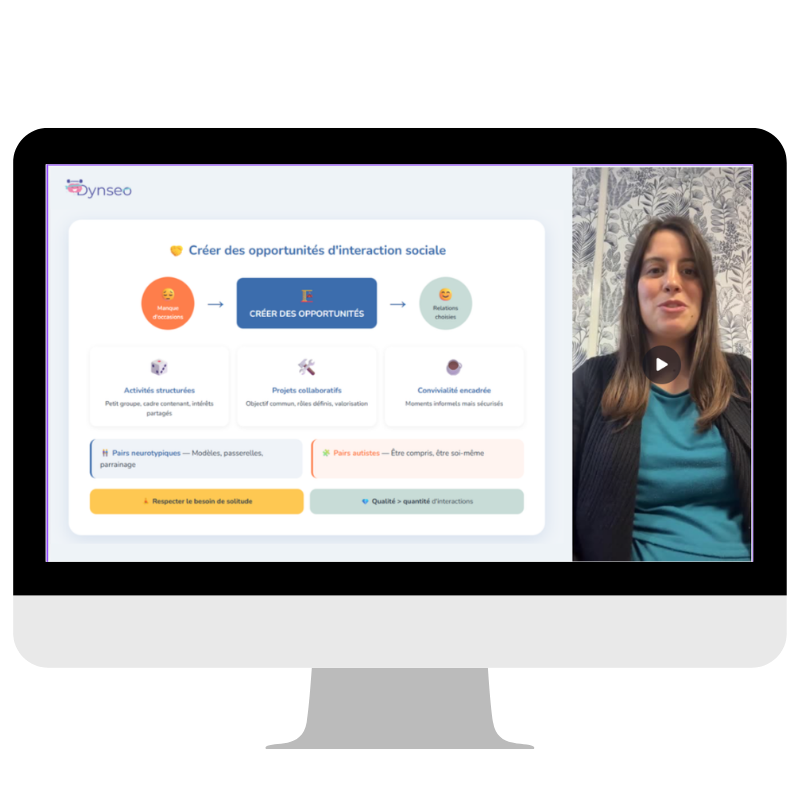
Access the training →
Detailed Training Program
Definition, Figures, and Realities of Invisible Disability
This introductory module presents the legal framework of disability in France, epidemiological data on invisible disability, the main types of invisible disabilities in the workplace, and the reasons why the vast majority of affected individuals do not report their situation to their employer. It deconstructs the restrictive image of visible disability to open up to the diversity of real situations.
Common Pathologies in the Workplace and Their Impacts at Work
This module presents the most common forms of invisible disability in the professional environment: chronic illnesses (fibromyalgia, multiple sclerosis, inflammatory diseases), mental disorders (depression, anxiety disorders, bipolarity), neurological sequelae (post-Stroke, post-traumatic brain injury), and neurodevelopmental differences (ADHD, autism). For each category, it describes the concrete impacts on professional functioning.
Why Employees Do Not Report — and How to Build Trust
Key module on the barriers to reporting and the levers for the manager. It identifies the real fears of employees (fear of being marginalized, losing responsibilities, being perceived differently) and proposes concrete practices to create an environment of psychological trust where communication can flow — without forcing, without pointing out.
Reasonable Accommodations: Definition, Examples, Implementation
This module presents the concept of reasonable accommodation in the legal sense, concrete examples classified by type of disability, and a method for implementing them with the support of the occupational physician. It also covers available funding (AGEFIPH) and the internal processes to mobilize (HR, occupational physician, disability referent).
What the law requires of the employer
This last module covers the legal obligations of the employer: obligation to employ disabled workers (OETH, 6% of the workforce), mandatory reasonable accommodations, non-discrimination, and the role of the occupational physician. It explains the penalties incurred and the resources available to comply.
The most common invisible pathologies in the workplace
The DYNSEO training covers the entire spectrum of invisible disabilities, but certain pathologies are particularly common in the workplace and deserve specific attention from managers.
| Type of invisible disability | Frequent examples | Typical professional impact |
|---|---|---|
| Chronic illnesses | Fibromyalgia, IBS, Crohn's disease, lupus, multiple sclerosis | Variable intense fatigue, pain, unexpected absences, difficulty meeting deadlines over time |
| Psychic disorders | Depression, anxiety disorder, bipolarity, PTSD | Mood and ability fluctuations, relational difficulties, absenteeism, ineffective presenteeism |
| Neurological sequelae | Post-Stroke, post-traumatic brain injury, epilepsy | Cognitive slowing, memory disorders, increased fatigue, sensitivity to stimuli |
| Neurodevelopmental | ADHD, autism, DYS disorders | Variability in performance, organizational difficulties, sensory overload, exhausting masking |
| Cardiovascular diseases | Post-heart attack, heart failure | Limitation on effort, increased stress from certain situations, demanding medical monitoring |
Why employees do not declare their disability
This is one of the most important questions addressed by the training — and one of those whose answers surprise managers the most. One might think that declaring a disability is in the employee's interest: it opens rights, accommodations, protections. Yet studies show that the vast majority of workers with invisible disabilities choose not to declare. Why?
The fear of stigma
The fear of being perceived differently, being sidelined, having responsibilities reduced "as a precaution," or simply being treated with awkward pity. This fear is often based on past experiences — or on observations of what has happened to others in the company.
The fear of impact on career
The fear that declaring a disability will hinder promotions, make access to certain tasks more difficult, or signal to the employer a "fragility" that may weigh on future HR decisions. In companies where performance is valued above all, this barrier is particularly strong.
Denial or Lack of Awareness
Many people do not know that their condition falls under the legal definition of disability — and therefore that they have rights. Others are aware of their situation but refuse to label it as "disability" because this term does not match the image they have of themselves. Raising awareness about what invisible disability truly encompasses is a powerful lever.
Mistrust of the Company
If the employee does not trust the confidentiality of HR information, has observed discriminatory behaviors in the company, or does not have a trusting relationship with their manager, there is no rational reason for them to make themselves vulnerable by declaring their situation.
What the manager perceives as a performance problem — and what it really is
The DYNSEO training helps managers develop a dual reading: that of observed behaviors, and that of the realities that may explain them. This dual reading is not meant to "excuse" insufficient performance — it serves to find the true causes and real solutions.
| What the manager perceives | What it could be | The question to ask |
|---|---|---|
| Frequent and unexpected absences | Chronic illness with unpredictable crises, depression | "Is there a health factor I am unaware of?" |
| Marked fatigue at the end of the day, increasing errors | Neurological fatigue post-Stroke, fibromyalgia, MS | "Is the organization of work time suitable for this employee?" |
| Fluctuating performance without explanation | Bipolar disorder, depression, ADHD | "Is this variability related to conditions I am not informed about?" |
| Avoidance of social situations or meetings | Social anxiety, panic disorder, autism | "Is this avoidance a symptom or a preference?" |
Create a climate of trust that encourages dialogue
The DYNSEO training on invisible disability emphasizes a crucial point: the manager cannot force the declaration of a disability — and should not try. What they can do is create the conditions for the person, if they wish, to feel safe to speak.
✅ 6 practices to create a psychological safety environment
- Speak openly about disability in general (during SEEPH, by sharing resources) — without pointing out specific individuals
- React calmly and kindly when a colleague mentions difficulties — without overpromising or dramatizing
- Scrupulously respect the confidentiality of shared information
- Clearly separate conversations about well-being from conversations about performance
- Regularly mention available resources (occupational doctor, disability referent, social worker)
- Avoid judgments about the absences or accommodations of other colleagues — what you say about others, the person concerned will hear for themselves
Reasonable accommodations: what the employer can and must do
Reasonable accommodation is both a legal obligation (article L. 5213-6 of the Labor Code) and an effective management tool. An accommodation is "reasonable" if it is proportionate — that is, if it does not impose an undue burden on the company. In practice, the vast majority of accommodations for invisible disabilities are simple and inexpensive.
Work time accommodation
Adjusted hours for medical treatments, therapeutic part-time work, flexibility during the most difficult time slots (mornings for certain chronic illnesses).
Adapted telework
Additional telework days to reduce commuting fatigue, ability to work from home during crises, adaptation of presence modalities.
Adaptation of the workstation and tools
Voice recognition software for DYS disorders or neurological sequelae, ergonomic chair, noise-canceling headset, adapted screen, accessories for chronic pain.
Adaptation of tasks
Redistribution of certain tasks incompatible with functional limitations, adaptation of delivery formats, temporary reduction of workload during difficult periods.
What the law concretely imposes
The employer is required to make reasonable accommodations to enable a worker with a disability to access or retain a job. Refusal of reasonable accommodation may constitute discrimination under the law. AGEFIPH can co-finance accommodations for employees benefiting from a RQTH. The occupational doctor plays a central role: they can recommend accommodations confidentially, without revealing the diagnosis to the employer.
"I had been diagnosed with fibromyalgia for 3 years, but I hadn't said anything to my manager. When I finally could talk about it — because he had created a space where I felt safe — he asked me 'what do you need?' Not 'can you still handle your tasks?' The question changed everything."
🎓 Ready to make a difference for your employees?
The training Invisible Disability: What Managers Need to Know gives you the keys to act accurately — online, Qualiopi certified, at your own pace.
Access the training →DYNSEO Complementary Trainings
The invisible disability training can be complemented by the training Understanding Autism in the Workplace, the training ADHD at Work, and the training Managing a Neurodivergent Employee — all accessible from the DYNSEO Inclusion Training Page.
FAQ — Frequently Asked Questions about Training and Invisible Disability
Does the training cover all types of invisible disabilities or does it focus on certain ones?
It covers the entire spectrum: chronic illnesses, mental disorders, neurological sequelae, non-visible sensory disabilities, and neurodevelopmental differences. It provides a general framework applicable to all these situations, with specific examples for the most common in the workplace.
What should I do if I suspect a colleague has an invisible disability but they don't talk about it?
Do not approach it from the angle of disability — that would be intrusive and potentially discriminatory. Address the observed difficulties from the perspective of support: "I've noticed that you seem tired these past few weeks — is there something I can do to better support you?" The goal is to open a space, not to obtain a confession.
Can a colleague with an invisible disability be sanctioned for absences or a drop in performance?
This is a delicate legal area. If the employer is not informed of the disability, they can theoretically sanction objective professional shortcomings. But if the disability becomes known, sanctions related to difficulties directly attributable to the unsupported disability may be requalified as discrimination. The DYNSEO training covers this point in detail.
Is this training eligible for OPCO funding?
Yes. DYNSEO's Qualiopi certification allows for coverage by OPCOs as part of the skills development plan. It can also be funded through the CPF depending on your situation. Check with your OPCO or HR department.
How to involve the occupational physician in the process?
The occupational physician is a key ally in supporting colleagues with invisible disabilities. They can recommend adjustments confidentially (without revealing the diagnosis), organize pre-reintegration visits after a long absence, and direct towards support systems (SAMETH, Cap Emploi). The DYNSEO training explains how to initiate and structure this collaboration.
Conclusion: seeing what is invisible is a managerial skill
Invisible disability is, by definition, difficult to see. But its effects on the professional lives of colleagues who experience it are very real — and its consequences on teams that do not support it are too: unexplained absences, fluctuating performance, burnout, departures. Training managers to understand invisible disability equips them with a more complete, fairer, and more effective framework.
The DYNSEO training Invisible Disability: What Managers Need to Know is this training — practical, accessible, certifying. It does not turn a manager into a health professional. It gives them the tools to ask the right questions, create the right environment, and act with the right levers.