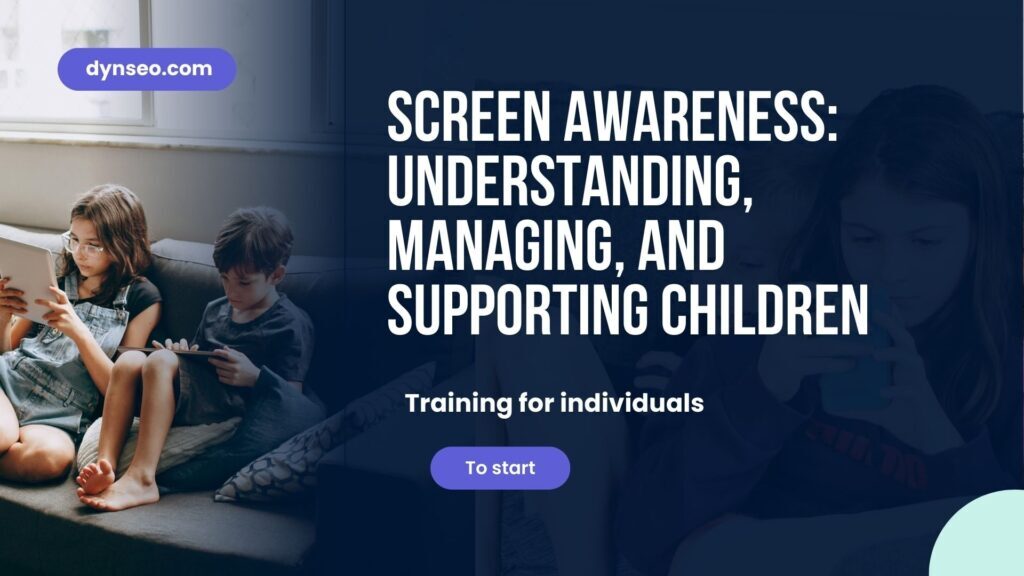
Training “Raising Awareness about Screens: Understanding, Acting, Supporting”: program, content, and who it is for
This page describes in detail the training on raising awareness about screens offered by DYNSEO, titled “ Raising Awareness about Screens : Understanding, Acting, Supporting ”. You will find its actual content, module by module, the profile of the people it is truly useful for, the time it requires, what it costs, and — just as importantly — what it does not do. The idea is simple : to allow you to know, before signing up, if it fits your situation as a parent or caregiver.
Dans cet article
La formation associée
Les ressources citées
 Planificateur de Devoirs
 Checklist Cartable
Screens are everywhere in the lives of children and teenagers: at home, at school, in their pockets. Most families are not looking to eliminate them, but to find a manageable framework, without constant conflict or guilt. This online training has been designed exactly for that: to provide clear guidelines and concrete actions for people who are neither doctors nor specialized educators, and who simply want to support their child without making mistakes.
The essentials in 30 seconds
“Raising awareness about screens: understanding, acting, supporting” is an online training of 6 modules and 18 lessons, designed by DYNSEO for families and caregivers of children and teenagers. It costs 20 €, can be followed at your own pace, and ends with a final quiz.
- For whom — parents, grandparents, childminders, activity leaders, anyone who supports a child on a daily basis. No prerequisites.
- What you will learn — understand the effects of screens according to age, set a framework, manage conflicts and screen time limits, create a positive routine, monitor social media and content, balance digital and physical activity.
- Duration — approximately 2 to 3 hours in total, with short video lessons.
- Access — immediate after purchase, unlimited over time, on computer, tablet, or phone.
- Organization — DYNSEO, a training organization certified Qualiopi (N° 11757351875), with a certificate of completion issued.
Why take a training course to raise awareness about screens when you are a parent or caregiver?
The issue of screens comes up in almost every family, and it is exhausting. We oscillate between letting it be (“at least he is calm”) and prohibition (“no more tablet, that’s it”), never quite sure if we are doing the right thing. It is not a matter of will: it is a lack of guidelines. No one learns, upon becoming a parent, how a child's attention develops, nor why the end of a video game triggers such a reaction.
However, major public health authorities converge on a message. The World Health Organization, in its 2019 recommendations on physical activity and sedentary behavior in young children, advises: no screen time before 1 year, very limited use between 2 and 4 years, and more active play and interactions. In France, Public Health France and the High Council for Public Health reiterate the same logic: it is not just the duration that matters, but the context, content, time of day, and adult supervision. These guidelines exist; one just needs to know how to translate them into the daily life of a real family.
This training precisely fills that gap. It does not demonize screens and does not promise a miracle recipe. It gives you the common language to understand what is happening in your child's mind, and the concrete actions that no one has time to explain to you: how to announce the end of screen time without a crisis, how to establish a lasting routine, how to identify problematic usage. These are situations you already face, but often tackle without a manual.
A screen is not “ good ” or “ bad ” in itself. What matters is what the child is watching, with whom, at what time, and what this usage replaces. A cartoon shared and commented on with an adult has nothing to do with two hours of solo videos before bed. All training starts from this nuance : moving from “ all or nothing ” to “ how ”.
Who is this training for ?
It is primarily aimed at families and caregivers : the vocabulary, examples, and situational contexts are designed for people who are not childhood professionals. No prerequisites, no technical knowledge. Several profiles find it particularly relevant.
The everyday parent
They manage tablet requests, evening negotiations, and homework. They want a clear framework that lasts over time, without turning every day into a tug of war.
The grandparent
They regularly take care of the grandchildren and do not want to be “ the one who lets everything happen ”. They seek simple references, consistent with those of the parents.
The caregiver and supervisor
Nanny, facilitator, educator, after-school professional : they support children who are already very exposed to screens and want concrete answers.
Made for you / not made for you
| Your situation | This training… |
|---|---|
| Screens have become a daily source of conflict at home | ✔ Perfectly suitable |
| You do not know what screen time is “ normal ” for the age | ✔ Suitable — the first modules establish these references |
| Your child isolates or gets upset as soon as we talk about stopping | ✔ Suitable — the “ practical advice ” module is dedicated to this |
| You supervise a group of children and seek common references | ✔ Suitable |
| You are looking for a diagnosis on a possible addiction of your child | ✘ No — this falls under a doctor or psychologist |
| You want a recognized state diploma | ✘ No — this is a certificate of completion, not a diploma |
An important point : if you observe signs of distress in your child that worry you — marked withdrawal, persistent sleep disorders, sudden drop in school performance, loss of interest in everything else — this training will help you better understand and communicate, but it does not replace professional advice. The right reflex is to talk to your general practitioner, the school doctor, or a psychologist.
The detailed program, module by module
The training consists of 6 modules and 18 video lessons, followed by a final quiz. Each lesson is short : we progress step by step, with time to assimilate and try one thing in between. Here is the actual content, as it is structured on the platform.
Introduction
- Screens in today's life — how digital technology has become part of family daily life, and why the question is no longer “ for or against ” but “ how to support ”.
- Recommended screen time — guidelines by age group, what the recommendations say, and how to adapt them to the reality of your family.
The effects of screens
- The screen use of today's children — a concrete overview of usage by age, starting from what really exists.
- The effects of screens — sleep, attention, language, physical activity : what exposure modifies, and under what conditions.
- The disorders associated with screens — the signals that should alert, without dramatizing, and the moment to turn to a healthcare professional.
Existing solutions
- Parental control — what it allows, its limits, and why it never replaces dialogue.
- Regular breaks — how to pace screen time to protect sleep, eyes, and attention.
- The child as an active person — moving away from passive consumption : creating, playing, moving, and making the child an actor rather than a spectator.
Practical tips and strategies
- How to introduce technology to a child — set a framework from the start rather than catching up later.
- How to help the child accept the end of screen use — announce, warn, accompany the transition without a crisis.
- How to create a positive routine for screen use — establish predictable habits that reassure the child and lighten the parent's load.
- How to prevent a child from isolating behind screens — identify withdrawal and reopen doors to other activities.
- How to manage excitement related to video games — understand the energy surge and accompany it instead of enduring it.
- How to manage a conflict around screens — defuse, set manageable limits, and stay in the relationship.
- How to monitor social media — support entry into networks without spying or turning a blind eye.
- How to balance physical and digital activities — reintroduce movement and real play into the day.
- How to manage the content watched by children — take an interest in what is seen, discuss it, and choose together.
Workshop to set up at home
- Workshop with COCO THINKS and COCO MOVES and CLINT, your brain coach — a concrete example of active and educational screen use, alternating cognitive games and physical challenges, easily set up at home.
Final quiz
- Validation quiz — a few questions to check that the essentials are acquired before receiving your completion certificate.
Don't look at everything at once. Follow one module per evening, and test one thing in between : warn ten minutes before the end of screen time, establish a fixed break, replace passive video with a game where the child is active. It's repetition that changes daily life, not the amount of information consumed at once.
Envie de transformer les conflits d'écran en routine apaisée ?
18 leçons courtes, des gestes concrets à appliquer dès le soir même, un accès immédiat après l'inscription.
Accéder à la formation — 20 €Le format et l'organisation
Tout est conçu pour des parents et des aidants qui n'ont pas de créneau garanti dans leur semaine. Pas d'horaire imposé, pas de classe virtuelle, pas de date limite : vous ouvrez la formation quand la maison est calme, même tard le soir.
| Critère | Détail |
|---|---|
| Format | 100 % en ligne, leçons vidéo courtes |
| Contenu | 6 modules · 18 leçons · 1 quiz final |
| Durée estimée | 2 à 3 heures, à fractionner librement |
| Rythme | Libre, sans date de fin imposée |
| Support | Ordinateur, tablette, smartphone |
| Accès | Immédiat après l'inscription, illimité |
| Niveau requis | Tous niveaux, aucun prérequis |
| Validation | Quiz final + attestation de fin de formation |
Le point qui compte le plus pour une famille : l'accès reste ouvert. Vous pouvez revenir sur la leçon consacrée à la fin de l'écran le jour où votre enfant traverse une période plus tendue, des mois après avoir terminé le parcours. C'est souvent à ce moment-là, quand la situation se corse, qu'un contenu prend tout son sens. Rien ne vous oblige à tout retenir du premier coup : la formation reste une ressource dans laquelle piocher au fil des étapes.
Ce que vous saurez faire à la fin
Pas seulement des connaissances théoriques : des gestes applicables dès le lendemain. Voici ce que vous devriez être capable de faire concrètement une fois le parcours terminé.
Poser un cadre clair
Définir des repères de temps et de contenu adaptés à l'âge, et les annoncer à l'enfant d'une manière qu'il comprend et accepte plus facilement.
Gérer la fin de l'écran
Anticiper la transition, prévenir avant l'arrêt et accompagner le passage à une autre activité sans que cela dégénère en crise à chaque fois.
Installer une routine
Mettre en place des habitudes prévisibles autour des écrans : quand, combien, où, et ce qui vient avant et après.
Désamorcer les conflits
Reconnaître ce qui déclenche l'opposition, garder le lien, et tenir une limite sans entrer dans un rapport de force.
Accompagner en ligne
Aborder les réseaux sociaux et les contenus regardés en dialoguant, repérer les usages qui dérapent et savoir quand alerter.
Rebalance the day
Reintroduce movement, real play, and shared times, and transform some passive screens into active and educational uses.
An example of a learned gesture: announcing the end of the screen
Rather than cutting off abruptly (“That's enough, turn it off!”), the training proposes a three-step transition. Ten minutes before: “In ten minutes, we turn it off; you finish your game or your episode.” Two minutes before: “Just two more minutes, I'll come back to remind you.” At the moment of stopping: “It's time, we turn it off together, and then we set the table / we read a story.” The principle: notify, propose a concrete follow-up, and remain present for the transition.
❌ To avoid: tearing the screen away without warning, negotiating “just five more minutes” repeatedly, or making the screen a reward or punishment. These reflexes increase the tension around the object instead of calming it.
Qualiopi and certificate: what it changes for you
DYNSEO is a Qualiopi certified training organization, registered under the activity declaration number 11757351875. This certification focuses on the quality of the training process: clarity of educational objectives, adaptation to the target audiences, qualification of the trainers, collection of feedback, and continuous improvement of the content.
Specifically, for a family: this means that the content is not improvised. The objectives are written before being filmed, the lessons are structured and revised. At the end of the course, after the quiz, you receive a certificate of completion in your name. It certifies your participation: it is neither a state diploma nor a regulated professional qualification, and it is honest to clearly specify this.
If you work in a nursery, after-school care, leisure center, or as a childminder, DYNSEO's Qualiopi certification allows an employer to consider funding as part of the skills development plan. The conditions depend on your skills operator : to be checked on a case-by-case basis with your HR service before registration.
Pricing and registration
The training is offered at €20. This is a deliberately accessible price : the goal is for a parent or caregiver to be able to train without budgetary arbitration, on a subject that concerns all families today. Access is immediate and unlimited in time.
- Open the training page and add it to your cart.
- Create your learner account (or log in if you already have one) and confirm the payment.
- You are registered : the training appears in your space and the first lesson starts immediately.
No entry date, no session to wait for. If you register on a Sunday evening because it's the only quiet moment of your week, you start within the next minute. And you can pause and resume as many times as necessary : the training is waiting for you.
What this training is not
Let's be clear, this avoids misunderstandings.
- This is not a medical or psychological opinion. No lesson replaces a doctor, pediatrician, or psychologist. If you suspect real suffering in your child, you should turn to them for a diagnosis.
- This is not a "detoxification" protocol. The training helps to set a framework and provide support, not to treat an established clinical situation.
- This is not individual support. There is no personalized follow-up included : it is a video course that you follow alone, at your own pace.
- This is not a diploma. The certificate attests to participation, not a professional qualification recognized by the State.
- This is not a list of applications to download. The goal is to make you autonomous in your decisions, not to sell you tools.
Free tools and the app that complements it
The training refers to several DYNSEO resources that can be used immediately. The following tools are free, printable, and downloadable from the tools catalog :
- Weekly homework planner — to schedule study times and leave a clear place for screens once the work is done.
- School gamification system — to reward efforts and off-screen activities in a fun way.
- School bag checklist — to make the child an actor in their organization, a first step towards autonomy.
- Emotional regulation toolbox (teens) — to support tensions, including those that arise around screens.
On the digital side, the "home workshop" module relies on COCO, DYNSEO's cognitive stimulation app for children aged 5 to 10, which alternates between thinking games (COCO THINKS) and physical challenges (COCO MOVES) : a concrete example of an active screen where the child moves and thinks instead of just consuming. For adults or teenagers, the app CLINT offers memory, attention, and logic games. You can also assess cognitive functions with the online cognitive tests.
To go further on screens and children
This article presents the training. Four other articles explore different angles :
Everyday Situations10 difficult situations with screens and how to respond, step by step
ToolboxScreens : activities, resources, and concrete adjustments to implement
Support & ContactsWho to contact, what support is available, and how to sustain it over time
The complete catalog of DYNSEO training also offers other pathways around school, parenting, and supporting adolescents.
Frequently Asked Questions
How long does the training to raise awareness about screens last?
Count about 2 to 3 hours in total for the 18 lessons and the final quiz. The lessons being short, most parents spread the course over one to two weeks, with one module per evening. There is no obligation to a specific pace: access remains open after the end of the course, and you can revisit any lesson when a particular situation arises at home. The training then becomes a resource to draw from throughout your child's life stages.
Do I need any specific knowledge to follow it?
No, none. The training is classified as "all levels" and is explicitly aimed at families and caregivers. The vocabulary is simple, explained as you go along, and illustrated by concrete everyday situations. You do not need any technical skills or any knowledge of psychology to start: this is precisely the goal of the first modules, to provide you with the basic references before moving on to practical advice and actions to apply at home.
Will I receive a certificate at the end?
Yes. After validating the final quiz, a certificate of completion in your name is issued by DYNSEO, a training organization certified Qualiopi (No. 11757351875). This certificate attests to your participation in the course. It does not constitute a state diploma or a regulated professional qualification. For a childhood professional, it can nonetheless demonstrate a commitment to skill enhancement on a subject that has become central in supporting children and adolescents.
Can the training be financially covered?
For an individual accompanying their child, the training is purchased directly for €20. For a professional, DYNSEO's Qualiopi certification allows an employer to consider financial coverage within the framework of the skills development plan. The conditions depend on the skills operator and must be verified with the HR department before purchase. No amount of aid can be guaranteed in advance: consult your employer or your affiliated organization.
Is there support or assistance during the training?
The training is a self-paced course that you follow at your own rhythm, without virtual classes or individual follow-up. If you have questions about accessing your space or a practical aspect, the DYNSEO team can be contacted. For anything related to your child's health or behavior — signs that worry you, suffering, usage that seems to escape the framework — the training directs you to the right contacts: general practitioner, school doctor, or psychologist, who are the only ones qualified to make a diagnosis.
This training is a support tool for families and caregivers; it does not replace professional advice. If you observe signs of suffering in a child — persistent sleep disorders, withdrawal, school decline, loss of interest in everything else — talk to a doctor or psychologist. In case of an emergency, contact the emergency services in your country.
Take control of screens, calmly
The training to raise awareness about screens includes 6 modules, 18 short lessons, and unlimited access to transform “ I don’t know what to do anymore ” into a clear and peaceful framework, starting this week.
Discover the training — 20 €Did this content help you? Support DYNSEO 💙
We are a small team of 14 people based in Paris. For 13 years, we have been creating free content to help families, speech therapists, care homes and healthcare professionals.
Your feedback is the only way we know if our work is useful. A Google review helps us reach other families, caregivers and therapists who need it.
One action, 30 seconds: leave us a Google review ⭐⭐⭐⭐⭐. It costs nothing, and it changes everything for us.