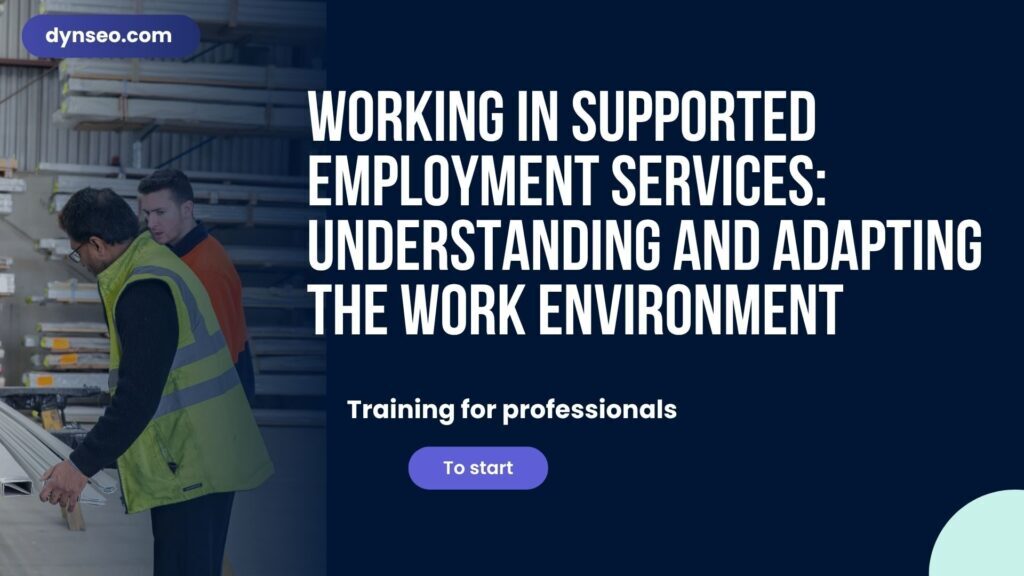
Training Working in Sheltered Workshops: understanding and adapting the work environment — program and reviews
ESATs support more than 120,000 workers with disabilities in France. Workshop monitors, supervisors, workshop leaders, and partner companies play a crucial role in their professional journey. This DYNSEO training, certified Qualiopi, provides the keys to structured, respectful, and effective support — from individualized projects to the prevention of burnout.
Dans cet article
La formation associée
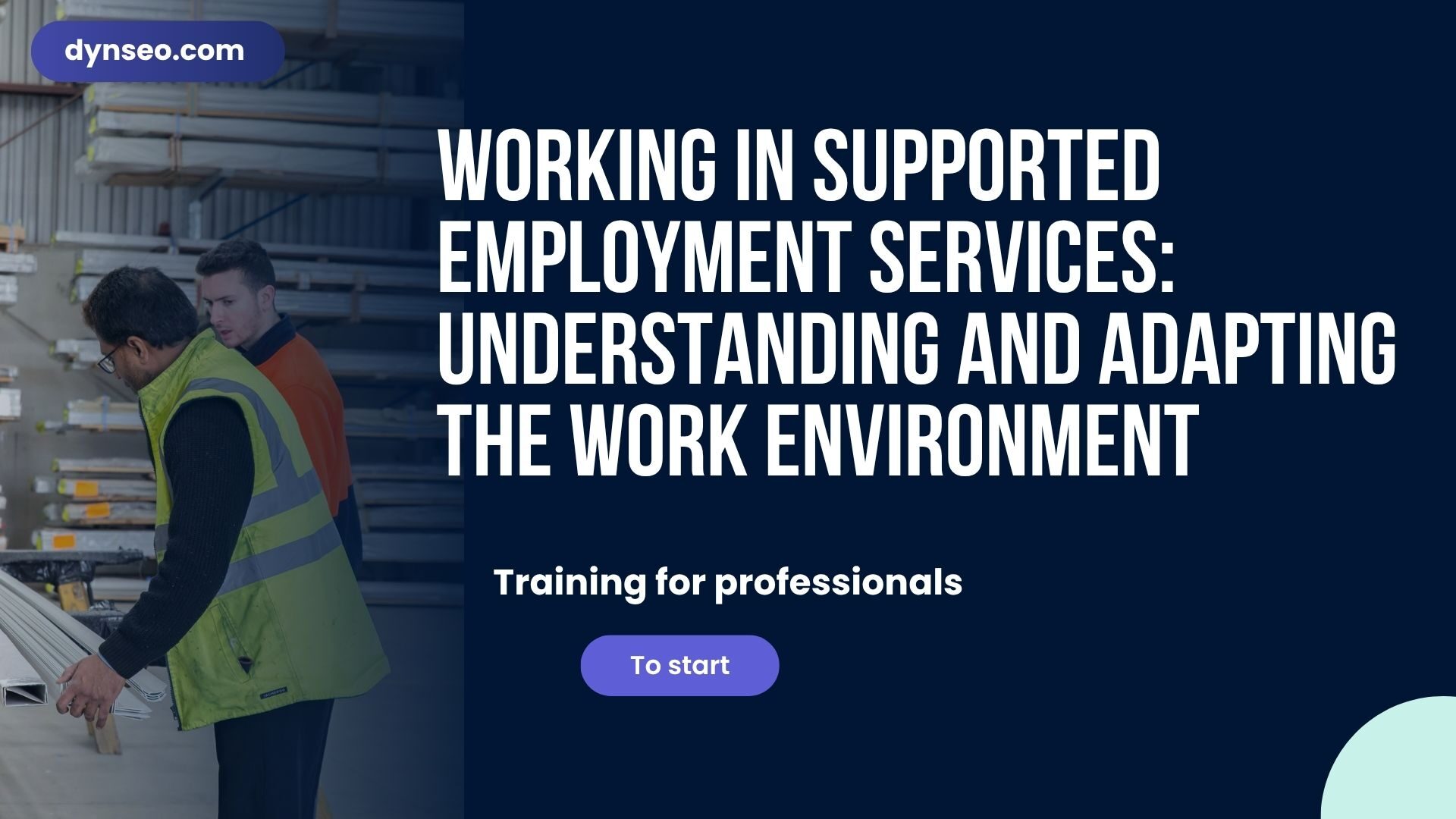
The Sheltered Workshop today: an essential link in the inclusive sector
To fully understand the stakes of dedicated training, it is first necessary to precisely situate what a Sheltered Workshop is — often poorly known outside the medico-social sector, including in the Diversity, Equity, and Inclusion departments of large companies.
Origin and mission of ESATs
Sheltered Workshops find their roots in Centers for Assistance through Work created in the 1960s-1970s, renamed Sheltered Workshops by the 2005 law for equality of rights and opportunities. Their mission is dual and constitutive: to offer medico-social support (personalized support, psycho-educational follow-up, access to care, personal development) and to propose a productive activity (workshops, services, subcontracting for companies, production for their own account). This dual mission makes the richness and complexity of the Sheltered Workshop — one does not work there like in a classic company, nor like in a pure social service, but in a fine articulation of both.
Who are the workers in ESATs?
The individuals supported in ESATs present disabilities that do not allow them, at this point in their journey, to work in a regular environment or in an adapted company. Intellectual disability remains the primary cause of orientation (65-70% of workers), in various forms (mild, moderate, associated with other disorders). Mental disorders represent a growing share (15-20%) — stabilized schizophrenia, bipolar disorders, chronic depression. Autism spectrum disorders are also increasing (about 10% today), particularly in specialized ESATs. Additionally, there are multiple disabilities, associated motor disabilities, and certain neurological pathologies. This diversity calls for a real technicality of support.
What jobs are available in ESATs?
ESATs cover an impressive range of activities: industrial packaging, green spaces, laundry, collective catering, printing, market gardening and agriculture, maintenance of premises, electronic wiring, sewing, carpentry, document processing, digitization of archives. Some ESATs specialize in niche areas with high added value (artisanal crafts, digital design, IT services) by enhancing the specific skills of the profiles welcomed. This diversity allows partner companies to find ESATs that meet their sectoral needs.
The actors involved
In a Sheltered Workshop, several professional actors collaborate. The workshop monitor (also called technical supervisor) is the central figure: he/she supervises a group of workers on a daily basis, organizes production, trains, and evaluates. The workshop manager coordinates several monitors and connects with management. The specialized educators carry the medico-social dimension (personalized project, individual follow-up). Psychologists, doctors, nurses intervene as needed. The director oversees everything, with an economic dimension (balancing the accounts) and a medico-social dimension (respecting individual projects). This multidisciplinary team is the key to quality support.
📊 The Sheltered Workshop in the French landscape of inclusion
The sheltered and adapted work sector represents more than 2,000 establishments and services in France, employing or supporting about 250,000 people with disabilities. With adapted companies (EA) that employ disabled workers as regular employees, it forms an essential link between the medico-social environment and the ordinary environment. Partnerships between these structures and "traditional" companies have been developing for 20 years, driven by the 2005 law, the reform of the obligation to employ disabled workers, and more recently by the Sheltered Workshop reform initiated in 2022.
The DYNSEO training: presentation
🌐 100% online
⏱ At your own pace
Working in Sheltered Workshops: understanding and adapting the work environment
A comprehensive training for workshop monitors, supervisors, multidisciplinary teams, and partner companies. Understanding profiles, work organization, personalized project, prevention of wear and tear, partnerships. Concrete and immediately usable.
Discover the training →What you will learn
The training covers six major areas. First, understanding Sheltered Workshops: missions, legal framework, funding, place in the inclusive landscape. Next, understanding the profiles welcomed: intellectual disabilities, mental disorders, ASD, associated disabilities. Then, adapting the work environment: organization of workshops, positions, instructions, visual supports, rhythms. After that, building and following the personalized project: evaluation, objectives, assessments, interviews. Then, preventing wear and tear — for aging workers as well as for supervisors. Finally, developing partnerships with client companies and the ordinary environment.
Who this training is for
It mainly concerns professionals in Sheltered Workshops: new or experienced workshop monitors, workshop leaders, educators, integration officers, directors. It is also very useful for partner companies: buyers managing subcontracting contracts with Sheltered Workshops, managers hosting individual detachments, disability missions of large groups working with the protected sector. Trainers, tutors, Pôle Emploi and Cap Emploi advisors responsible for directing towards the protected sector can also find solid foundations here.
Why the online format is suitable for the Sheltered Workshop sector
The constraints of presence in the workshop often make in-person training difficult to organize for monitors — who cannot leave their group without notice. The 100% online format, at one's own pace, allows for training without disrupting the functioning of the Sheltered Workshop. Sessions can be taken in small doses (30 minutes at noon, 1 hour after the workshop), spread over several weeks. The content remains accessible at any time, useful as a permanent resource.
The detailed program: modules and content
- Sheltered Workshops in the French inclusive landscape — History, missions, legal framework (2005 law, 2022 reform), funding, place in the medico-social system, differences with EA and ordinary environment.
- The profiles welcomed in Sheltered Workshops — Intellectual disabilities, mental disorders, ASD, associated motor disabilities, multiple disabilities. Useful clinical benchmarks, strengths, support needs.
- The role of the workshop monitor — Dual technical and educational role, mobilized skills, professional posture, articulation with the multidisciplinary team.
- Adapting the work environment — Organization of workshops, ergonomics, visual supports, instructions, rhythms, specific adjustments by profile, safety.
- The personalized support project — Skills assessment, construction of objectives, regular assessments, interviews with the worker and their family, articulation with the disability rights assessment office.
- Learning, transmitting, evaluating in Sheltered Workshops — Adapted pedagogy, task decomposition, formative assessment, recognition of skills (RAE, VAE).
- Preventing professional wear and tear — Wear of aging workers, adjustment of positions, reduction of working hours, transition to residential care homes for disabled adults. Wear of monitors: emotional load, protection strategies, team support.
- Business partnerships and bridges to the ordinary environment — Subcontracting contracts, availability, individual detachments, internships, support for transitions to ordinary employment.
Associated downloadable resources
Each module is accompanied by concrete resources: the Sheltered Workshop Job Adaptation Grid, the Sheltered Workshop Worker Tracking Sheet, the Business-ESAT Partnership Guide, the Personalized Project Template, the Professional Wear Prevention Checklist. The DYNSEO Tools Catalog offers other complementary resources.
The specific role of the workshop monitor
At the heart of the sheltered workshop, the workshop monitor performs a hybrid and demanding job that the training explores in depth.
A dual technical and educational role
The monitor must be both a technical professional (mastering the job performed in the workshop — packaging, green spaces, laundry, etc.) and a medico-social support (knowing how to adapt, support, evaluate, participate in the personalized project). This dual competence is rare and valuable. It is not improvised: it is built through initial training, continuing education, experience, and supervision. Many monitors come from the production world and must gradually acquire medico-social skills; others come from the social sector and must improve their technical skills in a specific activity.
The key skills of the monitor
Several skills characterize a good monitor: the ability to decompose a complex task into accessible steps, the patience to repeat without getting tired, the ability to adapt their communication to each profile (simple language, visual supports, pictograms), a sense of fine observation to detect emotional signals or drops in form, the ability to maintain a framework while respecting dignity, the ability to collaborate in a multidisciplinary team. The training works on each of these skills with practical tools.
Organizing a workshop on a daily basis
A typical day in a sheltered workshop alternates production, moments of individual support, collective assessments, breaks, and related activities. The balance between these times largely determines the atmosphere and performance of the workshop. The training provides benchmarks to structure this typical day: welcome ritual, displayed visual schedule, daily instructions, task distribution, evaluation time at the end of the day. This structuring benefits all workers and significantly reduces potential tensions.
Managing difficult situations
Monitors face a variety of situations: conflicts between workers, emotional crises, refusal to work, inappropriate behaviors. The training does not shy away from these realities and offers benchmarks: not taking it personally, calling on the multidisciplinary team, postponing the difficult moment without dramatizing, returning calmly to analyze. DYNSEO tools on emotion management (thermometer, alert signal card) can be adapted to the sheltered workshop context.
The legal framework mobilized
📜 The structuring texts for the sheltered workshop
The law of February 11, 2005 for equal rights and opportunities renamed the sheltered workshop and consolidated their status. Articles L.344-2 and following of the Social Action and Families Code define their operation. The law of February 11, 2022 for the democratization of sport and the Sheltered Workshop reform 2022-2024 have brought the status of sheltered workshop workers closer to that of regular employees (right to training, employee savings, right to strike, recognition of work accidents). The OETH allows contracting companies to deduct up to 50% of their contribution through contracts with ESATs. The AGEFIPH and the FIPHFP fund certain partnerships and pathways to the ordinary environment. The Climate and Resilience Law has strengthened the QVT obligations that also apply to ESATs.
The sheltered workshop reform 2022-2024: what is changing
This major reform gradually transforms the status of sheltered workshop workers. It introduces the right to a work support contract (CAT) that is better formalized, the right to professional training, access to employee savings, the right to strike, and recognition of work accidents. It also facilitates pathways to the ordinary environment (Tremplin fixed-term contracts, supported employment, enhanced secondment). This significant evolution calls for an update of practices that training incorporates.
The establishment project and the personalized project
Each sheltered workshop has an establishment project that defines its multi-year orientations. Each worker benefits from a personalized support project (PPA) that is regularly updated. These documents are not just paperwork: they structure action and give meaning. Training helps instructors to appropriate these tools as daily levers, not as administrative constraints.
Partnerships between companies and sheltered workshops: levers and best practices
A growing part of sheltered workshop activity relies on partnerships with "traditional" companies. These partnerships are beneficial for all — provided they are well thought out.
The different forms of partnership
Several modalities exist. Workshop subcontracting (the sheltered workshop performs a service in its premises for a client company) is the most classic. On-site service provision (a team from the sheltered workshop intervenes at the client's location) is developing, particularly in green spaces, maintenance, and catering. Individual secondment (a sheltered workshop worker is assigned to a company several days a week while remaining attached to the sheltered workshop) is a valuable pathway to the ordinary environment. The Tremplin fixed-term contract, resulting from the reform, allows for a longer period in the company with secured return to the sheltered workshop.
The benefits for the partner company
Beyond the OETH deduction, partnering with a sheltered workshop offers several advantages: quality services in activities where precision matters (packaging, archives, digitization), a measurable CSR impact that can be highlighted in external communication and CSRD reporting, human enrichment for teams that work alongside these collaborators, a positive employer brand effect, and often an exceptional partner loyalty. Leading groups (Engie, La Poste, Orange, SNCF) have documented these benefits for 10-15 years.
The benefits for the sheltered workshop and its workers
From the sheltered workshop's perspective, the partnership offers stable income, a variety of activities that enrich the offerings for workers, development opportunities for those who can evolve into the ordinary environment, and external visibility that enhances the establishment. For the workers themselves, service provision in the company or secondment are often moments of pride, expansion of their social world, and external recognition.
| Partnership modality | Description | Company advantage | Sheltered Workshop/worker advantage |
|---|---|---|---|
| Workshop subcontracting | Production in sheltered workshop for external client | Quality, deadlines, OETH | Income stability, continuous activity |
| On-site service | Sheltered workshop team at the client | Proximity service, visible CSR | Openness, variety, social connection |
| Individual provision | Worker assigned several days/week | Progressive integration, flexibility | Bridge to ordinary environment |
| Stepping stone CDD | Short contract in adapted/ordinary company | Supervised test, possibility of hiring | Secure experience, progression |
| Permanent hiring | Integration into a traditional company | Faithful talent, direct OETH | Success in professional journey |
Preventing wear and tear: a major issue for all
Professional wear and tear is a particularly sensitive topic in sheltered workshops. It affects both supported workers and the professionals who supervise them. The training dedicates a complete module to this issue.
Wear and tear of workers
Sheltered workshop workers are aging, often prematurely compared to the general population (accelerated aging related to certain pathologies). Physical wear and tear adds to psychological wear and tear. It calls for specific responses: adaptation of positions (reduced load bearing, lighter pace, enhanced ergonomics), progressive reduction of working hours, transition to less physical workshops, orientation towards adapted structures for aging disabled workers. The issue becomes critical in a sector where the supported population is aging.
Wear and tear of monitors and supervisors
Monitors accumulate several factors of wear and tear: emotional burden of working with vulnerable individuals, exposure to difficult behaviors, feeling of isolation in heavy situations, lack of external recognition, economic constraints of the sector. Turnover figures in some ESATs are concerning. The training addresses protection strategies: teamwork, regular supervision, practice analysis, psychological support, right to disconnect, preservation of work-life balance.
Prevention through organization
Much wear and tear can be prevented by attentive organization: rotation on difficult missions, respect for break times, mentoring of newcomers, continuous training, internal mobility, regular recognition, speaking spaces. Management plays a major role in this prevention — a sheltered workshop with management concerned about its teams lasts longer than one solely driven by its economic results.
The ROI of sheltered workshop partnership for companies
💰 OETH Deduction
Up to 50% of the annual contribution can be deducted through sheltered workshop contracts — a direct financial lever, particularly for companies struggling to meet the 6% quota.
🌱 CSR/CSRD Reporting
Structured partnerships feed into ESG and CSRD reporting on the "social inclusion and disability" dimension. These indicators are increasingly scrutinized by investors and stakeholders.
🏆 Employer brand
An active partnership policy with the protected sector strengthens the employer brand among candidates sensitive to DEI issues — a growing generation in all sectors.
🤝 Quality and loyalty
ESATs often offer exceptional quality in their areas of excellence and a partner loyalty that is far superior to the average of traditional subcontractors.
The DYNSEO B2B catalog: a coherent journey
This training is aligned with other DYNSEO B2B training dedicated to neurodiversity and inclusion.
Recommended path according to your situation
For a Sheltered workshop supervisor: this training is the fundamental building block. It can be complemented by Understanding autism in the workplace to deepen the profiles of individuals with ASD, and by Managing a neurodivergent employee for the cognitive dimensions.
For a purchasing manager or manager in a partner company: start with this training to understand the sheltered workshop environment. Follow up with Invisible disability: what the manager needs to know to broaden the general framework. Optionally complete with ADHD at work or DYS disorders in the workplace depending on the profiles encountered.
For a Sheltered workshop director or department head: explore the entire catalog to have a complete view of the neurodiversity issues addressed in the sector. The complete catalog is available online.
Deploying training in your sheltered workshop or your company
🏭 Deployment of sheltered workshop or managing association
Multi-collaborator licenses to train all monitors, supervisors, and multidisciplinary teams. Administrator space. Sector-specific launch webinars. Support for Uniformation and AGEFIPH funding. Possibility of adapting examples to your type of workshops.
Request a quote for the establishment →Funding options for a sheltered workshop
Several channels exist. Uniformation is the main OPCO of the medico-social sector and largely finances the training of ESATs. The AGEFIPH can co-finance certain actions, particularly those promoting pathways to the ordinary environment. The internal training budgets of managing associations complement this. Some departmental councils finance specific training within the framework of their disability policies. Our teams support you in funding engineering.
Funding for a partner company
For a company, training can be funded by the skills development plan, the branch OPCO, DEI or CSR budgets, and disability agreements with AGEFIPH. The approach can also be articulated with the company's responsible purchasing policy (ISO 26000 standard, Responsible Supplier Relations label).
Workshop professions: focus on four emblematic sectors
The training covers general principles, but it is useful to delve into the specifics of four classic sectors that employ a large part of sheltered workshop workers.
Industrial packaging
A classic of ESATs, packaging includes tasks such as shrink-wrapping, boxing, labeling, co-packing, and kit assembly. Client companies range from cosmetics to agri-food, from the pharmaceutical industry to equipment manufacturers. This activity particularly values profiles with mild to moderate intellectual disabilities, capable of quality repetitive routines. Job adaptation involves breaking down tasks, providing clear visual supports, and alternating tasks to prevent fatigue. Trained monitors structure these workshops to maximize quality while preserving the well-being of workers.
Green spaces
The second major activity in the sector, green spaces offer an outdoor setting, varying with the seasons, enhancing the image. Mowing, pruning, weeding, maintenance, landscaping: the tasks are numerous and can be progressively complexified according to profiles. Adaptations focus on tool ergonomics, task structuring, safety (systematic use of PPE, defined areas), and sun protection. Many sheltered workshop green spaces work directly on the sites of large companies as part of services — enriching the experience of workers.
Collective catering
More and more ESATs are investing in collective catering, whether in central kitchens, company restaurants, or catering services. These activities combine production and service, sometimes with direct contact with customers. They offer a strong rewarding dimension for workers, who see their work appreciated immediately. Adaptations concern hygiene (simplified HACCP procedures), equipment (adapted work surfaces, protections), and communication with clients (visual supports, scripts).
Digital and administrative services
An emerging sector particularly suited to high-functioning ASD profiles and certain profiles with stabilized mental disorders. Digitization of archives, data entry, cataloging, indexing, software testing, content moderation. These high value-added activities enhance the skills of rigor and precision specific to certain profiles. Adaptations mainly concern the environment (isolated office, controlled sound ambiance, quality screens, visual organization of tasks).
Integration with the ordinary environment: a major challenge
The evolution of the sector pushes for more pathways between ESATs and the ordinary environment. Training pays particular attention to this issue.
Assessing the potential for evolution
Not all sheltered workshop workers wish or can evolve into the ordinary environment — and this is legitimate. For many, the sheltered workshop remains the most suitable work environment in the long term. However, for a significant minority (estimated at 10-20% of workers according to studies), evolution is possible and desired. The assessment of this potential is based on several criteria: autonomy, acquired technical skills, ability to adapt to a new environment, personal motivation, family support. Trained monitors know how to identify these signals and discuss them with the multidisciplinary team.
The "supported employment" system
Created by the Labor Law of 2016, supported employment allows a disabled worker to be supported in a position in the ordinary environment by a specialized job coach who intervenes with both the employee and the employer. Particularly suited to ASD profiles and individuals with mental disorders, it securely maintains employment. Training helps monitors identify suitable candidates and prepare transitions.
The Tremplin fixed-term contract and long-term placements
The sheltered workshop reform has consolidated the mechanisms for pathways: the Tremplin fixed-term contract in adapted companies can last several years, individual placements can be progressive and long-term, and the worker retains a safety net with the possibility of returning to the sheltered workshop. These tools secure transitions and demystify attempts at evolution — a worker can try the ordinary environment without fearing an irreversible loss of status.
The DYNSEO applications as a complement
📱 MY DICTIONARY — Communication in sheltered workshops
The application MY DICTIONARY is particularly suited for the sheltered workshop audience, especially for non-verbal workers or those with specific communication needs. Widely deployed in specialized TSA ESATs.
Discover MY DICTIONARY →📱 CLINT — Cognitive Activities in sheltered workshops
CLINT can enrich the cognitive stimulation activities offered in addition to productive activities, especially for workers with mental health issues or TSA profiles.
Discover CLINT →📱 SCARLETT — Aging Disabled Workers
SCARLETT is particularly relevant for ESATs supporting aging workers or those transitioning to adapted structures for aging TH.
Discover SCARLETT →📱 COCO — ESAT-Child Partnerships
For ESATs forming links with the child sector (nurseries, schools) as part of shared activities, COCO can enrich these intergenerational bridges.
Discover COCO →Common Misconceptions about sheltered workshops to Debunk
False. ESATs today cover very diverse professions: arts and crafts, digital services, catering, green spaces, sewing, electronics, laundry. The diversity of activities is increasing each year, highlighting the specific skills of the profiles welcomed.
False. In their areas of specialization, ESATs often achieve quality above average (attention to detail, adherence to procedures, low turnover). Sustainable partnerships testify to this quality.
Confirmed. The reform brings the rights of sheltered workshop workers closer to those of regular employees, facilitates transitions to the ordinary environment, and modernizes practices. It requires skill enhancement of teams that training supports.
Well documented. When the partnership is structured around mutual commitment rather than just low-cost subcontracting, it creates lasting value for all parties.
Testimonials from Participants
“This training provides a clear framework for a job that we often practice through apprenticeship, without always having the theoretical foundations. The practical tools are immediately usable in my workshop.”
“We deployed it across all our supervisors — a total of 45 people. The feedback is excellent, team cohesion has strengthened around a shared vocabulary and practices.”
« We have trained our buyers and our disability mission managers. Since then, our dialogue with partner ESATs has become much richer. We are building services together that truly value the workers. »
The sheltered workshop reform 2022-2024 and its training challenges
The recent reform of ESATs marks a turning point that makes team training even more critical.
The new obligations for ESATs
ESATs must now offer their workers: access to professional training comparable to that of employees, the possibility to validate their acquired skills (RAE, VAE), gradual access to union and social rights, and strengthened pathways to the ordinary labor market. These developments require that the monitors master new dimensions — directing a worker towards a Tremplin CDD, preparing a VAE, supporting a strengthened placement.
The new levers for partner companies
On the company side, the reform opens up opportunities: longer duration Tremplin CDDs, facilitated supported employment, and strengthened placements with better security. These tools allow for more integrated, more ambitious partnerships that can lead to the permanent hiring of workers who have proven their capabilities.
The growing interest in disability missions
Large companies are rediscovering ESATs as a strategic lever. Disability missions are developing structured sheltered workshop policies: sourcing services, individual detachments, post-Tremplin hires. However, this ambition requires training teams to have a fine understanding of the sector — this is exactly the purpose of this training.
To go further: resources and support
DYNSEO offers a complete B2B catalog certified Qualiopi to build a coherent neurodiversity and inclusion policy. The DYNSEO practical tools (grids, checklists, templates) directly complement the training. The DYNSEO cognitive tests can also inform certain evaluation or individual follow-up processes.
Useful sector resources in France: ANDICAT (network of sheltered workshop directors), APEI and Unapei (federations of managing associations), CAHPP (purchasing center), AGEFIPH and FIPHFP (funding and resources).
Building a sustainable sheltered workshop policy in your organization
For a managing association of ESATs
Start with a diagnosis of existing practices (interviews, observations, monitor surveys). Identify priority areas (onboarding, communication, prevention of burnout, partnerships). Deploy training across all relevant teams. Organize collective anchoring sessions (practical workshops, case analysis). Measure the impact at 6 and 12 months. Adjust supervision practices and practice analysis.
For a company wishing to structure its sheltered workshop partnerships
Map nearby ESATs and their skills. Identify internal activities that could be outsourced to ESATs. Train buyers and managers in the sheltered workshop environment. Legally secure contracts. Measure the impact of OETH and communicate internally. Gradually consider more integrated modalities (placement, Tremplin CDD, or even hiring).
For a sheltered workshop wishing to develop its business partnerships
Identify its areas of excellence. Train teams in commercial and relational dimensions. Structure a clear offer and professional communication. Target local companies and relevant clients. Train teams supporting placements. The DYNSEO training addresses these dimensions in its module dedicated to partnerships.
Conclusion: the sheltered workshop, an ecosystem to master for performance
ESATs are an essential link in inclusion in France, with over 120,000 supported workers and a growing role in companies' DEI policies. Ongoing transformations (2022-2024 reform, aging workers, rise of TSA profiles, economic pressure) make team training more critical than ever. The DYNSEO training "Working in a sheltered workshop: understanding and adapting the work environment," certified Qualiopi, 100% remote and at your own pace, provides sector professionals and their partners with the keys to rigorous, human, and effective support. It is part of a coherent B2B catalog that allows for the construction of a complete skills development pathway. A high-impact investment for your establishment or partnership policy.
Access the training now →To complete your journey? Explore Understanding autism in the workplace, Managing a neurodiverse employee, and Invisible disability. The full catalog is available online.
FAQ: the 8 most frequently asked questions
What is a sheltered workshop?
A medico-social establishment that supports disabled adults in productive activity. 1,400 ESATs in France, over 120,000 supported workers.
Who is this training for?
Workshop instructors, workshop managers, multidisciplinary sheltered workshop teams; partner companies (buyers, managers, disability mission).
Is the training Qualiopi certified?
Yes, No. 11757351875, eligible for Uniformation, branch OPCO, and AGEFIPH.
Can a company train its teams on sheltered workshop partnership?
Yes, it is a growing practice. The training provides the keys to a successful and sustainable partnership.
Does the sheltered workshop partnership count towards the OETH?
Yes, up to 50% deduction on the contribution via contracts with sheltered workshops/EA/TIH.
What types of disabilities are in sheltered workshops?
Primarily intellectual disabilities, but also psychological disorders, TSA, associated motor disabilities.
Is the prevention of wear and tear addressed?
Yes, complete module: wear of aging workers AND wear of instructors.
Can it be deployed to an entire sheltered workshop team?
Yes, multi-employee licenses, admin space, webinars, funding support.